

What Is Qualitative Research Anyway
Teams rarely argue about screens, they argue about what users meant.
A Product Manager sees a drop-off in analytics and wants to cut steps. A Designer believes the issue is trust, not length. Engineering asks for a decision by Friday because the prototype is already moving toward implementation. This is the moment where speed and certainty start pulling against each other, and it happens constantly in prototype to production work.
Qualitative research gives that tension a method. It is the disciplined practice of studying human experience so a team can understand the reasons behind behavior, not just the behavior itself. Quantitative data can tell you that people stopped at a form field. Qualitative work helps you learn whether they were confused, hesitant, distracted, or unconvinced.
That difference matters more than is often admitted. If you ship based only on what the dashboard says, you can easily polish the wrong part of the experience. I've seen teams shorten a flow that users found clear, while ignoring the one sentence that made the product feel risky. The prototype looked tighter. Production performance did not improve in the ways anyone hoped.
The work is interpretation with structure
People sometimes reduce qualitative research to "talking to users." That framing undersells it. Good qualitative work has a clear question, a deliberate sample, a discussion guide, a way to capture evidence, and a repeatable synthesis method. The rigor isn't in pretending humans are spreadsheets. The rigor is in staying close to what people say, do, avoid, and misunderstand.
This is what I mean: qualitative research studies the gap between what a team assumes and how a person makes sense of an experience.
A few things fall under that umbrella:
Interviews: Used to uncover motivations, expectations, language, and decision criteria.
Observation: Used to notice workarounds, environmental constraints, and behaviors people forget to mention.
Usability testing: Used to watch where a concept, flow, or prototype stops making sense.
Longer-form studies: Used when habits and decisions unfold over time, not in a single session.
Why it matters in prototype to production work
The handoff breaks when the team treats a prototype as proof. A prototype is usually proof of possibility. Production needs proof of comprehension, trust, edge cases, and sustained use.
That is why qualitative research belongs throughout the path from concept to shipped product. It helps teams decide:
whether the workflow matches user mental models
whether the language supports confident action
whether a polished prototype is hiding fragile assumptions
whether the thing you're preparing to build is solving the right problem
If you want a broader set of practical frameworks, you can learn user research with Figr.
Practical rule: If your team is debating user intent from screenshots alone, you're overdue for qualitative research.
Qualitative vs Quantitative Finding the Right Balance
Product teams don't need to choose between stories and numbers, they need to know what each one is good for.
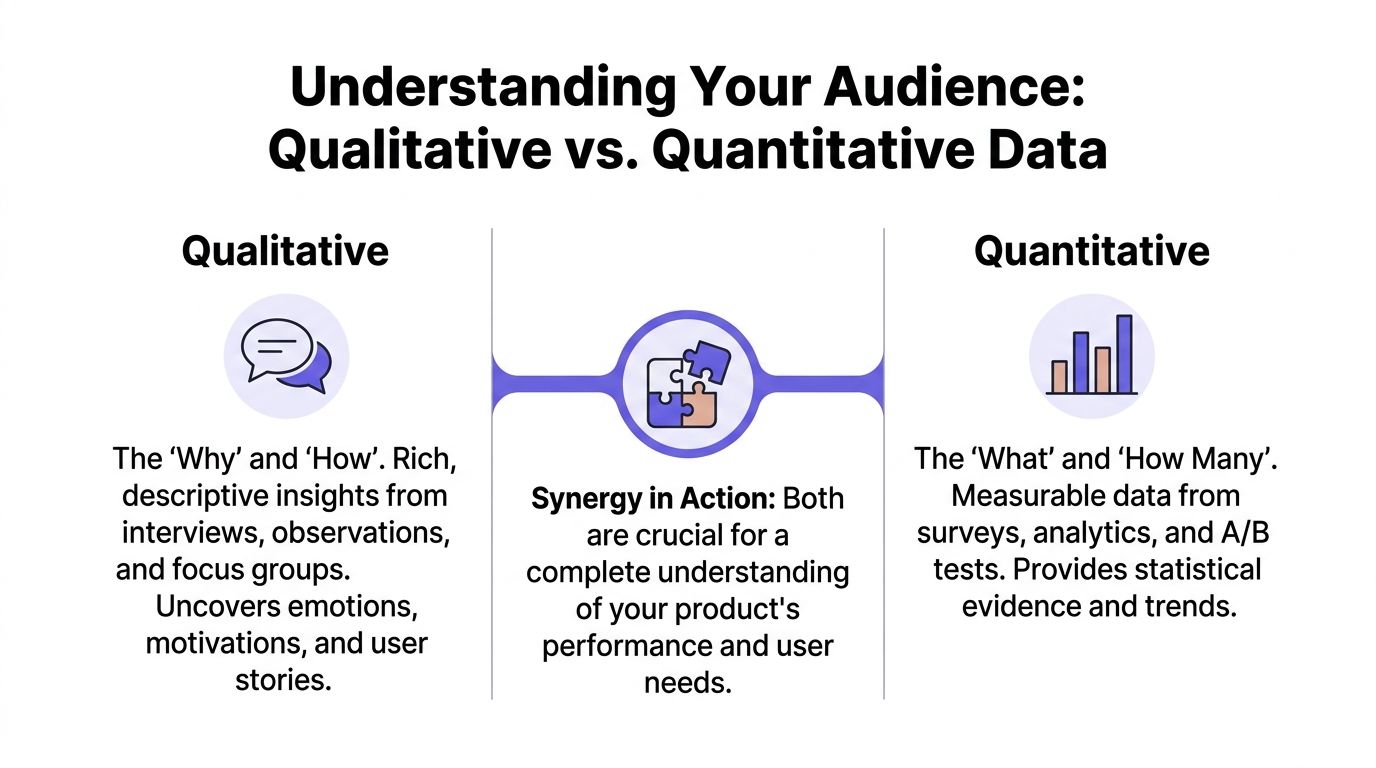
A simple way to think about it is this: quantitative data is the star rating, qualitative data is the review text. One tells you the pattern at scale. The other tells you why that pattern exists. If a flow has a visible drop in completion, analytics tells you where it happened. Research tells you what the experience felt like in that moment.
That distinction is easy to say and surprisingly hard to practice. Teams often overvalue whichever evidence arrives first. If analytics lands first, they optimize for measurable steps. If interview clips land first, they can overfit to memorable anecdotes. Good product judgment comes from holding both forms of evidence together long enough to let them correct each other.
What each approach actually answers
| Approach | Best at answering | Common inputs | Typical output |
|---|---|---|---|
| Qualitative | Why something is happening | Interviews, usability sessions, observation, diary studies | Themes, mental models, pain points, design implications |
| Quantitative | What is happening and how often | Surveys, product analytics, funnels, experiments | Rates, trends, segment patterns, performance comparisons |
The basic gist is this: quantitative data generalizes, qualitative data explains.
That makes them powerful at different moments in the prototype to production cycle. Early on, qualitative work helps shape the concept, the flow, and the language. Later, quantitative data helps teams verify whether the shipped experience behaves as expected. In the middle, they work best together. A confusing step in a usability session becomes more meaningful when analytics shows the same step is a real drop-off point in production.
How to use both without turning it into a turf war
A useful sequence looks like this:
Start with qualitative work when you're exploring a problem, a concept, or an unfamiliar audience.
Use quantitative signals to size the pattern, track behavior, or compare variants.
Return to qualitative work when the numbers expose a behavior but don't explain the cause.
This matters for AI products too. A few successful prompts in a demo don't mean the system is ready for production. GenAI proof-of-concept validation needs hundreds of test cases, because a handful of prompts isn't enough for deployment decisions, as noted in this GenAI POC validation guide.
A dashboard can tell you where trust breaks. It can't tell you what trust meant to the person who left.
If you want a practical overview of the different methods for user research, it helps to treat them as complementary lenses, not competing camps.
The real balancing act
At scale, this becomes an economics question. Teams pay for uncertainty either before launch or after it. Research done early costs calendar time. Research skipped early usually returns as redesign, engineering rework, support load, and stakeholder churn. Which bill would you rather pay?
That's why the strongest teams don't ask whether qualitative or quantitative is better. They ask which decision is in front of them, and what kind of evidence will reduce the wrong kind of confidence.
Common Qualitative Methods for Product Teams
Different research methods answer different product questions.
That sounds obvious until a team uses interviews to validate interface clarity, or runs a usability test when the underlying issue is that nobody understands the problem space yet. Method choice shapes the quality of the decision that follows. If the wrong tool is used, the team often gets data that looks useful and still sends the product in the wrong direction.
User interviews for motives and framing
Use interviews when you need to understand how people describe a problem in their own words. This is the method I reach for when a team is still trying to understand needs, decision criteria, trust barriers, or existing workarounds.
A good interview doesn't ask, "Would you use this?" It asks about recent behavior, context, trade-offs, and consequences.
Useful outputs often include:
Language clues: The terms users naturally use, which often differ from product copy
Decision patterns: What made someone move forward, hesitate, or abandon
Mental models: How people believe the workflow should work before they touch your product
Contextual inquiry for real-world behavior
Use contextual inquiry when the environment matters. This is especially useful in B2B SaaS, fintech operations, or any workflow where interruptions, compliance, tools, and team dependencies shape behavior.
Watching someone in context reveals things interviews often miss:
hidden steps between systems
sticky notes, spreadsheets, and side channels
moments where a user says one thing but does another
constraints that never make it into a prototype
Teams often discover that a "simple" production handoff was built on a lab version of reality.
Usability testing for design decisions
Use usability testing when you already have something to react to, whether that's a wireframe, a high-fidelity prototype, or a near-production build. This method is especially valuable in prototype to production transitions because it exposes missing states, broken expectations, and unclear interactions before engineering hardens the experience.
I tend to frame it as a behavior study, not an opinion session. You're watching whether people can move through the task, where they pause, what they misread, and what assumptions the interface creates.
A few examples of what it catches well:
State gaps: Empty, loading, error, or permission states that weren't designed yet
Content assumptions: Static prototype content that hides messy real data shapes
Flow fractures: Places where intent is clear in design review but unclear in actual use
Diary studies for time-based behavior
Use diary studies when behavior unfolds over days or weeks. This matters for onboarding, habit formation, financial workflows, approval systems, and AI-assisted tools that change value over repeated use.
Diary studies help answer questions such as:
When does a feature become part of someone's routine?
What causes early enthusiasm to fade?
Which edge cases appear only after repeated exposure?
That time dimension matters because production doesn't live in a single test session.
How to choose the right method
If your team is stuck, start with the question, not the method.
Need to understand why a problem exists? Use interviews.
Need to see how work happens in the wild? Use contextual inquiry.
Need to test whether a solution makes sense? Use usability testing.
Need to follow a behavior over time? Use a diary study.
For a helpful outside overview, this comprehensive guide to UX research methods is worth bookmarking.
One more caution for AI products. Teams often confuse a compelling prototype with sufficient validation. For GenAI systems, deployment decisions should be based on evaluation sets with hundreds of test cases, not a handful of curated prompts, according to this POC validation reference.
How to Find the Right People to Talk To
Recruiting is usually where good research intentions go to stall.
Someone says the team should talk to users. Everyone agrees. Then the calendar fills, nobody owns recruiting, and the study fades away. I watched a startup team do this last week with an onboarding redesign. They had polished prototype screens, strong opinions, and exactly zero confirmed participants. The issue wasn't lack of belief. It was lack of process.
Start with behaviors, not demographics
A useful screener identifies people by what they do, what they recently experienced, and what decisions they make. Demographics can matter, but they rarely tell you whether someone can answer the question you have.
For example, if you're studying a fintech onboarding flow, stronger criteria might be:
Recent experience: Began account setup in the recent past
Relevant behavior: Completed some steps but did not finish activation
Decision role: Personally responsible for evaluating or submitting financial details
That will usually get you farther than broad labels like job title or company size alone.
Use channels that fit the question
Different channels create different trade-offs.
Existing customers: Fast and relevant, but can skew toward current power users or people with established goodwill
Intercepts in product or on site: Useful when you need people who just had the experience you're studying
Sales and support referrals: Great for finding users with specific pain points, especially in B2B flows
Research panels: Faster when you need niche segments and don't have internal access
What matters most is fit. Good enough participants who reflect the behavior in question are often more useful than a long hunt for a perfect sample.
A simple recruiting workflow
Step 1. Write the research question.
Be precise about the decision the study needs to inform.
Recruitment gets easier when the goal is narrow.
Step 2. Turn the question into screener criteria.
Screen for recent behavior, task relevance, and familiarity.
Exclude people who only match in superficial ways.
Step 3. Pick the fastest credible channel.
Use current users when the product context matters.
Use outside recruiting when your own base is too narrow.
Step 4. Offer clear logistics.
State time required, session format, and purpose.
Friction in scheduling kills response rates.
Step 5. Confirm with a human touch.
Reminder messages improve attendance.
People show up when the invite feels specific and respectful.
If you're trying to sharpen who your product is really for before you recruit, this piece from the Figr blog on product audience insights can help frame the audience more clearly.
Field note: The perfect participant recruited too late is less useful than the relevant participant recruited in time.
Turning Messy Conversations into Clear Insights
Analysis is where many teams lose confidence.
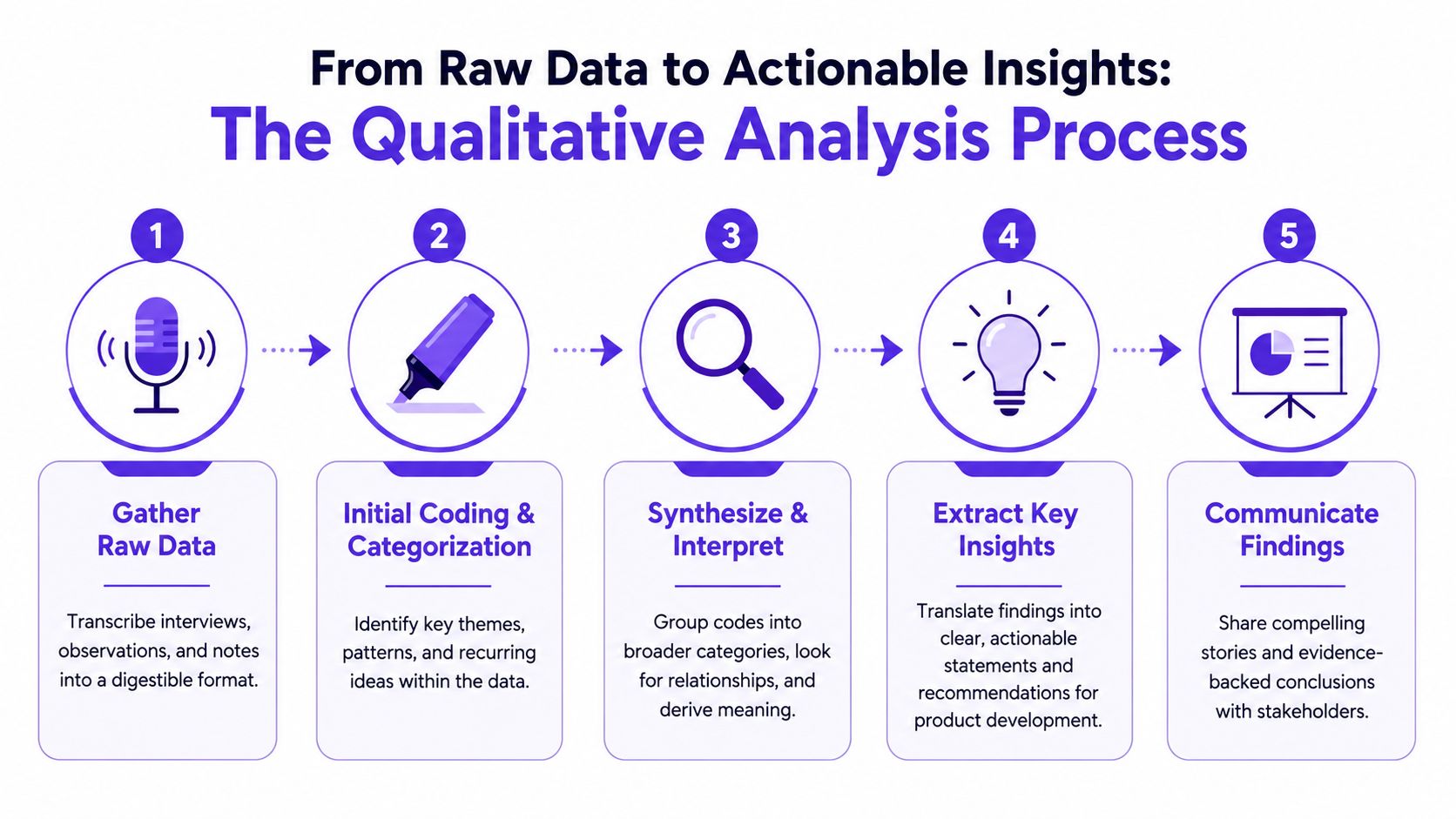
You finish the sessions, open the notes, and suddenly the neat research plan turns into a pile of transcripts, screenshots, timestamps, quotes, and half-formed impressions. That feeling is normal. Qualitative analysis always begins messier than people expect because human behavior is messy. The skill is learning how to turn that mess into a pattern without flattening it.
Start by coding what stands out
Coding sounds academic, but in practice it means tagging moments that matter. A quote about trust. A pause before clicking continue. A misunderstanding about pricing. A workaround somebody invents on the spot.
You aren't trying to sound clever. You're trying to notice recurring signals.
A simple coding pass often includes tags like:
Confusion about labels
Fear of making a mistake
Missing context before action
Reliance on external confirmation
Mismatch between expectation and system response
Group codes into themes
Once you've tagged enough moments, patterns begin to appear. Several different quotes might point to the same underlying issue. A user says the flow feels "formal." Another says it feels "risky." A third asks whether they can change it later. The quotes differ. The theme may be the same: commitment anxiety.
At this stage, synthesis happens. You're moving from isolated observations to a story about behavior.
A theme is strong when it has three qualities:
Quality: Evidence
What it means in practice: Multiple observations support it
Quality: Relevance
What it means in practice: It answers the product question
Quality: Consequence
What it means in practice: It suggests a design or strategy implication
This is why analysis is more than summarizing. You're identifying the insight that should change the product.
A quick visual method can help here. Teams often use affinity diagrams for product managers to cluster notes into themes without overcomplicating the process.
Here is a useful walkthrough before you start synthesizing on your own:
Don't stop at themes, translate them into decisions
This is the part stakeholders need. "Users were confused" is too weak. "Users expected to review information before submission, and the lack of a review step increased hesitation" is actionable.
Research becomes useful when the insight changes the next decision.
A good synthesis output usually includes:
The theme: what kept showing up
The evidence: representative observations or quotes
The interpretation: what the pattern means
The implication: what the team should change, test, or clarify next
Some teams use grounded theory when they want a more inductive path, letting patterns emerge without forcing an early framework. That can be helpful when the domain is new or the team's assumptions are especially shaky. For most product teams, though, a disciplined thematic analysis is enough to turn noise into guidance.
Ensuring Your Research Is Trustworthy
The most common skeptical question about qualitative work is fair: how do you know this isn't just anecdote?
Trustworthiness is the answer. In qualitative research, you are not chasing statistical certainty. You are building confidence that the interpretation is credible, grounded, and useful enough to support a decision. That standard is demanding in a different way. It asks whether the team can trace the conclusion back to evidence and whether the evidence was gathered and interpreted responsibly.
Credibility starts with triangulation
A strong finding usually shows up in more than one form. You hear it in interviews, see it in usability behavior, or notice it reflected in support conversations. That cross-check matters because any single method has blind spots.
Useful ways to increase credibility include:
Triangulation: Compare insights across methods or sources
Peer review: Have another researcher or teammate challenge the interpretation
Member checking: In some contexts, confirm whether your reading of an experience feels accurate to participants
Dependability comes from process clarity
Teams trust research more when they can see how the conclusion was reached. Keep a visible audit trail. Save the discussion guide. Preserve notes on recruiting criteria. Record how themes were clustered and why some observations were treated as outliers.
That habit becomes especially important in prototype to production environments, where decisions harden quickly and memory gets selective.
There is a useful analogy in hardware. The path from concept to scaled manufacturing relies on EVT, DVT, and PVT, where Engineering Validation Test checks core functions and risks, Design Validation Test confirms performance and reliability while finalizing manufacturability, and Production Validation Test verifies process stability at target rates before scaling, as described in this hardware scaling playbook. Research needs the same discipline. You don't want to discover that the early evidence was vague after the system is already being built around it.
Confirmability means checking your own bias
Every researcher, Designer, and Product Manager brings expectations into a study. The goal isn't to become bias-free. The goal is to make interpretation transparent enough that bias has less room to hide.
A few habits help:
Write down assumptions before sessions begin
Separate raw observations from conclusions
Keep direct evidence close to each recommendation
The strongest qualitative insight is one a skeptical engineer can inspect and still find reasonable.
Transferability is the practical question
Can this insight travel beyond the exact people you spoke with? That depends on how clearly you've described the context. A finding from enterprise finance admins may not map cleanly to first-time consumers, and that's fine. Good qualitative work doesn't pretend to speak for everyone. It speaks clearly about who the finding applies to, under what conditions, and why.
From Research to Reality A Step by Step Example
The easiest way to understand research is to follow a real decision through it.
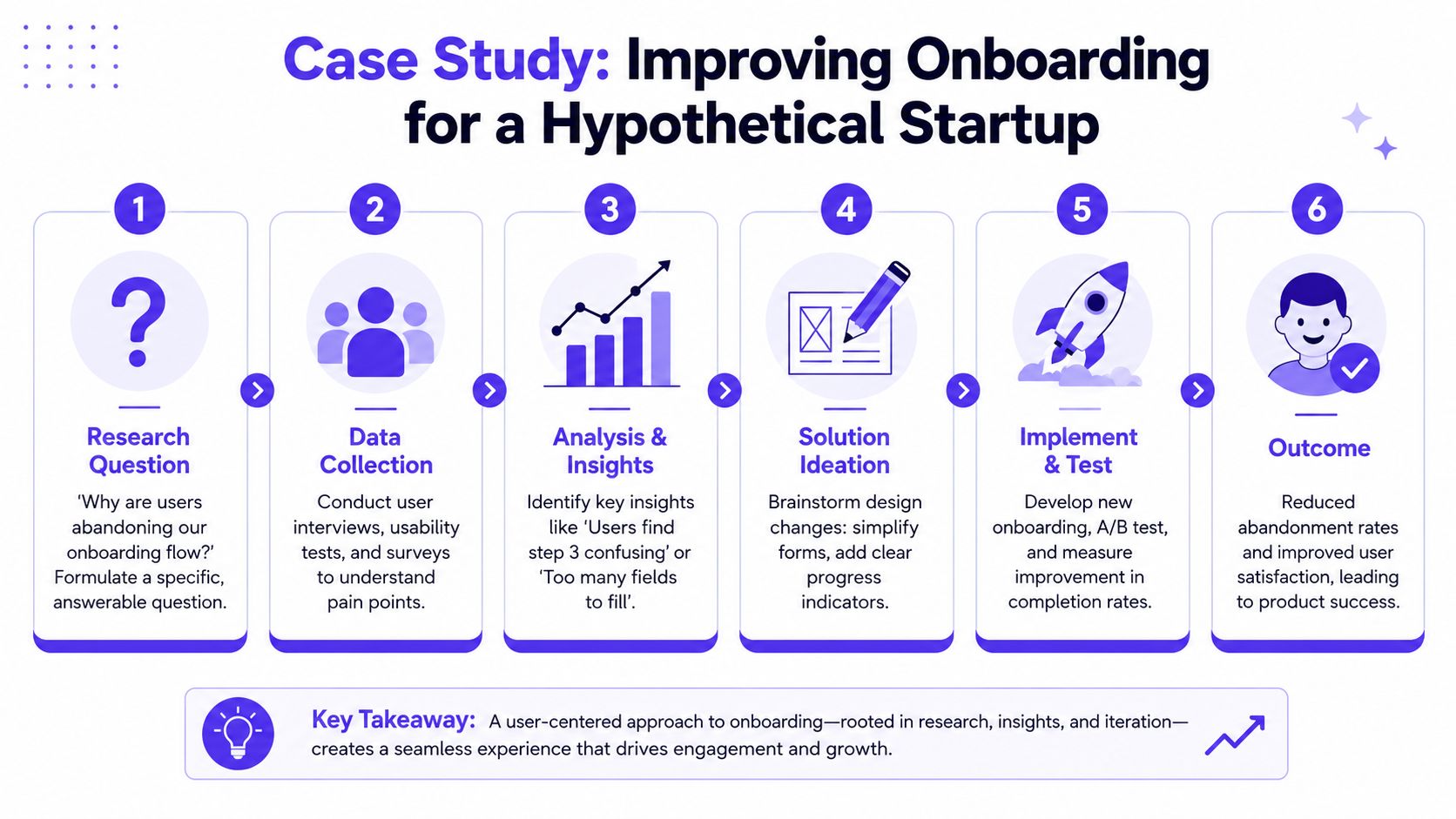
A SaaS startup has a serious onboarding problem. New users sign up, start the setup flow, and then stall before the core activation step. The team already has a high-fidelity prototype for a revised onboarding experience, but nobody trusts it yet. Product thinks the issue is too many fields. Design thinks the copy is vague. Engineering wants clarity before building more than the happy path.
The question comes first
The team starts with a focused question: why are recently signed-up users failing to complete onboarding?
That question sounds simple, but it creates discipline. It keeps the study from drifting into broad preference testing or generic brand feedback.
The workflow in practice
Step 1. Choose a method mix.
Run usability sessions on the prototype to observe behavior.
Pair that with short interviews to understand motives and hesitation.
Step 2. Recruit relevant participants.
Focus on people who recently signed up but did not fully activate.
Keep the segment behavior-based so the feedback matches the decision.
Step 3. Run sessions around actual tasks.
Ask people to move through onboarding as if they were setting up for real use.
Probe at pauses, uncertainty, and decision points.
Step 4. Code the evidence.
Tag moments of confusion, trust concerns, terminology mismatch, and uncertainty.
Distinguish between surface complaints and recurring underlying causes.
Step 5. Synthesize themes.
Group the evidence into patterns the team can act on.
Tie each theme to a product implication.
Step 6. Turn findings into artifacts.
Update the user journey map.
Rewrite key copy.
Add missing states and review steps to the next prototype.
What the team learns
The strongest theme isn't "too many fields." It is that users don't understand why the product needs certain information this early, and they don't trust that they can revise it later. Another theme appears around terminology. Internal product language makes sense to the team but not to new users. A third pattern emerges from usability behavior: users expect a confirmation checkpoint before committing setup decisions.
That combination changes the roadmap. The team adds clearer context before high-friction fields, introduces a review step, rewrites several labels, and updates the journey map to highlight confidence-building moments rather than just speed.
I've seen teams skip this stage and go straight from polished prototype to build. They usually discover the same issues later, only now the problems are embedded in code and sprint commitments.
Why prototype quality still matters
Prototypes should be realistic enough to expose real misunderstandings. If the content is too generic, the test won't reveal trust issues tied to actual data or actual stakes. That's one reason I often point teams to founder-friendly resources like this app prototyping guide for founders, because it reinforces that the prototype has to support a decision, not just look finished.
For teams trying to compress the gap between concept and a testable artifact, this accelerated design workflow is a useful reference.
The output is clearer than a raw transcript dump
At the end of the study, the team has:
A concise insights report: The top patterns, evidence, and recommended changes
A revised journey map: Pain points anchored to moments in the flow
Updated prototype requirements: Including missing states, clarifying copy, and trust-building interactions
Shared alignment: Product, design, and engineering now understand the problem the same way
That's where research earns its place in prototype to production work. It turns debate into grounded choices.
Tools Templates and Ethical Considerations
Teams often don't need a perfect research stack. They need a usable one.
A lightweight setup is usually enough to start. You can record sessions with common meeting tools, use transcription tools such as Otter.ai, and synthesize findings in tools like Dovetail or Condens. Recruiting can happen through your own customer base, product intercepts, or dedicated platforms like UserInterviews.com and UserTesting.
A simple research starter kit
Discussion guide: A short script with your key questions, tasks, and follow-up prompts
Consent language: Clear notice about recording, usage, privacy, and voluntary participation
Notes template: A shared format for capturing observations, quotes, and behavior
Insight summary slide: One page with themes, evidence, implications, and open questions
If your work touches AI-assisted product design, Figr is one option for generating design artifacts from existing product context, including flows and prototypes, but it still needs human judgment and research evidence to guide what should be built.
Ethics is part of product quality
Ethics isn't a legal footnote. It's part of whether the research deserves to influence the product at all.
A few essential requirements:
Informed consent: Participants should know what you're collecting and how it will be used
Privacy discipline: Store recordings and notes carefully, especially when sensitive workflows are involved
Faithful representation: Don't cherry-pick quotes that support a preferred roadmap
Respect for vulnerability: Some users describe stressful workflows, failures, or financial anxieties. Handle that with care
Good qualitative research is persuasive because it is honest. It doesn't overclaim. It doesn't flatten people into personas and call it done. It gives the team evidence strong enough to act on, while staying humble about what the evidence can and cannot prove.
If your team is trying to move from prototype to production without losing the reasoning behind the work, start with one real question, recruit a handful of relevant users, and run the next study with discipline. Then carry those insights into the artifact itself. That's how product decisions stay connected to the people they're meant to serve.