

A product discovery workshop can leave teams aligned but unable to decide what happens next. A useful workshop is a time-boxed working session that turns user and product evidence into a prioritized opportunity, explicit assumptions, and a validation decision, especially when stakeholders are already defending competing solutions.
Without that finish line, the whiteboard fills while uncertainty stays untouched. Designers polish a preferred flow, engineers estimate work with unresolved dependencies, and the PM carries a feature commitment into planning without knowing which customer behavior would justify it.
A decision-quality workshop gives the session a firmer endpoint: a decision owner, a bounded problem, and an evidence-backed next action. The three-hour agenda below is a proposed facilitation format for improving existing software, with preparation outside the session and research continuing afterward.
What a Product Discovery Workshop Produces
A productive workshop ends with an actionable decision record. Participants should be able to explain what deserves attention, what remains uncertain, and what evidence would change their direction.
Consider a hypothetical session about SaaS onboarding. Interview notes are scattered across slides, stakeholders favor different redesigns, and the timer shows less than an hour remaining. A designer asks which customer observation supports either proposal. Nobody can immediately find it.
That's the decision-quality gap: the team has shared opinions, but no traceable basis for committing resources.
Define the finish line before opening the board
The distinction between discovery questions matters. A Virginia Tech research review separates customer discovery into problem interviews, confirmation interviews, and solution interviews, progressing from identifying a problem to examining its importance and evaluating possible solutions.
A workshop should preserve that progression. An attractive interface can answer a solution question while leaving the underlying problem unresolved.
For existing software, start with the current workflow and its friction. Choose appropriate user research techniques to investigate the gaps rather than asking participants to fill them through imagination.
The minimum useful output includes:
- Prioritized opportunity: A specific user difficulty connected to a desired outcome.
- Evidence trail: Linked observations, analytics definitions, research notes, and known limitations.
- Assumption register: Claims that must hold for a proposed direction to work.
- Validation decision: The next investigation, its owner, and the rule governing what happens afterward.
- Deferred scope: Requests and alternatives deliberately excluded, with reasons.
Assign authority as well as participation
Product, design, research, engineering, and customer-facing colleagues contribute different context. The facilitator protects the process; the decision owner accepts responsibility for the eventual choice.
Those roles can overlap, but their responsibilities should remain explicit. Otherwise, who resolves a disagreement when the session runs out of time?
Practical rule: Finish with a decision someone owns, not a board everyone vaguely supports.
The record can justify proceeding, narrowing the scope, collecting more evidence, or declining to build. Each is a legitimate outcome when the reasoning is visible.
Choose the Right Workshop Decision
Choose a decision that the available evidence can reasonably support. A workshop can prioritize an onboarding difficulty or select an assumption to investigate. It can't establish market-wide demand through internal agreement.
The AIM Institute's discovery-interview research analyzed responses from 397 participants across 64 companies and more than 1,800 customer interviews; 86% reported learning something unexpected. Those findings support listening beyond internal assumptions, without making a small qualitative sample representative of an entire market.
What, exactly, are you authorizing at the end of the session?
Choose the right product discovery decision
Use these labeled comparisons as a compact decision matrix.
Workshop question: Which onboarding obstacle deserves investigation?
Best available evidence: Observed workflows, support cases, and trustworthy funnel events.
Reasonable session output: A prioritized problem and missing-evidence list.
Boundary to preserve: Frequent mentions don't establish population prevalence.
Workshop question: Which proposed flow should enter prototype testing?
Best available evidence: Task observations, user needs, current screens, and technical constraints.
Reasonable session output: Competing concepts and a targeted research question.
Boundary to preserve: Selecting a concept doesn't establish adoption.
Workshop question: Can this direction enter delivery planning?
Best available evidence: Relevant test findings, feasibility checks, and unresolved-risk assessment.
Reasonable session output: Proceed, constrain, investigate further, or stop.
Boundary to preserve: A delivery commitment shouldn't conceal an untested critical dependency.
Write the decision statement
Use a sentence that names the audience, problem boundary, available evidence, accountable owner, and roadmap consequence:
For new workspace administrators, the PM will decide which first-dashboard obstacle to investigate, using onboarding observations and checked event data; delivery scope changes only after the selected assumption passes its agreed test.
This is what I mean by decision quality: readers can inspect the reasoning without attending the meeting.
Use the broader product discovery guide to connect the session to ongoing learning. For prioritization mechanics, the guide for product leaders provides a useful companion.
Skip the workshop when the decision is already clear and execution needs coordination. Convene one when cross-functional interpretation could change the next action.
Run a Three-Hour Product Discovery Workshop
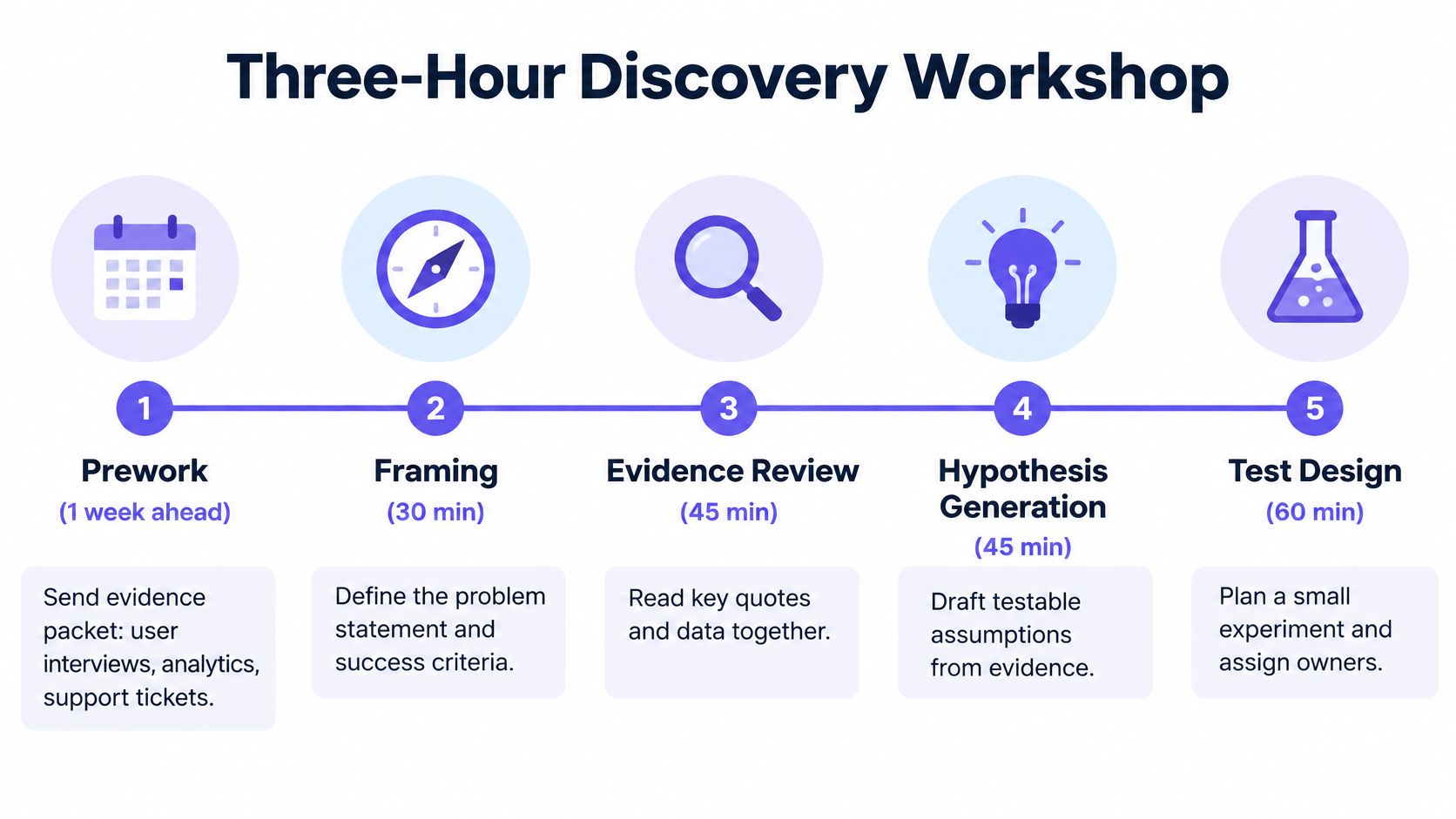
Use the proposed three-hour session to move from framing through evidence review, hypothesis generation, and test design. Preparation happens beforehand; interviewing customers shouldn't be squeezed into a meeting designed to synthesize research.
The timeline below separates preparation from live working time.
Prepare the evidence and the room
- Prework, one week ahead. Send the decision statement, agenda, evidence packet, and current-flow capture. Include interview excerpts with context, support themes, analytics definitions, and screenshots of loading, empty, error, and permission states.
- Keep the working group bounded. For this format, invite six to eight active participants. Include product, design, engineering, research or research responsibility, and customer-facing context; request asynchronous input from additional specialists.
- Assign operational roles. Name a facilitator, decision owner, note-taker, and timekeeper. Roles can overlap, but avoid making the facilitator simultaneously defend the preferred solution.
- Prepare remote participation. Give everyone board access, a text alternative, and a place for pre-session comments. Ask unavailable stakeholders to document constraints and nominate someone who can clarify them.
These are suggested facilitation limits, not research-backed universal optima. Reduce scope if your evidence packet requires extensive explanation.
Facilitate the live sequence
Framing, 30 minutes. Restate the decision boundary and agree on the outcome measure. Separate decisions the owner can make today from commitments requiring additional authority.
- Opening exercise: Participants write their interpretation of the problem.
- Output: A provisional problem statement and explicit decision rules.
Evidence review, 45 minutes. Read key observations together, then use affinity clustering to group related friction. Keep each note linked to its original evidence.
- Evidence discipline: Separate observed behavior, participant explanation, and team interpretation.
- Root-cause exercise: Use the 5 Whys to investigate a plausible causal chain, stopping when evidence ends.
- Output: An evidence-led problem statement and unresolved questions.
Hypothesis generation, 45 minutes. Turn the problem into a How-Might-We prompt, then sketch independently before discussing.
- Opportunity prompt: How might administrators reach a meaningful dashboard without unnecessary setup?
- Alternative generation: Explore changes to sequencing, information, permissions, and recovery, rather than cosmetic variants alone.
- Output: Competing approaches and the assumptions behind them.
Test design, 60 minutes. Compare expected impact, evidence confidence, and feasibility using written rationales. Reserve a brief screen break within this block.
- Prioritization: Use dot voting to focus discussion, then inspect the reasons behind the votes.
- Risk classification: Mark assumptions as value, usability, or feasibility risks.
- Closure: Complete the assumption register, experiment plan, owner, deadline, and decision rule.
The common progression from problem clarification through research, solution generation, prioritization, and prototyping appears in Tkxel's workshop guidance, alongside the 5 Whys and MoSCoW.
Keep exercises subordinate to the decision
MoSCoW can clarify essential versus optional scope once the direction has a defensible basis. It's less useful when participants label their own requests Must-have before examining the problem.
Future Processing's discovery-workshop guidance also describes dot voting, priority matrices, and story mapping. Choose the mechanism that exposes the trade-off you face.
Would a numerical score add clarity, or merely disguise uncertain judgments?
Record the rationale either way. An assumption register should contain the claim, evidence link, confidence, risk category, validation method, owner, deadline, and decision rule. Carry learning work into agile sprint planning as an explicit task rather than converting it into implementation scope.
Work the SaaS Onboarding Example From Evidence to Test
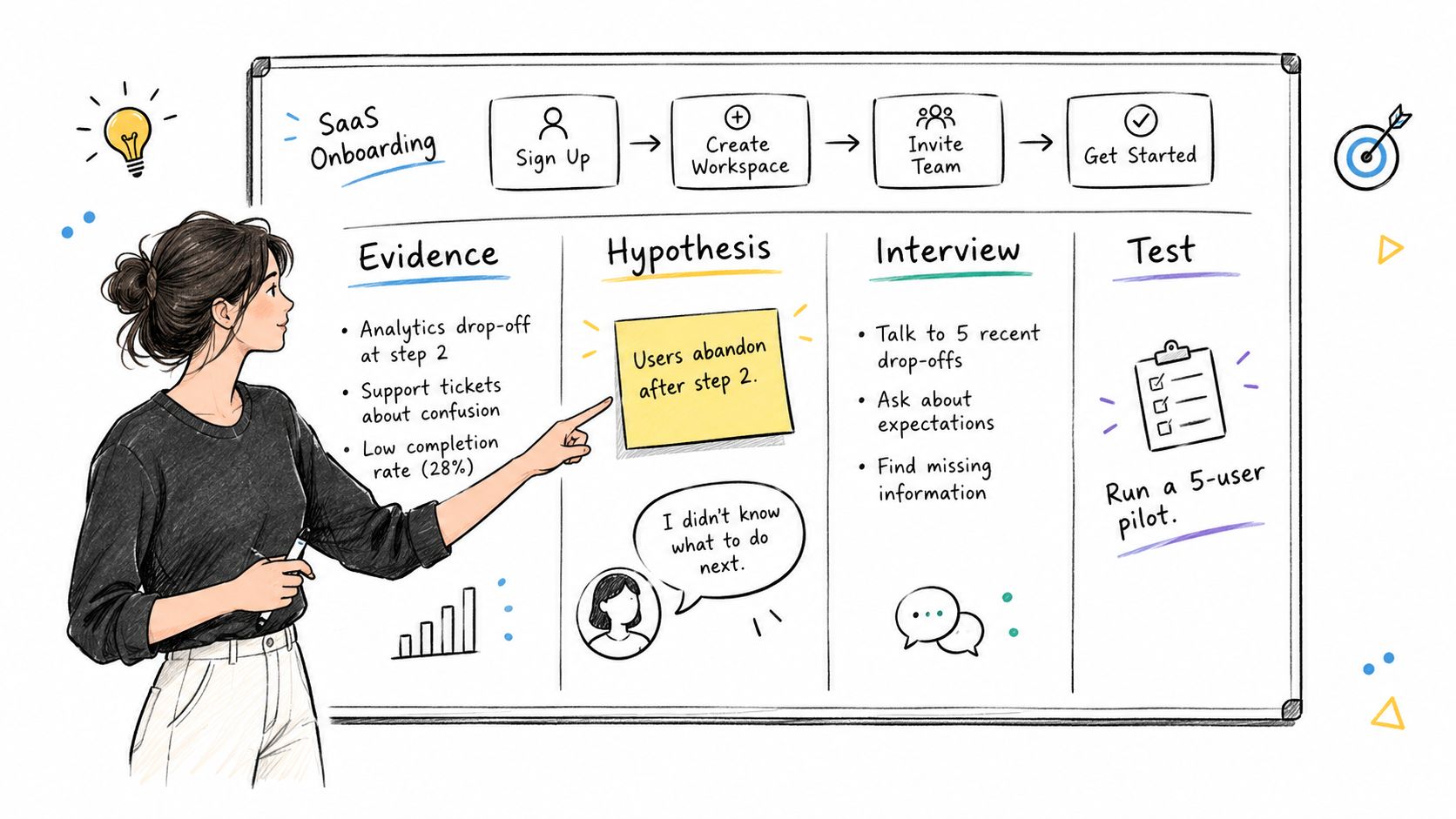
Follow a hypothetical onboarding problem from observation to a research decision. Every behavior and artifact in this example is illustrative, not a customer result.
A PM enters the session believing administrators need a longer setup checklist. The proposed business outcome is meaningful first-dashboard use, while the current product asks users to connect a data source before showing useful content.
Separate the evidence from the proposed fix
The hypothetical evidence packet contains:
- Observed behavior: An administrator opens the connector screen, encounters an authorization request, and leaves to contact a colleague.
- Interview context: Administrators describe uncertainty about whose credentials they should use.
- Funnel movement: Available events suggest exits near connection, but inconsistent naming prevents a trustworthy completion calculation.
- Completion notes: The team's checklist marks account creation complete without establishing whether the dashboard became useful.
- Requested feature: A stakeholder proposes a guided checklist.
The cluster is about permission uncertainty and delayed value, not necessarily missing guidance. The narrow problem statement becomes: new administrators can't confidently reach a useful first dashboard when setup requires access controlled by someone else.
Why assume that more instructions will remove an authorization dependency?
Richard Seidl's product-discovery discussion describes moving from users' real work to a concrete problem statement and then prototype feedback. Preserve that order here.
Compare flows that challenge the hypothesis
The team explores competing directions:
- Preview-first flow: Show clearly labeled sample data before requesting a connection.
- Delegated-connection flow: Help the administrator request authorization from the appropriate colleague.
- Guided current flow: Retain the sequence but explain credentials, permissions, and recovery.
For a concrete tooling application, the team could give Figr existing product screens, design-system context, supplied requirements, and research notes to explore these alternatives and their states. Alongside manual sketching or Figma, this helps prepare reviewable, Figma-ready design artifacts for subsequent research.
The team still decides which evidence matters and whether the proposed states faithfully represent the product.
A prototype is a research artifact. Customer validation requires evidence from the intended audience.
Turn the preferred direction into a test plan
The UK government's Test, Learn and Grow guidance treats testing, learning, and iteration as a distinct phase. Apply that principle with the cheapest artifact capable of answering the question.
- Target participants: New workspace administrators, including people who need another person's authorization.
- Task scenario: Prepare a dashboard for a colleague using a realistic setup situation.
- Competing concepts: Preview-first and delegated connection, with the current flow as context.
- Usability questions: Can participants distinguish sample from live data and identify the next required action?
- Success measures: Independent task completion, correct data-status interpretation, observed assistance, and recovery behavior.
- Decision threshold: Advance only when participants complete the critical task without moderator rescue and no unresolved sample-data misunderstanding remains; otherwise revise and retest.
- Owner and deadline: The designer owns preparation and sessions; the PM records the readout date before closing the workshop.
- Stopping rule: Pause the preferred direction if the permission dependency remains unresolved or participants mistake sample results for real results.
That qualitative gate governs prototype iteration, not market demand. Later behavioral experiments need trustworthy instrumentation and an appropriate design; consult A/B testing best practices before choosing that method.
Handle Disagreement Without Turning Votes Into Validation
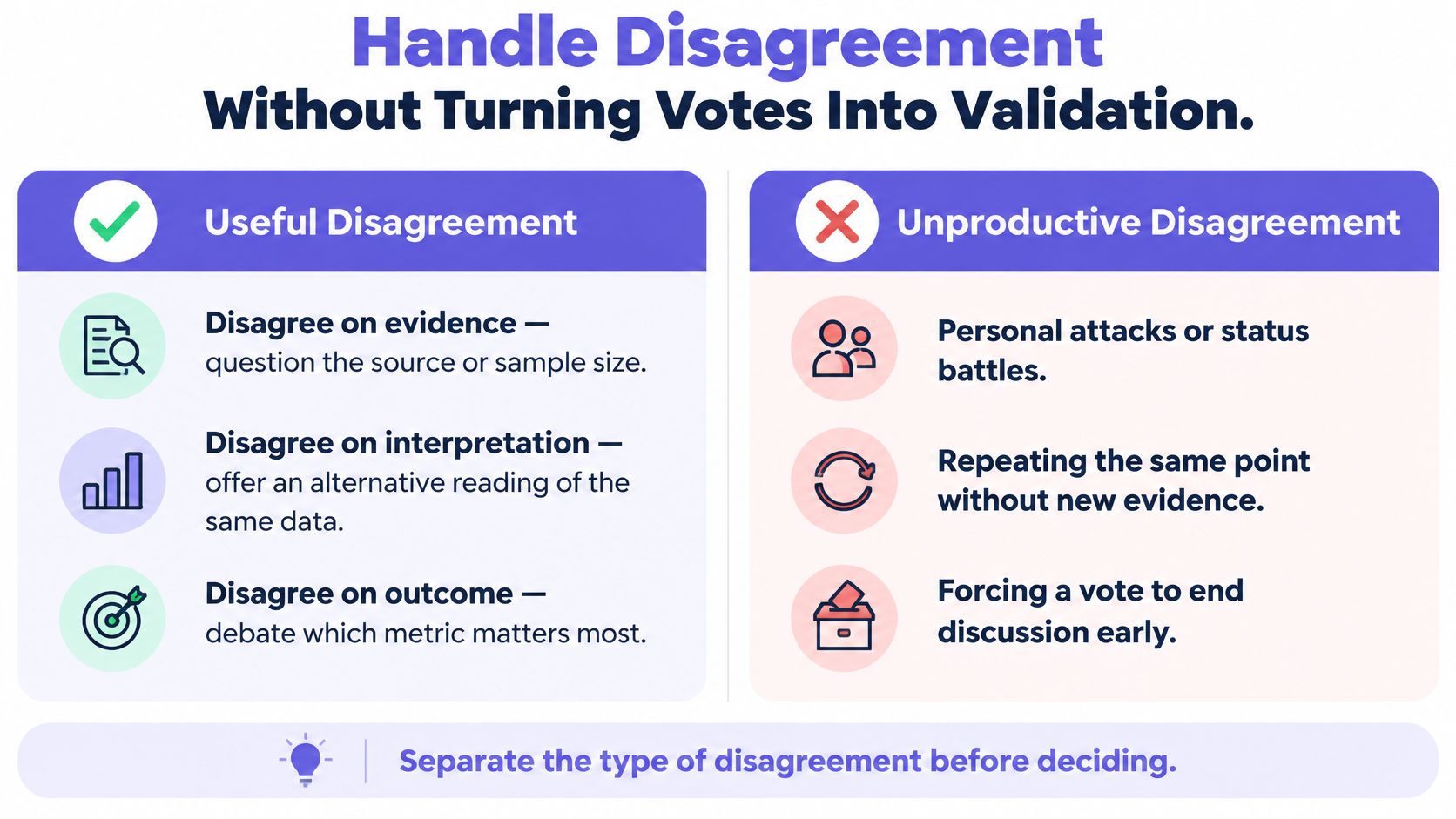
Classify the disagreement before choosing how to resolve it. A disputed observation needs source inspection; a disputed interpretation needs alternative explanations; a feasibility concern needs technical investigation.
A preference argument needs a return to the user's task.
Make dissent inspectable
Suppose engineering doubts delegated authorization can work within the existing permission model. Calling that resistance would hide a potentially decisive constraint.
Use a short protocol:
- Restate the claim: Identify precisely what someone disputes, without describing their motives.
- Attach the evidence: Open the relevant observation, architecture note, or event definition.
- Name the gap: Record what the available material cannot establish.
- Assign authority: Identify who owns the product decision and who must assess the constraint.
- Choose the next test: Agree on a technical spike, targeted observation, or revised prototype.
Useful facilitator language is direct: Which observation would distinguish these explanations? What evidence would make you change your recommendation?
Hinty's workshop guidance highlights the gap between workshop outputs and evidence-backed delivery gates, alongside challenges involving fragmented evidence, accessibility, missing stakeholders, and participants less able to express their context.
Protect participation without manufacturing agreement
Remote facilitation needs more than an open invitation to speak. Begin with silent writing, allow plain-language contributions, and read text submissions aloud with permission.
When audio fails, accept asynchronous input rather than treating silence as agreement. Assign someone to monitor chat so the facilitator doesn't miss a technical objection while another participant presents.
Avoid letting the fastest board editor become the unofficial author of everyone's position.
A workshop vote measures the room's relative attention. It doesn't measure customer value or demand.
Missing context deserves an explicit consequence. If security expertise is unavailable, make the recommendation conditional on review. If analytics conflict with interviews, investigate definitions and context before declaring either source wrong.
Logic Unit's software-discovery guidance includes workflows, dependencies, architecture, security, privacy, operations, and cost among discovery concerns. Bring relevant constraints into the record, including accessibility needs and legacy states.
The human decision owner remains accountable. The room should challenge their reasoning, and the record should preserve unresolved objections.
Ending with a narrower test, a delay, or a decision not to build can be the most responsible use of the session.
Follow Up With a Decision-Quality Checklist
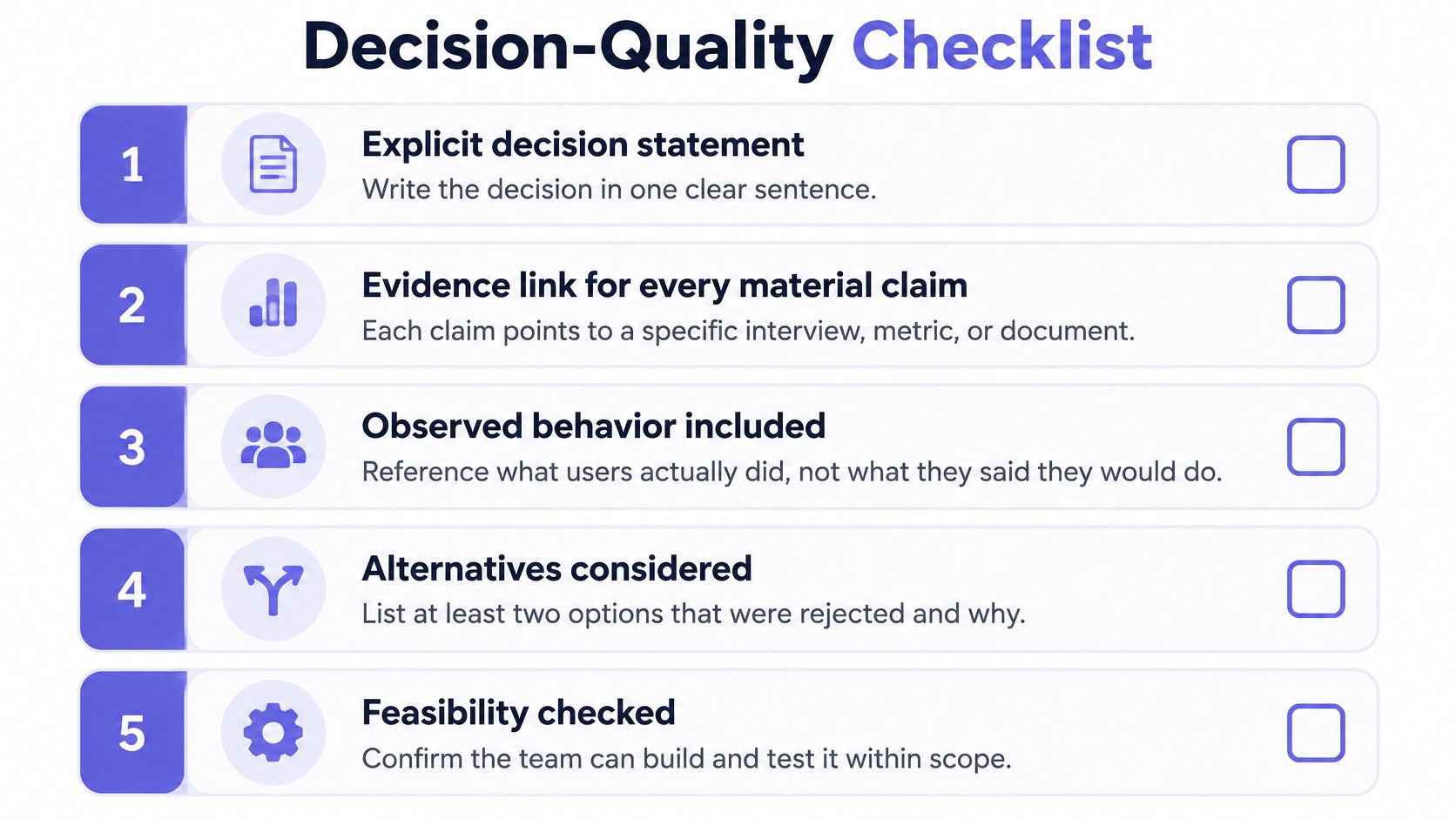
Publish a durable decision record and schedule the work it authorizes. As a practical operating target, distribute it within 24 hours, while participants can still identify missing context.
Preserve stable research links, access permissions, and analytics definitions. A screenshot of a board is useful context, but it's a poor substitute for a searchable decision record.
Check the handoff before committing delivery
- Decision statement: Can an absent colleague identify the audience, boundary, owner, and consequence?
- Evidence integrity: Does every material claim link to inspectable evidence, with limitations recorded?
- Observation discipline: Are actions separated from explanations and interpretations?
- Alternative reasoning: Are rejected approaches and their trade-offs visible?
- Assumption ownership: Does each critical assumption have a risk category, owner, deadline, and validation method?
- Test specificity: Does the prototype investigate a particular behavior rather than general preference?
- Success criteria: Were outcome measures proposed before the session and test rules fixed before results arrived?
- Feasibility and inclusion: Are technical dependencies, accessibility needs, and edge conditions represented?
- Roadmap consequence: Does unresolved uncertainty constrain the commitment?
When evidence supports delivery, preserve the reasoning in requirements. Guidance on how to write a PRD can help translate decisions into acceptance criteria without presenting open assumptions as established facts.
Review what changed after testing: the chosen direction, confidence, scope, or next research question. Don't measure success through attendance or the volume of sticky notes.
Questions PMs ask before scheduling
Can we run a workshop without user interviews?
Yes, if the available behavioral and support evidence fits the decision. Label missing motivational context and authorize research where needed.
Should customers attend the working session?
They can contribute context, but stakeholder synthesis and customer research serve different purposes. Don't ask customers to adjudicate internal priorities.
What happens when the session runs out of time?
Preserve the unresolved claim and assign follow-up. Don't force agreement to finish the agenda.
When should discovery move into delivery?
When the agreed gate is met and the owner accepts the remaining risk. Keep post-launch learning explicit.
In short, workshop value depends on how the team spends its next unit of time. Incentives favor visible delivery; a defensible decision to investigate or decline work requires equally visible reasoning.
Adapt this agenda to your current onboarding problem, prepare the evidence packet, and check the current product documentation before introducing the design agent into your workflow.
Figr helps teams use existing product screens, design-system context, and supplied research to explore competing flows and prepare reviewable design output. Bring your workshop's selected assumptions to Figr, develop alternatives for the next research session, and keep the validation decision with your team.