

It’s 9:00 AM on Monday. The calendar alert for sprint planning pops up, and you feel that familiar pit in your stomach. Why? Because you know the backlog is a mess of half-baked ideas, the engineers are seeing stories for the first time, and the next two hours are doomed to be a debate club, not a planning session.
We treat sprint planning like it's just another meeting on the calendar.
This is the original sin of failed sprints. Agile sprint planning isn't an event you show up for; it’s the final output of a well-oiled system. It's the moment where ambiguity and wishful thinking are forced into a concrete, executable plan. Time isn't a conveyor belt; it's a switchboard, and this is the moment you connect the right circuits. The meeting is just the visible part. The real work, the work that matters, happens long before anyone joins the video call.
Sprint Planning Is a System, Not a Meeting
A sprint planning session is only as good as its inputs. Garbage in, garbage out. When you walk in with vague user stories, unknown dependencies, and zero context, what do you expect to walk out with? You get confused estimates and a sprint goal that's already broken. The meeting is just a container; the quality is determined by what you put inside.
Just last week, I watched a team try to plan their sprint around a single backlog item: "Improve user dashboard." What does that even mean? New metrics? A different layout? Faster load times? With no clarity, the team spent 90 minutes spitballing ideas instead of planning work. They left without a sprint goal because they never had a real plan.
The system failed days before the meeting ever began.
Architecting a Better System
If you want to fix the meeting, you have to fix the system that feeds it. This means making preparation a non-negotiable rhythm for your team. When you make this shift, your team stops reacting to chaos and starts executing with purpose. This is what I mean by architecting the process:
- Refined Inputs: The product backlog must be a source of clarity, not confusion. User stories arrive at the meeting already broken down, discussed, and roughly estimated.
- Clear Roles: The Product Owner shows up with prioritized goals, not a wishlist. The dev team brings their technical expertise, ready to ask the right questions about implementation.
- Predictable Outputs: The finish line is a committed sprint backlog and a crystal-clear sprint goal. This goal serves as the team's north star for the next two weeks.
This systematic approach is why Agile projects boast a higher success rate than traditional methods. It’s a system built for clarity in a world that’s anything but. The best teams I've seen create formal Standard Operating Procedures for their planning process, ensuring nothing is left to chance.
The Art of Preparation: What Happens Before You Meet
A sprint planning session doesn't begin when the calendar invite chimes. It starts days earlier, in the quiet, focused work of preparation. A great planning meeting is an anticlimax, the final, predictable step in a process that has already wrung out most of the ambiguity.
Skip this phase, and the meeting collapses from a planning session into a chaotic discovery workshop.
The single most vital activity is backlog refinement, sometimes called backlog grooming. It is the collaborative dissection, the questioning, the clarifying of work until it's so well understood that estimating it becomes almost trivial. Think of it like a professional kitchen. The chefs don't start chopping onions when an order comes in. They do their mise en place hours beforehand, meticulously preparing every ingredient. When it’s time to cook, they just assemble.
Backlog refinement is your team’s mise en place.
The High Cost of Skipping Prep
I once worked with a team that ditched refinement to "save time." They pulled a single, innocent-looking user story into their sprint: "As a user, I want to upload a file." Engineering gave it a two-week estimate.
It took six.
Why the catastrophic miss? Mid-sprint, the engineers discovered a hornet's nest of complexity. That one story concealed eleven hidden states: uploading, processing, success, network error, file-too-large error, wrong file type, and on and on. You can see a similar exploration of Dropbox's file upload states here. Each discovery triggered an emergency huddle, pulling the PM and designer into a vortex of "what should happen when..." conversations. The two-week estimate was for one screen; the six-week reality was for twelve screens and endless ad-hoc decisions.
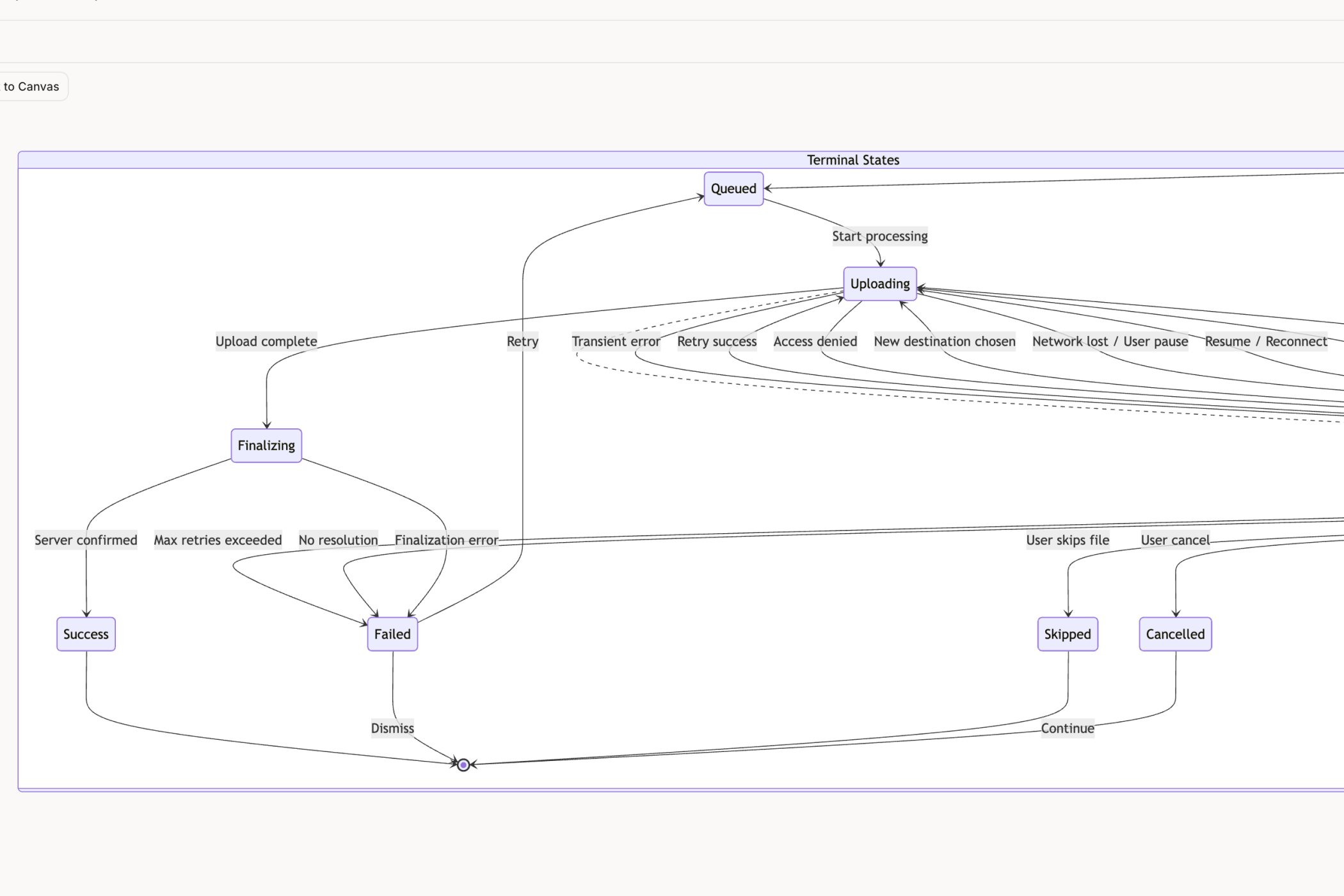
This is the tax you pay for skipping preparation. It’s a debt that always comes due, with interest. For teams looking to avoid this, it's non-negotiable to learn how to validate features before writing a single line of code.
Roles and Responsibilities in Refinement
Effective refinement isn't a free-for-all. It’s a structured conversation where each person holds a different piece of the puzzle. The basic gist is this:
- The Product Owner: Owns the "what" and the "why." They prioritize the backlog based on business value and must clearly articulate the user problem each story solves.
- The Development Team: Owns the "how." Engineers, designers, and QA ask the clarifying questions that surface hidden complexity. They poke holes in assumptions and break down large stories into manageable chunks.
- The Scrum Master: Owns the "flow." They facilitate the session, ensuring the conversation stays on track and the team produces sprint-ready stories.
This isn't about hierarchy; it's about focus. The goal is a shared understanding so deep that the work feels tangible. Modern tools can dramatically accelerate this. Quickly mapping the states of a task assignment component in a tool like Figr can expose hidden requirements, like these component states, before they derail a sprint.
Running the Session for Peak Productivity
The sprint planning meeting is a performance. Like any good performance, it needs a script. You are there to commit, not to explore. Exploration happened during refinement. Now is the time for decisions.
To keep the session on track, a timed agenda is your most powerful tool. It’s the structure that forces clarity.
The Agenda as a Pacing Tool
For a typical two-week sprint, the planning session should be capped at four hours. A great one is often shorter. The agenda isn't just a list; it’s a rhythm that guides the team through a logical sequence of commitments.
A productive session generally flows like this:
- Set the Stage (15 minutes): The Product Owner presents the proposed sprint goal. This is the "why" behind the work, a mission statement for the next two weeks.
- Backlog Selection (60-90 minutes): The team reviews the highest-priority, sprint-ready items. This is a Q&A, not a deep dive. If core concepts are challenged, the story wasn't ready.
- Task Breakdown & Estimation (60-90 minutes): Here's where the work gets real. The team breaks each story into specific sub-tasks. How will we build this? What needs to be tested?
- Final Commitment (15 minutes): With tasks identified, the team does one last capacity check. Can we realistically accomplish this? They formally commit to the sprint backlog and lock in the sprint goal.
This whole process hinges on the quality of your pre-sprint prep. You need to get from a prioritized list to a refined, ready state before the meeting even starts.
This flow is the engine that drives a productive planning session. Get it right, and the meeting practically runs itself.
The Art of Estimation
Estimation is a structured conversation disguised as a numbers game. The point isn’t to predict the future with perfect accuracy. It’s to create a shared understanding of complexity.
Two popular techniques dominate the landscape:
- Planning Poker: My go-to. It uses a modified Fibonacci sequence (0, 1, 2, 3, 5, 8, 13...). Team members reveal estimates at once. Wide divergence forces a conversation between the highest and lowest estimators, surfacing hidden assumptions.
- T-Shirt Sizing: A quicker method for initial refinement. You categorize items into sizes like XS, S, M, L, XL to get a rapid, high-level sense of the work.
A Scrum Master’s most critical job here is facilitation. You have to protect the team from premature solutioning. A powerful prompt I use is simply asking, "Is this conversation helping us estimate, or are we designing the feature right now?"
Productive sessions depend on mastering the clock. You might find general time management tips useful. Since stakeholder priorities will inevitably clash, it’s good to have a playbook for how to handle those conflicts as a product manager.
From Estimation to Commitment
Estimates are on the board. Stories have been prodded. Now, the mood shifts. This is where abstract talk becomes real, moving from points and guesses to the solid ground of commitment. It's a psychological turning point.
A list of tasks with numbers next to them is just a list. A sprint backlog, built by the people who will bring it to life, is a pact. When the team collectively builds this backlog, it creates ownership. It’s no longer work that's "assigned"; it's work that's "chosen."
From Hours to Honesty
Before the team can commit, they need a brutally honest conversation about their real capacity. This has almost nothing to do with calculating developer hours. Capacity planning fails when it's a math problem. It succeeds when it's an honest conversation about interruptions.
A friend at a Series C startup told me their team’s breakthrough came when they started plotting "dark matter" on their capacity plan. Dark matter is all the invisible but predictable work that eats up energy but never lands on a task board: mandatory all-hands meetings, security training, recurring guild catch-ups.
By making this invisible work visible, their sprint success rate shot up. Why? Their commitments were finally anchored in reality, not optimism.
Forging the Sprint Goal
With a realistic capacity understood, the team can pull prioritized items from the top of the product backlog. This isn't a random grab bag. The selection is guided by the Sprint Goal.
The Sprint Goal is a short, one-sentence mission statement that gives the work purpose. It answers: "If we accomplish nothing else, what is the most important thing we can deliver?"
Without a goal, a sprint backlog is just a disjointed collection of tasks. With one, every task becomes a step toward a shared objective. For example, instead of "Complete stories X, Y, and Z," a goal is: "Streamline the checkout process to reduce cart abandonment by enabling guest checkout." You can see what a redesigned checkout setup flow might look like in this Shopify example. This goal becomes the North Star. For teams dialing this in, knowing how to prioritize a product backlog is the skill that makes this possible.
This level of focus matters at scale. Why do so many agile transformations fail? Because they adopt the ceremonies but miss the principles. Teams go through the motions of planning without ever truly committing to a focused goal. This reveals a deep incentive structure in most companies: being busy is rewarded more than being effective. A clear sprint goal pushes back against that culture.
In short, building the sprint backlog is the final, vital act of the planning session. It's about architecting a plan for focused, predictable value.
Avoiding Common Pitfalls and Measuring Success
It’s the end of a sprint. The team shipped work, but morale is low. Everyone feels like they’ve been running on a treadmill: busy but not productive.
This is the quiet failure of sprint planning. It’s not a single catastrophic event, but a slow erosion of trust and predictability. The good news is that these failures leave footprints in the data. They are not mysteries; they are patterns. By learning to spot these patterns, you can move from reacting to problems to actively preventing them.
From Symptoms to Solutions
Most sprint planning issues fall into a few common categories. Once you recognize the symptom, the fix becomes straightforward. Here are the most common pitfalls:
- Symptom: Chronic Overcommitment. The team consistently fails to complete all the work in the sprint backlog.
- Fix: Honor Your Historical Velocity. Velocity isn’t a target; it's a diagnostic tool reflecting your team's proven capacity. If your average velocity is 30 story points, committing to 45 is not optimism, it’s a recipe for failure.
- Symptom: Vague Acceptance Criteria. Engineers are blocked by endless mid-sprint questions. "What should this button do on error?" "How does this look on mobile?"
- Fix: Make "Definition of Ready" a Prerequisite. A user story is not ready for planning unless its acceptance criteria are explicit and testable. No exceptions.
- Symptom: Constant External Interruptions. A stakeholder swoops in with an "urgent" request, derailing the team's focus.
- Fix: Protect the Sprint and Make Costs Visible. The Scrum Master’s role is to shield the team. If an interruption is unavoidable, an equivalent amount of work must be swapped out transparently.
Metrics That Reveal the Truth
Metrics aren't about judging the team; they're about understanding the health of your process. You’re looking for stability and predictability.
- Velocity: This measures the work a team completes per sprint. A stable velocity suggests a predictable process. A volatile one is a red flag.
- Sprint Burndown Chart: This visualizes work remaining versus time left. An ideal chart shows a steady downward trend. If the line flatlines, the team is blocked.
- Say-Do Ratio: This compares committed work versus delivered work. A consistently high ratio (90% or more) is a strong indicator of a healthy cycle.
In his book, Scrum: The Art of Doing Twice the Work in Half the Time, Jeff Sutherland argues that achieving a stable velocity is the prerequisite for predictable delivery. It's the bedrock upon which all reliable forecasting is built. These metrics provide the feedback loop to achieve that stability. If you're looking for more ways to visualize this data, our guide on how to build a product management dashboard can help.
Your Next Actionable Step
We’ve covered strategy, process, and pitfalls. So, what can you actually do tomorrow morning? Theory is useless without a single, grounded action to make it real.
Before your next sprint planning session, find one user story. Pick the one that feels most ambiguous, the one with hidden complexity that makes the engineers nervous. You know which one I'm talking about.
Instead of just adding more text to the ticket, try something different.
Use a tool like Figr to quickly capture the existing user flow and ask it to map potential edge cases. Generate initial test scenarios from that flow, much like the team did in this Waymo trip modification example. Bring this visual artifact to your planning meeting.
Don’t announce a grand process change. Just present the work with this new layer of clarity.
Then, watch. See how the conversation changes. Notice how much faster the team gets to a confident estimate when they can see the work instead of just reading about it. This small, tactical shift makes the invisible work visible.
That’s the entire point. It’s not about running a better meeting; it’s about building a better, shared understanding of the work that needs to get done. That's where real speed comes from.
Your Sprint Planning Questions, Answered
New teams often get tangled up in logistics. How long should it be? Who really needs to be there? Let's clear up the most common questions.
How Long Should a Sprint Planning Meeting Be?
The classic rule is two hours of planning for every week of your sprint. So, for a two-week sprint, block out a maximum of four hours.
But that’s a cap, not a target. A well-oiled team with a properly groomed backlog often finishes much faster. If you're consistently done in half the time, that's not a failure, it's a sign of a mature process.
What Is the Difference Between Backlog Grooming and Sprint Planning?
Aren't they just two words for the same thing? No. They serve completely different purposes.
Think of backlog grooming (or refinement) as the ongoing prep work. It's the process of clarifying and prioritizing items for future sprints. It’s the mise en place.
Sprint planning is the formal event that kicks off a new sprint. The goal here isn’t just to look at stories; it's to select a specific set and create a concrete plan.
Grooming is about preparation. Planning is about commitment.
Who Should Attend the Sprint Planning Meeting?
For this to work, attendance isn't optional for the core crew. The entire Scrum team must be in the room.
This breaks down into three key roles:
- The Product Owner: Represents the customer and the business. They explain the "what" and the "why."
- The Development Team: The builders. They figure out the "how," estimate the work, and commit to the backlog.
- The Scrum Master: The facilitator. They keep the meeting on track and protect the timebox. They’re the grease in the gears.
Leave any of these people out, and you create an information vacuum. That leads to bad assumptions, a shaky plan, and a total lack of shared ownership. It’s a recipe for a failed sprint.
Turn your product thinking into production-ready artifacts. With Figr, you can generate user flows, uncover edge cases, and create high-fidelity prototypes that mirror your existing product, helping you design with confidence and ship faster. Explore Figr today.