

Product teams usually don't fail discovery because they lack opinions, they fail because no one can tell when a solution has been tested enough to deserve engineering time.
That gap gets expensive fast. A team keeps revisiting the same idea in slides, stakeholder reviews get noisier, and design work starts to outrun evidence. Ship dates slip, edge cases stay hidden, and the roadmap fills with half-validated bets that look sensible until the first real users touch them.
A better approach is to treat product discovery as a standalone decision system, not a one-time phase. That means framing the problem from real evidence, testing the riskiest assumption first, matching fidelity to the stage of risk, and carrying context forward so the team knows when to stop debating and start building.
Why Product Discovery Stalls in SaaS Teams
A friend at a Series C company once described a feature that lived in six weeks of meetings and never made it to code. The team had notes, slides, and strong opinions, but no repeatable frame for deciding what evidence mattered. That's the orphaned discovery loop, work that feels active while consuming the same attention every week.
When discovery lives in decks, the Product Manager becomes the person who relays context instead of the person who owns a decision. Engineering waits for clarity, design waits for alignment, and stakeholders keep asking for “just one more review.” I've seen that pattern turn a narrow uncertainty into broad scope creep because nobody can point to the exact assumption that still needs proof.
The practical problem is missing structure. Teams often write a planning brief without the fields that force trade-offs into the open, so the document can't tell you what's known, what's guessed, and what still needs testing. That's where a standalone framework helps, because it turns discovery from conversation into artifact.
Practical rule: if the team can't name the riskiest assumption, it's not ready to talk about solution scope yet.
That's also where context tools start to matter. Figr's delivery management insights from Figr are useful here because delivery and discovery only look separate until a handoff breaks. The basic gist is simple, the more the product memory lives across sessions, the less the team re-litigates old decisions.
At scale, this isn't just a workflow annoyance. Every unclear decision creates a tax on coordination, and coordination is one of the most expensive parts of software work. Product teams don't lose time because they're lazy, they lose time because uncertainty is cheaper to postpone than to name. A strong discovery frame changes that incentive by making uncertainty visible early.
Build a Standalone Discovery Framework
A solid product discovery workflow starts with an outcome, not a solution. The Double Diamond still matters because it formalized the move from broad exploration to focused validation, but for solution validation you need a tighter operating rhythm. The point is to widen the problem space first, then narrow the test that is most likely to fail.
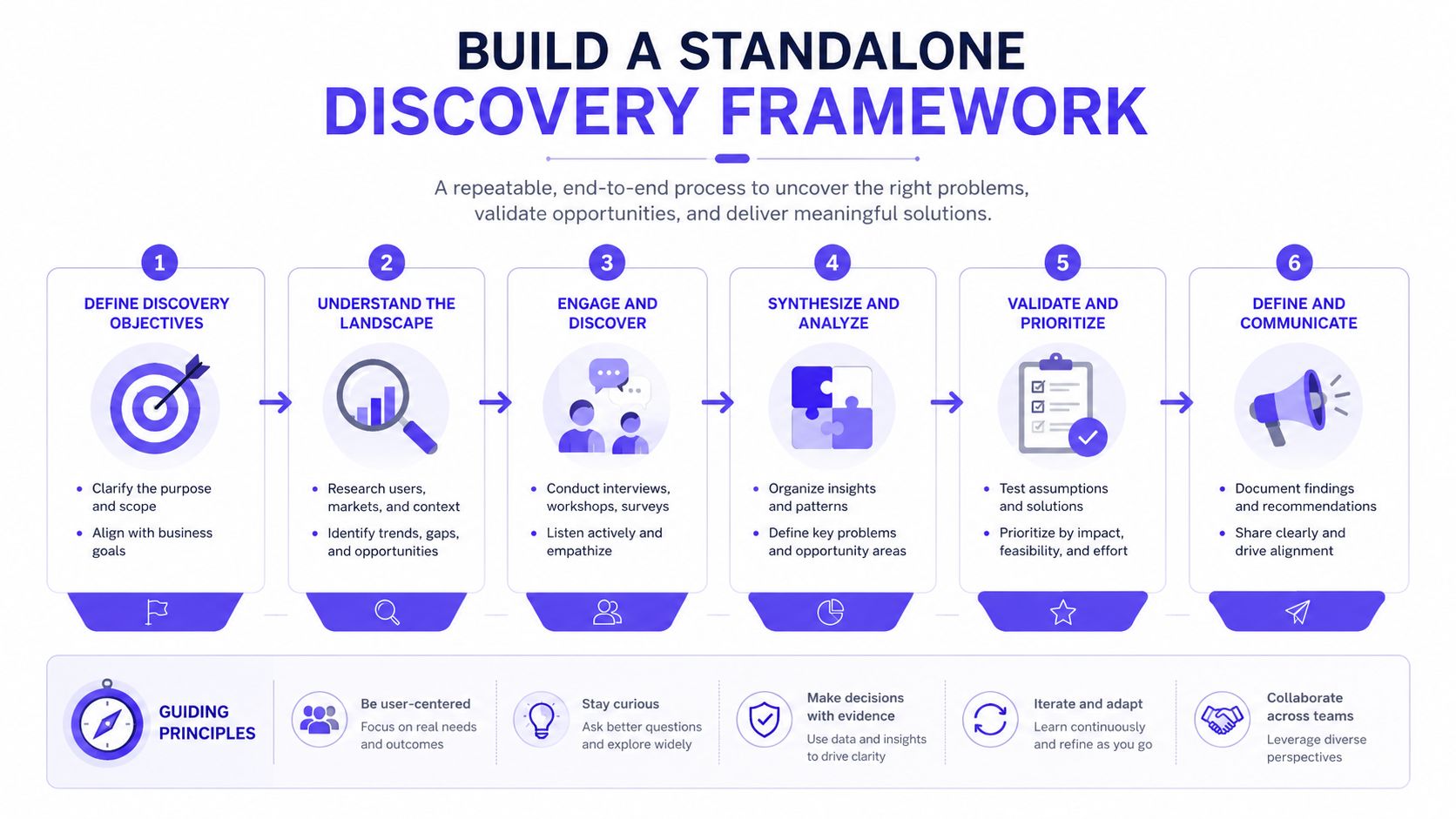
A discovery brief that can actually be used
A brief should be specific enough to test, not broad enough to admire. I like to keep one line for the outcome, one for the audience, one for the obstacle, and one for the evidence that already exists.
Opportunity: what user or business outcome is at stake.
Assumption: what must be true for the solution to work.
Experiment type: interview, prototype test, fake-door, or analytics review.
Evidence strength: weak, mixed, or strong.
Owner: one accountable person.
Review date: the next decision point.
That structure keeps the Product Manager from turning discovery into a backlog of opinions. It also makes handoff easier because engineering can see where the confidence came from, not just what the team wants to build. If the brief lacks an owner or a review date, it usually means the team is still calling discussion “progress.”
The workflow itself
Frame the outcome.
Start from the measurable result you want, not the feature shape.
Pull from churn trends, support tickets, NPS verbatims, usage analytics, or sales objections, then write one sentence that names the user, goal, and obstacle.Map the assumption stack.
Separate what you know from what you're betting on.
The riskiest assumption should be the one that would kill the idea if it were false.Choose the first test.
Match experiment type to assumption type.
If you need behavior, use a fake-door or prototype. If you need comprehension, use interviews. If you need pattern signals, use analytics.Prototype at the minimum useful fidelity.
Don't add polish before the evidence calls for it.
Use the lightest artifact that can expose the risk.Synthesize fast.
Capture what changed within a day, while the evidence is still fresh.
The point is to shorten the distance between insight and decision.Make the go/no-go call.
Decide whether to build, revise, or stop.
That decision should be anchored in evidence strength, not in how much effort has already gone into the idea.
A senior Product Manager at a small team told me the framework felt dull the first time they used it. Then it started saving meetings. That's the right test, because a good framework should reduce drama, not add theater.
For teams that want help turning that brief into a working artifact, a framework for product teams can be useful as a reference point. The point isn't ceremony, it's repeatability.
What Fidelity Do You Need at Each Stage
I have seen discovery stall because a team made the prototype look finished before they knew what risk they were testing. The right fidelity is the one that answers the current question, not the one that looks best in a review. Early discovery needs enough shape to test meaning, while later discovery needs enough realism to test behavior.
Match fidelity to the question in front of you. If you are still mapping the problem, notes and rough flows are usually enough. If you are testing whether users will act, you need something clickable. If you are validating a solution path, you need a higher-fidelity prototype that reflects the product's actual constraints.
Practical rule: do not raise fidelity until the current evidence can no longer answer the question in front of you.
Practitioner guidance still supports repeated contact with users. One playbook recommends weekly interviews, and others advise 5 to 10 interviews before major decisions, which is enough to catch consistent themes without mistaking one strong opinion for a pattern. That cadence matters because discovery goes stale when the team waits too long between tests. Mind the Product's product discovery techniques explains why repeated contact and context-rich observation matter more than one-off feedback sessions.
Prototype scope follows the same logic. A fake-door tells you whether people care enough to click. A higher-fidelity flow tells you whether they understand the path and can complete it. If you are spending time on visual polish before the team knows the core behavior is sound, you are optimizing the wrong thing.
Figr's prototyping decision framework helps when the fidelity question gets political, because Design System Intelligence keeps tokens, components, and states consistent as the artifact matures. That does not replace judgment, it keeps the artifact from drifting away from the intended product while the evidence gets stronger.
Problem mapping
Right fidelity: Notes, sketches, and rough user flows.
At this stage, the goal is not to design the solution in detail. You are trying to understand whether the underlying problem is real, important, and worth solving.
What you’re trying to learn: Is the problem real and worth solving?
Risk testing
Right fidelity: Clickable concepts, fake-door tests, or low-fidelity prototypes.
Once the problem is clear, the next step is to test the riskiest assumptions without investing heavily in design or development.
What you’re trying to learn: Will users understand the idea and engage with it?
Solution validation
Right fidelity: High-fidelity prototype.
Here, the concept is developed enough to test something that closely resembles the final experience. The focus shifts from validating the idea to validating how well the solution actually works.
What you’re trying to learn: Does the solution hold up in realistic use?
The economics are straightforward. Lower fidelity is cheaper to change, so it belongs earlier when uncertainty is highest. Higher fidelity belongs later, when the team is testing details that matter to shipping. If you reverse that order, you pay for realism before you have earned confidence.
Where Discovery Workflows Break Down
Discovery usually breaks at synthesis, not at data collection. Teams can gather interviews, analytics, and stakeholder feedback all week and still fail to make a decision because the evidence points in different directions. That is the triangulation bottleneck, and it's the part most playbooks skate past.
The issue gets sharper when the team has plenty of data but no decision rule. Analytics may show one behavior, users may describe another, and leadership may prefer a third interpretation. The job then becomes adjudication, not collection. A discovery process that can't handle disagreement is just a note-taking habit.
What conflict looks like in practice
Analytics say one thing.
Usage data shows a drop-off, but it doesn't explain why users leave.Users say another.
Interviewees describe a pain point, but their behavior doesn't always match their words.Stakeholders want a shortcut.
The loudest opinion can start shaping scope before evidence is coherent.
Product leaders need a rule here. I've found it helps to test the same assumption from two or three angles, then log the conflict explicitly instead of smoothing it over. That's where framework guidance on product discovery techniques is useful, because it reinforces triangulation and warns against relying on a single point of evidence.
When the team skips that step, the failure mode is familiar. Missing edge cases show up late, review cadence gets skipped, and ownership diffuses across design, product, and engineering. A prototype then gets rewritten not because the insight was wrong, but because the original decision path was never documented clearly enough to survive handoff.
Figr can help with that context gap through UX Reasoning, because it maps intent, flow logic, states, and constraints before handoff. It doesn't discover edge cases automatically, and it shouldn't be treated that way. The value is in making the unknowns visible early enough that the team can resolve them while the cost is still low.
A practical conflict log usually needs only a few fields, but it needs discipline:
Claim: what the team thinks is true.
Source: interview, analytics, or stakeholder input.
Contradiction: what doesn't line up.
Decision owner: who resolves it.
Next check: what evidence will settle it.
That log sounds bureaucratic until the first revision cycle disappears. Then it just feels like product management.
When Should Building Start After Discovery
Building should start when the riskiest assumption has been tested well enough to justify engineering investment. That sounds obvious, but many teams still start based on momentum, not evidence. The difference shows up in how quickly the team can move from uncertainty to a go/no-go call.
Industry guidance now recommends measuring discovery by time to decision, with enterprise teams targeting 2 to 4 week discovery cycles from opportunity identification to a validated go/no-go decision, and by the share of assumptions tested rather than accepted. That changes the question from “have we explored this enough?” to “what evidence would let us stop?” Holyshift's product discovery metrics guidance is one clear reference for that shift.
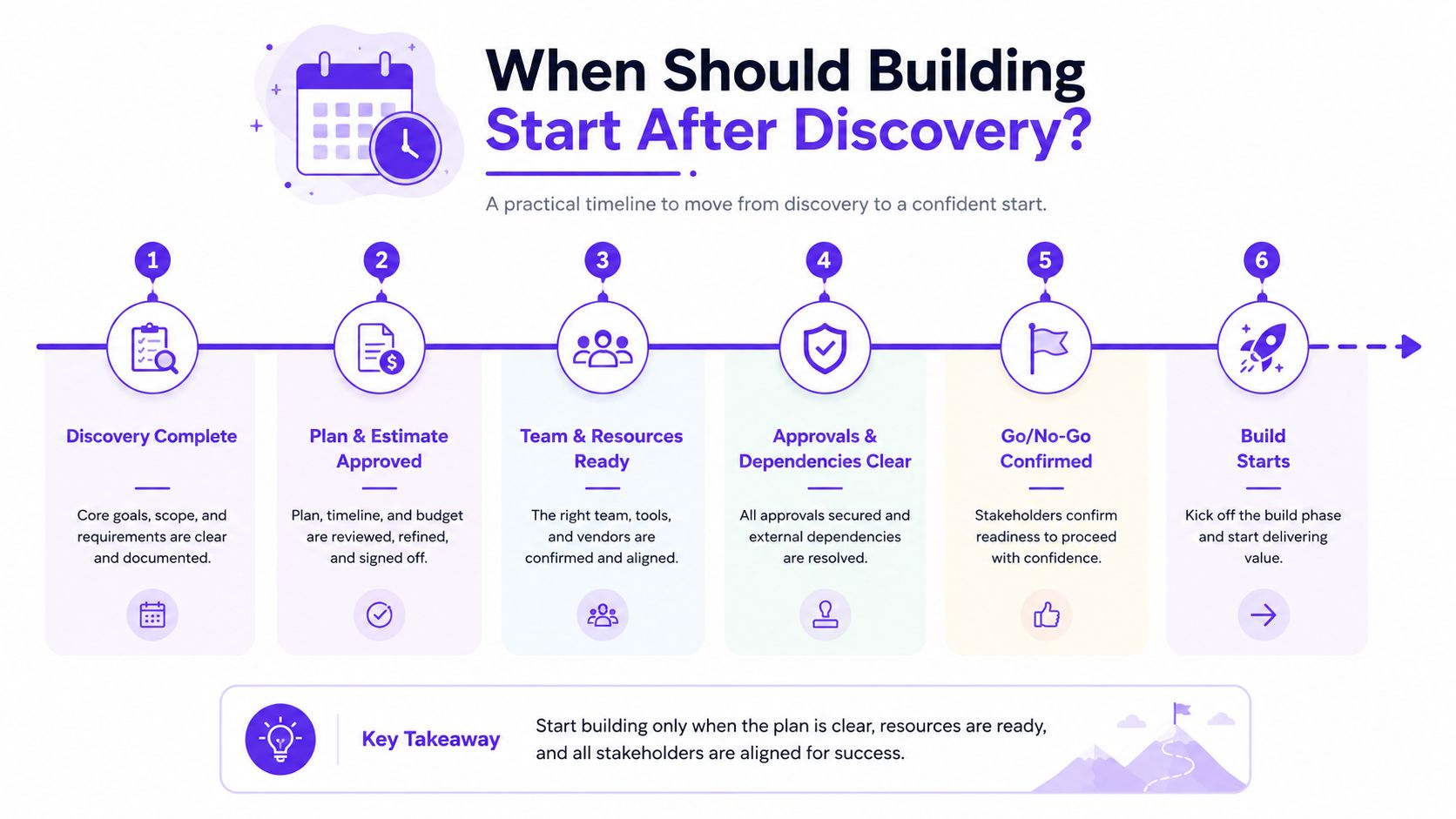
The exit criteria should be visible before anyone asks for a sprint. I'd use three checks. The first is whether the riskiest assumption is either validated or invalidated. The second is whether evidence strength has been logged clearly enough that another Product Manager could follow the logic. The third is whether the team has a realistic expectation for feature adoption at 30, 60, and 90 days, because discovery should connect to outcomes, not just artifact quality.
Practical rule: if you can't explain why engineering should start now, the discovery loop probably isn't done.
Product discovery becomes a management discipline instead of a qualitative ritual. At scale, teams don't suffer from a lack of ideas, they suffer from unclear thresholds. Strong thresholds preserve speed because fewer weak ideas make it into build. Weak thresholds create busy teams that keep shipping expensive guesses.
Figr's analytics context helps here because it can compare funnel drop-offs and product behavior against the live product context the team already owns. For teams that need a broader lifecycle view, the product development stages article is a useful adjacent read, since discovery only makes sense when it connects cleanly to delivery.
Use Figr to Ground Discovery in Product Context
Figr is useful when discovery needs to stay tied to the actual product instead of a generic concept. The workflow starts by ingesting live screens through the Chrome capture, importing Figma files so the design system is already present, and pulling in PRDs and docs so the product knowledge is not lost between meetings. That gives the Product Manager a working context rather than a blank canvas.
A better discovery artifact carries more than a screenshot. It should remember the decisions behind the screen, the constraints in the design system, and the behavioral signals from analytics or research. Figr's Context Pod keeps that memory across sessions, so the team isn't forced to rebuild the same context every time someone opens a new thread.
That matters once the team starts prototyping. The platform can generate a Figma-ready high-fidelity prototype that mirrors the existing product rather than inventing a disconnected one. It also supports Figma Sync, so the artifact stays editable instead of getting flattened into a dead-end file. For a Product Manager, that means the prototype can move through review without losing the design logic that made it credible in the first place.
I've seen teams waste time because prototypes looked plausible but ignored tokens, states, or the product's real interaction patterns. Figr's Design System Intelligence helps keep those constraints in view, and that matters more than visual polish. If the artifact can't survive stakeholder scrutiny or handoff, it's not helping discovery.
The product also gives teams a few practical starting points:
Live Product Capture: bring the current product into the discovery loop.
Screen recording analysis: inspect behavior in context.
Docs and PRD ingestion: keep strategic intent attached to the artifact.
Analytics context: compare user behavior with what the team thinks is happening.
A Product Manager who wants a faster path from evidence to artifact can use Figr as an AI design tool for product teams, but the point remains the same across tools. Discovery works better when the prototype is grounded in the product the team already ships, not in a generic idea of what the product could be.
The Visual Context Graph Connects Five Context Layers
The Visual Context Graph is the moat because it turns product context into a connected system instead of a pile of inputs. The five layers are visual context, behavioral context, design system context, product knowledge context, and implementation context. Together, they give discovery something most workflows lack, a way to understand what the product is, how people use it, and what it can become.
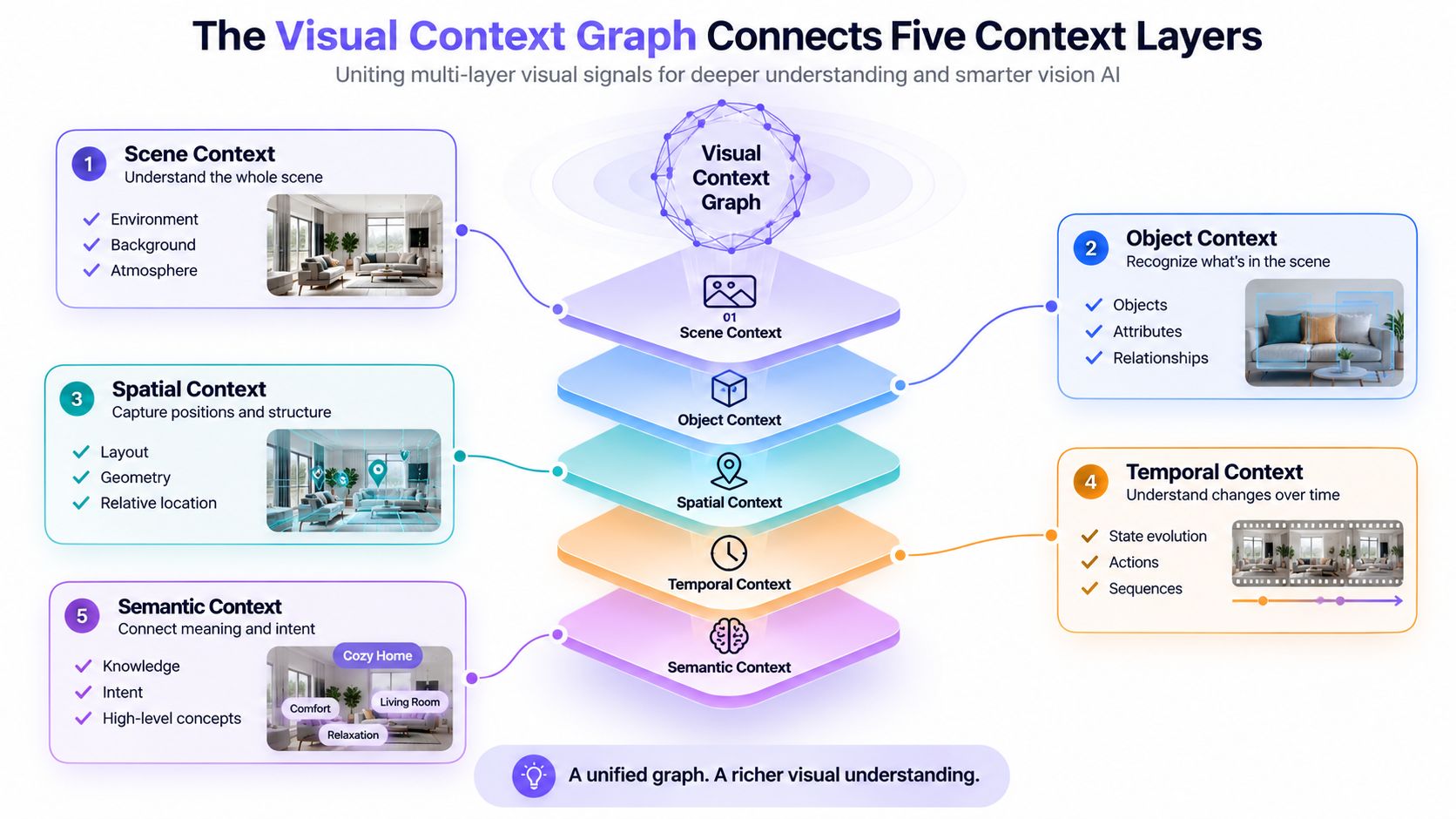
Why each layer matters
Visual context comes from live screens and captures how the product currently looks and behaves.
Behavioral context comes from analytics, which tells you where users drop off and where they persist.
Design system context keeps components, tokens, variants, and states aligned.
That's the layer that prevents discovery artifacts from drifting into fantasy.
Product knowledge context brings in PRDs, research, and positioning.
It keeps the team from solving a problem the product never promised to solve.
Implementation context shows what can survive engineering reality.
Without it, a polished idea can look valid long before it's buildable.
That stack explains why some AI design tools produce screens that look right but feel wrong. They start from the blank page. Figr starts from the product. For discovery, that difference changes the quality of the questions the team asks, because the prototype is already anchored to the systems the team uses to ship.
The deeper pattern is trust. When the team can see the product memory behind each artifact, reviews get shorter and handoffs get less fragile. Discovery stops being an isolated exercise and becomes part of how the organization thinks. That's the core value of a context graph, because it reduces the need to re-explain the same product every week.
If you're trying to validate a solution direction and you're tired of discovery that evaporates into slides, Figr gives you a way to keep the product context intact while you test what matters. It ingests live screens, design systems, PRDs, research, and analytics, then turns that context into prototypes and decision-ready artifacts the team can use. If you want to see how that fits into your own workflow, visit Figr.
FAQ
What is product discovery in plain terms?
It's the process of deciding what to build by testing assumptions before engineering starts.
Good discovery reduces uncertainty, not just volume of ideas.
How is solution validation different from customer discovery?
Customer discovery finds the problem, solution validation tests whether a proposed answer is worth building.
The second stage needs more fidelity and clearer exit criteria.
How much fidelity do I need early on?
Only enough to test the current risk.
If you're still asking whether the problem is real, don't polish the prototype.
When do I know discovery is done?
When the riskiest assumption has been tested and the team can make a clear go/no-go call.
If the decision keeps getting delayed, the question isn't done yet.
Where does AI fit into product discovery?
AI is useful when it keeps the product context connected across research, prototypes, and handoff.
It helps most when it supports judgment, not when it tries to replace it.