
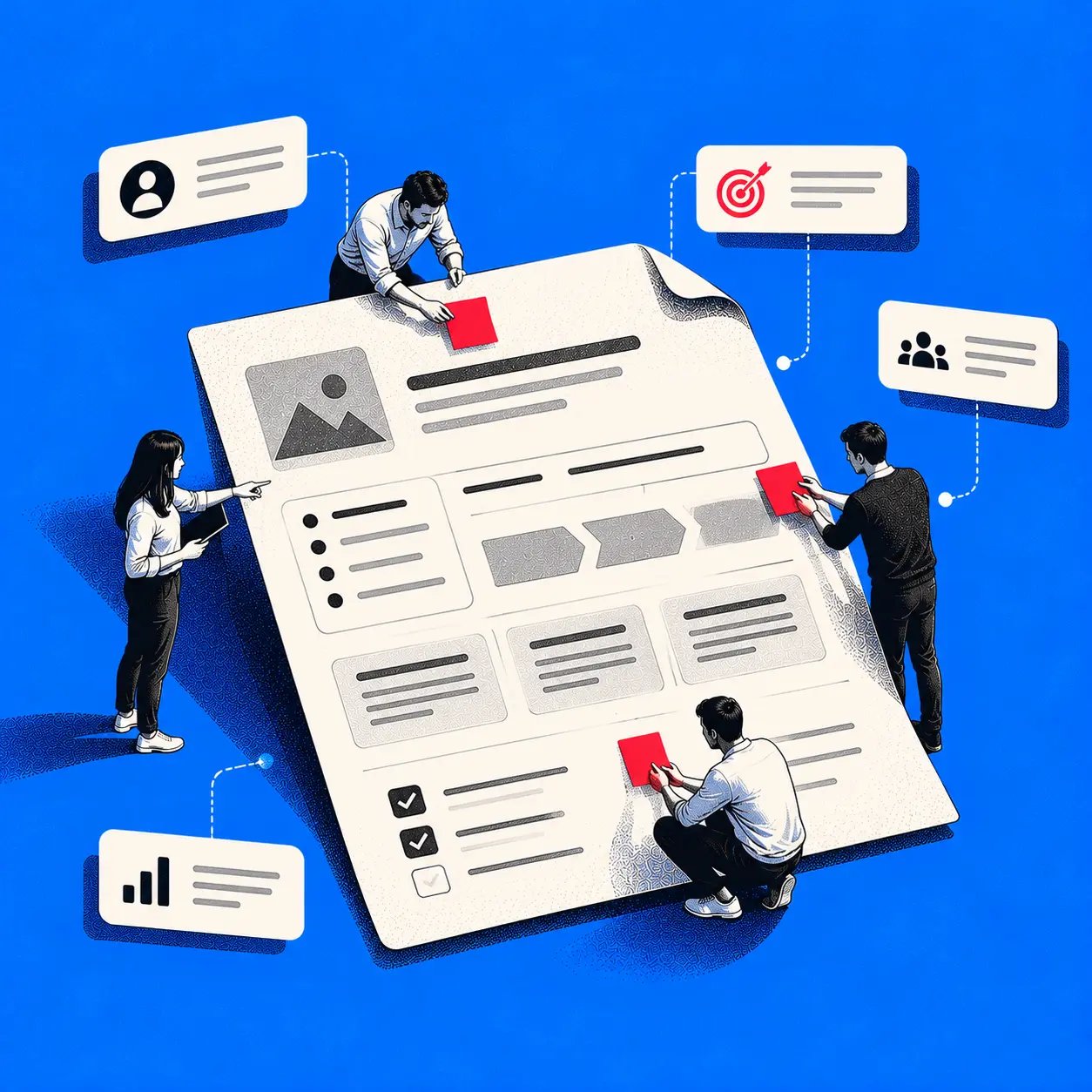
A product development brief template is a one page decision log that states the problem, users, evidence, desired outcome, scope, exclusions, constraints, risks, success measures, and decision owner before design begins. Teams often skip evidence thresholds and exclusions, so they get alignment on an idea without agreement on whether it should proceed.
You've seen the failure mode. A brief circulates, everyone nods, and two sprints later design is defending flows against requirements nobody wrote down. Decisions made in chat get relitigated in review, edge cases surface during QA, and the team ships a polished answer to the wrong question.
A good product brief template fixes that by forcing the hard agreements early, while they're still cheap. The basic gist is this: treat the brief as a requirements control artifact, not a presentation. Copy the template, fill it, and let unresolved uncertainty stay visible until evidence closes it.
The One-Page Template You Can Copy
Copy this product development brief template into your doc tool and complete every field before requesting design work. If a field is empty, that's information. It tells reviewers exactly where the risk lives.
| Field | What to write |
|---|---|
| Problem | The user pain in one sentence, with the measurable gap it creates |
| Audience | The named segment affected, including access needs |
| Evidence | Funnel data, support volume, interviews, or experiment results, each with a source |
| Desired outcome | The behavior change you expect, stated as a measurable result |
| In scope | Capabilities this initiative will deliver |
| Exclusions | Capabilities explicitly not included, even if stakeholders want them |
| Constraints | Technical, compliance, timeline, and dependency limits |
| Assumptions and risks | Unvalidated beliefs, confidence level, impact if wrong, and kill criteria |
| Success measures | Primary metric, guardrails, acceptance thresholds, and review date |
| Decision owner | One named person, plus reviewers and the decision date |
| Prototype and research plan | What will be tested, with whom, and what result changes the direction |
| Open questions | Each question with an owner and a date, never an orphaned list |
Three quality rules apply to every field. Each requirement should be singular, unambiguous, and verifiable, with one owner attached. Why? The cost curve is brutal. A review from the Carnegie Mellon Software Engineering Institute on requirements defect costs reports that roughly 50% to 64% of software defects originate in requirements and design, and correcting a requirements defect after release can cost 10 to 200 times more than correcting it during requirements work.
A blank field is a decision you haven't made yet. Leaving it blank is honest. Filling it with adjectives is not.
Keep the brief to one page by linking out to research and analytics rather than pasting them in. Compression is useful, but only when the linked evidence is one click away. In short, the page is the decision surface, and the links are the proof.
A Filled Example for a SaaS Permissions Initiative
Last week I watched a PM present a permissions redesign where every stakeholder had a different scope in mind. The brief below is a hypothetical version of that initiative, written the way it should have arrived at review.
Problem. Workspace admins can't tell who can access billing data, so they grant broad admin rights as a workaround and create avoidable security exposure. Audience. Admins at mid market accounts who manage seats and roles, including admins who use assistive technology to move through dense settings tables. Evidence. Support tickets about role confusion, drop off in the invite flow when admins hit the role picker, and interview notes where admins described guessing. The evidence separates validated facts from assumptions, which matters more than the volume of links.
Desired outcome. Admins assign the correct role the first time without asking support. Success measures. Task success in moderated testing, role related ticket volume after launch, and time to complete an invite, paired with guardrail metrics for product teams such as accidental privilege grants, which must not increase. In scope. A readable role comparison view, safer defaults for new invites, and an audit trail entry for every role change. Exclusions. Custom role creation and SCIM provisioning stay out, even though enterprise prospects ask for both. Saying so now prevents a mid build negotiation the team will lose.
Where This Example Earns Its Keep
Constraints. The work must use the existing authorization service, and role changes need an audit record for compliance review. Assumptions and risks. The brief assumes admins think in job based roles rather than permission bundles. If prototype testing shows admins still can't predict access correctly after two design revisions, that's the kill criterion for this direction, and the team returns to research before engineering commits.
Decision owner. The product manager owns scope calls, the security lead owns permission model changes, and both sign before design moves past prototype. Notice what this example refuses to do. It doesn't promise a solution shape beyond what testing has to prove. It names who can stop the work. How many briefs you've reviewed can say that?
Field-by-Field Guidance for Hard Decisions
Each field exists to force one specific decision. Treat fields as prompts and you'll get prose. Treat them as commitments and you'll get a brief worth reviewing.
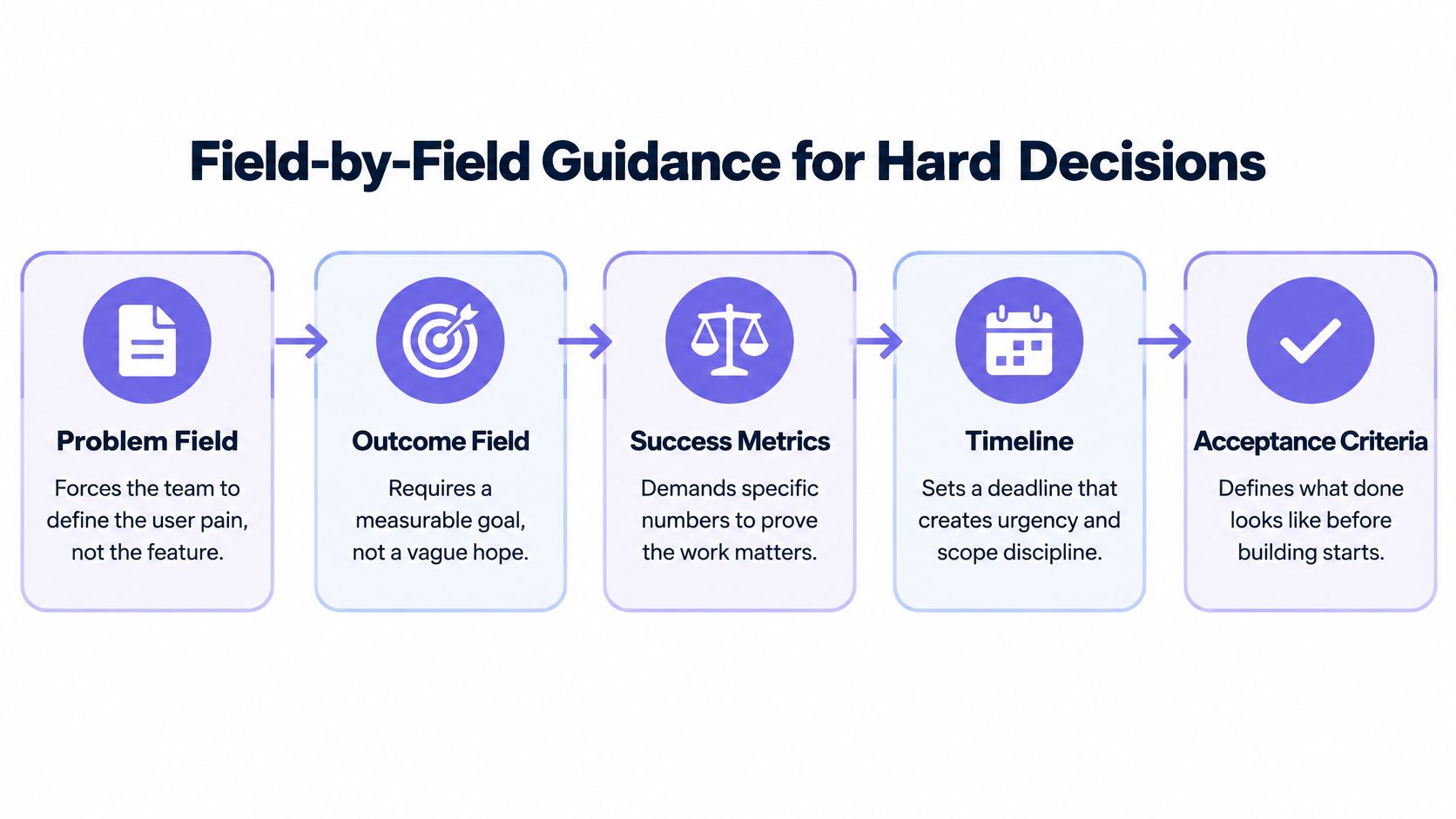
- Name the user's goal, the obstacle, and the observable cost
- Ban solution nouns from this field entirely
- List the segment, the unmet need, and the source behind each claim
- Follow the frame outcomes and map assumptions guide to separate facts from beliefs
- Replace vague goals with measurable targets reviewers can test
- Weak: the flow should be fast. Strong: the 95th percentile response must stay below 2 seconds under defined load
- Every in scope item implies three tempting exclusions. Write them down
- Ask what the cost of not delivering each item is
- One requirement per line, each with acceptance criteria and a test idea
- Challenge each line with three questions. How will this be tested? What evidence justifies it? Who owns it?
- A brief without an owner is a suggestion box
- Record what evidence would change the recommendation
The discipline pays. Empirical project research covered in the Australasian Journal of Information Systems study on requirements quality found that good requirements predicted 89% of successful projects, and combining requirements quality with effective management raised that prediction to 93%. The same research area reports that allocating at least 15% of project time to requirements gathering doubled the chance of project success.
For founders working without a dedicated product org, the Founder Connects product guide offers a broader view of how early product decisions compound across the startup lifecycle. Does your current brief make any of these six decisions explicitly, or does it hope reviewers will infer them?
Where the Brief Ends and the PRD Begins
Three artifacts get conflated constantly, and the confusion costs teams weeks. Each one earns its place at a different moment.
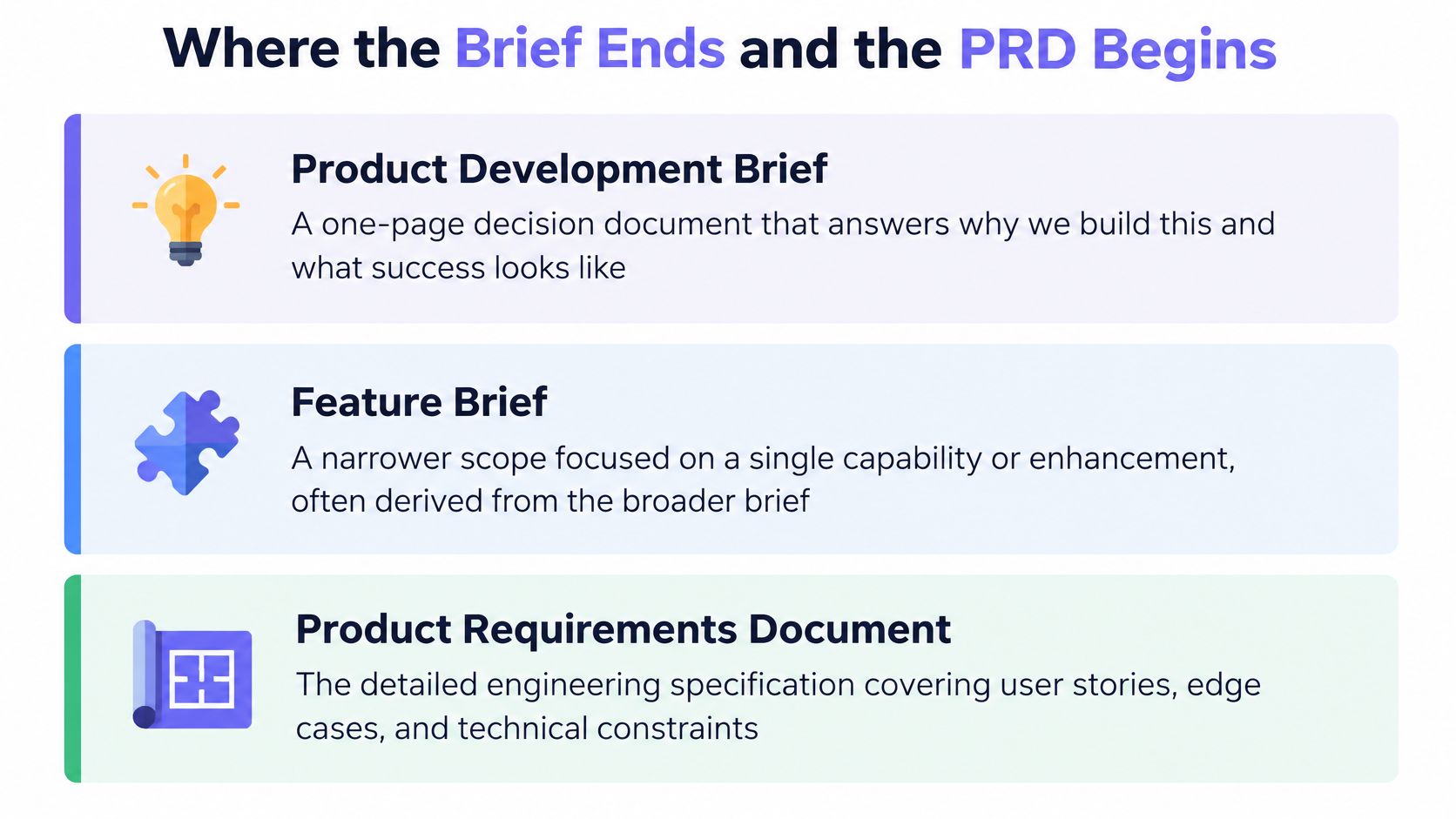
Product development brief. A one page decision artifact that exists before design. It answers why this work matters, who it's for, what evidence supports it, and what would change the decision. Prototype plans and research commitments live here. The UK Government Service Manual guidance on prototyping before building states that teams must make prototypes to explore, share, and test designs before building, and should discard prototypes that don't test well.
Feature brief. A narrower artifact covering a single capability inside an approved direction. It inherits the problem and outcome from the product brief and focuses on one slice of scope, its states, and its acceptance criteria. It shouldn't reopen the parent decision.
Product requirements document. The detailed implementation contract written after the brief clears review. Edge cases, API contracts, test cases, and nonfunctional requirements belong here. The guide to writing a product requirements document covers that layer, and the collection of product requirements document examples shows how detailed it gets.
Practical rule: If the team is still debating whether to build it, you're in brief territory. If they're debating how it behaves at the boundary, you're in PRD territory.
The sequence is simple to state and hard to protect. Align on the problem, validate with prototypes, commit in the PRD, then build. What's your team's trigger for moving from one artifact to the next? If nobody can name it, the brief and the PRD will collapse into one long document nobody updates.
The Mistakes That Quietly Kill a Brief
Most briefs don't fail loudly. They fail by letting ambiguity pass review dressed as consensus.
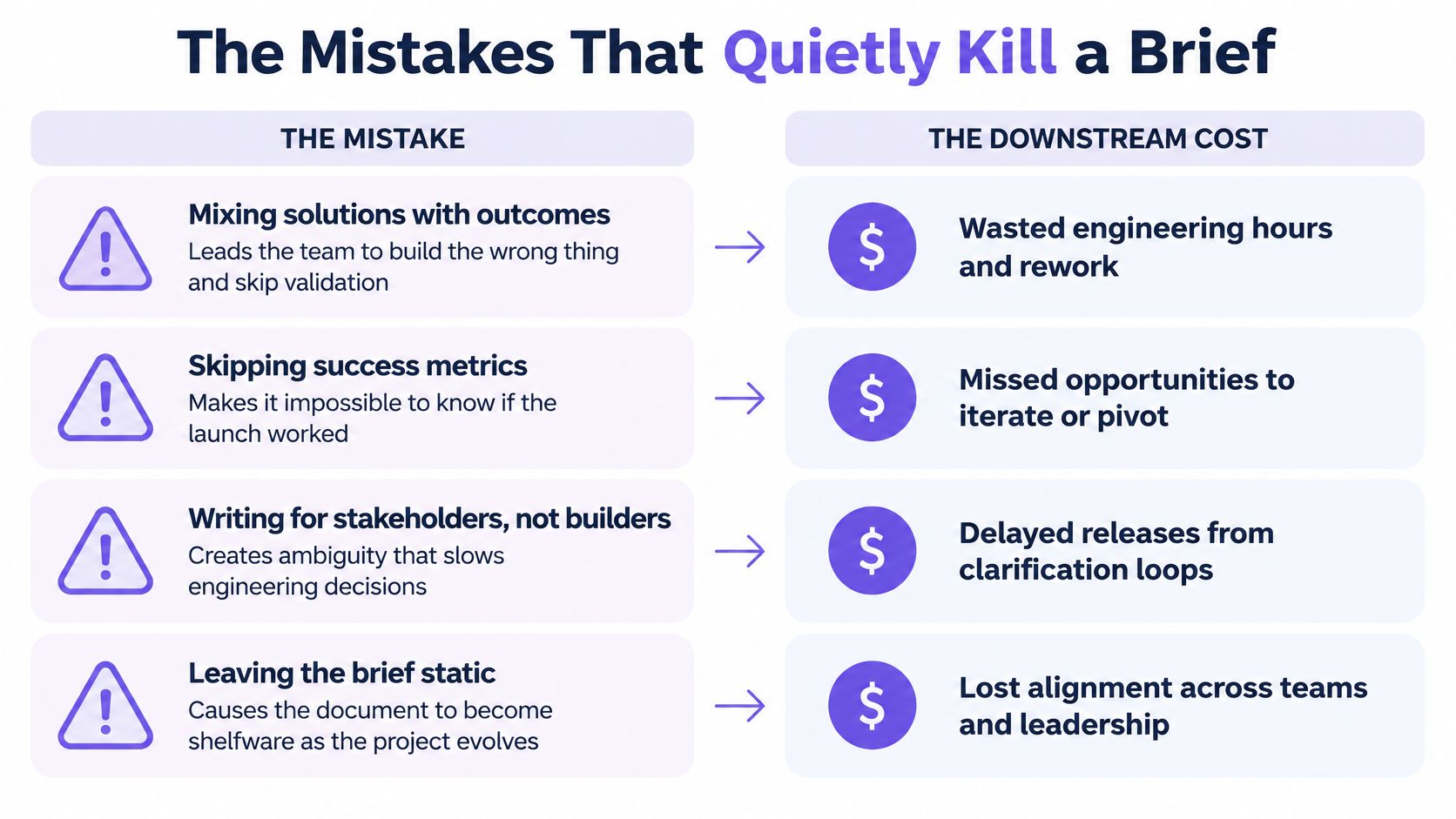
Mixing solutions with outcomes. When the problem field already contains a feature name, research becomes decoration. The team validates a preferred answer instead of the user's need. Rewrite any sentence that names a screen before it names a pain.
Adjectives without thresholds. Fast, simple, and intuitive can't be tested, so they can't be accepted or rejected either. Every adjective needs a number, a condition, and a test method, or it leaves the brief.
Risks written as compliance copy. A risk field listing generic concerns protects nobody. A useful entry names the assumption, the evidence that would disprove it, the owner watching it, and the date by which it resolves. Mapping who influences those calls helps, which is where stakeholder mapping with Figr earns a look before your next review.
Decisions living in chat. If a scope call happens in a thread and never reaches the brief, it will be relitigated by whoever missed the thread. The brief is the record. Anything else is folklore.
Why These Habits Cost Real Money
The Standish Group CHAOS report on software project outcomes reported only 16.2% of projects completed on time and on budget with the specified functionality, while 52.7% were challenged and 31.1% were cancelled, with a clear requirements statement among the three major success factors. IBM's software quality research, summarized in IBM Rational's paper on the ROI of requirements quality, found requirements errors comprised 41% of discovered errors and consumed roughly 70% to 85% of total project rework costs.
Run the review like an inspection. Check for ambiguity, contradiction, omission, and unverifiable language, then block approval until every high priority requirement has an owner, measurable criteria, and one negative or boundary case test. Would your last brief survive that gate?
Adapting the Template to Your Stage and Stack
The fields stay constant. Their depth changes with your stage, and pretending otherwise produces either bloated early briefs or dangerously thin platform ones.
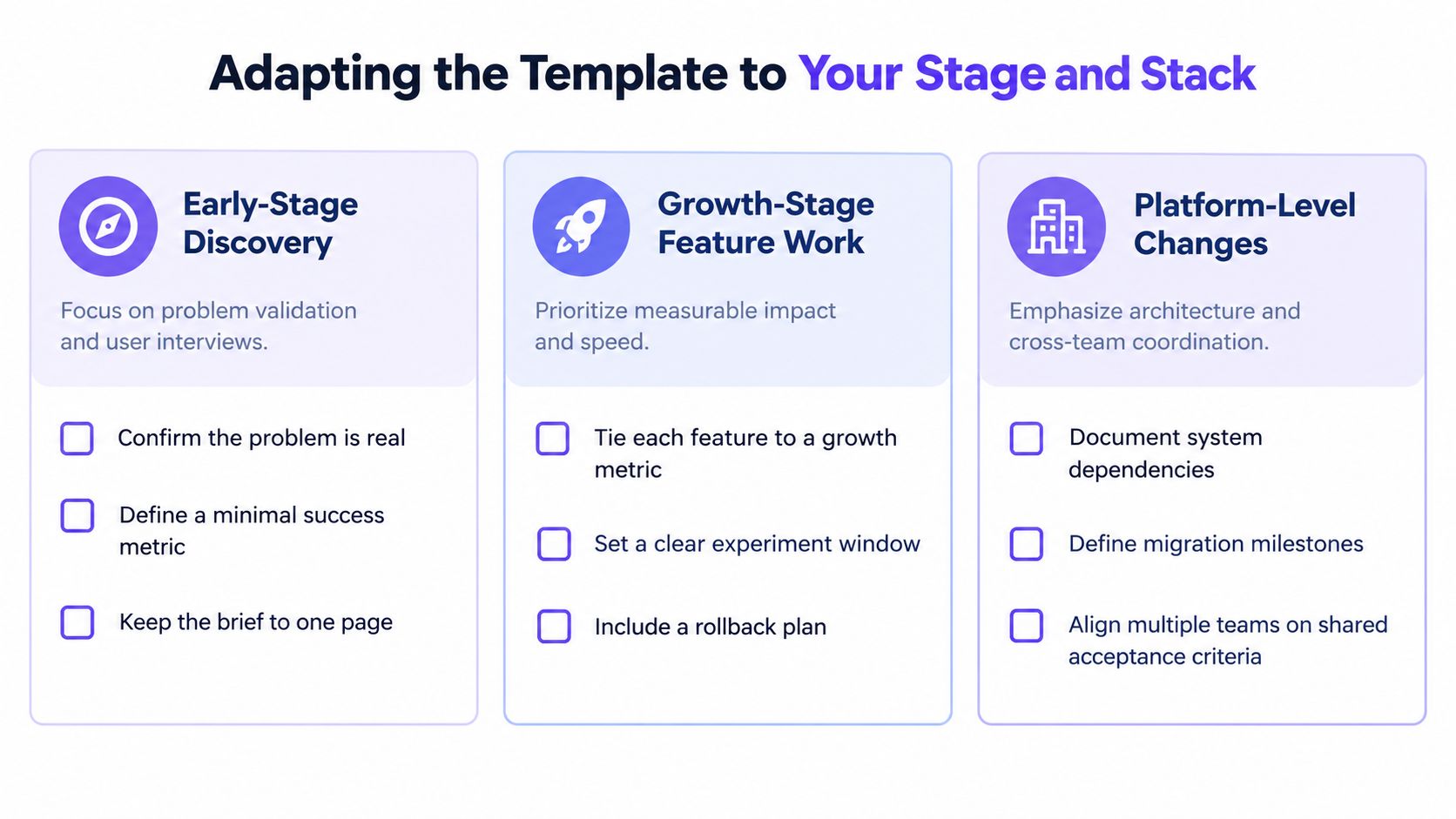
Early discovery work leans on the problem, evidence, and assumptions fields. Research planning should combine primary interviews with analytics and support data, as the GOV.UK service standard on understanding user needs directs, and it should include users with limited digital access or impairments. Small tests carry real weight here. The Nielsen Norman Group model from Nielsen and Landauer shows five participants can reveal approximately 85% of usability problems in qualitative testing, though conversion claims need larger samples.
Growth stage feature work expands success measures and experiment windows, and the product development stages overview helps locate where your initiative sits. Platform changes expand constraints, dependencies, and migration risks, because a shared component multiplies every unresolved question across teams.
The adaptation logic resembles how template systems elsewhere stay manageable. Teams maintaining content sites face the same discipline when handling WordPress CPT template variations, where each variant inherits a base structure and changes only what the context demands. Steal that pattern. Keep problem, decision owner, and success measures mandatory at every stage, then scale the rest.
One concrete workflow: once a brief clears review, teams can use Figr to turn the brief and existing screens into alternative flows and states for design review, keeping human judgment on scope and evidence. Retire assumptions as evidence lands, and log every scope change with a date and an owner. What keeps your brief alive after sign off?
Common Questions PMs Ask After Seeing the Template
How long should writing the brief take? A focused draft fits in one working session if evidence is already gathered. If it takes longer, the delay usually sits in the evidence field, which tells you research comes before writing.
Who signs off? The decision owner signs, and design, engineering, and any risk owner named in the brief review before that. Sign off means nobody reopens scope without a logged change. Can your stakeholders say what their signature commits them to?
What if you inherit a weak brief? Don't rewrite it without flagging changes. Mark unvalidated claims as assumptions, attach owners and dates, and run one inspection review. You keep the history and expose the gaps.
How does the brief stay in sync with a PRD in flight? The brief holds the decision and its rationale, the PRD holds behavior. When a PRD decision changes scope, the brief gets a dated entry the same day. One source per layer, linked both ways.
When should you skip the brief? Small UI corrections and post launch experiments with clear guardrails rarely need the full template. Anything touching permissions, billing, or shared infrastructure does. Your next step: take one initiative currently in design, open the template, and fill the exclusions field first. That single field will surface your biggest hidden disagreement.
Bring your next brief and your existing product screens to Figr, explore alternative flows and states grounded in your real design system, and refine the strongest direction into reviewable, Figma ready output. You'll keep judgment where it belongs, with your team, and spend review time on decisions instead of redrawing screens.