

Your launch dashboard is green while customers are getting stuck behind a payment spinner. Checkout completion has improved, the release meeting is underway, and everyone wants to call the experiment a win.
Without a clear boundary for acceptable harm, the team starts negotiating with the warning signs. Payment failures become an engineering follow-up, support contacts become a customer-success problem, and the product manager gets credit for the conversion lift.
Guardrail metrics give those warning signs decision authority. Used properly, they connect product ambition to an explicit acceptable-loss boundary, so your team knows what evidence permits a launch, what requires more testing, and what stops the release.
The Ship That Looked Like a Win
Consider a hypothetical release meeting. I'm advising the product lead, who opens with an encouraging checkout result. The designer smiles, engineering wants to close the ticket, and someone asks whether the rollout can expand.
Then the payments engineer shares a different chart: more customers are encountering payment failures. The room goes quiet, briefly. Someone suggests that the conversion improvement probably outweighs the inconvenience.
Who agreed to that trade?
The moment a dashboard needs authority
This is what I mean by win laundering: turning a visible improvement into permission to discount less convenient evidence. The shortcut is seductive because the primary metric has a clear owner, while the affected customers often don't have anyone representing them in the meeting.
A guardrail metric is a pre-specified constraint protecting a critical dimension during an experiment. Its purpose is to prevent an improvement in the primary outcome from accompanying unacceptable deterioration elsewhere.
The important word is pre-specified. If the team decides how much payment failure is tolerable after seeing the conversion result, it's bargaining with its own evidence.
Release principle: Agree on the loss you can accept before anyone knows how attractive the upside looks.
In the hypothetical meeting, the productive conversation starts when the product lead asks for the agreed payment-failure boundary. If nobody wrote one down, the team has discovered a decision-design problem, even if the implementation eventually proves sound.
Catching harm before the retrospective
Post-launch monitoring still matters. Figr on monitoring feature performance is a useful companion when planning how to follow a feature after release. But monitoring without an agreed response leaves someone manually deciding which warning deserves action.
For operational releases, Datadog's explanation of guardrail-driven rollouts describes connecting health indicators to rollout pauses and reversals. That's a useful implementation pattern, distinct from proving an experiment acceptable.
Don't confuse a fast rollback with a sound ship decision. Your team needs both: evidence before expansion and a practical way to contain harm afterward.
How Guardrails Differ from North-Stars and KPIs
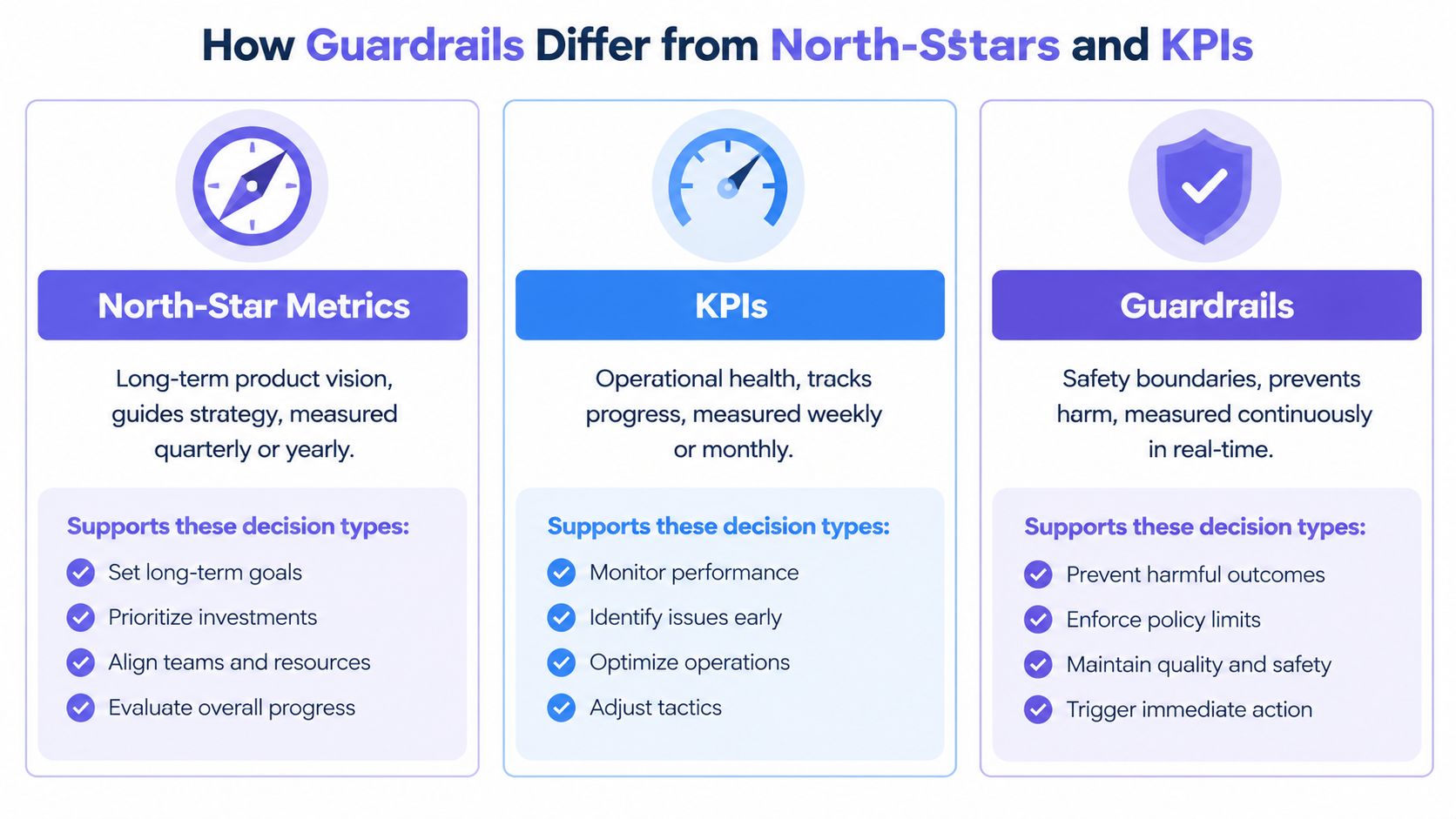
I use a simple distinction in product reviews: direction, health, and permission. These are different decisions, and the metrics supporting them deserve different treatment.
A north-star metric expresses the product's intended long-term value. A KPI helps an owner judge ongoing performance against a goal. A guardrail establishes a boundary around a proposed change.
Which question is your dashboard answering?
Assign the metric a job
| Metric role | Decision it supports | Recommended conversation | Common misuse |
|---|---|---|---|
| North-star | Where should we invest? | Quarterly strategy review | Treating distant value as immediate release evidence |
| KPI | Are we meeting our operating goals? | Weekly team review | Assuming a healthy aggregate proves a variant harmless |
| Guardrail | Is this change acceptable? | Pre-launch ship review | Treating a failed boundary as another tradeable outcome |
If your marketing team needs help defining its strategic direction, Cometly's guide can help you find your marketing north star metric. Keep that discussion separate from deciding whether a particular onboarding experiment introduces unacceptable friction.
The same discipline applies to UX. Establishing how to measure UX correctly helps teams define meaningful outcomes, but a useful measurement still needs an explicit decision role.
Separate tradeable outcomes from boundaries
A secondary outcome contributes information. You might accept a decline in feature discovery if the experience becomes substantially clearer. A guardrail is generally non-compensatory: an unacceptable deterioration blocks shipping despite a primary win.
That distinction belongs in the experiment charter, not in a dashboard's color scheme.
A KPI can become a guardrail, but its existing target doesn't automatically make it suitable. Overall support volume might look healthy while the treatment creates additional contacts among exposed users. The operating dashboard and the experiment analysis answer different questions.
Ask the owner to complete this sentence: For this change, we will stop if… If they can only describe what they usually monitor, they haven't defined a guardrail yet.
The names matter less than the authority attached to them. A metric with no release consequence is an observation, regardless of what the dashboard calls it.
The Standard Set of Product Guardrails
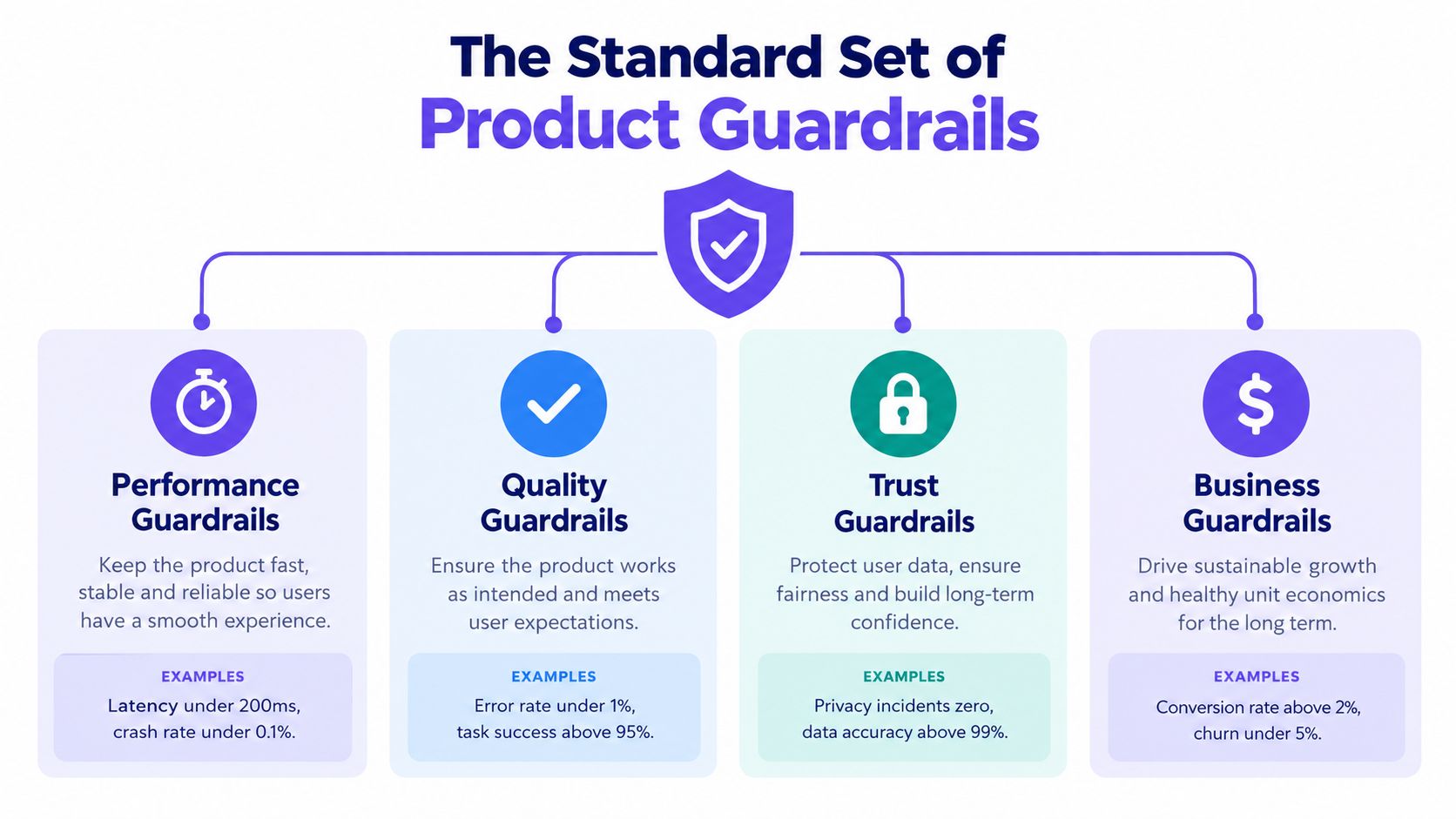
Build your starter set around credible harm, then choose the measurement. Starting with every available chart creates a reporting exercise before you've identified what needs protection.
For a checkout change, payment failure deserves attention. For an onboarding redesign, task completion and accessibility may deserve more scrutiny. Why should those releases inherit identical dashboards?
Map each category to a customer consequence
- Performance: Monitor page-load latency, crashes, and errors where the changed experience runs. Set a boundary based on the customer's task and the existing performance commitment, rather than a convenient round number.
- Quality: Consider support contacts, refunds, and satisfaction measures such as NPS. Specify which contacts count and how they relate to exposure; otherwise, your team may debate unrelated tickets.
- Funnel: Protect activation, retention, or a downstream conversion step that the primary metric could obscure. Define the observation window before evaluating the result.
- Reliability: Examine availability, payment failures, and data freshness when the change touches those dependencies. Distinguish a broken service from a slower but functioning experience.
- Trust: Include accessibility violations, security findings, or moderation concerns where relevant. For severe findings, use an explicit release blocker rather than pretending every risk can become a smooth statistical average.
These are candidate categories, not a requirement to select a metric from every bucket. Kameleoon's guardrail guidance connects experimentation areas to protected outcomes and distinguishes immediate monitoring from longitudinal checks.
For the availability component, SiteAlive's explanation about monitoring website availability offers a focused starting point. Keep service monitoring connected to the release review without treating it as a substitute for experiment analysis.
Make thresholds operationally defensible
Treat the illustration's thresholds as examples, not defaults. Your product's risk tolerance must determine the actual boundaries.
For latency, ask which interaction becomes meaningfully harder. For support contacts, ask whether the increase reflects confusion, blocked work, or a harmless request for clarification. For conversion, document whether the margin means relative change or percentage-point change.
Those distinctions prevent superficially precise thresholds from concealing different customer costs.
Your ship-room view should show the metric, affected population, agreed margin, evidence status, and accountable owner. Replace unexplained red and green tiles with a decision someone can defend.
Choosing, Powering, and Pre-Specifying Guardrails
The statistical shortcut that backfires is declaring safety because a harm test wasn't significant. A weak experiment can fail to detect a deterioration your business would never knowingly accept.
No detected harm and evidence of acceptable harm require different reasoning. Your setup must support the latter.
Write the loss boundary before the test
Let Δ represent treatment minus control, and let m represent the maximum acceptable deterioration.
For a higher-is-better metric, require the confidence interval's lower bound to exceed −m. For a lower-is-better metric, require its upper bound to remain below m. That's the practical non-inferiority question: does the uncertainty still include a loss you've agreed is unacceptable?
Microsoft's KDD experimentation research recommends powering primary and guardrail metrics to at least 80% for operationally meaningful changes; an apparently reassuring p-value above 0.05 doesn't establish that the agreed loss has been ruled out.
If the interval crosses the boundary, call the result inconclusive. Don't rename uncertainty as safety.
A small observed deterioration with wide uncertainty can be less reassuring than a larger estimate measured precisely.
Choose the minimum practically important harm from the customer and business consequence. Then calculate whether the experiment can detect it using the metric's variability, baseline behavior, allocation, and intended analysis.
The acceptable-loss margin and minimum detectable effect serve different jobs. One expresses tolerance; the other describes the experiment's sensitivity. What good is protecting a boundary your test can't resolve?
Protect the experiment before interpreting outcomes
Instrument guardrails at the treatment's randomization unit. If assignment happens by account, don't casually analyze individual events as though each came from an independently assigned customer.
Run a sample-ratio mismatch, or SRM, check before reading outcomes. The Cambridge University Press chapter on sample-ratio mismatch and trust-related guardrails explains why allocation discrepancies require investigation: targeting bugs, exposure logging failures, filtering, cookie loss, or assignment defects can undermine interpretation.
Assignment counts and exposure counts must remain distinguishable. A user assigned to a variant who never reaches the changed screen still belongs in the assignment record.
Use this setup ritual alongside your A/B testing best practices:
- Map the harm. Name the affected journey and population.
- Lock the margin. Record direction, units, owner, and rationale.
- Check sensitivity. Confirm the proposed sample can resolve meaningful harm.
- Verify integrity. Validate assignment, exposure logging, and the SRM check before interpretation.
Why More Guardrails Usually Make Decisions Worse
A team adds another alert because nobody wants to look careless. Then another stakeholder asks for their metric. Soon, the release meeting becomes an argument about which red tile deserves attention.
I call this dashboard debt: every added check creates a measurement, interpretation, and ownership obligation. Who's paying it?

Separate false alerts from false reassurance
Under a simple independent-testing model, the chance of at least one false alert is the complement of the chance that every test avoids one. Bell Statistics' guardrail discussion illustrates the issue with three tests at a 0.05 significance level producing roughly 14% false alerts, and ten approaching 40% under a simple model.
Those aren't universal rates. Correlation and the release decision rule change the calculation.
That conventional alarm model shouldn't be confused with an all-guards-must-pass non-inferiority framework. Statsig's explanation of Spotify's risk-aware framework reports that false-positive correction is generally unnecessary for non-compensatory guardrails, because shipping requires every guard to pass, while false-negative rates must account for the number of guardrails and other quality tests.
That distinction matters. You can't solve every multiple-metric problem by applying the same correction.
Capacity rule: If you can't power a guardrail, you can't promise statistical protection for it.
Make each addition earn its place
Use a small standardized set, supplemented by change-specific risks. Evaluate proposed changes to that set explicitly:
- Add: The metric protects a distinct material harm, has an owner, and can be measured with adequate sensitivity.
- Combine or demote: Several signals largely describe the same failure, and a diagnostic view can preserve detail.
- Keep as a hard check: Severe accessibility or security findings require direct review even when statistical powering is inappropriate.
Correlated alerts need interpretation. Support contacts and abandonment might reflect the same broken interaction; they shouldn't automatically count as separate votes.
A short-term deterioration also needs its pre-agreed observation window. Don't invent a future recovery story to rescue today's result.
AI-assisted changes deserve particular care when they touch several journeys at once. When using AI tools for product feature prioritization, carry the affected journeys into risk review. Faster design generation doesn't justify thinner evidence.
Two Short Scenarios That Show Governance in Action
The following scenarios are hypothetical. They illustrate decisions, not reported company results.
Checkout gets a pause instead of a victory lap
A product team redesigns checkout and sees conversion improve. Its payment-failure guardrail doesn't pass the pre-specified non-inferiority rule, so the release owner pauses expansion.
Engineering investigates and finds a race condition between submitting payment and updating checkout state. The team fixes it, verifies the affected path, and evaluates the corrected treatment before expanding again.
What made that outcome possible? The payments owner had authority before the experiment started. Nobody needed to persuade the room that failed payments mattered after the attractive result arrived.
The team also had a reversible rollout mechanism. A feature flag guide for PMs can help product leads understand that containment option, although a flag doesn't repair flawed evidence.
Onboarding gets an exception nobody owns
Another team uses AI assistance to simplify onboarding. Activation improves, but accessibility checks identify problems, and assistive-technology users contact support about blocked tasks.
The product lead argues that the aggregate benefit justifies shipping. The team overrides the boundary without identifying an accountable risk owner or defining when the exception expires.
In this hypothetical outcome, affected customers abandon the experience and an accessibility complaint becomes public. The team then rebuilds both the flow and its release policy.
The avoidable failure was the undocumented transfer of risk from the launch team to customers.
Write the override policy while everyone is calm
My recommendation is explicit governance:
- Accountability: The executive responsible for the affected risk signs any permitted exception, alongside the relevant engineering, accessibility, or security owner.
- Evidence: The request documents affected users, severity, uncertainty, mitigation, reversibility, and a review deadline.
- Boundaries: Legal obligations and designated severe safety failures remain outside routine product overrides.
- Auditability: Preserve the original result and record who accepted the exception. Don't relabel a failed guardrail as a pass.
Zoom out, and the incentive problem becomes obvious. A launch owner receives visible credit for upside while support and engineering may inherit the cleanup. Written ownership makes those costs part of the original decision.
Your First Guardrail Review This Week
Bring an upcoming experiment to a short review with product, engineering, analytics, and the owner closest to the potential harm. Don't begin by adding charts. Begin by asking which customer could lose if the change succeeds.
Quick guardrail starter set
| Category | Example metric | Example threshold |
|---|---|---|
| Performance | Page-load latency | Pre-agreed maximum increase |
| Quality | Relevant support contacts | Maximum acceptable increase among exposed users |
| Funnel | Downstream completion | Pre-agreed maximum decline |
| Reliability | Payment failure rate | Agreed non-inferiority margin |
| Trust | Accessibility findings | No unresolved release-blocking violations |
These are threshold forms, not universal values. Fill them with your product's operating commitments and customer consequences.
Turn the review into a release contract
- Select the baseline set. Keep only the routinely relevant protections your team can maintain.
- Add release-specific risks. Trace changed flows, dependencies, and affected populations.
- Register the decision. Record margins, analysis rules, observation windows, and override authority before launch.
- Review breaches afterward. Determine whether the failure came from product behavior, instrumentation, or an unrealistic threshold. Assign the repair.
The most valuable habit is refusing to call evidence safe while the agreed loss remains plausible. Can your release owner explain that conclusion without pointing at a green tile?
In short, good experimentation requires a decision contract that survives an attractive result.
Guardrail Metrics FAQ
What is a guardrail metric in a product experiment?
A guardrail metric is a pre-specified limit on harm outside an experiment's primary goal. It helps a team decide whether a promising result is acceptable to ship, not just whether the main metric improved.
How is a guardrail different from a KPI?
A KPI tracks ongoing performance against a goal. A guardrail sets a release boundary for a specific change. The same measure can serve both roles, but the guardrail needs an agreed population, margin, observation window, and consequence if it fails.
How many guardrail metrics should an experiment have?
Use a small set that covers distinct, credible risks. Add a metric when it protects a material harm and the team can measure and act on it. Keep overlapping signals as diagnostics rather than giving each one an independent release vote.
Does a nonsignificant result mean a guardrail passed?
No. A test can miss meaningful harm when its estimate is imprecise. Compare the uncertainty interval with the acceptable-loss margin set before the experiment. If unacceptable harm remains plausible, the result is inconclusive.
What should a team do when a guardrail fails?
Pause the affected rollout or expansion, check instrumentation and experiment integrity, and investigate the customer impact. Fix the cause and reassess before shipping. If an exception is permitted, document the risk owner, evidence, mitigation, and review deadline without relabeling the failure as a pass.
AI-assisted product work makes this discipline more valuable whenever teams explore changes faster than they can assess consequences. Keep generated designs connected to affected journeys, edge cases, and verification work.
On Monday morning, open the next experiment proposal and write its acceptable-loss boundary with the person who would own the damage.
Figr offers an AI design agent that uses existing product context to generate flows, edge cases, test cases, and UX reviews. Visit Figr to map your next proposed change and surface the risks your guardrail review should address before code is written.