
Customer feedback sounds soft until you sit in a roadmap review and realize every opinion in the room is backed by a different assumption. The team thinks the new flow is cleaner. Support knows users keep hitting the same wall. Sales wants the loudest account request. Product has to decide what is signal and what is noise.
When that choice goes wrong, the cost shows up everywhere. Retention slips, launches miss the mark, support volume rises, and the roadmap fills with work that felt urgent but never mattered. One industry synthesis says companies that respond to customer feedback see 25% to 30% higher retention, and about 65% of successful product launches cite customer feedback integration as a central part of the strategy, which is why ignoring it becomes expensive fast. The same source says feedback-driven businesses adapt to market changes 35% faster Number Analytics.
The fix is not to collect more comments and hope for clarity. The fix is to treat feedback as a decision system, one that helps Product Managers sort anecdotes from patterns, route issues to the right owners, and turn user frustration into better product judgment. That is where the greatest value lives.
The Real Cost of Ignoring Customer Feedback
A polished release can still miss the mark when it reflects internal assumptions more than real user friction. I've seen that in roadmap reviews where the team agreed the feature looked clean, then support tickets showed people getting stuck on the same step days later.
What the missed signal actually looks like
The failure is usually quiet at first. Users do not write long explanations about why they left. They hit a blocker once, maybe twice, then stop coming back or stop upgrading. That is why feedback matters financially, not just emotionally.
Temkin Group found that a company with $1 billion in annual revenue could earn about $700 million more within 3 years by investing in customer experience, while PwC-based consumer data says 80% of customers consider experience as important as products and services, and 74% are likely to buy based on experience alone Ortto. Those numbers point to the same operational reality, customer experience shapes buying behavior, and feedback is how teams find where the experience is breaking.
Practical rule: if the same complaint keeps showing up in support, sales calls, and user interviews, it is already a business issue, not a UX debate.
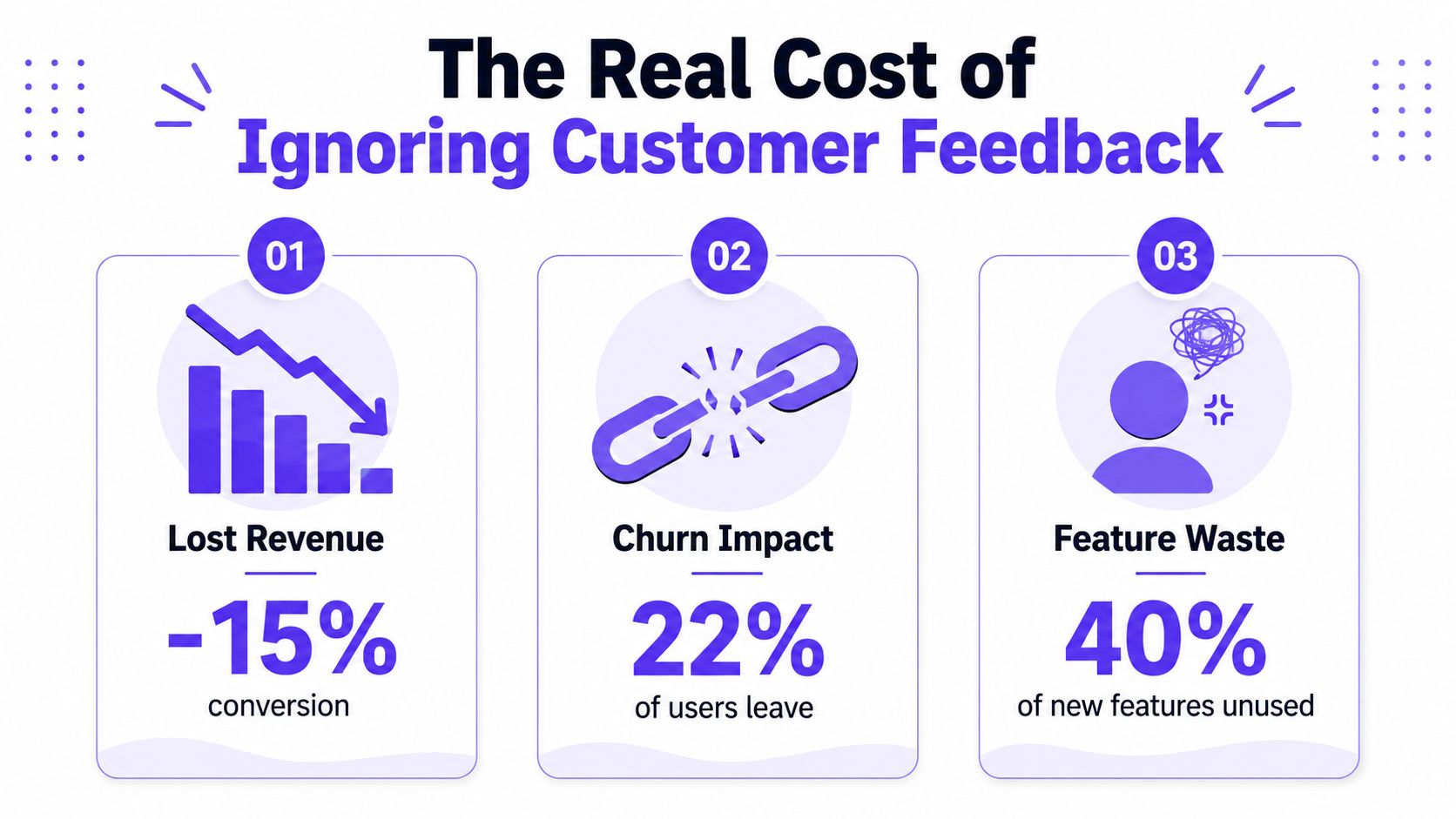
The basic point is simple, feedback turns abstract risk into something a team can act on before it becomes churn. Teams that never read the pattern end up paying for it later in rework, escalations, and roadmap regret. In many product orgs, rework consumes 15–30% of sprint capacity, which is the kind of drag feedback should help reduce.
Where Figr fits in the workflow
In practice, teams need a way to capture what users said without losing the surrounding context. Figr can ingest live screens, Figma files, design systems, PRDs, research, and analytics, then keep that product memory across sessions.
If you only measure feedback after release, you are already paying for the mistake. If you collect it early and route it well, you cut down false starts that drain design and engineering time.
How Feedback Becomes a Decision-Support System
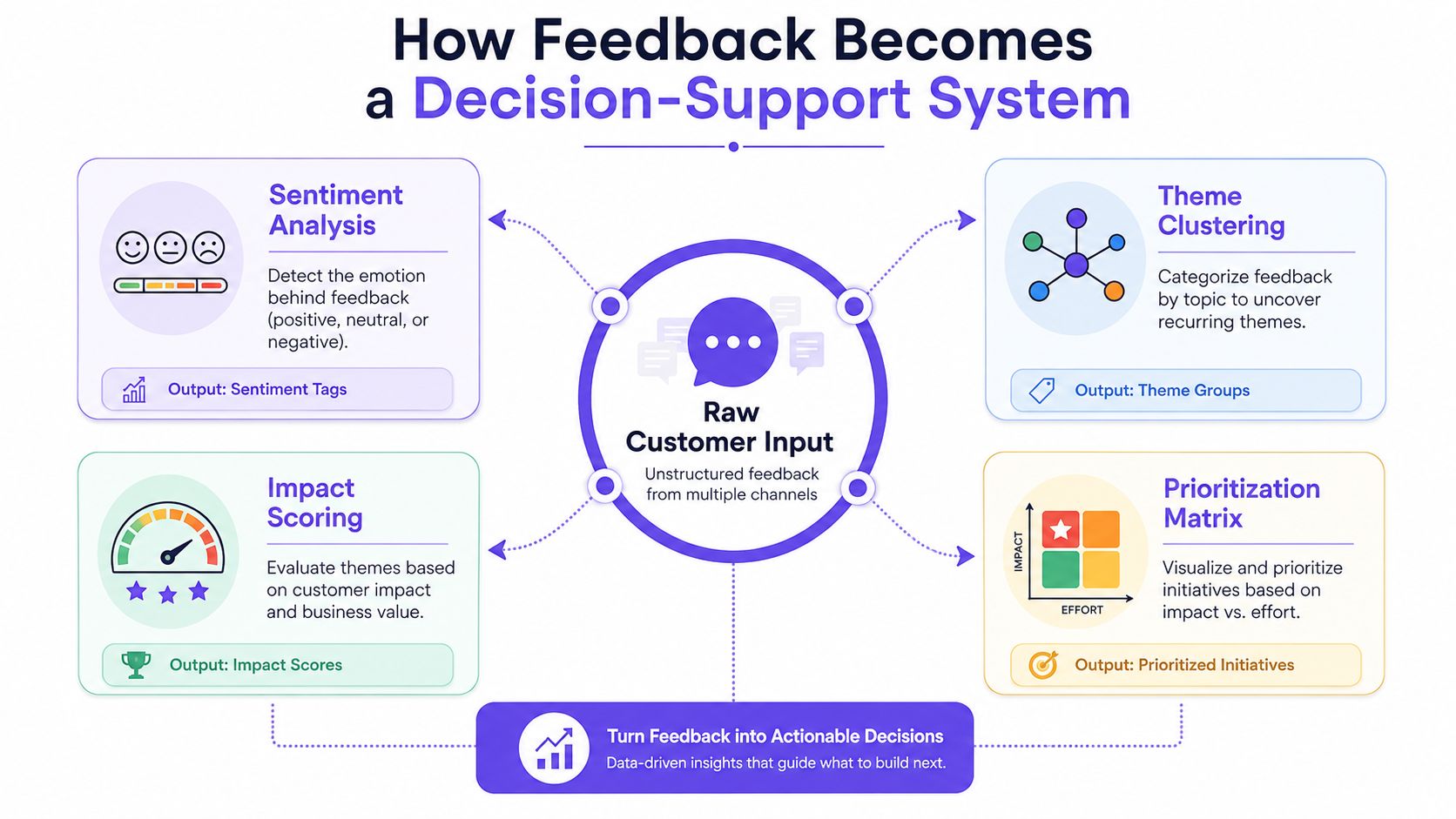
Customer feedback becomes useful when it is turned into a decision-support layer. Raw comments are emotional, fragmented, and inconsistent. Product decisions need clusters, patterns, and a way to compare trade-offs without turning every loud request into a roadmap item.
From noise to product signal
The useful move is to cluster feedback by product area, request type, workflow stage, urgency, and business impact. Atlassian's guidance on customer feedback treats this as prioritization work, not just collection. That matters because a feature request from one enterprise user, a workflow complaint from a new user, and a bug report from support all need different treatment.
I've sat in meetings where a single executive request threatened to overrule a bigger pattern. It happens because isolated anecdotes feel vivid. Structured feedback makes them comparable, which is the only reason a roadmap can stay coherent.
A Product Manager's job here is not to collect the most feedback, it's to convert it into a ranking problem.
Why structure changes the discussion
Once feedback is tagged and grouped, the conversation shifts. The team stops asking whether one person is upset and starts asking whether a repeated pattern blocks a core journey. That is a different meeting, and it usually leads to better decisions.
A useful product review has three layers of evidence. First, the feedback itself. Second, the behavior data that shows where people drop off. Third, the implementation cost, which keeps the team honest about scope. When those three line up, the decision is usually straightforward.
Figr helps here by bringing analytics, PRDs, and design context into the same working surface. Its SaaS product roadmap tools angle matters because roadmap decisions get better when feedback is tied to the product state users saw, not a generic summary.
Not All Feedback Deserves Equal Weight
The strongest feedback is not always the loudest. Timing, context, and representativeness decide whether a comment should influence a roadmap or shape the next conversation. A user who is confused in the middle of a task is usually giving a more useful signal than a survey response submitted days later, after the moment has passed.
Timing and context change quality
In-product collection captures people while the experience is still fresh, which is why recent guidance on customer feedback favors real-time input. That usually produces cleaner signal than generic surveys sent after the fact. Long surveys often do the opposite, people get tired, they skim, and the response quality drops.
I've seen teams overvalue feedback from the most articulate customers. Those users may be genuine, but they are not always representative. A Product Manager has to ask whether the issue appears across multiple segments or whether it belongs to a narrow edge case that should not steer the roadmap.
Useful filter: if feedback lacks context about where in the workflow it happened, treat it as a clue, not a decision.
Behavior data tells you why the numbers moved
Analytics can show where the funnel dropped off. Feedback explains the frustration behind it. That pairing matters because behavior data shows the location of the problem, while the user's words explain what it felt like on their side.
Figr helps connect analytics context, design system context, and product knowledge around the same user problem. The practical value of AI tools for product feature prioritization is that they can sort signal with the surrounding context instead of treating every request as interchangeable. You are not asking AI to guess what matters. You are giving it the evidence it needs to judge whether the feedback is timely, specific, and representative.
That discipline changes the review meeting. Teams stop treating every complaint as equal and start asking whether the feedback is current, grounded in the workflow, and broad enough to matter. That is how you avoid building for the vocal minority.
Building a Closed-Loop Feedback Workflow
Feedback only changes anything when it moves through a closed loop. Collect it, sort it, route it, act on it, then follow up. If one of those steps is missing, the signal gets stuck in a notebook, a spreadsheet, or a support queue, and the customer assumes nobody is paying attention.
The workflow that keeps feedback alive
1. Collect the input.
Pull feedback from support, interviews, surveys, in-app prompts, and sales conversations.
Keep the source attached so later decisions still have context.
2. Analyze the pattern.
Tag themes, group duplicates, and separate bugs from feature requests.
Look for repeated friction points, not just the loudest complaints.
3. Distribute the finding.
Send the signal to product, customer success, and marketing.
HubSpot's guidance on customer feedback treats cross-functional sharing as a first move, not an afterthought.
4. Implement the change.
Route the issue to the right owner, whether that means a product fix, a help-doc update, or a messaging adjustment.
If nothing can be shipped, document why and make the decision visible.
5. Follow up with the customer.
Close the loop so the person who raised the issue knows what happened.
That is where trust compounds.
SurveyVista's framing of the closed loop in customer feedback importance matches what I've seen work in practice. Ownership matters. Figr can support this workflow through data-driven product decisions with Figr by turning the feedback trail into reusable artifacts instead of scattered notes.
What good ownership looks like
A closed loop falls apart when nobody owns the synthesis. Product thinks support will do it. Support assumes product already saw it. Marketing hears about it after the launch copy is frozen. That handoff chaos is where useful signal dies.
Clear storage ownership, triage workflows, SLAs, and frequent syncs fix that. Not because process is trendy, but because someone has to be accountable when a pattern shows up. If the team can't name the owner, the feedback is probably not operational yet.
Using Feedback to Spot Unmet Needs Early
The strongest feedback often shows up as a workaround. Users describe a hack, a missing step, or a feature they wish existed, and that is usually the first sign of unmet demand. The team that listens closely can spot a market gap before churn data makes it obvious.
Complaints can hide opportunity
A support thread about exporting data can point to a need for clearer reporting confidence. A complaint about switching tabs can signal a workflow mismatch that users have learned to tolerate. The visible issue is rarely the full opportunity.
Clientsavvy's write-up on uncovering unmet market needs is useful because it treats feedback as discovery, not just repair. That matters for Product Managers who need a defensible pipeline of product bets. If feedback only goes into bug fixes, the signal that a new use case is forming stays buried.
The mix of sources matters
Interviews catch nuance. Surveys capture scale. Social listening shows the language users repeat outside your product. Support data reveals where friction becomes expensive. Put those together, and the pattern is harder to miss.
A friend at a Series C company once told me their best roadmap idea came from a cluster of complaints that looked unrelated at first. One user asked for a shortcut. Another asked for an import path. A third described a manual workaround that had become normal. That was not random noise, it was the shape of an unmet need.
The best product opportunities often arrive disguised as annoyance.
Figr's product research with confidence workflow fits this kind of discovery because it helps teams turn recurring themes into structured artifacts, not just notes in a doc. The value is in making the insight usable by product, design, and engineering together.
A Practical Triage Framework for Roadmap Decisions
Feedback becomes strategic when the team can rank it against a shared rule. Frequency matters, impact matters, and feasibility matters. Without that filter, the roadmap turns into a queue where the loudest request gets attention first and the work that would help the most users keeps slipping.
A matrix that Product Managers can use in practice
Repeated workflow blocker
Frequency: High
Impact: High
Feasibility: Medium
Priority: Top
One-off enterprise request
Frequency: Low
Impact: High
Feasibility: Low
Priority: Review separately
Cosmetic UI complaint
Frequency: Medium
Impact: Low
Feasibility: High
Priority: Lower
Small fix tied to a core journey
Frequency: Medium
Impact: High
Feasibility: High
Priority: High
Small improvements inside a critical user journey are often strong candidates for prioritization. They combine meaningful user impact with relatively low implementation effort.
The point of the matrix is not to make judgment disappear. It is to make the trade-offs visible before a roadmap meeting turns into a debate about whoever speaks the most.
How to use the matrix in a meeting
Start with frequency.
If many users run into the same friction, the problem is probably real.
If only one account mentions it, keep it visible but do not overreact.
Check impact next.
Ask what breaks, slows down, or confuses users.
A small annoyance in a core workflow often matters more than a bigger annoyance in a rare path.
Finish with feasibility.
Some requests matter, but the timing is wrong or the cost is too high for the current cycle.
That does not mean no. It means the item stays in view until the team has the capacity to handle it well.
SmartSurvey's advice on the importance of customer feedback fits this way of working. A team needs a rule for turning a noisy stream into a short list of actions. Without one, it is easy to confuse responsiveness with progress and end up making roadmap calls by instinct.
Distributing Feedback Across Product and Support Teams
Feedback has more value when it moves beyond the Product Manager's inbox. Product needs it for roadmap judgment. Support needs it for response quality. Marketing and sales need it because repeated complaints often change how the product should be explained.
Shared visibility changes behavior
When feedback is distributed in real time, teams stop working from stale assumptions. Customer support can see what product is investigating. Marketing can adjust messaging when users repeatedly misunderstand a feature. Sales can hear where the promise and the experience no longer match.
That kind of distribution also prevents a common failure mode, siloed interpretation. A support team might treat a complaint as a one-off. Product might see a pattern in the same complaint. Marketing might realize the issue is a promise problem. Shared feedback surfaces all three views at once, so the team can decide whether the fix belongs in the product, the message, or the support process.
Why alerts matter
HubSpot recommends sharing feedback with product, customer support, and marketing and sales, and sending it through email alerts or Slack alerts when it matters most HubSpot. I've seen that kind of distribution change the tone of a review meeting. People arrive with context instead of surprise.
The useful part is not the alert itself. It is the routing. A complaint that reaches the right owner early can shape a response, a bug fix, or a messaging correction before the same issue spreads across more tickets. If the feedback stays trapped in one queue, it becomes noise. If it reaches the teams that make decisions, it becomes part of the operating system.
Figr fits naturally here as one way to carry feedback into working artifacts that different teams can read. Its gallery is useful for seeing how product context affects output, and the Intercom analytics-enhanced support example is a good reference point for how support-oriented inputs can inform product thinking without losing the original signal.
Cross-functional feedback is less about visibility and more about shared ownership.
How Figr Turns Feedback into Design Artifacts
Figr is useful when feedback has already been gathered and the team still needs to turn it into something shippable. Its Visual Context Graph connects visual context, behavioral context, design system context, product knowledge context, and implementation context so the output reflects the actual product, not a generic template. That matters when feedback points to a workflow, an edge case, or a design decision that can't be judged in isolation.
What the context graph changes
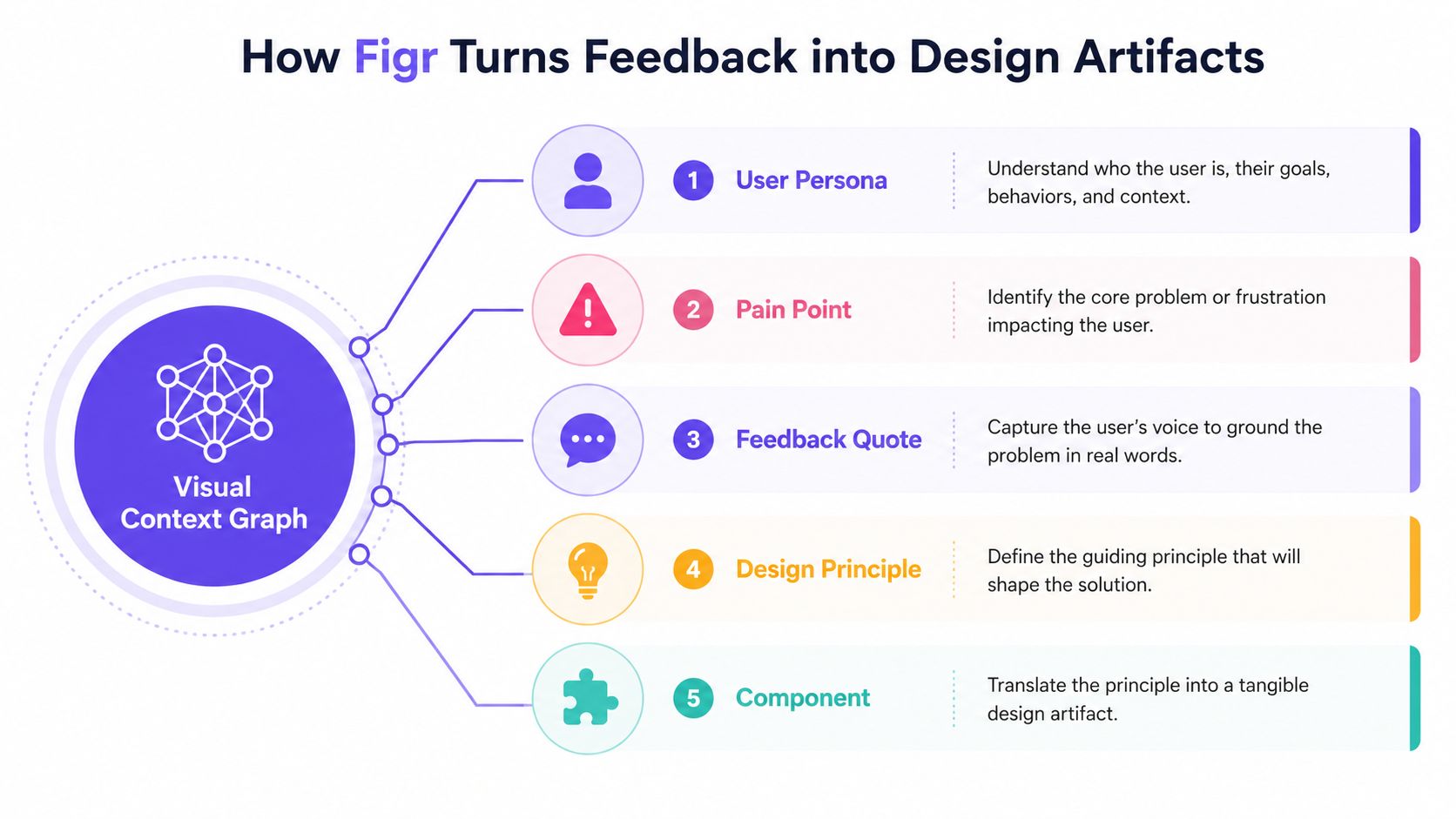
A plain feedback note like “people get stuck on setup” is too vague to design from. Figr can bring together the user-facing screens, existing design tokens, PRDs, and analytics context, then generate Figma-ready artifacts that support a clearer review. That includes UX reasoning, edge case mapping, and high-fidelity prototypes that fit the product's actual constraints.
Why that helps teams ship cleaner decisions
The value is not that an AI guesses the answer. The value is that it narrows the distance between a customer complaint and a design discussion. When feedback is grounded in product context, the team spends less time reconstructing the problem and more time deciding what to do about it.
That's the practical payoff of treating feedback as a system. The team gets a cleaner handoff, fewer revisions, and a better shot at shipping work that reflects what users meant.
If you're trying to turn feedback into decisions instead of a backlog graveyard, start with the context around each comment, not just the comment itself. Figr is built to pull together live product screens, design systems, PRDs, analytics, and research so teams can move from raw input to Figma-ready artifacts without losing the story in between. If that's the workflow you need, try Figr.
FAQ
Why is customer feedback important for Product Managers?
It shows where users are stuck, what they value, and which requests should influence the roadmap.
Without it, Product Managers end up prioritizing internal opinions.
Should all customer feedback be treated equally?
No. Timing, context, and representativeness change how much weight a comment deserves.
A repeated pattern from active users matters more than a vague one-off complaint.
How do I stop feedback from disappearing after collection?
Use a closed loop, collect, analyze, distribute, implement, and follow up.
Ownership is what keeps the loop from breaking.
What's the fastest way to triage feedback?
Score it by frequency, impact, and feasibility.
That gives you a repeatable rule for prioritization meetings.
Where does Figr fit in this process?
I'd use it after feedback is collected, when the team needs context-rich artifacts for review and handoff.
It helps connect feedback to screens, systems, and product decisions.