

It’s 4:47 PM on Thursday. Your VP just asked for something visual to anchor tomorrow's board discussion on customer churn. You have a PRD. You have bullet points from sales calls. You have 16 hours and no designer availability.
What you need isn't more data. It's a system for turning that chaos into a clear signal.
A voice of the customer template is that system. It's not another spreadsheet to be filled out and forgotten. It’s a structured process for capturing, sorting, and understanding feedback from every channel: sales calls, support tickets, survey results, app reviews. It translates a messy pile of raw comments into evidence you can build on. For product teams, this is the machine that finds real patterns and grounds every decision in what customers actually need.
Why Your Customer Feedback Is Noise, Not Signal
It’s 3:15 PM. You have a dozen conflicting feature requests from the sales team, a cryptic Zendesk tag from support, and three user interview transcripts that all point in different directions. This isn't a goldmine of insight.
It's a cacophony.
Most teams are drowning in feedback, not because they lack it, but because they have no system to process it. Without a framework, every opinion carries the same weight. The loudest voice in the room often wins, not the most critical insight.
From Cacophony to Clarity
Think of your customer feedback as raw audio inputs. The sales team's requests are the drums: loud, urgent, and driving the beat. Support tickets are the bassline, a steady, pulsing rhythm of recurring problems. User interviews? They're the vocals, full of nuance and emotion.
Just plugging all those microphones in at once creates a wall of noise. You need a mixing board.
A Voice of the Customer template is that mixing board. It gives you the structure to isolate each signal, adjust its volume based on real impact, and blend the inputs into a coherent track. This isn't about collecting more feedback; it's about making the feedback you already have work for you. A strong customer research analysis playbook is the first step in turning all that raw data into real growth.
The Shift Toward a Single Source of Truth
A friend at a B2B SaaS company told me they recently consolidated five different feedback spreadsheets into a single VoC system. The result was immediate. Roadmap debates that used to drag on for three meetings now get settled in one, because they are anchored by evidence, not just opinions.
This isn't an isolated trend. Gartner predicts that by 2025, 60% of organizations with VoC programs will supplement traditional surveys with more advanced analysis of voice and text. Everyone is chasing a single, reliable source of customer truth. The goal is simple: move from guessing what customers want to knowing what they need, with absolute clarity.
Building Your Listening Engine: A Practical VoC Template
A good Voice of the Customer template isn’t a passive document. It is an active system, a machine for converting the qualitative chaos of feedback into the quantitative clarity that drives decisions.
It’s the difference between a bucket catching rainwater and a hydroelectric dam channeling a river.
One just collects. The other directs energy.
The basic gist is this: each piece of feedback enters the system as a raw quote, and the template’s structure helps you process it into an actionable signal. To get a feel for the inputs you’ll be handling, it helps to look at different Voice of Customer examples to see the sheer variety of data sources out there.
This process transforms a jumble of feedback into a clear, usable signal.
As you can see, a well-designed template acts as a filter, organizing random comments into a coherent and prioritized output.
The Anatomy of the Template
Your template needs several key columns. Think of each one as a gear in your listening engine. When they work together, they build momentum and surface what truly matters. Let’s break them down.
Here’s a look at the essential structure that turns a simple spreadsheet into a powerful analysis tool.
Voice of the Customer Template Structure
.tbl-scroll{contain:inline-size;overflow-x:auto;-webkit-overflow-scrolling:touch}.tbl-scroll table{min-width:600px;width:100%;border-collapse:collapse;margin-bottom:20px}.tbl-scroll th{border:1px solid #ddd;padding:8px;text-align:left;background-color:#f2f2f2;white-space:nowrap}.tbl-scroll td{border:1px solid #ddd;padding:8px;text-align:left}Column NamePurpose and Data to CaptureExampleFeedback SourceIdentifies the origin channel. Context is king. An NPS survey comment is different from a support chat.NPS Survey, Support Ticket, Sales Call, App Store ReviewRaw QuoteCaptures the customer’s exact words. No paraphrasing. You need their original emotion and nuance."I was so frustrated trying to export my report. It took me 10 minutes to find the button."Customer SegmentDefines who is speaking. Knowing if they're an enterprise client or a free trial user changes the weight of their feedback.New User, Enterprise Client (ARR > $50k), Power UserCore ProblemTranslates the quote into the underlying "job-to-be-done." This is where the real analysis begins."User needs to easily share report data with their team outside the app."Impact ScoreQuantifies the pain on a simple scale. This helps you prioritize objectively.1 (Minor annoyance) to 5 (Critical, churn risk)FrequencyA simple tally of how many times this theme appears. This helps separate one-off issues from systemic problems.42
Each of these columns builds on the last, turning a vague complaint into a specific, prioritized problem you can actually solve.
From Document to Decision Engine
I watched a product manager last year take this exact structure and apply it to their backlog. They had been debating a feature redesign for two quarters. After filtering their new VoC template for all feedback tagged with "onboarding friction," they found that 70% of the complaints came from their target enterprise segment.
The debate ended. The data provided the mandate.
That’s what this template does. It’s not just a repository for information. It is a framework for debate, a tool for alignment, and the foundation for a customer-led product strategy. Of course, this template is only as good as the information you feed it. Learning how to collect customer feedback effectively is the first and most critical step.
How To Find Patterns In The Chaos
You've done the work. The Voice of the Customer template is full, humming with raw quotes from surveys, support tickets, and sales calls. But right now, it’s just a collection of individual entries. It’s a sky full of stars, not a map of constellations.
So, how do you find the meaningful shapes in all that data?
This isn’t about reading every line item one by one. It’s about creating a new layer of data on top of the old one: thematic tags. This is the bridge you build from raw feedback to genuine strategic insight.
From Quotes to Clusters
This is what I mean: you need a simple, standardized taxonomy. Start with broad categories that nearly every software company deals with.
Your initial tag library should be small and intuitive:
- UX Friction: For when users describe something as "confusing," "hard to find," or "took too many clicks." This points you straight to design or flow issues.
- Missing Feature: When a user explicitly says, "I wish I could..." or "Why can't I...?" This is the sound of an unmet need.
- Performance Issue: This bucket is for feedback about slowness, bugs, or crashes. Words like "laggy," "it broke," or "didn't load" all belong here.
- Pricing/Value: Any comment questioning the cost, the billing model, or the return on their investment.
Go through your template and assign one primary tag to each piece of feedback. The goal isn’t perfect categorization on the first pass, it’s about consistent application. A friend at a Series B company told me they cut down their roadmap debates by 40% just by getting everyone to use the same feedback tags. It forces the whole team to speak the same language.
If you’re dealing with a massive volume of feedback, you can also look into AI tools that automate product feedback analysis to speed this part up.
Visualizing the Signal
Once everything is tagged, the magic happens. You can now pivot the data.
A simple bar chart showing the count of each tag instantly tells a story. What you thought was the biggest problem might be dwarfed by a simmering performance issue you underestimated. Just last week, I watched a PM do this and discover that UX Friction was driving three times more support tickets than all Missing Feature requests combined.
The objective is to turn a dense spreadsheet into a compelling visual that tells a story to stakeholders. It surfaces priorities organically, based on evidence, not the loudest voice in the room.
This visualization transforms your VoC template from a static archive into a dynamic dashboard. It becomes a living document that guides your focus. You’re no longer just collecting feedback, you are systemizing insight. The next step is connecting these clusters of feedback directly to your product artifacts, like mapping the task assignment flow for a high-friction area in a tool like Figr.

Connecting VoC Insights Directly To Your Product Workflow
It’s 4:51 PM. You’ve just finished tagging your VoC template, and a clear pattern emerges: users find your checkout process confusing. You have the insight. You have the quotes.
Now what?
An insight is useless until it changes the product. A spreadsheet full of problems is just a well-organized list of failures unless it connects directly to the places where decisions are made and work happens.
The bridge from data to action isn't abstract, it's tactical. This is where the voice of the customer template becomes a working blueprint.
From Feedback Cluster To Figr Canvas
You must link a cluster of feedback to a tangible product artifact. For the confusing checkout, this means taking those 15 user quotes tagged "UX Friction" and using them as the input for a new task.
For instance, you could create a canvas in Figr and ask it to map the existing checkout user flow based on screenshots of your live app. Suddenly, the abstract complaints from your template are visualized as a concrete, step-by-step journey. You can overlay analytics data to pinpoint exactly where users are dropping off, confirming their qualitative pain with quantitative evidence. A project we observed did this with a Shopify checkout redesign, using engagement data to validate the friction points customers described.
This connection makes the problem real for engineers and designers. It's no longer just a line item, it's a broken step in a flow they can see and fix. The VoC template isn’t the end of the line, it’s the spark. It provides the why and the where for your product team to explore the how.
Generating Artifacts from VoC Data
This direct connection from feedback to workflow can take several forms, each translating customer words into engineering or design work.
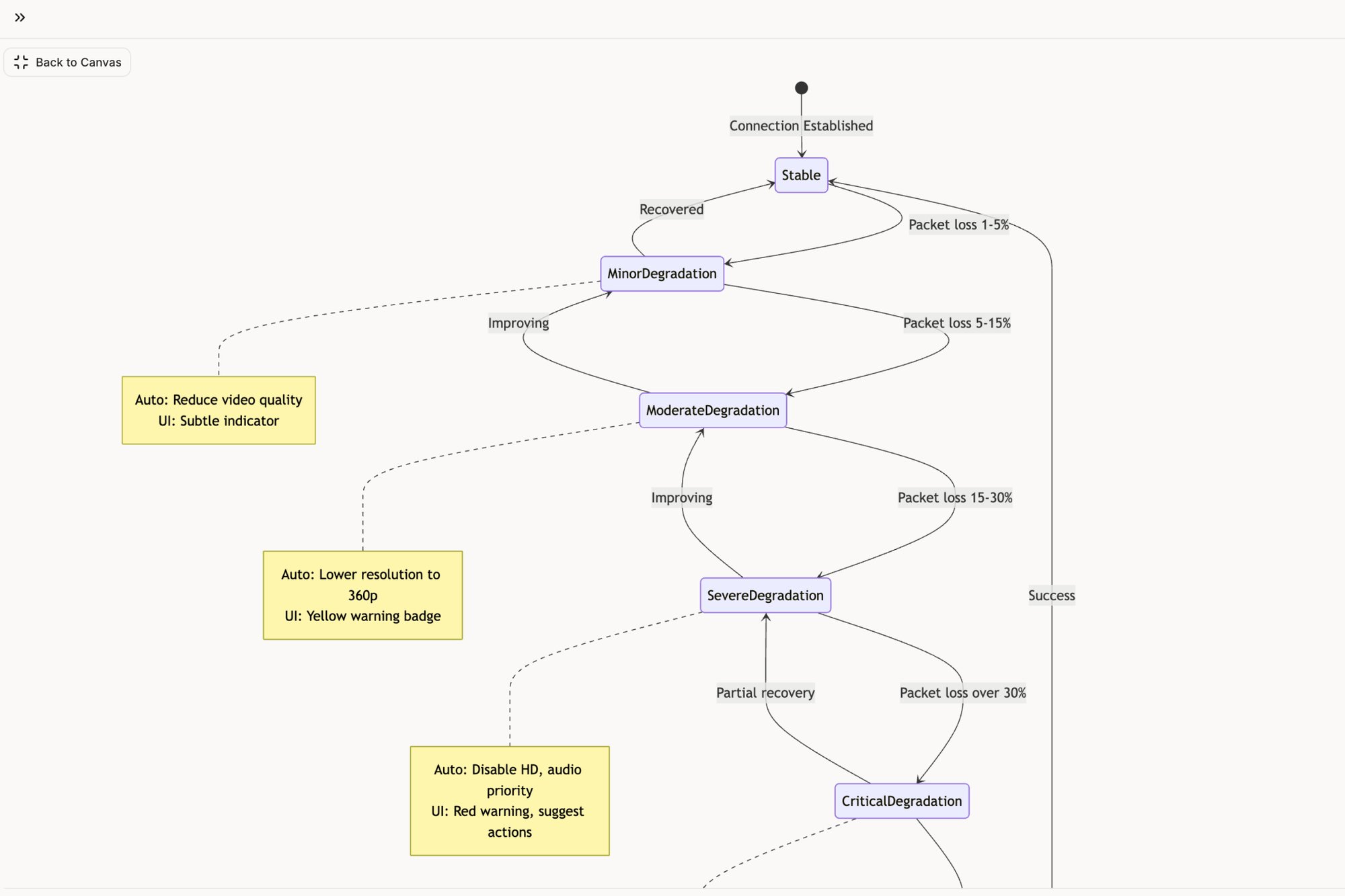
- Mapping User Flows: A cluster of feedback around a confusing process becomes the starting point for a visual flow map. This helps everyone see the problem from the user's perspective, like this user flow for Zoom's network degradation states.
- Generating Test Cases: What if users report edge cases, like a payment failure or a login loop? You can feed those scenarios directly into a tool to generate comprehensive test cases. This ensures QA is explicitly testing for the real-world problems customers are already hitting.
- Prototyping Solutions: Once the problem is mapped, you can use the original VoC quotes as design prompts to create a high-fidelity prototype of a better solution, grounded in solving the specific pains you identified. One team did exactly this to explore a better UI for a financial forecasting feature based on founder feedback.
By integrating these artifacts, you create a closed loop. High-performing CX teams using VoC templates report a 25-40% reduction in opinion-driven debates because the data is tied directly to the work. To learn more about this, you can explore the research on how VoC templates drive faster alignment.
Making feedback tangible where decisions happen is key. You can learn more about the best practices for integrating feedback into product management tools in our related guide.

The Real Economics Of Listening At Scale
It’s easy to look at a voice of the customer template and see it as just a better way to organize feedback. A tidier closet for your user complaints. But that misses the point entirely. A systematic listening process isn’t an administrative task, it’s a powerful economic engine.
Why does this structured approach matter beyond just fixing a single broken feature?
This is the zoom-out moment. The incentives here are crystal clear: businesses that systematically listen and act on customer feedback simply grow faster. It's all about the compounding returns you get when you stop guessing and start knowing.
De-Risking Innovation
Every new feature is a bet. Every single roadmap decision is a gamble on what you think the market will reward. A VoC template acts as your house odds, shifting the probabilities in your favor by grounding every bet in validated customer problems.
You’re not just fixing bugs, you're identifying unmet needs that can become your next major product line.
A friend at a fintech startup recently told me their most successful new feature didn’t come from some off-site brainstorm. It came from noticing a quiet pattern in cancellation surveys, a signal that pointed toward a massive, unserved market need. Systematic listening isn't just reactive, it's predictive.
The Competitive Moat You Can’t Buy
The economic impact is undeniable. The global Voice of the Customer platform market is projected to grow from $9.5 billion to over $22.5 billion by 2034. That growth is fueled by a simple truth: businesses using these insights can reduce churn by up to 15%.
Anyone can copy your features. They can undercut your pricing tomorrow.
But what they can't easily replicate is the deep, institutional knowledge you build by systematically listening to your customers over time. That understanding becomes your moat, a competitive advantage baked directly into your company’s DNA.
In short, a VoC process de-risks innovation and builds a product the market actually wants to keep paying for. The financial case is clear, and understanding the ROI of integrating these processes is crucial for any product leader. It’s not about being "customer-centric" as a slogan; it's about being customer-led as a business model.
Common Questions About VoC Templates
It’s one thing to build a voice of the customer template. It’s a whole other challenge to weave it into the very fabric of your team’s weekly rhythm. Once the spreadsheet is made or the tool is configured, the real work begins. How do you keep the momentum going and make sure the insights don’t just sit in a file, but actually spark change?
The questions that come up at this stage aren’t about columns and rows anymore. They’re about habit, cadence, and trust.
How Often Should We Update Our VoC Template?
Think of your template less like a quarterly report and more like a living pulse monitor. For high-volume feedback channels, think support tickets or in-app surveys, a weekly review is essential. This pace is just right to spot emerging trends before they snowball into major problems.
For slower, deeper sources like one-on-one user interviews, the updates should be immediate. The insights from a 45-minute call are too rich to sit in a notebook for a week. The real key is consistency. Set up a dedicated weekly or bi-weekly sync with key people from product, support, and sales. The goal is to review the updated template together, ensuring the insights stay fresh, relevant, and actionable.
What Are The Biggest Mistakes To Avoid?
The most common failure I see is collecting data without a clear plan to act on it. This creates what I call "feedback theater." Customers feel like they’re being heard, but their words just vanish into a void. It’s a fast way to erode trust and overwhelm your team with unactionable noise.
Another critical error is failing to standardize the data. If your US sales team tags feedback differently than your EU support team, you can't identify global patterns. The themes will be a mess. Start small. Define your process for analysis and action from day one. And make sure everyone who inputs data uses the exact same framework. No exceptions.
Can This Template Work For B2B And B2C?
Absolutely. The core principles of listening are universal. The structure, focusing on Source, Quote, Problem, and Impact, is robust enough for any model because it gets to the fundamental user need.
Where it changes is in the segmentation.
- B2C Companies: You'll likely segment by user persona, demographic data, or behavioral cohorts (e.g., power users vs. new signups).
- B2B SaaS Companies: It makes more sense to segment by account size (ARR), user role within an organization (admin vs. end-user), or industry vertical.
Your voice of the customer template is the same engine. You just adjust the lens through which you view the data.
Ready to build a system that turns unstructured feedback into actionable product artifacts? Figr is an AI design agent that connects real user insights to your product workflow, generating user flows, prototypes, and test cases grounded in your actual app. Stop debating and start building with clarity. Explore Figr today.