
Your team is polishing a scheduling feature, but nobody has checked whether customers want to manage schedules inside your tool.
If that belief is wrong, better screens won't rescue the work. Engineering inherits integrations to maintain, support gets another workflow to explain, and the roadmap loses room for a problem customers need solved.
A riskiest assumption test helps you check the belief that could sink the initiative before you commit to building it. You'll learn how to identify that belief, choose a focused experiment, and update a living risk map after every result.
What a Riskiest Assumption Test Actually Checks
Consider a hypothetical scheduling feature. A team spends three months building calendar controls, reminders, and permissions, then learns that customers want scheduling to stay in their existing calendar. The team tested how scheduling should work without checking whether it belonged in the product.
A riskiest assumption test, or RAT, is a small, fast experiment that checks the belief most capable of causing an initiative to fail. ModelThinkers' explanation of RAT emphasizes isolating a measurable belief before substantial investment, then using the result to proceed, investigate further, pivot, or stop.
Separate consequence from confidence
Assess each belief on separate dimensions:
- Impact if wrong. Identify what would break if the belief were false. Distinguish an inconvenient preference from a condition the product needs to succeed.
- Strength of evidence. Identify what supports the belief today. A confident stakeholder and observed customer behavior aren't equivalent evidence.
The scheduling team's critical belief was about adoption, not calendar usability. Customers might understand every control and still refuse to move their work.
Practical rule: Test the belief whose failure would change the investment decision.
The output is reduced uncertainty, not a miniature complete product. A usability review checks whether people can use something; a launch rehearsal checks readiness. A RAT can examine either concern, but only when that concern represents the most consequential unknown.
That's why matching test fidelity to risk matters. Build only enough realism to make the evidence credible.
Before continuing, write down a candidate belief from your roadmap. Use a plain sentence describing something that must be true, rather than a feature you want to deliver.
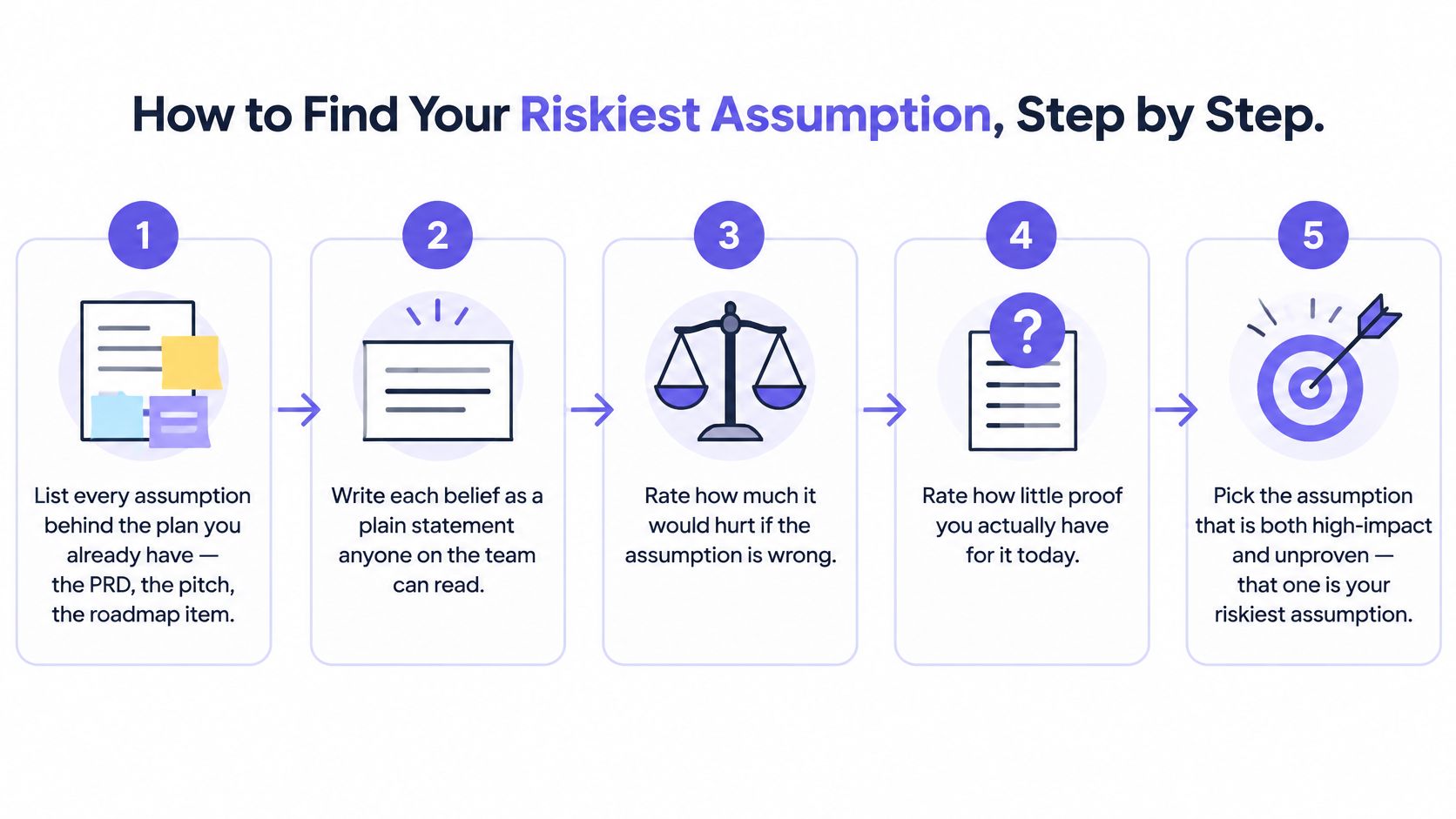
How to Find Your Riskiest Assumption, Step by Step
Start with the plan you already have: a PRD, pitch, roadmap item, or collection of sticky notes. Underline claims about customers, buying behavior, implementation, and delivery. Those claims become your assumption list.
PatternLab's assumption-testing guidance prioritizes beliefs that combine high importance with weak evidence. Keep those dimensions separate so enthusiasm doesn't get mistaken for confidence.
Build the shortlist
The scoring scale below is an illustrative planning tool, not a validated measurement system.
Step 1. List every belief the idea needs.
Include customer, market, technical, and operational assumptions.
Don't limit the list to questions your design team knows how to answer.Step 2. Score the impact of being wrong.
Use an illustrative scale from 1 to 5, from recoverable inconvenience to an initiative-ending problem.
Score what breaks, not how strongly someone wants the feature.Step 3. Rate the evidence supporting each belief.
Use an illustrative scale from 1 to 5, from opinion alone to repeated relevant behavior.
Don't count agreement in a meeting as customer evidence.Step 4. Plot impact against evidence.
Mark beliefs with high consequences and little support.
Preserve the evidence behind each score so another reviewer can challenge it.Step 5. Select the leading belief and state it plainly.
Choose the candidate most likely to change your commitment.
Don't choose a comfortable usability question because recruitment looks easier.
Apply the ranking
In a hypothetical exercise, a team lists 12 assumptions. Five receive high-impact scores, but only two of those have customer evidence. The remaining high-impact beliefs deserve scrutiny before the team debates minor interface preferences.
Review the underlying evidence before selecting user research techniques. An interview, observation session, and analytics review answer different questions.
The sentence moving forward might be: Target operations managers will move their recurring scheduling work into our product without requiring colleagues to change tools.
That sentence exposes a behavioral commitment, a target user, and a coordination constraint.
When One Assumption Depends on Another
Test dependent beliefs in the order most likely to expose an initiative-ending constraint with the least wasted work. A simple impact map needs this extra judgment because assumptions rarely stand alone.
Consider a hypothetical operations workflow. Users want automated recommendations, but useful recommendations require access to sensitive operational data. The business case also assumes adoption will grow without creating unaffordable onboarding work.
A prototype can make the recommendations look attractive while leaving data access, security review, procurement, and integration untouched. Guidance on product-discovery experiment design distinguishes methods for different risks, but choosing their order still requires judgment about dependencies.
Follow the dependency chain
A useful default sequence is:
Establish that the target user experiences the problem.
Look for recent examples, consequences, and existing workarounds.
Avoid testing a solution to a problem the segment doesn't prioritize.Observe whether the proposed behavior occurs.
Give users a realistic opportunity to act.
Separate understanding the workflow from choosing to adopt it.Check whether the organization can support delivery.
Examine technical access, operating effort, purchasing constraints, and economics.
Bring the owners of those constraints into the decision.
This sequence isn't a rule that customer research must always come first. If a known integration restriction could make the entire solution impossible, investigate that restriction before commissioning a polished prototype.
Put the cheapest credible test of an initiative-ending belief first, even when it belongs to another team.
Re-rank when a dependency changes
In a second hypothetical SaaS scenario, a prototype receives a positive response. IT then explains that data access requires a six-month security review. The leading uncertainty shifts from user interest to whether the organization can deliver within its required window.
Update the risk map immediately. Record the new constraint, change the evidence rating, and reconsider which belief comes next.
The basic gist is this: a passed test changes the queue; it doesn't approve the whole initiative. As adoption grows, coordination and implementation costs can change the economics. Product, engineering, security, and commercial teams need a shared map rather than separate definitions of readiness.
Choosing the Smallest Test for Each Assumption
Smallest test by assumption type
All thresholds below are hypothetical planning examples, not industry benchmarks.
| Assumption type | Smallest test | Evidence to collect | Illustrative pass threshold |
|---|---|---|---|
| Problem exists | Customer interviews | Workarounds described unprompted | 5 of 8 interviewees describe the same workaround |
| Usability | Clickable prototype task | Task completion without help | 8 of 12 participants finish the task unaided |
| Demand | Fake-door test | Sign-ups or clicks on a waitlist | 3% of qualified visitors click |
| Value to user | Concierge service | Repeated requests after the manual version | 30% of served users request a second session |
| Willingness to pay | Pricing conversation or pre-order | Quoted price accepted | 4 of 10 prospects accept the quoted price |
| Operational feasibility | Manual pilot | Staff hours per delivered outcome | Delivery fits 2 staff hours per account |
| Technical feasibility | Throwaway proof of concept | Whether the connection works with real data | One real data source connects end to end |
Choose the smallest experiment capable of changing the decision, rather than a miniature production release. Simpliaxis' assumption-mapping guidance supports matching the method to the assumption and defining success before collecting evidence.
Match the method to the uncertainty
A fake door measures response to an offer, not satisfaction with a delivered service. Explain that the feature isn't available after someone expresses interest, and don't imply that you can deliver something you can't.
A clickable prototype reveals whether users can complete a task under test conditions. It doesn't establish whether they'll remember the feature or return during their normal work.
A concierge service delivers the outcome manually. It helps separate whether users value the result from whether automation works. A pricing conversation tests acceptance of a specific offer, while an actual pre-order adds a stronger commitment.
Operational pilots and technical proofs answer different questions. A connection can work technically while account setup remains too costly to deliver.
For physical-product teams, American Additive Manufacturing rapid prototyping is a relevant resource when an assumption requires a tangible part rather than a screen. For software concepts, Figr's guide to concept validation helps distinguish methods for assessing a proposed solution.
Keep the evidence bar proportional to the commitment. A lightweight signal may justify another experiment; it doesn't automatically justify a major launch.
Writing a Pass or Fail Rule Before You Test
Write the decision rule before collecting evidence. Otherwise, an ambiguous result gives everyone room to defend the outcome they already wanted.
A useful rule specifies the evidence source, metric, minimum observation volume, threshold, and response to failure. Method Atlas' RAT guidance recommends this precommitment and illustrates it with a criterion in which at least 8 of 12 target users identify an actionable issue, and at least 6 would use the artifact in their next planning cycle.
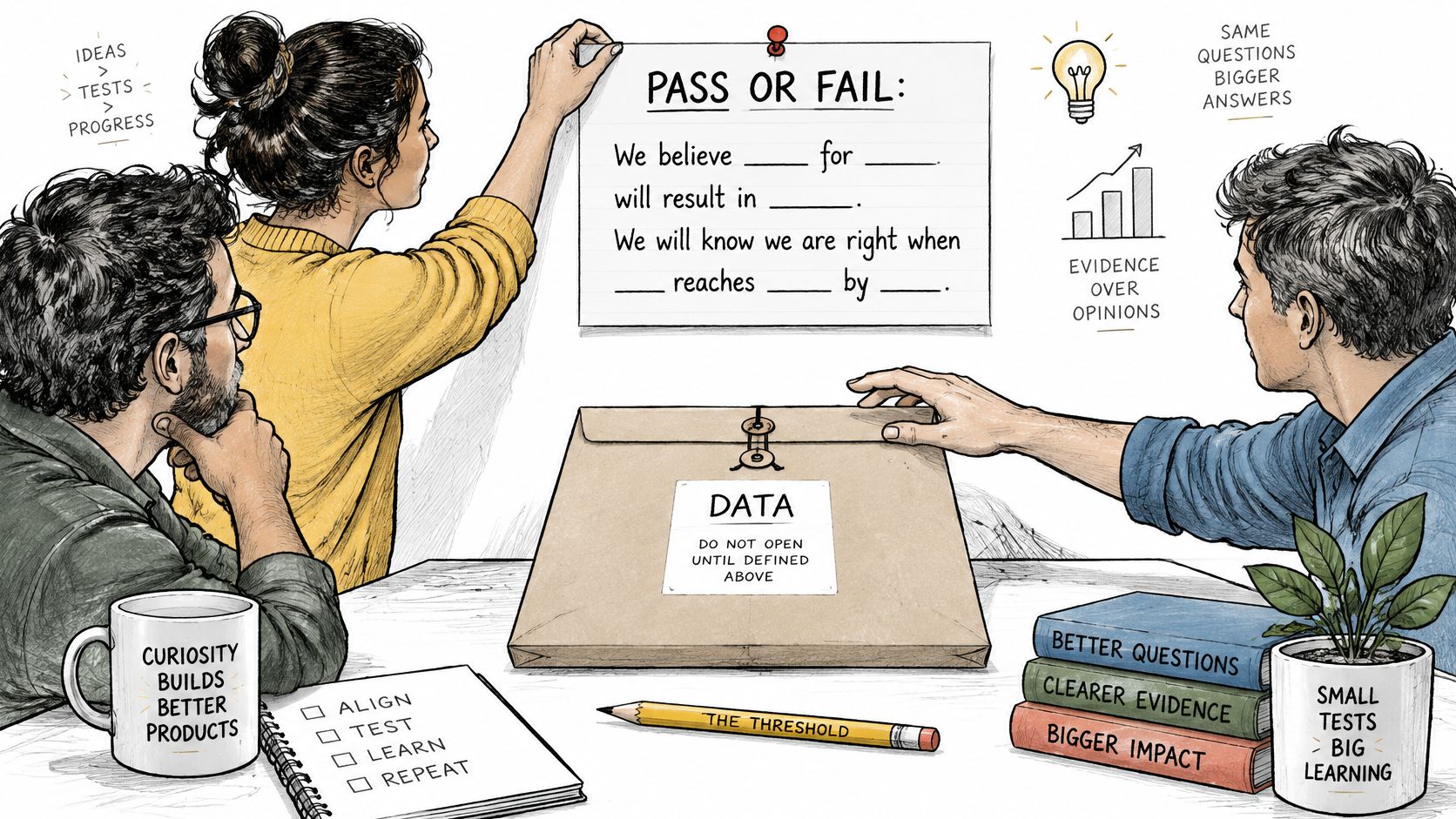
Write a decision-capable test card
Use these fields to make the agreement explicit:
- Assumption and method. State the belief and the experiment that will examine it.
- Evidence source and metric. Name the participants or dataset, then define the observable behavior.
- Minimum volume and window. Specify how much evidence you need and when collection ends.
- Threshold and consequence. Record what qualifies as a pass and what you'll change if it fails.
A compact hypothesis reads: For this target population, we expect this behavior under these conditions within this window. We'll measure it using this evidence, and if it falls below the agreed threshold, we'll take this action.
Figr on running better UX experiments offers further context for connecting a UX question to an experiment.
A hypothetical PM workflow test
A team wants to learn whether PMs find an AI-generated UX review useful. It recruits 12 target PMs for prototype sessions and adopts the illustrative rule above. Participants must identify an issue independently, without the facilitator pointing one out.
The agreed pass action is to build the next version for further testing. The fail action is to revise the workflow or narrow the segment.
In this hypothetical outcome, 7 of 12 identify an actionable issue, and 5 say they would use the review in their next planning cycle. Both conditions fall short, including the intended-use condition. The team narrows its next test to PMs actively running quarterly planning instead of collecting favorable quotes.
Decision discipline: A threshold changed after the result is a new hypothesis, not a successful old test.
Lowering the intended-use threshold to 5 of 12 would erase the original decision boundary. The team can propose that threshold for a new test, but it can't retroactively claim a pass.
Also keep the commitment modest. Stated intent may support another iteration; it doesn't establish repeated use or commercial demand.
Reading Results Without Fooling Yourself
Read the result as evidence about the tested belief, within the tested conditions. Don't turn a narrow success into permission to make a larger commitment.
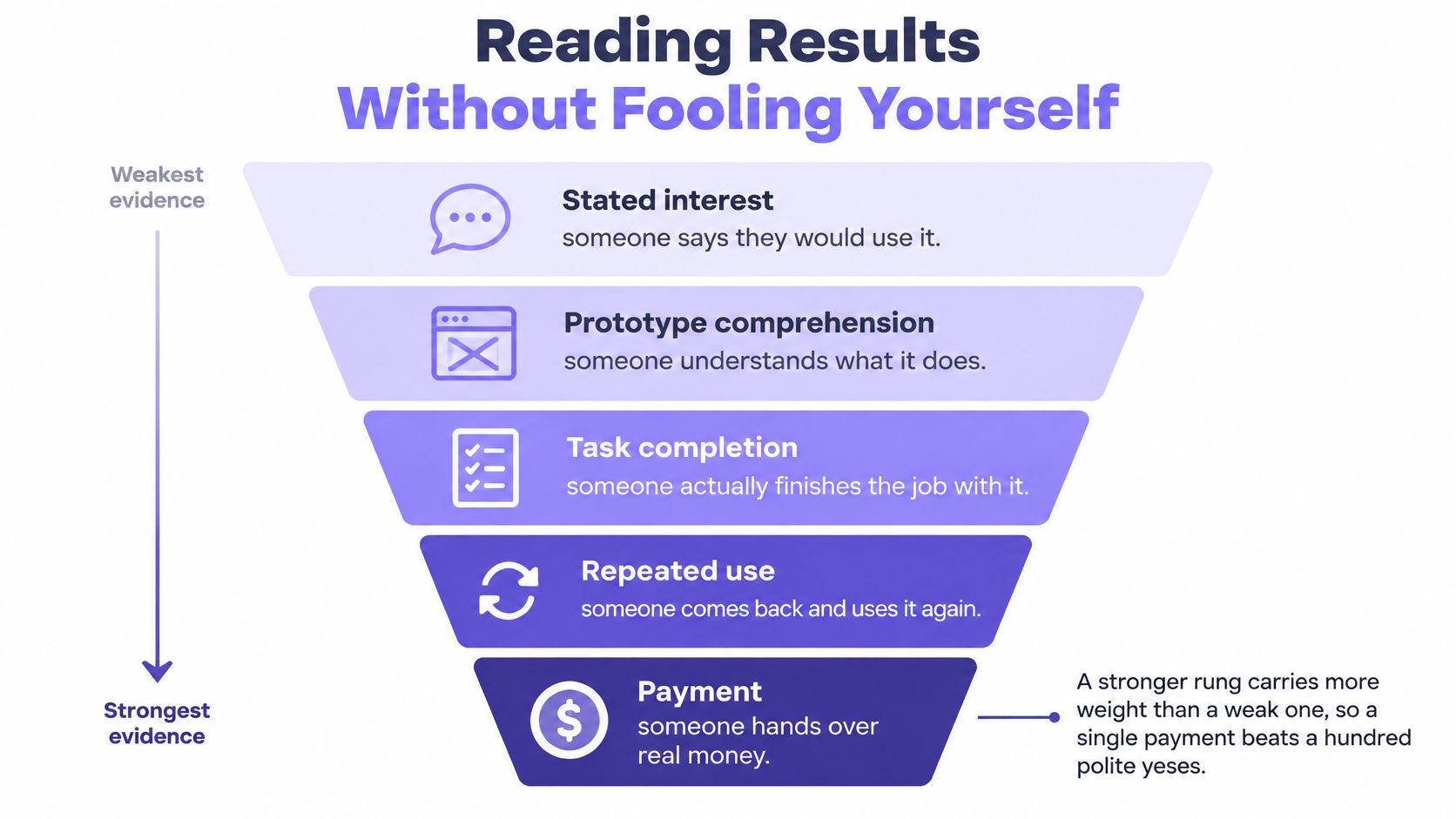
The evidence ladder below is a practical guide to behavioral commitment. Its rungs generally become stronger as users move from saying something to doing something, returning, and paying.
Identify what the signal actually proves
- Stated interest. Someone says the idea sounds useful. You've learned about their response to a description, not their purchasing behavior.
- Prototype comprehension. Someone understands what the concept does. You haven't established that they need it.
- Task completion. Someone finishes the job with the proposed interface. You still need evidence about use outside the session.
- Repeated use. Someone returns when the need arises again. Check whether reminders or personal assistance caused the return.
- Payment. Someone commits money to the offer. Examine the buyer, terms, and delivery costs before inferring a sustainable business.
A stronger rung carries more weight only when it's relevant to the belief. Payment from an unusual buyer doesn't establish usability for the intended end user. Likewise, a survey of intent can't serve as a purchase signal.
Convert the result into a decision
A pass moves attention to the next consequential unknown. A fail calls for changing the workflow, segment, or solution, or stopping the initiative. An inconclusive result calls for a sharper method or enough additional observations to meet the original minimum.
Consider a hypothetical worked example. A team passes a prototype comprehension test with 10 users, then runs a two-week repeated-use pilot. Only 4 of 10 return, below its precommitted requirement that most participants return.
The team drops that feature concept and interviews participants about the underlying job. Their accounts support the problem, but reveal that the proposed workflow asks them to leave the tool where the work already happens. The decision is to explore another solution, not add reminders to force adoption.
Update the living risk map
Record the result alongside the exact population, conditions, and limitations. Then revise the evidence ratings of related beliefs. A workflow failure may reveal a new dependency rather than settle the original explanation.
In short, keep the conclusion no broader than the evidence. Six interviews describe six people, not an entire market. A memorable positive session can dominate discussion, so use the full observation record rather than the anecdote that comes most easily to mind. Figr's examples of availability bias explain that judgment trap.
Dashboards add another boundary. Analytics can show where users leave, but they don't establish why. In our workflow, Figr cannot tell exactly why users drop off; analytics context helps form hypotheses and review flows, and we pair it with product context, research, and team judgment.
Finally, check what remains untouched. Testing the easiest belief can produce clean evidence while leaving the structural risk unresolved. A successful button test doesn't answer whether customers can obtain permission to use the workflow.
Riskiest Assumption Test Questions Readers Ask
How many users does a riskiest assumption test need?
The sample should fit the threshold, method, and stakes of the decision. The PM-session example is illustrative, not a universal sample-size rule. A small qualitative test can reveal a failure mechanism, but it describes the people tested. Estimating market demand or comparing small differences requires a different sampling plan.
How is it different from an MVP or an A/B test?
A RAT isolates a consequential belief; an MVP is a minimal product used to learn through use. An A/B test compares variants and needs enough relevant traffic to support its analysis. It can serve as a RAT when the risky belief is measurable through that comparison, but it isn't required for early discovery.
What if team members score the same assumption differently?
Ask each person to write the evidence and consequence behind their score before discussing it. Have another reviewer assess the same material independently. When support remains thin, retain the lower evidence rating rather than averaging away uncertainty. For impact disagreements, document the competing failure scenarios and ask the relevant decision owner to resolve them.
How long should the test take?
Set the observation window before starting, based on when the behavior could realistically occur. A prototype task can be observed quickly; renewal or recurring use needs an appropriate cycle. The week-long closing plan is a target for testing a bounded belief, not permission to compress behavior that takes longer to observe.
Confirm the Riskiest Assumption This Week
Aim to reach a decision within a week when the behavior and recruitment make that feasible. Don't mistake the deadline for a requirement to manufacture certainty.
Make the test a scheduled commitment
Step 1. Write the shortlisted assumption as a sentence.
Name the target user and the behavior or constraint.
Remove vague claims such as customers will love it.Step 2. Write the hypothesis and failure action.
Include the metric, threshold, observation window, and minimum evidence.
Agree on what changes if it fails.Step 3. Choose the smallest credible test.
Use the method that answers this belief directly.
Cut production work that contributes no evidence.Step 4. Arrange the evidence collection.
As an illustrative starting plan, book five to eight sessions or pull relevant analytics.
Pair behavioral patterns with interviews, and expand recruitment if your rule requires it.Step 5. Schedule the decision meeting.
Meet the day after the evidence arrives.
Put the pass/fail rule in the agenda before discussing impressions.
We can identify ambiguity, missing decisions, and assumptions inside a PRD or research brief. Verify that help on a real document before relying on it. We explain decisions and detect edge cases, but product judgment still belongs to your team.
Make the commitment now: run this test before the next design sprint starts.
Bring a PRD or research brief to Figr to surface assumptions and missing decisions before turning the idea into designs. Use those questions to choose a focused test, then let observed behavior guide your next investment.