
You're probably hiring for a title when you should be hiring for a decision boundary. That's the trap in product design vs UX design, and it shows up the moment a team starts confusing aesthetic polish with ownership of the product's shape.
When that confusion goes uncorrected, teams end up with beautiful screens and weak product judgment. Roadmaps drift, research gets squeezed into the margins, and no one can say who owns the full journey from problem framing to launch readiness.
The fix is simple, but it changes how you hire, assign work, and review decisions. Treat this as a scope problem, not a title problem, and the roles become easier to separate, easier to merge when needed, and easier to scale as the product grows.
The Hiring Mistake That Keeps Repeating
Last week I watched a head of product skim three résumés, circle the one with UX Designer on top, and move on with real confidence. Six months later, the team still had no one who could own the full product decision path, and every disagreement came back to the same silent problem, nobody had been hired for scope.
That's the mistake. Teams use titles as a proxy for decision ownership, then act surprised when the work doesn't line up. A UX Designer can be excellent at shaping interaction quality and still never be asked to own the business trade-offs behind the feature.
Practical rule: if you can't describe what decisions the role owns on day one, you're not hiring a role, you're hiring a label.
The basic gist is this: product design and UX design overlap, but they don't start from the same center of gravity. One is built to carry a product bet from framing to launch, the other is built to protect the quality of the experience inside that bet. If you don't define that split early, you'll burn time in handoffs, reviews, and rework.
A clean way to avoid that is to first fix team quality and velocity issues before you add more people to an unclear system. That's the logic behind how to fix team quality and velocity issues, because hiring the wrong kind of designer only makes a weak process look busier.
Where Each Discipline Actually Comes From
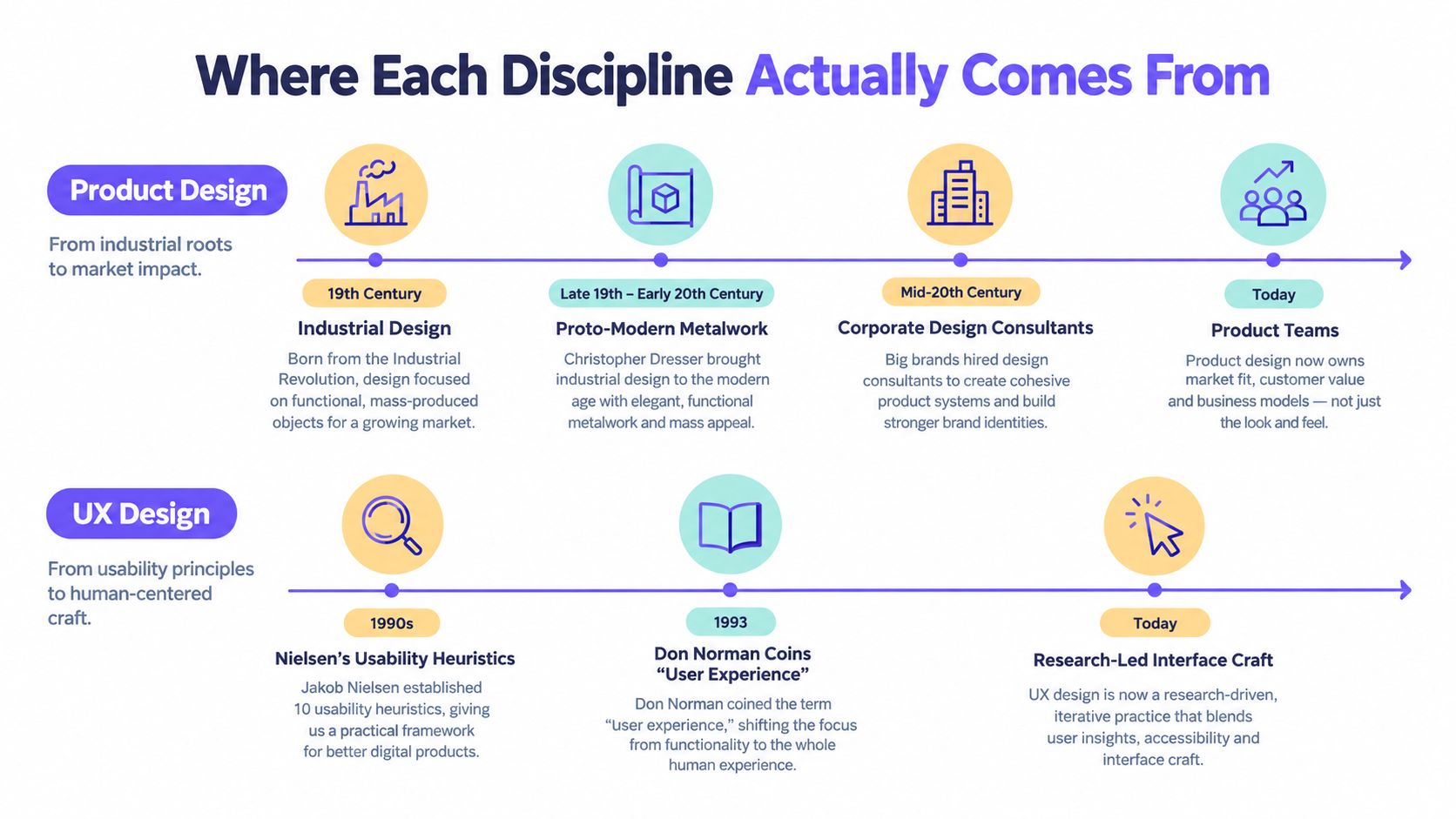
Product design comes out of industrial design, where form, function, and manufacturability were treated as one problem. Think of Christopher Dresser and the broader 19th-century move toward scalable goods, where a designer had to care about what something looked like, how it worked, and whether it could really be made at volume.
UX design comes from a different lineage. Jakob Nielsen's 1994 publication of the 10 usability heuristics was derived from factor analysis of 249 usability problems and 101 usability principles, and he later noted that the heuristics explained most observed problems and still anchor practice today. Nielsen also described his first formal web usability tests in 1994 as among the earliest of their kind, which matters because it shows UX emerged as a research-backed discipline, not as a style exercise. Nielsen's historical account is still one of the clearest ways to see that split.
Different inheritance, different defaults
This is what I mean. Product design inherits a craft tradition, which means it tends to think in systems, constraints, and long-term viability. UX design inherits evaluation methods, which means it tends to think in evidence, friction, and measurable usability. Those defaults matter when a team is choosing who should lead a feature, who should challenge the flow, and who should decide whether the thing is viable at all.
If you want a quick visual of what strong UI output looks like when the interaction layer is taken seriously, the ogBlocks user interface examples are a useful reference point for studying layout clarity and presentation choices without pretending that visuals alone solve the product problem.
A product team that understands both histories makes better trade-offs. It stops expecting a UX designer to own the business case for a feature, and it stops expecting a product designer to uncover every usability flaw through taste alone. That distinction is why I still tell teams to start by balancing feasibility and viability before they argue about execution details.
Scope, Deliverables, and Decision Ownership
The cleanest way to separate the roles is to stop talking about “design” as a blob. Talk about scope, deliverables, workflow stage, and decision ownership. Once you do that, the overlap becomes manageable instead of mystical.
A strong product designer sits close to the roadmap. They don't just make the feature understandable, they decide whether the feature belongs in the first place and how it fits the business model. A strong UX designer protects the experience inside that decision, which means they push back on ambiguity, friction, and anything that makes the product harder to use.
The real split in a SaaS org
In a small SaaS team, one person may hold both hats because there isn't enough surface area to separate them. That doesn't mean the roles are identical. It means the organization is compressing two kinds of judgment into one seat until scale forces them apart.
Decision rule: product design owns the bet, UX owns the experience quality of that bet.
That's why writing a product requirements document sits naturally closer to product design, while usability testing and accessibility review sit closer to UX. One shapes the decision, the other stress-tests the interaction. If you blur those, you get polished handoff docs and weak ownership. If you separate them cleanly, you get faster decisions and fewer downstream arguments.
The mistake I see in mature teams is over-defining deliverables and under-defining authority. A designer can produce beautiful artifacts and still have no real power over the thing the team ships. The better question is simple: who gets to say no, and on what grounds?
How the Work Splits on a Real SaaS Feature
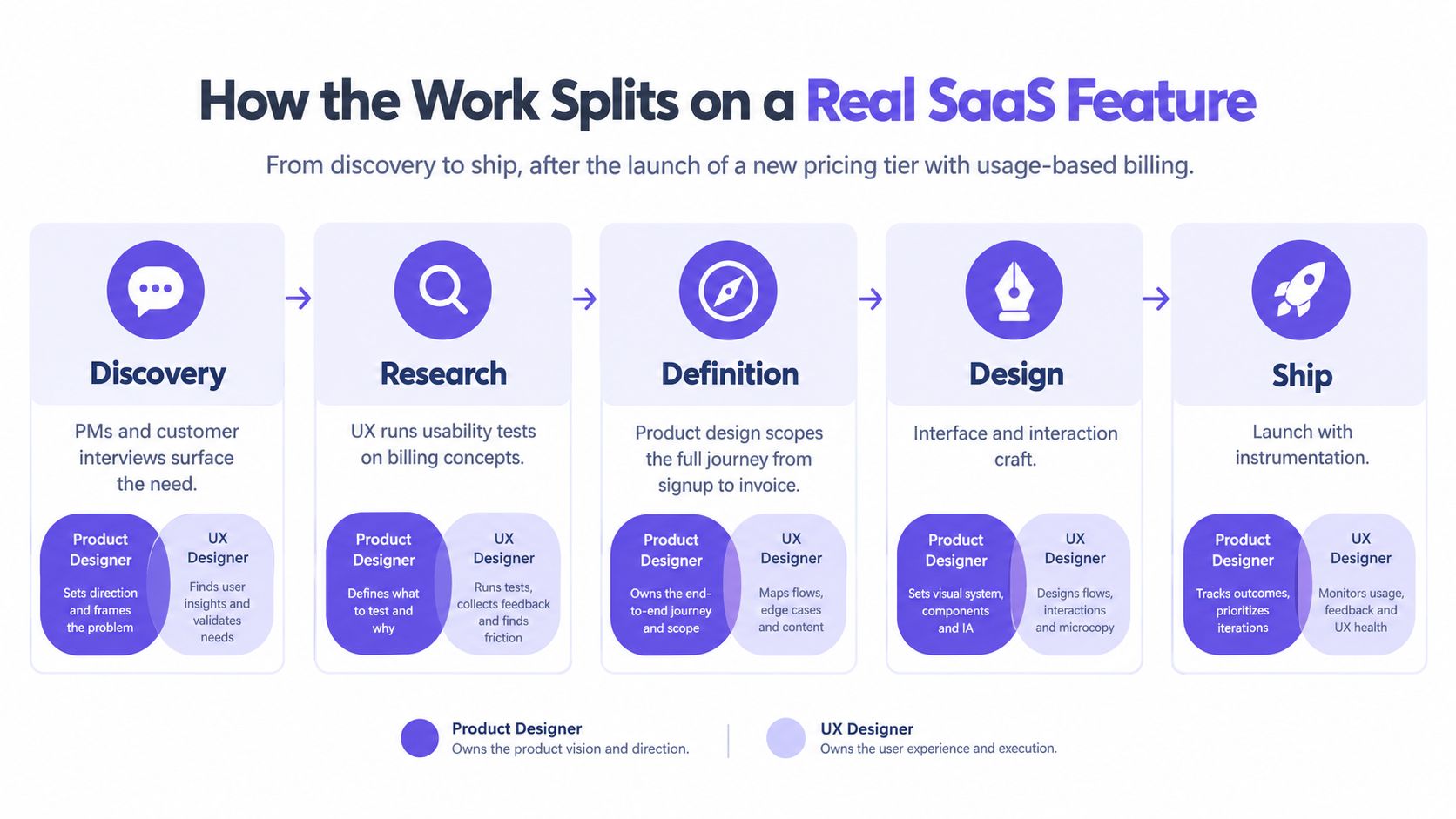
A pricing tier with usage-based billing is where the distinction gets real. The feature sounds simple until you trace the user from discovery to invoice, because that's where ownership gets tested in public.
Discovery and framing
PMs and customer interviews surface the problem first. UX work here is about clarifying jobs-to-be-done, spotting friction points, and turning vague complaints into testable hypotheses. Product design then takes that input and decides how the pricing tier fits the roadmap, the signup path, and the broader product story.
Definition and design
Once the problem is real, product design chooses the structure of the journey. Where does the billing context appear? What language reduces anxiety? What visual treatment makes the tier understandable without turning the pricing page into a spreadsheet?
UX then pressure-tests the interactions. It checks whether the overage alert is comprehensible, whether the invoice flow creates confusion, and whether the edge cases are still usable when someone is already frustrated. That's where the disciplines overlap on purpose, because the best product work happens when the framing and the interaction are being challenged at the same time.
Ship and learn
The rollout story belongs to product design. So does the in-app education and the adoption readout after launch. UX keeps the final QA lens on the experience, especially if the alerting, invoice copy, or error handling still creates avoidable friction.
A team that handles this well doesn't draw a hard wall between the two roles. It uses weekly critiques, shared QA, and fast feedback loops so the handoff feels like collaboration instead of a baton pass. If you want a useful model for that kind of shared process, how to build collaborative design process is a good place to compare your current workflow against something more deliberate.
Metrics That Separate the Two Roles
UX metrics answer a narrower question than product metrics do, and that's the point. They tell you whether people can complete the task, understand the flow, and tolerate the interaction without friction.
Product metrics answer the bigger question, whether the experience was worth shipping at all.
A practical rule helps here. If the metric changes when pixels move, it's UX. If it changes when the feature changes, it's product. That's not perfect, but it keeps the team honest.
Shared diagnosis, separate ownership
When activation drops, UX should be one of the first places you look, because the problem may live in the onboarding flow, the copy, the layout, or the sequence. But product design still owns the larger call, whether the feature is aimed at the right problem in the first place.
The better teams don't let either side optimize in isolation. UX can't win by making a flow prettier if adoption stays flat. Product design can't win by shipping more scope if nobody can complete the core task. Both layers have to roll up to one product outcome, or the org starts rewarding local wins that don't move the business.
Why the Boundary Is Moving in 2026
A SaaS team that still treats product design and UX design as fixed job titles is already behind. The better question is who owns which decisions. AI, design systems, and accessibility are pushing both disciplines toward broader system judgment, and that changes the hiring brief.
Recent UX trend reporting points to AI as a collaborator, AI agents taking actions for users, AI-powered accessibility testing, and transparent AI disclosure (Lyssna's 2026 UX trends overview). That matters because once interfaces can generate content, act on behalf of users, or adapt in real time, teams need clear calls on trust, clarity, and disclosure.
Accessibility is tightening the same boundary. WCAG 2.2 was published as a W3C Recommendation on 5 October 2023 (W3C), and the framework centers on perceivable, operable, understandable, and resilient principles (UK Service Manual). That means accessibility cannot sit at the end of the process as a cleanup task. It has to shape product specs, UX reviews, and QA gates from the start.
Product design is moving too
Product designers are not just shipping screens. They are expected to run discovery, read behavioral analytics, and decide whether a feature should exist in the system at all. The role is shifting from output volume to judgment under constraint.
The boundary is widening, not disappearing. UX is moving deeper into architecture conversations. Product design is moving deeper into research and operational evidence. Teams that hire well now hire for decision scope, not for a title they saw on a LinkedIn profile, and many are landing near a 60/40 split for UX design between systems work and research.
A Hiring Playbook for Product Leaders
A small team needs generalists. Under 5 designers, hire one product designer who can run research and make product calls. You do not have enough volume to split the work yet, and narrow roles will slow you down.
At 5 to 15 designers, split product design and UX into two tracks and keep shared systems ownership. That is the point where roadmap pressure starts squeezing research depth, and you need one person protecting interaction quality while another owns product judgment. Teams at that stage often use specialist hiring partners like Lathire to fill the UX track without weakening decision quality.
At 15+ designers, add a design systems lead and a research ops layer. Craft breaks when nobody owns consistency, and research breaks when every squad improvises its own method.
What to listen for in interviews
- Decision scope: Ask which decisions the candidate should own and which ones they should only influence.
- Systems thinking: Ask how they would handle one pattern used across onboarding, billing, and settings.
- Accessibility fluency: Ask how they would design for a keyboard-only path, a screen reader path, and a failure state.
- Trade-off judgment: Ask what they would cut if the roadmap slipped by one sprint.
Strong candidates do not just describe screens. They explain the logic behind the screen, the evidence behind the choice, and the risk behind the compromise.
I saw this go wrong at a series B analytics startup. The team hired two product designers instead of one UX researcher because speed looked safer. Six weeks later, the activation drop came from onboarding flow, not feature design, and the team had plenty of opinions but not enough research depth. That mistake is expensive because it feels efficient until it reaches users.
Use tools that keep hiring decisions tied to product reality, not design theater. That is where Figr fits naturally. It helps teams reason through UX, map flows and edge cases, and generate design artifacts from existing product context instead of starting from a blank canvas.
The right answer to product design vs UX design is scope, not title. Define who owns the bet, who owns experience quality, and where both roles need shared evidence before shipping. If you want a clearer way to hire, split, or merge those responsibilities, see how Figr turns live product context into PRDs, flows, reviews, and production-ready design decisions.