

The wrong Product Manager to designer ratio undermines teams long before anyone updates the org chart. You can feel it in backlog grooming, in rushed reviews, in the awkward handoff where nobody is sure who owned the problem framing.
When that ratio drifts, Product Managers start sketching flows at night, designers get pulled in too late to shape decisions, and engineering receives work that looks ready until edge cases explode in delivery. Quality slips first. Then trust. Then morale.
A better operating model starts with context, because ratio problems are rarely just hiring problems. Teams do better when the Product Manager and designer can work from the same product memory, the same constraints, and the same decision trail. That is where tools like Figr fit, using a Visual Context Graph to connect screens, flows, design systems, research, and implementation details so fewer decisions get lost between discovery and delivery.
What Is the PM to Designer Ratio Really?
The PM to designer ratio tells you whether design is embedded in product thinking or rented at the end.
Last week I watched a Product Manager walk a designer through a flow using a patchwork of Slack threads, a stale PRD, and screenshots pasted into a doc. The designer was sharp. The Product Manager knew the domain cold. They still spent most of the meeting rebuilding context that should have been shared from the start.
That scene is common because teams often treat the ratio like a headcount formula. It isn't. It's a signal about partnership.
The ratio measures strategic proximity
In user-facing product teams, the historical rule of thumb has been 1:1, one Product Manager paired with one designer, and that view has been reinforced by product leaders including Ken Norton, as summarized in this discussion of PM, designer, and engineering team balance. The number matters, but the operating behavior matters more.
A healthy pairing usually looks like this:
Shared discovery: The Product Manager brings business context, constraints, and decision pressure.
Shared problem framing: The designer tests assumptions, surfaces user friction, and spots interaction risks early.
Shared iteration: Both people refine the work before engineering commits to a direction.
That is why high-functioning teams often organize around a triad, Product Manager, designer, and tech lead. The triad creates a small decision core. When that core works, teams move with less drama because the problem gets defined before the solution calcifies.
Practical rule: If your designer only appears after requirements are approved, your ratio may look acceptable on paper and still be broken in practice.
Partnership versus service
This is what I mean: the ratio is really a test of whether design participates in discovery or mainly responds to tickets.
When design is a partner, the Product Manager doesn't need to carry the full burden of making the work legible. When design is a service function, the Product Manager spends huge amounts of time packaging context, defending choices, and filling in gaps that should have been explored together.
That often turns into informal product manager design work. Sometimes that's useful. Early sketches, rough flow thinking, and directional artifact creation can help. The trouble starts when a Product Manager becomes the default substitute for missing design capacity.
Why the ratio feels emotional
People don't argue about this ratio because they love org design. They argue because of what it does to daily work.
A Product Manager with no design partner starts over-explaining. A designer stretched across too many teams starts protecting calendar time instead of exploring options. Both people get narrower. The product usually follows.
How to Tell When Your Ratio Is Broken
A broken ratio shows up as behavior before it shows up as staffing data.
You usually don't need a spreadsheet to spot it. You need to pay attention to where work stalls, where rework piles up, and who is carrying invisible labor. In B2B SaaS teams, the signs often hide behind complexity, because everyone can claim the work is just nuanced. In consumer products, the symptoms show up faster in inconsistent flows and weak polish.
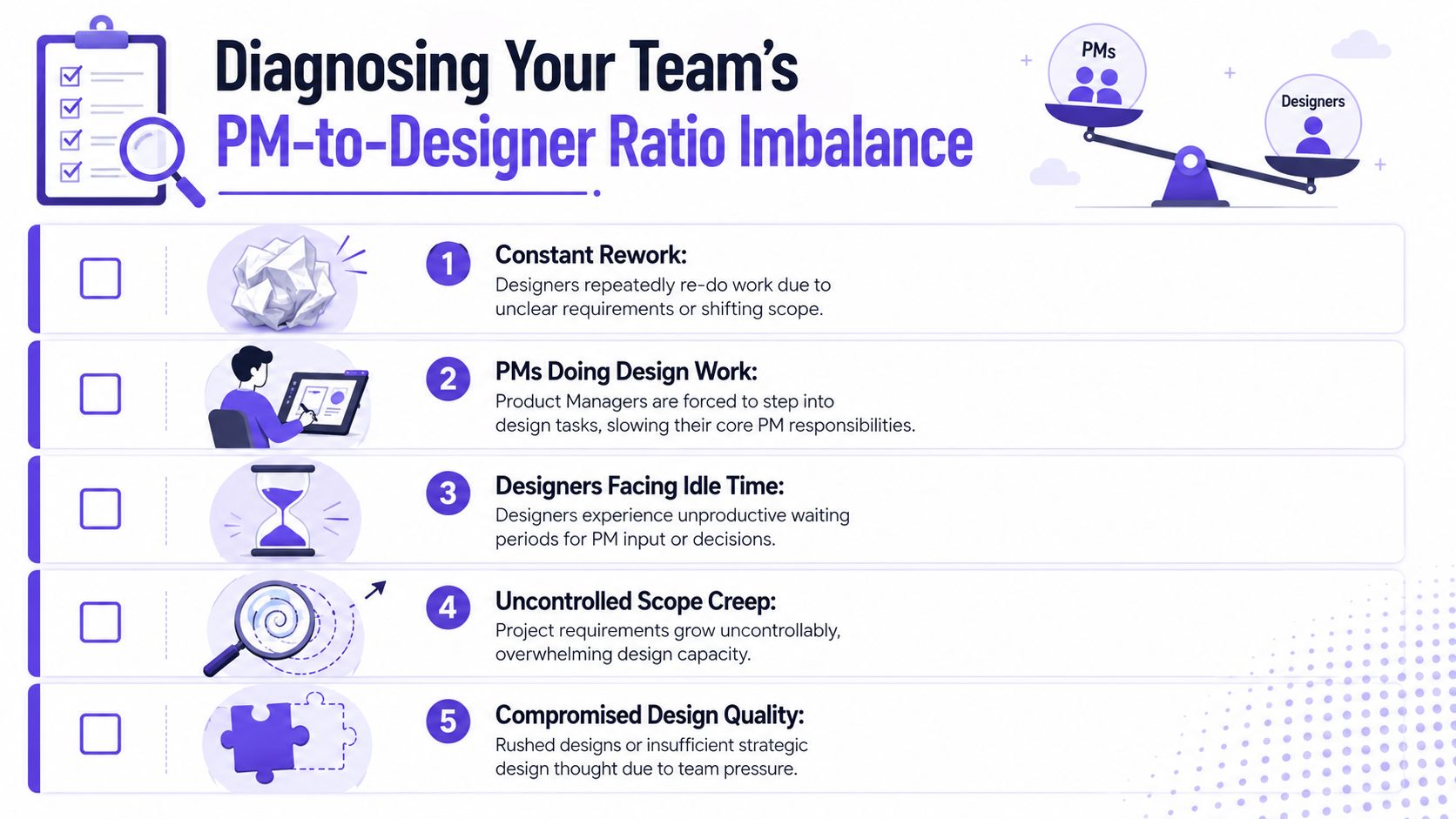
Five red flags I trust
The pattern usually starts small, then becomes normal.
Constant rework: The team revisits the same flow because the original problem framing was thin, or key states were missed.
Product Managers doing design work by default: Rough wireframes become polished mocks because nobody has enough design capacity.
Designers waiting on context: A designer has craft capacity but can't move because the Product Manager hasn't packaged decisions, trade-offs, or research clearly.
Scope creep with no design reset: New requirements enter the flow, but nobody rethinks the user experience as a whole.
Compromised quality: The shipped experience works in the happy path and frays everywhere else.
What broken feels like on the ground
You can hear it in language.
Teams start saying things like, "We'll clean it up later," or "Let's just get engineering started." Designers become reviewers instead of co-authors. Product Managers become traffic controllers. Nobody is explicitly choosing that model, but everyone adapts to it.
When design shows up mainly in review meetings, the team has already accepted a lower ceiling.
Another tell is emotional tone. People get touchy about changes that should be routine. Why? Because every revision now threatens someone's overloaded week.
If that sounds familiar, you're probably dealing with a structural issue, not an interpersonal one. A lot of leaders misdiagnose this as collaboration friction when it's really capacity friction. The symptoms often overlap with broader delivery issues, which is why this guide on how to fix product development cycles tends to resonate with teams that think they only have a process problem.
B2B and consumer teams break differently
In B2B SaaS, ratio problems often hide inside configuration, permissions, admin surfaces, and long-tail workflows. The team says the product is "complex," which is true, but complexity doesn't remove the need for design partnership. It increases it.
In consumer products, the same imbalance tends to produce a different smell. The core flow gets attention. Empty states, edge states, trust moments, and recovery flows get neglected. The result is a product that demos well and feels rough in actual use.
The Three Ratios You See in the Wild
Teams often land in one of three recognizable PM to designer ratio patterns, and each one creates a different product culture.
The benchmark for user-facing teams is still 1:1, and a 3:1 Product Manager to designer ratio is a strong signal that design is being treated like a service rather than a core product function, as argued in this analysis of team composition and design partnership. I think that framing is right because it matches what teams feel day to day.
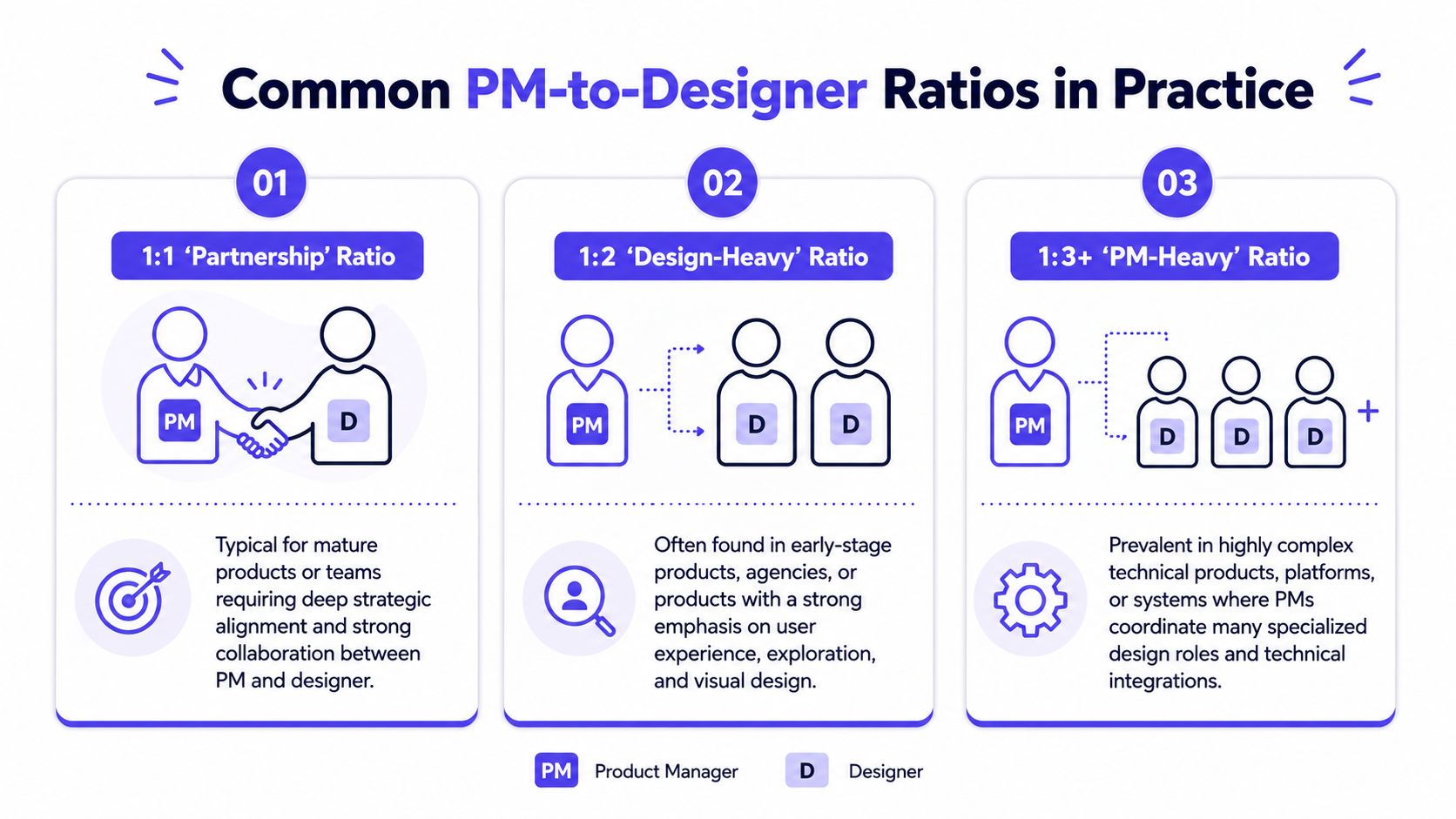
The 1 to 1 partnership ratio
This is the cleanest model for user-facing products.
A Product Manager and designer can stay in sync on discovery, problem framing, and iteration. Work tends to move with fewer ceremony layers because the pairing itself absorbs ambiguity. Mature consumer teams often prefer this setup because quality depends on many small decisions that can't be outsourced to a single review.
What usually happens at this ratio?
Velocity is steadier: Fewer loops are needed to align on user intent.
Discovery is stronger: The designer has time to challenge assumptions before artifacts harden.
Quality is more resilient: Edge cases get attention before handoff.
This doesn't mean every team with a 1:1 ratio is healthy. Some teams still underuse design. But when the partnership works, it creates the best conditions for high-quality user-facing work.
The 2 to 1 pragmatic ratio
This is common in B2B SaaS, especially where one designer supports two Product Managers working on related surfaces or adjacent domains.
It can work well when the product area is stable, the design system is mature, and the Product Managers are disciplined about intake. It tends to fail when every stream claims to be urgent.
I think of this as the ratio of operational honesty. You are acknowledging constraint, but you are still trying to preserve real design partnership where it matters most.
A team at this ratio needs sharper rules:
Shared designer across two squads: reserve recurring discovery time, not just review time
Heavy roadmap churn: reduce active streams before asking for more design throughput
Stable platform area: let the PM carry more early artifact creation
The 3 to 1 or 4 to 1 service desk ratio
This ratio is common in resource-constrained environments, and it almost always changes the nature of the work.
The designer becomes an allocator of scarce attention. Product Managers compete for cycles. Discovery gets rationed. Design reviews become narrower because there isn't enough time to explore alternatives.
The basic gist is this: at 3:1 to 4:1, teams usually keep shipping, but they stop learning well.
That has practical effects:
The work gets more prescriptive: Product Managers write more solution detail into docs.
The design gets safer: Familiar patterns win because exploration is expensive.
The team gets more brittle: Small changes cause larger coordination costs.
Can this ratio ever be acceptable? Yes, in short bursts, or in lower-UX surfaces with tight reuse. But if this becomes the long-term model for a user-facing team, the product usually pays for it later.
Why a Bad Ratio Sinks Product Quality
A bad ratio lowers product quality by shrinking the time available for judgment.
That sounds abstract until you've seen the shipping pattern. Discovery gets trimmed. Design reviews become tactical. Product requirements become more prescriptive because the Product Manager is trying to protect engineering from ambiguity. Then the team ships something technically complete and experientially thin.
The second-order effects are the real cost
The first-order problem is obvious: people are overloaded.
The second-order problem is what matters more. Designers under pressure default to known patterns. Product Managers without a design partner start solving in prose. Engineers build faster against narrower assumptions. The resulting product often works, but it doesn't absorb edge cases gracefully and doesn't create much confidence for the user.
A ratio problem starts as a staffing issue and ends as a product judgment issue.
Many teams are often misled. They see tickets moving and assume the system is healthy. But velocity without learning is expensive. You can ship a lot of the wrong shape.
The right ratio depends on the product surface
The most interesting nuance in this conversation comes from Nielsen Norman Group's perspective on UX staffing patterns. For non-user-facing products such as internal tools and APIs, 1:0.3 or 1:0.5 can be more effective, and NN/g reports that 62% of B2B SaaS companies over-invest in designers for non-UX work, causing 25% longer cycle times.
That matters because many teams apply the 1:1 rule too broadly.
If your product area is primarily workflow plumbing, admin logic, or technical surfaces with limited interaction novelty, forcing a user-facing design ratio can create a different waste pattern. You end up assigning designers to work that doesn't really need high-touch exploration. Then everyone wonders why cycle time worsened.
Quality drops when nobody owns the fuzzy middle
The fuzzy middle sits between idea and implementation. It includes flow logic, state coverage, edge cases, and the subtle trade-offs that decide whether a feature feels obvious or awkward.
When the ratio is off, that middle gets neglected. Nobody has enough time to interrogate it.
A friend at a growth-stage SaaS company told me his team shipped a permissions redesign that looked clean in review and caused weeks of confusion in real use. The issue wasn't visual polish. The issue was that nobody had enough capacity to walk through all the "what happens if" branches before handoff.
That's why org design matters at scale. Teams optimize for visible throughput because it's easy to report. Users feel the missing judgment because they live inside the exceptions.
How to Fix Your Team's PM to Designer Ratio
You fix the PM to designer ratio by changing workload shape first, then headcount second.
A lot of teams jump straight to "we need another designer." Sometimes that's true. Often the more useful first move is to expose where design time is going, where Product Managers are compensating, and which work needs deep design partnership.
Audit the work before you argue for the org chart
Step 1. Track where the designer's time goes.
Look at the last few sprints and sort work into buckets:
Discovery work: problem framing, concepts, exploration
Delivery support: specs, states, revisions, reviews
Reactive work: stakeholder asks, polish passes, one-off requests
If discovery keeps losing, the ratio is already hurting product quality.
Step 2. Mark where Product Managers are filling gaps.
Write down where Product Managers are doing informal design labor.
Drafting low-fidelity flows
Packaging screenshots and references
Resolving interaction questions in docs
Making final calls on UX details without a designer present
That hidden labor is often the best evidence for change.
Separate product types instead of using one blanket ratio
Step 3. Split user-facing from non-user-facing work.
A consumer onboarding flow and an internal settings panel shouldn't be staffed by the same rule. If your org treats every surface as equally design-intensive, you'll confuse capacity with fairness.
Step 4. Protect designer time for the highest impact moments.
Reserve capacity for discovery on the riskiest flows. Push lower-risk work toward templates, reusable patterns, and stronger Product Manager preparation.
Team design thus becomes strategy. I like the framing of team structure as competitive advantage because it captures what leaders miss, structure decides where judgment gets applied.
Build the business case in operational language
Step 5. Show the cost of rework, not the pain of waiting.
Leadership rarely responds to "the team feels stretched." They do respond to recurring redesigns, delayed decisions, and handoffs that bounce back from engineering.
Use examples such as:
Repeated revision loops: The same flow reopened because context was missing
Decision latency: Reviews stall while people recover the original rationale
Quality drift: States or edge cases discovered too late
Step 6. If hiring is blocked, redesign the workflow.
At this stage, many Product Managers get stuck, but there are still options.
Narrow active workstreams: Fewer parallel bets create more real partnership time.
Standardize the obvious: Use your design system harder for routine surfaces.
Raise the bar for intake: Force clearer problem statements before design starts.
Use AI for early exploration: Let Product Managers prepare stronger starting points so designers spend less time reconstructing context.
That last point matters more than many teams admit. The strongest version of how AI upgrades PM-designer collaboration isn't replacing designers. It's reducing the amount of low-value setup work that crowds out real design thinking.
Fix the operating model, not just the staffing model
A healthy ratio still fails under chaotic intake.
If every stakeholder can inject urgent work, the designer becomes a queue manager. If Product Managers write solution-heavy PRDs, the designer becomes a renderer. If engineering starts before the trade-offs are settled, everyone becomes a firefighter.
Fixing the ratio means protecting the partnership. That usually starts with fewer simultaneous priorities, cleaner context, and sharper rules about what deserves bespoke design effort.
When Does AI Change the Ratio Math?
AI changes the ratio math when it enables Product Managers to absorb early exploration without replacing design judgment.
That matters because the rest of the software org is changing too. According to Allstacks' view on the AI-era Product Manager to engineer shift, AI-driven changes are compressing the Product Manager to engineer ratio toward 1:3 or 1:4 because engineering speed has increased by 55% while Product Manager discovery speed has not. Their argument is that product management becomes the structural bottleneck, which is exactly what many teams are starting to feel.
Faster engineering raises the cost of weak discovery
When engineering gets faster, bad product decisions spread faster too.
That's the subtle shift. Teams used to treat build capacity as the main constraint. Now the harder question is often, "Should we build this shape at all?" That increases the value of the Product Manager and designer pairing because someone still needs to validate intent, sequence, state logic, and user trade-offs before engineering turns ideas into code.
This is why I don't think AI automatically reduces the need for designers. In many environments, it increases the need for good design judgment because the cost of shipping weak decisions falls, and weak decisions become easier to produce at scale.
Where AI helps Product Managers absorb more
AI is most useful in the rough middle of the workflow.
A Product Manager can use AI to prepare:
Early flow options: Different ways to structure a task before formal design begins
Artifact drafts: PRD inputs, edge case lists, acceptance criteria, and review prompts
Context summaries: Research notes, funnel observations, and decision histories pulled into one place
That changes the conversation with a designer. The handoff becomes less about reconstructing the problem and more about sharpening the solution.
If you're thinking about org planning, it helps to borrow ideas from data-driven people strategy, because the staffing question is becoming a workflow question. Leaders need better signals on where capacity creates judgment, and where it only creates queue depth.
What AI does not fix
AI won't rescue a team that has no product clarity, a weak design system, or chaotic decision rights.
It also won't remove the need for a designer on user-facing work that requires nuanced trade-offs. The Product Manager can carry more of the setup, and in some cases more of the early-stage design exploration, but the designer still brings synthesis, user empathy, interaction quality, and the discipline to resist plausible but shallow solutions.
That is why the most useful reading on AI for product managers tends to focus on making the most of AI rather than substitution. The gain comes from reducing blank-canvas work and strengthening the starting point.
Building Product Memory With the Visual Context Graph
Product memory is the missing layer that makes a stretched PM to designer ratio feel worse than it should.
Most ratio pain is context pain. The Product Manager knows why a decision was made. The designer knows where the interaction broke. Engineering knows what the system can tolerate. But that knowledge lives in different places, so every new project begins with archaeology.
Why product memory matters
When teams lose memory, they recreate debates instead of moving work forward.
That shows up in familiar ways:
PRDs get longer: Product Managers try to compensate for missing shared context.
Design reviews get noisier: People argue from fragments instead of evidence.
Rework increases: A choice that was already settled comes back as a new issue.
I care about this because ratio conversations often ignore information flow. A team can survive a lean staffing model if context is durable. A generously staffed team can still thrash if nobody can recover the reasoning behind the work.
The five layers of the Visual Context Graph
Figr's Visual Context Graph is useful. It creates product memory across five connected layers so artifact creation starts from an established product, not a blank prompt.
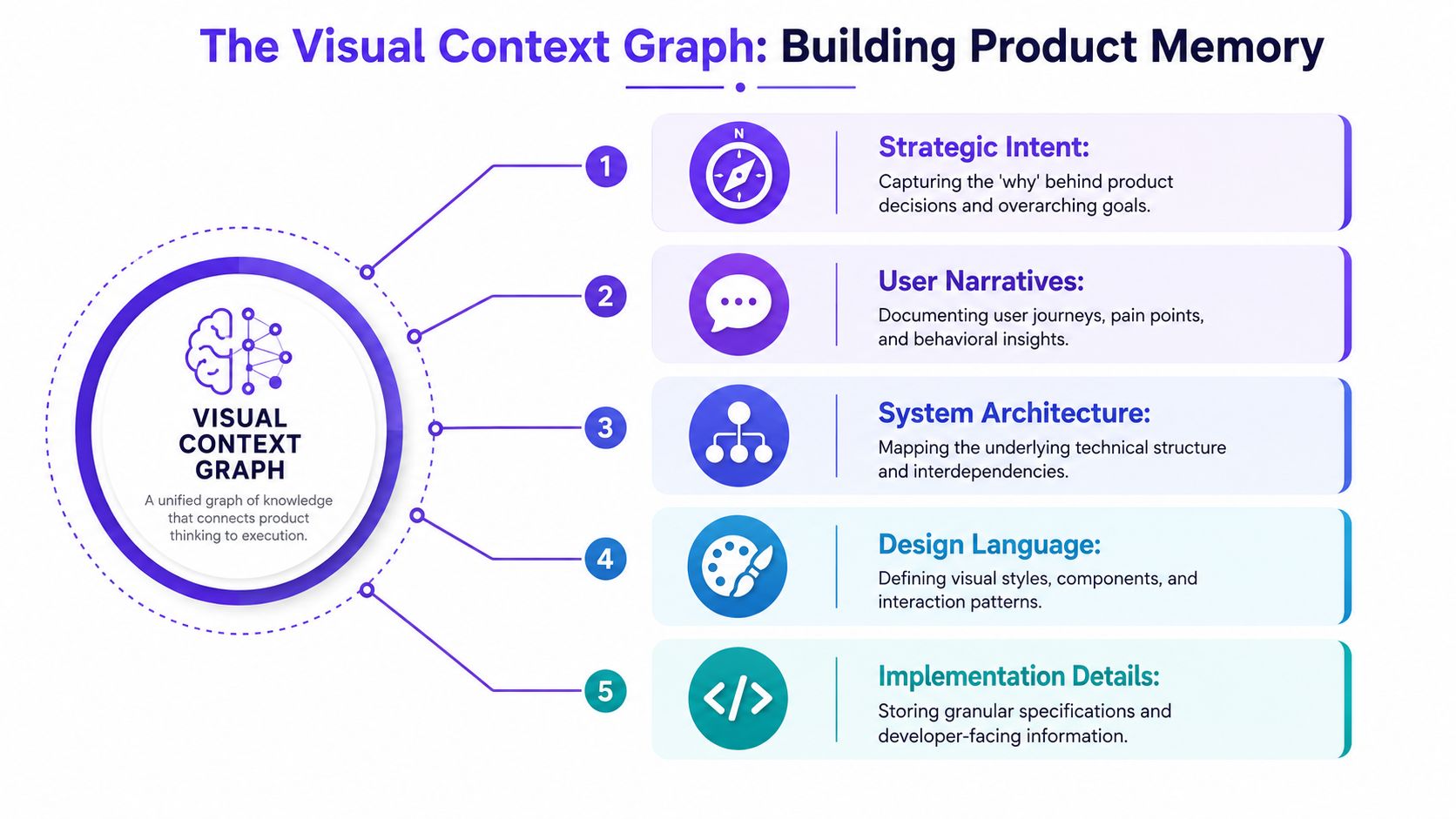
The layers are:
Visual context: Screens and frames
Behavioral context: Recordings and flows
Design System context: Tokens and components
Product Knowledge context: PRDs, research, and decisions
Implementation context: Code constraints
The quality of a draft depends on the memory behind it.
That matters in practical terms. Instead of asking a designer to infer your product from a short brief, the system can ground early artifacts in live screens, imported Figma structure, product docs, and known constraints. A Product Manager can prepare stronger starting points. A designer can spend more time on judgment and less time on recovery.
What that changes in the workflow
The payoff isn't magic. It's compression of setup work.
A Product Manager can capture the current product, ingest research and decision history into a Context Pod, and generate Figma-ready outputs that reflect existing patterns. Designers still need to review, refine, and make final calls. But they begin from a richer substrate.
That is why remembering decisions with AI matters so much in lean teams. The system doesn't replace the partnership. It makes the partnership less fragile.
Conclusion
A mismatched PM to designer ratio rarely fails all at once. It shows up as slower decisions, thinner design critique, more PM-owned wireframes than anyone planned for, and a team that starts confusing motion with progress. Over time, that hurts product quality and morale at the same time.
The ratio matters because it shapes who gets to think early, not just who reviews late. On healthy teams, designers have enough capacity to influence problem framing, flows, and trade-offs before scope hardens. On unhealthy teams, they get pulled in after key decisions are already made, and the work turns reactive. PMs feel that too. They absorb discovery gaps, patch rough UX with docs and annotations, and burn energy on work that should have been a shared loop.
AI changes part of the equation. It can help PMs produce better first drafts, organize context, and reduce blank-page time in early exploration. That helps lean teams, especially when design capacity is tight. It does not replace design judgment, interaction quality, or the value of a designer pushing back on a weak idea.
If your ratio feels off, start with the operating model before you start the hiring debate. Look at where design enters the process, where rework keeps appearing, and which work the PM has taken on to keep delivery moving.
FAQ
What is a good PM to designer ratio?
I use the product surface first. For user-facing teams, 1:1 is the cleanest partnership model. For some B2B or non-user-facing work, a leaner setup can still work if the workflows are stable.
How do I know if my ratio is too high?
I look for rework, delayed design involvement, and Product Managers doing too much informal design labor. If design mainly appears in review, the ratio is probably off.
Can a Product Manager do early design work?
Yes, I think rough exploration is often helpful. The trouble starts when the Product Manager becomes the default substitute for missing design capacity.
Does AI reduce the need for designers?
I wouldn't use it that way. AI can help me prepare better drafts, flows, and artifacts, but I still want a designer to shape interaction quality and challenge assumptions.
Should internal tools use the same ratio as customer-facing products?
Usually no. Internal tools, APIs, and low-UX surfaces often need a different staffing model than customer-facing experiences.
If your team is feeling the strain of a mismatched ratio, Figr is a practical next step. It helps Product Managers and designers work from shared product context, generate Figma-ready artifacts, and reduce the rework that comes from lost decisions. You can try Figr and see how much better the partnership gets when context stops leaking.