

This gap, between what was written and what was needed, creates a hidden liability. I call it Specification Debt: the cumulative cost of ambiguity that teams pay in the form of rework, missed deadlines, and demoralized engineers. A vague requirement is a loan taken out against future velocity, and the interest is paid with late-night fixes and frustrated sighs.
This isn't about writing longer documents. It is about creating shared understanding. A great PRD is like a musical score. It’s not just the notes on the page, but the tempo, the dynamics, and the rests between them that guide the orchestra to create a cohesive piece. Poorly defined specs are like a score with missing bars, forcing the musicians to guess what comes next.
The following product management best practices are a system for minimizing this debt. They are not a checklist but a way of thinking. They will show you how to build the right thing, the right way.
1. Data-Driven Decision Making
Your gut feeling is a powerful starting point, but it is a terrible closing argument. The most respected product management best practices are rooted in evidence, not just intuition. Data-driven decision making is the discipline of grounding your roadmap in quantitative and qualitative signals, turning user behavior into a compass for your product. It’s about trading the question "What do we think users want?" for "What do users actually do?"
Every significant user action, from a click to time spent on a task, is a vote. Aggregating these votes reveals patterns of preference, friction, and desire. This is how we move from guessing to knowing. Netflix famously uses viewing data to greenlight billion-dollar productions. They don't guess, they measure. Why should you?
How to Implement Data-Driven Decisions
Getting started requires a shift in mindset, not a data science PhD.
- Establish Baselines First: Before you change anything, you must know where you are. Measure the current conversion rate, task completion time, or engagement level. Without a baseline, you cannot prove your change had an impact.
- Run Structured Experiments: Do not just ship and see. Form a hypothesis ("We believe changing the button color will increase clicks by 10%"), define your success metric, and set a statistical significance threshold. A/B testing is your lab for verifying ideas.
- Conduct Drop-Off Analysis: Funnel analytics are your best friend for finding user pain. Where are users abandoning a process? A 40% drop-off between step 2 and step 3 of your sign-up flow is not a mystery, it is a bright, flashing sign telling you exactly where to focus your UX improvements.
By embracing a culture of experimentation and robust analytics, teams can make informed choices, moving beyond assumptions to foster continuous improvement. For instance, understanding how to apply data-driven design principles can be a real differentiator for your team's output.
How Figr Accelerates This Practice
Figr helps connect the "what" from your analytics to the "why" and "what's next" of product development. Instead of just seeing a drop-off rate in a dashboard, you can import analytics directly into Figr to visualize the problematic user flow. From there, you can brainstorm solutions, generate a PRD for the fix, and create test cases, all within one canvas. For example, after identifying a confusing Shopify checkout setup, a PM used Figr to map the old flow and then design and document the new, streamlined setup flow, linking data directly to design decisions.
2. User-Centric Design and Research
Building a product in a vacuum is like drawing a map of a city you have never visited. It might look plausible on paper, but it will fail the first person who tries to use it. User-centric design is the discipline of anchoring your product in the real world of your users: their needs, behaviors, and frustrations. It moves the focus from "What feature can we build?" to "What problem can we solve for them?"
The core idea is simple: the people who use your product know more about their problems than you do. Your job is not to invent solutions from scratch, but to listen, observe, and synthesize their reality into a coherent product experience. Last week I watched a PM spend two hours with five users testing a new flow. They discovered a fundamental flaw in their core assumption. That two hours saved what would have been six weeks of wasted engineering effort.
How to Implement User-Centric Research
You do not need a formal research lab to start. You just need curiosity and a willingness to listen.
- Start Early and Never Stop: User research is not a one-time phase at the beginning of a project. It is a continuous loop. Talk to users before you write a single line of code, test prototypes with them before development, and gather their feedback after launch.
- Prototype Before You Build: A high-fidelity prototype is your cheapest, fastest way to learn. It allows you to fail safely, on paper, before committing expensive engineering cycles.
- Map the Journey: Create a visual user journey map that documents every step, touchpoint, and emotion a user experiences while trying to accomplish a goal. The low points on this map are your product roadmap in disguise, pointing directly to the most valuable problems to solve.
By embedding continuous research into your process, you make the product resilient to your own biases. To explore this further, understanding the human-centered design process provides a structured way to apply these principles effectively.
How Figr Accelerates This Practice
Figr bridges the gap between watching a user and documenting the solution. Instead of messy notes from a user interview, you can import screenshots or a screen recording of the session directly into a Figr canvas. From there, you can map out the user's painful journey, generate user personas based on their behavior, and brainstorm improvements. For instance, after watching a user struggle, a PM can instantly create and share a prototype of an improved project UI, turning an observation into a testable artifact in minutes, not days.
3. Clear Product Requirements and Documentation
A verbal agreement in a meeting feels like alignment, but it evaporates the moment everyone logs off. Clear product requirements and documentation are the antidote to this collective amnesia. This product management best practice is the discipline of translating conversations and strategy into an unambiguous, shared source of truth for what to build, why it matters, and how to measure success. It is about moving from "I think we all agreed..." to "Here is the spec we are building against."
A Product Requirements Document (PRD) is not a bureaucratic checklist, it is an act of leadership. If you cannot write it down clearly, you do not understand it well enough. The legendary clarity of Stripe’s API documentation is not a byproduct of its success, it is foundational to it. They treat documentation as a core feature.
How to Implement Clear Product Documentation
Great documentation is an exercise in empathy for your engineering and design partners.
- Standardize with Templates: Do not reinvent the wheel for every feature. Create a PRD template that ensures every project starts with the same core questions answered: problem statement, user context, goals, and non-goals. Consistency breeds speed.
- Define "Done" Upfront: State the success metrics and acceptance criteria before a single line of code is written. What does a successful outcome look like for the user and for the business? How will the team know when they have achieved it?
- Embrace the Unhappy Paths: A feature’s quality is defined by how it handles failure. Documenting edge cases, error states, and empty states is not pessimistic, it is professional. Explore what happens in failure scenarios to prevent frantic, late-cycle decisions.
By treating documentation as a continuous, collaborative process, teams can drastically reduce ambiguity and costly rework. If you're interested in refining your approach, you can learn more about how to write an effective PRD and make it a team asset.
How Figr Accelerates This Practice
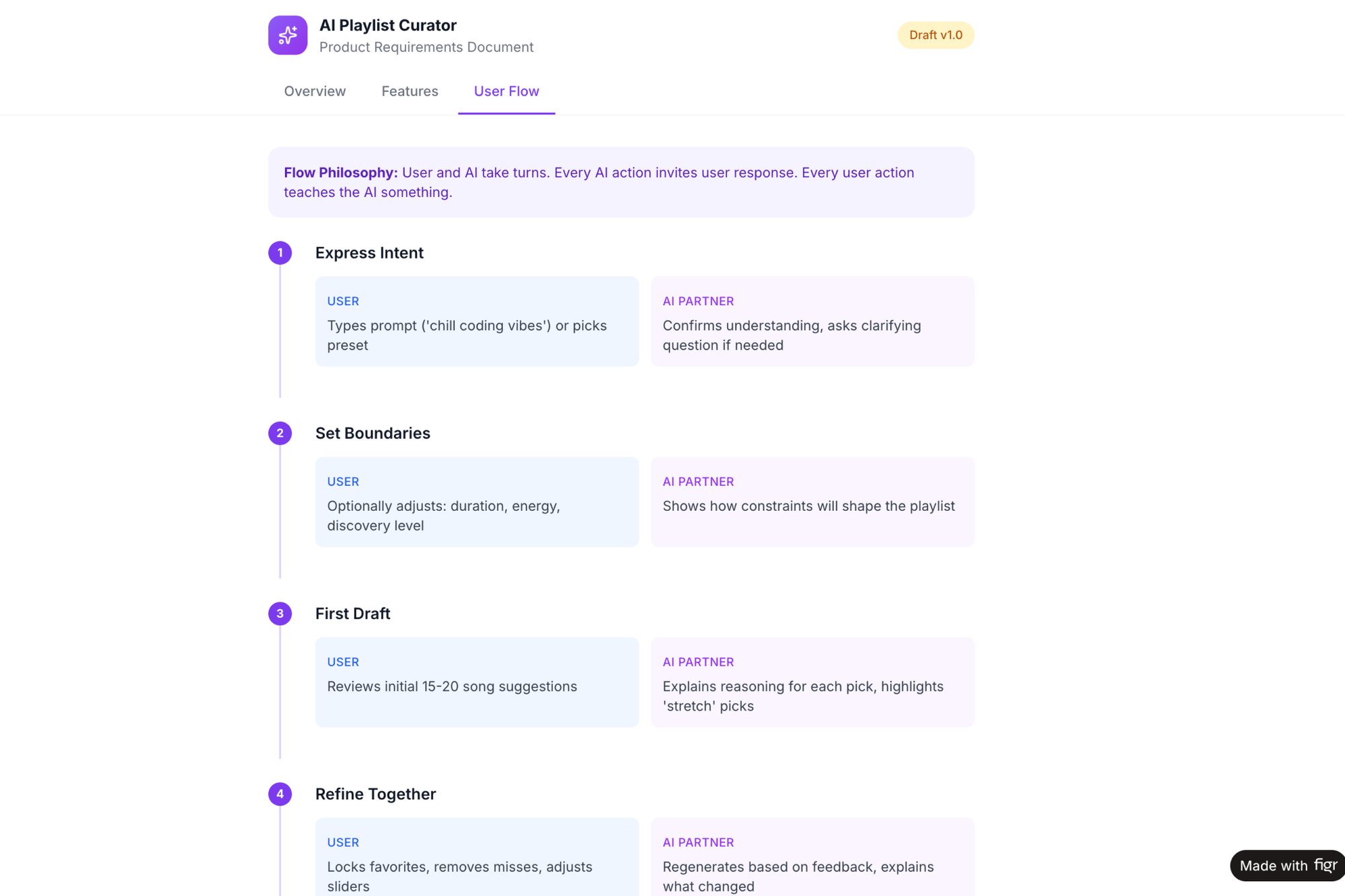
Figr turns documentation from a static chore into a dynamic, AI-assisted workflow. Instead of staring at a blank page, you can start with existing context, like a screen recording of a competitor’s flow. Figr can map this flow and then generate a first-draft PRD, complete with user stories, technical requirements, and acceptance criteria. For example, a PM researching a new feature like AI playlist curation for Spotify can get a structured PRD in minutes, ensuring the team starts with a strong, comprehensive foundation.
4. Rapid Prototyping and Iteration
A detailed PRD is a map, but a prototype is a test drive. One tells you where you’re supposed to go, the other tells you how the road actually feels. Rapid prototyping is the discipline of building just enough of an idea to make it real enough for a user to touch. It’s about converting abstract requirements into interactive questions, allowing you to learn from user reactions in hours, not months. This is a core tenet of effective product management best practices because it lowers the cost of being wrong.
The further you travel down the development road, the more expensive it is to turn back. A failed idea on a napkin is cheap. A fully coded feature that users ignore is a catastrophic waste of resources. Methodologies like Google Ventures' Design Sprint are built on this idea, compressing months of debate into a single week of building and testing a realistic prototype.
How to Implement Rapid Prototyping
This is not just about moving pixels around. It is about structuring your discovery process to prioritize learning.
- Start with Low-Fidelity: Begin with paper sketches or simple wireframes to validate the core concept. Is the problem you're solving the right one? Is the basic flow logical? Do not worry about colors or fonts yet.
- Test Multiple Variations: Do not fall in love with your first idea. Create two or three distinct approaches to solving the same problem and test them with users. This helps you discover which mental models resonate, not just whether a single design is "good."
- Establish Clear Feedback Loops: A prototype without a user is a decoration. Before you build, define what you need to learn. Set up moderated or unmoderated tests with specific tasks for users to complete and questions for them to answer.
By embracing this cycle, teams can fail small and fast, ensuring that by the time engineering writes the first line of code, the solution is already significantly de-risked. For a deeper dive, explore these best practices for prototyping in agile environments.
How Figr Accelerates This Practice
Figr turns prototyping from a specialized design task into a rapid product management activity. Instead of starting from a blank canvas, you can capture your existing product's screens and have Figr’s AI generate a high-fidelity, interactive prototype in minutes. From there, you can instantly test variations. For example, a PM could analyze the current job posting flow on LinkedIn, identify friction, and then use Figr to generate a streamlined experience prototype to validate with recruiters before writing a single line of a PRD.
5. Design System Adoption and Consistency
A product without a design system is like a city built without zoning laws. Every team builds what they need, how they want, and soon you have a confusing, inefficient sprawl. Design system adoption is one of the most crucial product management best practices for scaling teams because it provides a shared language of components, patterns, and rules. It’s the practice of creating a single source of truth that ensures a button in one part of your app looks and behaves exactly like a button in another.
The basic gist is this: instead of designers and engineers reinventing common elements for every new feature, they pull from a pre-approved, pre-built library. This is not just about consistent colors. It’s about functional predictability, which builds user trust and dramatically speeds up development. Systems like Shopify's Polaris are not just style guides, they are efficiency engines that codify countless design decisions so your team does not have to remake them.
How to Implement a Design System
Adopting a design system is a cultural shift, not just a technical one. It is about agreeing to build with Lego bricks instead of carving new parts from scratch every time.
- Start with Atomic Components: Do not try to boil the ocean. Begin by cataloging and standardizing your most-used elements like buttons, input fields, and modals. Brad Frost’s Atomic Design methodology provides a clear blueprint for this.
- Document Usage and Rationale: A component library without documentation is just a folder of assets. For each component, explain when and why to use it. What problem does it solve? What are the do's and don'ts?
- Establish Clear Governance: Who can add or change components? What is the review process? A design system needs a clear governance model to prevent it from becoming as chaotic as the product it was meant to organize.
By investing in a shared system, product teams reduce redundant work, eliminate design debt, and create a more cohesive user experience. You can find more practical advice on crafting a consistent app design system to get started.
How Figr Accelerates This Practice
Figr acts as the connective tissue between your design system and your product development workflow. Instead of just referencing a separate Figma file, you can bring your design system's principles directly into the ideation process. Figr can import your design tokens and component styles, ensuring that any AI-generated mockups or user flows automatically adhere to your brand's visual language. For example, a PM could use Figr to map out and visualize the states for a new task assignment component, confident that the generated UI concepts will use the correct, system-approved styles from the start.
6. Cross-Functional Collaboration and Alignment
A product spec is not a stone tablet passed down from the mountain, it is a conversation starter. The best product management practices treat product development not as a relay race but as a team sport. Cross-functional alignment is the discipline of creating a shared consciousness between departments, ensuring the team building the product shares the same vision as the team that conceived it.
This is what I mean: when engineering, design, marketing, and product all have a stake in the outcome and a voice in the process, you build a better product faster. You catch flawed logic before a single line of code is written. You surface technical constraints before a pixel is pushed. Spotify’s famous squad model is a testament to this, creating autonomous, cross-functional teams with a unified mission. They do not just ship features, they own outcomes.
How to Implement Cross-Functional Alignment
Getting started requires moving artifacts out of silos and into shared, living spaces. It is about co-creation, not just review cycles.
- Establish Clear Roles and Decision Authority: Use a DACI (Driver, Approver, Contributor, Informed) framework. Who gets a voice, who gets a vote, and who makes the final call? Documenting this prevents decision paralysis and endless debate.
- Create Shared Artifacts: The source of truth should be accessible to everyone. A PRD is good, but a visual flow diagram that connects the spec to the design to the test cases is better. These artifacts become the team's shared map.
- Hold Regular Design and Spec Reviews: Invite the full team, not just leads. An engineer might spot an edge case the PM missed. A QA tester might see a flow that is impossible to automate. This early feedback is exponentially cheaper than feedback found after a feature is built.
By building a culture of shared ownership, teams can reduce friction and accelerate execution. Agile and Scrum methodologies can provide the right cadence for this collaboration.
How Figr Accelerates This Practice
Figr acts as the shared whiteboard for the entire cross-functional team. It breaks down the walls between disciplines by connecting different artifacts into a single, coherent story. Instead of a PRD in a document, a design in Figma, and test cases in a spreadsheet, everything lives on one canvas. A PM can map out the logic for a new Mercury runway forecasting feature, linking it directly to the PRD. The engineer can see the exact flow, the designer can attach prototypes, and QA can generate and link test cases, all in one place, ensuring everyone is building the same product.
7. Comprehensive Quality Assurance and Testing
Shipping a feature is not the finish line, it’s the starting gun. Comprehensive Quality Assurance (QA) is the practice of treating quality not as an afterthought but as a core product feature. It’s the systematic process of finding what could break, before your users do. This discipline moves beyond just checking if a button works and into a deep exploration of edge cases, accessibility, and real-world failure modes.
Every feature you ship has an invisible twin, a collection of all the ways it can fail. Great QA is not about blaming developers, it is about making that invisible twin visible to everyone before it gets into production. A friend at a fintech company told me about a file upload feature that went from a two-week estimate to a six-week reality. Why? The PM specified one screen, but engineering found eleven edge-case states during development. Each state required design decisions, PM input, and multiple rounds of "what if..." conversations.
How to Implement Comprehensive Testing
You do not need a massive, dedicated QA department to start. You need to embed a quality-first mindset into your existing workflow.
- Involve QA from Day One: Bring your QA lead or a quality-focused engineer into the very first design and PRD reviews. They are trained to see the "what ifs" that designers and PMs might miss.
- Prioritize Ruthlessly: You cannot test everything with the same intensity. Focus your manual and automated testing efforts on high-impact user flows like sign-up, checkout, and core value-delivery actions. A bug in the "change your avatar" flow is an annoyance, a bug in the payment flow is a catastrophe.
- Automate Regression Testing: Your team’s velocity is directly tied to the confidence they have in making changes. Automated regression suites act as a safety net, ensuring a new feature does not silently break another. To deliver a high-quality product, product managers must understand Mastering Software Quality Assurance Processes.
By integrating functional, accessibility, and edge case testing throughout the development cycle, teams build a more robust and trustworthy product.
How Figr Accelerates This Practice
Figr bridges the gap between design intent and testable reality. Instead of QA engineers manually interpreting a design spec to write test cases, they can use Figr to autogenerate them directly from the user flow and design logic. For instance, when designing a complex feature like modifying a ride-sharing trip, a PM can map the flow in Figr, which can then generate a comprehensive suite of test cases for Waymo’s trip modification feature. This ensures every possible state change, user input, and error condition is accounted for.
8. Accessibility-First Design and Implementation
We often design for an idealized user, a persona with perfect vision, steady hands, and no cognitive strain. Reality is a spectrum of ability. Accessibility-first design is the practice of creating products for the full range of human experience from the start, not as a final, rushed checklist item. It's the difference between bolting a ramp onto the side of a building and designing the entrance with a gentle, integrated slope for everyone.
The basic gist is this: by building for users with permanent, temporary, or situational disabilities, you create a better, more robust experience for all users. Microsoft’s inclusive design principles show how a solution for one, like high-contrast mode for a person with low vision, often helps many, like someone using their phone in direct sunlight. This is not just about compliance, it is about expanding your market and improving usability at its core.
How to Implement Accessibility-First Design
This practice demands intentionality, not just good intentions. It must be woven into the fabric of your development process.
- Set a Clear Standard: Adopt the Web Content Accessibility Guidelines (WCAG) 2.1 Level AA as your non-negotiable baseline. This provides concrete, testable criteria for everything from color contrast to keyboard navigation.
- Specify in the PRD: Accessibility requirements are product requirements. Your user stories and PRDs should explicitly call out the need for
alttext, ARIA labels, and keyboard-only functionality. Make it part of the definition of "done." - Test Early and with Real Tools: Do not wait for a pre-launch audit. Use automated browser extensions and linters in your development pipeline. Crucially, conduct regular usability tests with people who actually use screen readers, magnifiers, and other assistive technologies.
By making accessibility a foundational part of your product management best practices, you build products that are not just functional, but equitable and truly user-centered.
How Figr Accelerates This Practice
Figr helps you move from abstract accessibility guidelines to concrete design and testing. You can take screenshots of a confusing flow, like the one in this Skyscanner elder-friendly audit, and use Figr to pinpoint specific WCAG violations. Based on this audit, you can then generate redesigned mockups that fix contrast issues, increase tap target sizes, and simplify language, all on the same canvas. This allows you to document test cases for assistive tech, ensuring the engineering team has clear, actionable requirements.
9. Product Analytics and Metrics Definition
Saying your product is "good" is like saying the weather is "nice." It’s a pleasant, but ultimately meaningless, sentiment. Great product management best practices demand precision. Product analytics and metrics definition is the discipline of translating vague goals like "user engagement" into a specific, measurable, and actionable set of numbers. It is about building a shared language of success that everyone understands.
You cannot improve what you cannot measure. Defining your metrics is like choosing the instruments for an orchestra; each one tracks a different part of the performance, but together they create the full picture of your product's health. Why does this matter at scale? The incentives driving your teams are directly tied to the metrics you celebrate. If you only reward shipping new features, you get a bloated product. If you reward improving an activation metric, you get a focused, value-driven product.
How to Implement Product Analytics and Metrics
This is not just about throwing charts on a dashboard. It is about creating a coherent system for understanding value.
- Define Your North Star Metric: Start with the one metric that best captures the core value you deliver to customers. It should align directly with your business goals. For Airbnb, it’s nights booked. For Spotify, it is time spent listening. What is yours?
- Distinguish Leading from Lagging Indicators: Lagging indicators (like monthly revenue) tell you what happened. Leading indicators (like daily sign-ups or features adopted per user) predict what will happen. A strong metrics framework balances both.
- Establish Actionable Thresholds: Do not just watch the numbers go up or down. Set alerts for significant anomalies. A 10% drop in your key activation metric is not just data, it is a fire alarm telling your team to investigate immediately.
By defining a clear hierarchy of metrics, from a single North Star down to specific feature-level KPIs, teams can ensure their daily work contributes directly to long-term success.
How Figr Accelerates This Practice
Figr acts as the bridge between your raw metrics and strategic action. Instead of staring at a funnel analysis in your analytics tool and wondering what to do, you can visualize that user journey directly in a Figr canvas. This allows you to connect a quantitative drop-off with the qualitative experience. For example, after identifying poor engagement with a new checkout process, a PM can use Figr to document the broken flow, then design and create a PRD for a new, streamlined setup flow that directly addresses the friction points revealed by the data.
10. Continuous Learning and Experimentation Culture
A roadmap is a declaration of intent, not a prophecy. The space between what you plan and what the market wants is where the most valuable learning occurs. A culture of continuous learning and experimentation is the engine that closes this gap. It is about turning product development into a series of small, calculated bets instead of a single, high-stakes gamble. This is one of the most vital product management best practices for avoiding costly mistakes.
The core idea is to treat every feature as a hypothesis to be tested. Amazon's "Day 1" culture is built on this foundation, relentlessly experimenting to find what delights customers. Booking.com runs thousands of A/B tests concurrently, allowing user behavior, not executive opinion, to dictate design. They do not assume they know the answer; they build systems to discover it.
How to Implement a Culture of Experimentation
You do not need a massive team to start. You need a disciplined process for asking questions and listening to the answers.
- Formalize Your Hypotheses: Do not just "try things." Frame every test with a clear statement: "We believe that [change] for [user segment] will result in [measurable outcome]. We will know this is true when we see [metric] change by [amount]." This forces clarity.
- Isolate Your Variables: To know what worked, you must test one significant change at a time. If you change the headline, the button color, and the page layout all at once, your results are a noisy mess.
- Document and Share Everything: Create a central repository for all experiment results, especially the failures. A failed test that teaches you what not to do is more valuable than a minor win. Sharing these lessons prevents teams from repeating others' mistakes.
By building a systematic approach to testing, you replace opinion-based arguments with evidence-based conversations, accelerating your path to product-market fit.
How Figr Accelerates This Practice
Figr acts as a lab for your product hypotheses. Instead of just theorizing about a better experience, you can build and document test variations with incredible speed. For instance, when comparing two competing products like Cal.com and Calendly, you can map their flows side-by-side, identify friction, and then design a superior third option. From this analysis, Figr can generate the A/B testing results document and the corresponding test cases needed to validate your new design, ensuring every experiment is well-documented.
Your Next Move
The practices we have explored are not items on a checklist. They are not trophies to collect. They form a system, a set of interconnected disciplines that shift a team's center of gravity from outputs to outcomes. From shipping features to solving real problems.
Think of a product team as an orchestra. A clear product requirements document is the musical score. Data is the tuning fork, ensuring every instrument starts from the same objective note. The product manager is the conductor.
A novice conductor just waves the baton, keeping time. An expert conductor, however, listens. They hear the subtle dissonance between the woodwinds and the strings. They adjust the tempo to give a complex passage room to breathe. They don't just lead, they integrate. They make the individual sections sound like a cohesive, powerful whole. This is the essence of great product management. It is the art of listening, adjusting, and unifying the efforts of a talented group of people toward a single, resonant goal.
Mastering these product management best practices is about moving from merely managing a backlog to conducting an orchestra. It’s about building the muscle memory for deep user empathy and the discipline to define success before you start building. This is what separates teams that ship code from teams that ship value.
"Specification is a discovery. You don't know what you need to build until you start specifying it." - Ryan Singer, Shape Up
In short, the most significant barrier to deep work is the ambiguity hiding in plain sight. We think a user flow is simple, like a card freeze feature in a banking app. But when we map it, we find a dozen states: card already frozen, card expired, network error, confirmation screen, and so on. A tool like Figr can help generate these test cases and edge cases simulations, but the critical first step is simply seeing them.
So, here is your next move.
This week, pick one user flow in your product. Map it out. I mean every possible error, every empty state, every loading state, every point of potential confusion. You will almost certainly find more states than you expect.
That gap, the space between the one path you imagined and the dozen that actually exist, is your first piece of specification debt. Naming it is the first step to fixing it. That is where real product craft begins.
Tired of discovering edge cases and UI states halfway through a sprint? Figr helps you map user flows, generate test cases, and create interactive prototypes from a few screenshots or a screen recording. Stop the endless back-and-forth and start building with clarity. Explore the Figr canvases and see how fast you can turn ambiguity into actionable specs. One of the most critical best practices is building a roadmap that drives alignment. For the complete methodology, see our product roadmap guide.