

Rather than a collaboration problem, teams frequently face a shared-context problem. Product Managers write the brief, Designers explore solutions, engineers arrive later with constraints, and everyone wonders why the same feature gets debated three times.
When that gap stays open, work starts to drift. A roadmap item becomes a handoff, then a redesign, then a feasibility reset. I watched a Product Manager recently spend days aligning comments across a doc, a Figma file, and a Slack thread, only to learn in review that the team had been solving three different versions of the same problem. That's how trust erodes, expensively.
A better collaborative product design process gives the team one operating surface from day one. When shared context includes screens, flows, research, design system rules, decisions, and implementation constraints, product and design stop arguing from partial truths. That's the bridge: a common memory, a visible decision model, and a workflow that keeps learning attached to the work.
Why Product and Design Thinking Feel Like They Are in Conflict
Product and design usually feel misaligned because they optimize for different risks.
Product thinking asks whether the team is solving the right business problem, at the right time, with the right trade-offs. Design thinking asks whether the team understands the user well enough to create something people can use, trust, and adopt. Both are necessary. Both are incomplete on their own.
The friction starts when each discipline believes it owns the truth.
I've seen this pattern enough times that it deserves a name: the mirrored mandate. Product protects focus. Design protects fidelity to the user. Both are doing their job, but without a shared decision model, each side experiences the other as drag.
The conflict is usually structural
A lot of teams diagnose this as a personality issue. It rarely is.
The sharper diagnosis comes from what Plane describes as the decision-governance problem: teams need a repeatable way to move from shared context to final calls without slowing execution, especially when priorities shift or user evidence conflicts with delivery constraints. That's the fundamental tension. Who decides what, when the evidence is mixed and time is short?
This is what I mean: the dispute isn't “strategy versus empathy.” The dispute is often “which evidence carries more weight in this moment, and who has the authority to close the loop?”
That's why healthy PM-designer collaboration with AI matters. A shared system can hold more than the final mock. It can hold the rationale, the assumptions, the rejected options, and the trade-offs that shaped the final call.
Different lenses, same product reality
Product leaders tend to think in bets, sequencing, opportunity cost, and outcome ownership. Designers tend to think in user intent, interaction quality, comprehension, and edge-case behavior. Engineers bring another essential lens, system behavior under real constraints.
None of that is conflict by itself.
Conflict appears when these lenses show up sequentially instead of simultaneously. Product defines first. Design interprets next. Engineering reacts last. By then, the team isn't collaborating. It's renegotiating.
Practical rule: If a key decision can't survive contact with engineering constraints or user evidence, it wasn't a decision yet. It was a draft.
A collaborative product design process works when all three functions shape the problem while it's still movable. That sounds obvious. Why is it still rare? Because teams frequently still treat context as meeting output instead of shared infrastructure.
How to Map the Two Competing Workflows
Product and design often follow two parallel workflows that look coordinated from the outside and feel disconnected from the inside.
Early in a project, both functions usually believe they're aligned. The Product Manager has the business case, the Designer has early discovery, and everyone says the same words in kickoff. Then the workflows diverge. Product starts narrowing. Design starts exploring. One tries to reduce ambiguity, the other tries to surface it.
That divergence is normal. The problem is that organizations often fail to map it explicitly.
Product thinking and design thinking diverge across every dimension that matters. Their primary goals split first: product thinking exists to define market need and business value, while design thinking exists to understand user problems and shape usable solutions. The core motions follow from that. Product runs on hypothesize, prioritize, scope, and measure. Design runs on research, define, ideate, prototype, and test.
The artifacts each produces look different too. Product leaves behind briefs, PRDs, priorities, and release logic. Design leaves behind flows, journey maps, prototypes, and interaction rationale. Each discipline also fails in a characteristic way. Product tends to over-scope before the evidence is clear. Design tends to over-explore without a decision frame.
That tells you when to lead with each. Product thinking is the right tool for ambiguous business bets. Design thinking is the right tool for ambiguous user behavior or usability problems. Underneath it all sits a different fear driving each side: product is afraid of building the wrong thing, while design is afraid of building the right thing poorly.
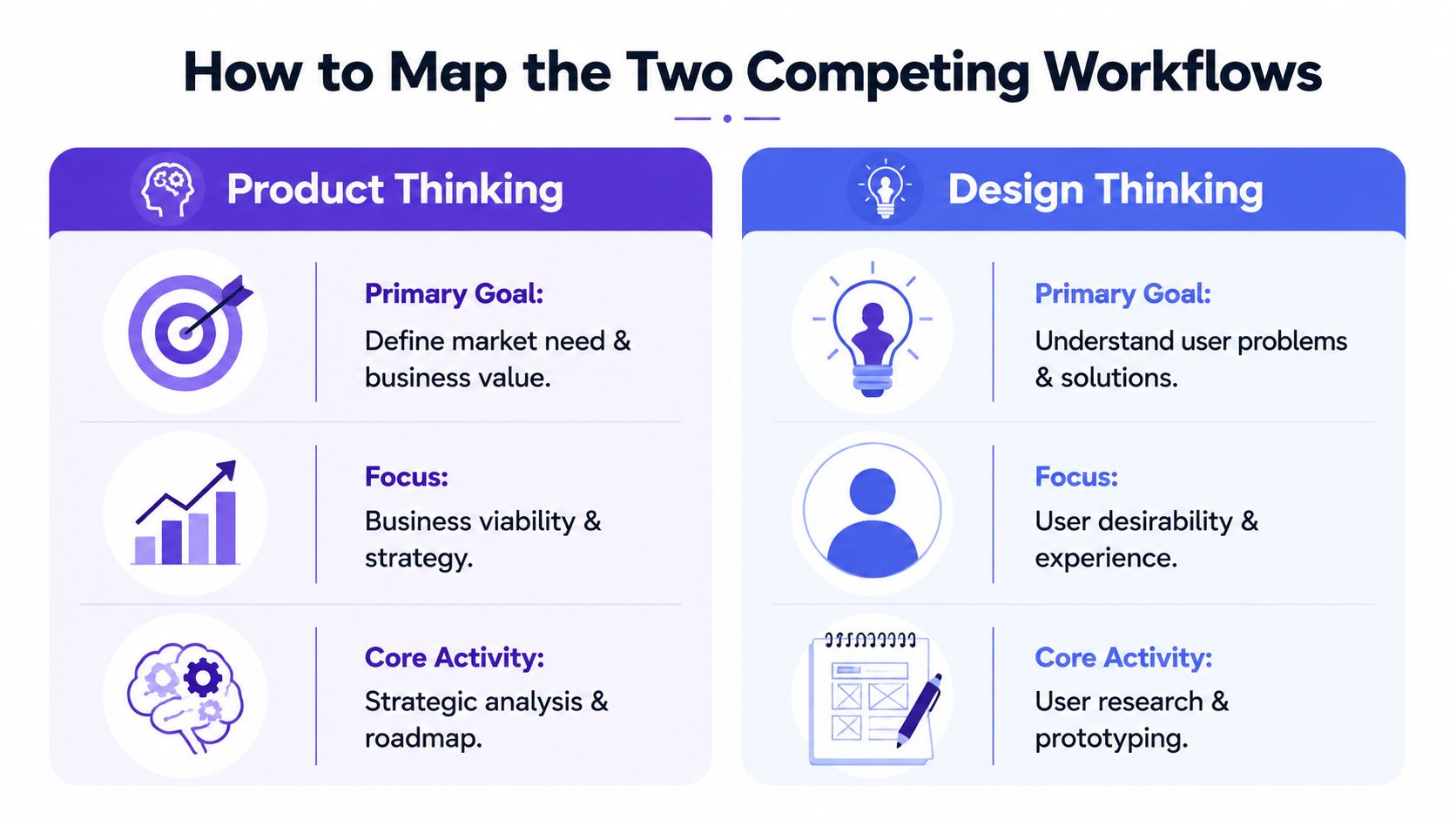
Why the maps drift apart
Product workflow usually converges earlier. It wants a clear problem statement, bounded scope, known dependencies, and a path to delivery. Design workflow often needs more divergence before convergence. It wants to test assumptions, compare flows, inspect behavior, and understand edge states before locking structure.
That difference creates a familiar failure pattern: product experiences design as wandering, design experiences product as premature compression.
Neither side is wrong. They're just operating from different clocks.
The basic gist is this: product treats ambiguity as risk to reduce, design treats ambiguity as signal to inspect. A mature team knows when to do each.
What the map helps you diagnose
Once you name the two workflows, a lot of recurring friction becomes easier to debug.
If product is frustrated, the team may lack a narrowing mechanism.
If design is frustrated, the team may lack enough context to explore the problem properly.
If engineering is frustrated, the team may be receiving outputs without the assumptions behind them.
For Product Managers, one useful discipline is process mapping before solutioning. Figr's guide for product managers is helpful here because it pushes teams to visualize the work as a system rather than a sequence of isolated handoffs.
Teams rarely fail because they had too many ideas. They fail because the route from idea to decision stayed invisible.
When you map both workflows side by side, you stop asking which one should win. You start asking where they need to sync, where they should remain independent, and what artifact carries context across the gap.
What Does Healthy Collaboration Actually Look Like
Healthy collaboration is visible in team behavior long before it shows up in output quality.
A lot of teams mistake collaboration for calendar density. More workshops. More review sessions. More people in the file. But Figma's research on collaboration found something more useful: while co-creation matters in sprints, the most consistently needed behaviors are reflection and role clarity, and high-performing teams preserve decision records and build review loops after the live session so they can reduce the need for another meeting, as explained in Figma's collaboration research.
That finding matches what experienced teams already feel in practice. Live sessions create energy. Asynchronous systems create continuity.
The signals of a healthy team
You can usually spot a strong collaborative product design process through small signals:
Clear decision owners: Everyone can contribute, but someone closes the loop.
Session traceability: The team can explain why a choice was made without reconstructing a Slack archaeology dig.
Asynchronous review: Comments, follow-up, and iteration continue after the room goes quiet.
Multiple participation channels: Voice helps some people think, writing helps others, and teams need both.
Review discipline: Feedback is tied to goals, constraints, or evidence, not preference.
That's also why mature teams often borrow practices from strong collaborative project management systems. The useful lesson isn't more process. It's that work moves faster when ownership, state, and next actions stay visible.
Collaboration is shared memory
Last week I watched a Designer walk a team through a promising flow. The session itself went well. People nodded, raised risks, suggested edits. Two days later, the same issues resurfaced because the team had captured comments but not decisions. That's the quiet tax of missing memory.
A good review process stores more than opinions. It stores intent.
That's where a documented review cadence matters. Figr's stakeholder review playbook is a good example of the kind of structure teams need: who reviews, what kind of feedback belongs at each stage, and what gets recorded so the same meeting doesn't happen twice.
Healthy collaboration feels lighter, not louder.
The zoom-out matters here. At scale, teams don't slow down because people stopped caring. They slow down because ambiguity compounds faster than shared understanding. Reflection and role clarity aren't soft skills around the edges of the work. They are the work.
The Three Anti-Patterns of Collaborative Design
Most collaboration failures are predictable long before a release slips.
The dangerous part is that they often look reasonable in the moment. A quick handoff feels efficient. Broad stakeholder input sounds inclusive. One person holding all the discovery context can seem practical. Then the cost arrives later, usually as churn in the process rather than in the roadmap.
The throw-it-over-the-wall handoff
This pattern shows up when discovery, design, and build happen in sequence, with context thinning at each stage.
The Product Manager writes the brief. The Designer turns it into screens. Engineering gets a walkthrough near the end. Everyone is moving fast, until the first technical or behavioral surprise appears. Then the team realizes the artifact moved forward, but the understanding didn't.
Symptoms include:
Late feasibility reversals
Missing states and transitions
Design intent lost in implementation
Repeated “we assumed” conversations
If this sounds familiar, it helps to uncover root causes of handoff problems at the system level, not just at the artifact level.
Design by committee
This one is subtler, because it hides behind the language of alignment.
The team invites everyone to weigh in, but no one is clear on what kind of feedback they own. The result is a pile of preferences masquerading as strategy. One person wants more density. Another wants less. Someone asks for a variant based on an anecdote. The Designer keeps editing. The Product Manager keeps translating. No one is deciding.
The long-term damage is worse than delay. The team starts rewarding the safest idea, not the clearest one.
When every stakeholder has input but no one has decision rights, collaboration turns into dilution.
The discovery bottleneck
I've seen this most often on fast-moving teams with a strong individual contributor. One person, often the Product Manager or lead Designer, becomes the human API for all context. They know the research, the constraints, the edge cases, the old decisions, and the customer nuance. Everyone depends on them.
It works until it doesn't.
Once that happens, progress waits for availability. Reviews stall because only one person can explain the rationale. New teammates struggle to contribute because they inherit artifacts without the thinking behind them.
A collaborative product design process needs shared context that survives calendars and role changes. Otherwise the team confuses heroics with maturity.
A Practical Workflow for Unified Product and Design Work
A unified workflow starts with shared context, not shared opinions.
That matters because collaborative design is a multi-stage process that moves from problem definition and research to ideation, prototyping, evaluation, and implementation, with repeated feedback loops throughout, as outlined in this collaborative design process overview. Teams that skip those loops usually pay for it later in rework.
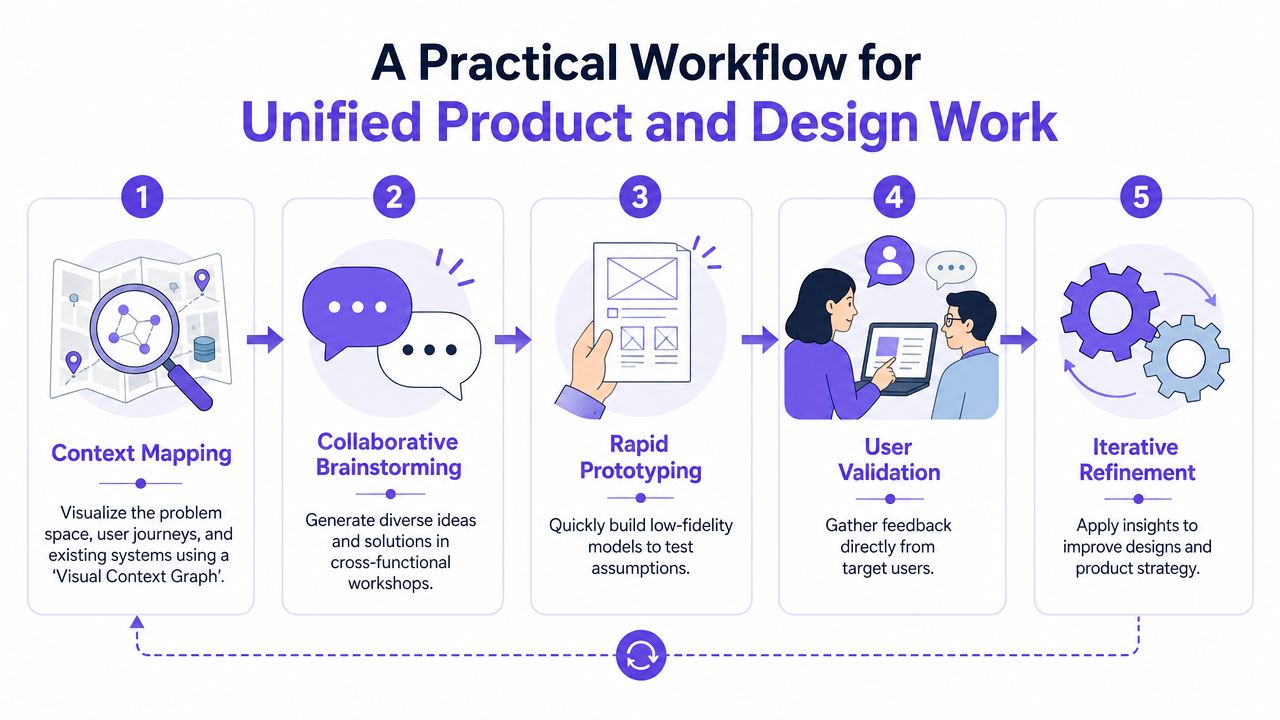
The workflow that actually holds up
Step 1. Build a shared Context Pod.
Pull in the working materials before anyone starts solutioning.
That usually includes PRDs, user research notes, analytics observations, live screens, design system references, and existing decisions.
The goal is simple: nobody should have to guess what the product already knows.
Step 2. Frame the problem together.
The Product Manager defines the business outcome and constraints.
The Designer reframes the user problem, flow risks, and interaction questions.
Engineering pressure-tests feasibility while the work is still cheap to change.
Step 3. Visualize flows before polishing screens.
Map the current journey, the desired path, and the branches that create edge cases.
Identify states early:
Entry states
Empty states
Error states
Permission or role states
Partial completion states
Step 4. Co-create the first real draft.
Use live sessions for divergence, especially when the team needs to compare routes quickly.
Keep the artifact close to reality, not generic wireframes that erase system constraints.
Generate review-ready flows and prototypes that preserve structure, logic, and state behavior.
A quick walkthrough helps if your team needs to see the rhythm in motion.
Step 5. Review asynchronously and record final calls.
After the live session, move feedback into a durable decision record.
Assign decision owners for open questions.
Track which issues are resolved without another meeting.
Where teams usually break the chain
The failure isn't usually in ideation. It's in translation.
A friend at a Series C company told me their team kept redesigning the same billing flow. They had strong people and solid intent. What they lacked was a persistent object that held the why, the flow logic, the edge cases, and the implementation constraints in one place. Each function kept reconstructing the problem from its own source material.
One practical option is Figr, which can ingest product context from live screens, Figma files, PRDs, research, analytics, and design systems into a shared Context Pod, then generate artifacts like edge case maps, flows, prototypes, and Figma-ready outputs tied to that context. Used well, that kind of system reduces blank-canvas work and keeps product, design, and engineering anchored to the same source of truth.
How AI Accelerates Product Thinking Outcomes
AI becomes useful in product design when it helps the team converge faster on a justified decision.
That's the part many teams miss. They use AI to produce more options, more drafts, more surface area. True gain comes when AI helps compare alternatives against a target, explain trade-offs, and carry strategic context forward into artifacts the team can use.
From design debate to measurable selection
A study of professional designers using decision-making AI found a workflow where teams compared candidate designs against a benchmark score, turning subjective review into a measurable selection problem, as described in the AI-assisted design decision study.
That matters for product thinking because Product Managers constantly have to justify why one route should move forward over another. If two flows are both plausible, the question shifts from “which one do we like” to “which one better meets the target under the constraints we've set.”
That is a far more useful conversation.
Where this changes daily work
Take a gallery-style workflow like the checkout redesign examples on Figr's gallery. The useful pattern isn't the screen itself. It's the chain underneath it: problem framing, current-state capture, flow comparison, edge-case coverage, and artifact generation that can move back into delivery. That's where AI starts helping product thinking outcomes, not just design throughput.
When teams need stronger upstream signal, external inputs can help too. For example, teams doing discovery or category analysis can use resources like GoldMine AI market research to sharpen market context before they narrow product direction. That kind of input works best when it feeds the same shared system the team uses for design decisions.
streamlining UX with AI agents becomes meaningful when the agent isn't inventing a detached interface. It's working from actual product memory, actual constraints, and actual decision criteria.
The best use of AI in product work is convergence with receipts.
Why the Visual Context Graph Is the Foundation
A collaborative product design process breaks when the team can't see how product knowledge connects to interface decisions.
That's why the Visual Context Graph matters. It gives the team a shared map of the product across five connected layers, so decisions don't float free from the reality they need to serve.
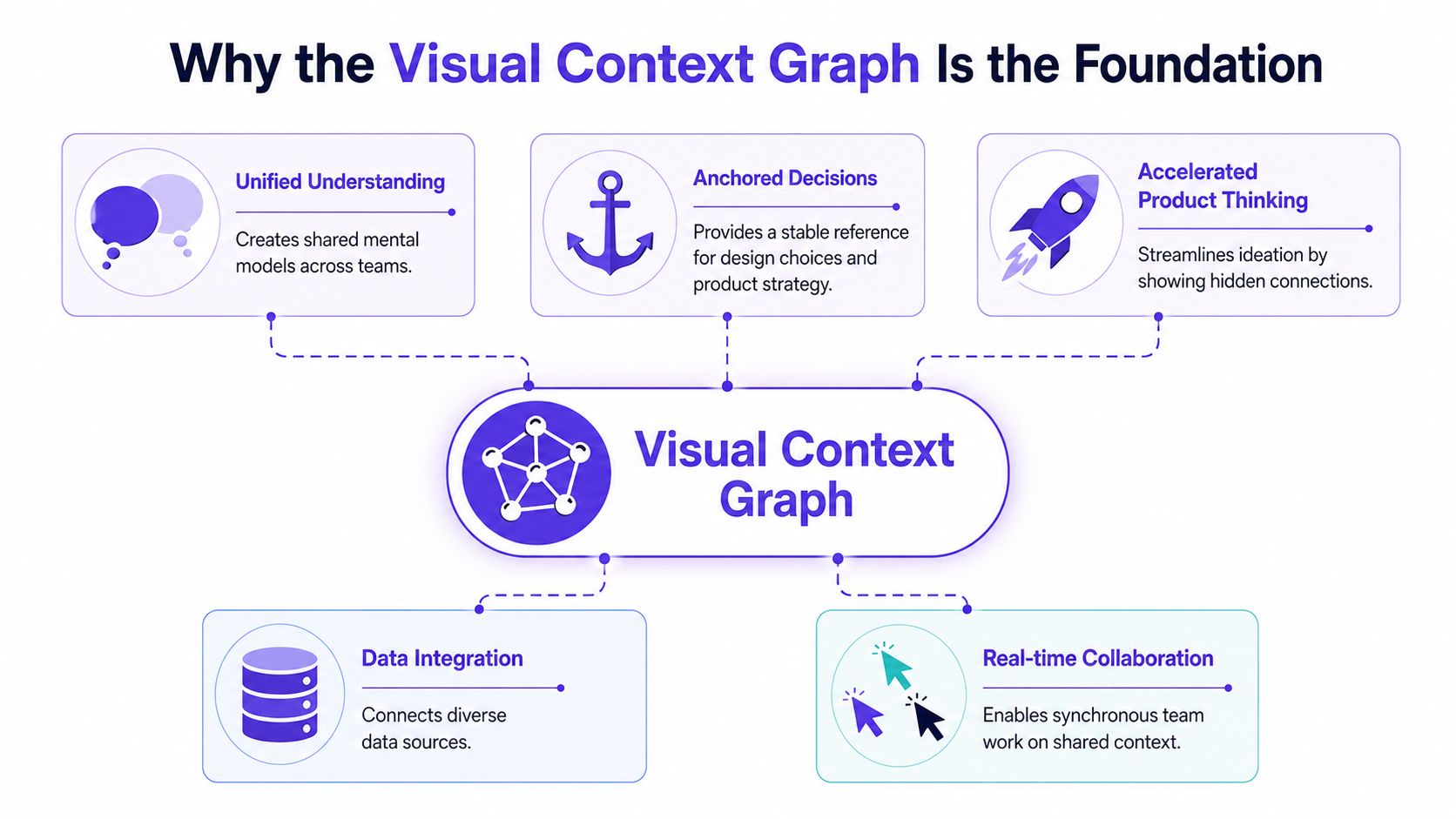
The five layers that remove ambiguity
Visual context- is the screens, frames, and layout patterns. It grounds decisions in what already exists.
Behavioral context- is the recordings, journeys, and task flows. It shows how users actually move through the product.
Design System context- is the tokens, components, variants, and usage rules. It keeps exploration aligned with the system.
Product Knowledge context- is the PRDs, research, decisions, and briefs. It preserves rationale and intent.
Implementation context- is the code constraints, technical patterns, and feasibility limits. It stops outputs that look plausible but break in delivery.
When these layers stay disconnected, teams keep making local decisions without global understanding. A screen may look clean and still break the logic of the flow. A flow may satisfy research and still violate system constraints. A component may be perfectly styled and still fail the delivery model.
Why this changes collaboration quality
I think of the Visual Context Graph as an antidote to context flattening. That's the failure mode where a product team reduces a rich problem into a few screenshots and a few comments, then expects everyone else to infer the rest.
The graph restores dimensionality.
Visual context keeps teams anchored to the product they have.
Behavioral context reveals where friction lives in real usage.
Design System context protects consistency and speeds decisions.
Product Knowledge context stores why the team chose a path.
Implementation context keeps ambition attached to feasibility.
A screen without context is decoration. A decision without context is drift.
The practical implication is simple. When product, design, and engineering can inspect the same graph, the conversation changes. Fewer debates start from memory. More decisions start from evidence attached to the work.
When to Use Which Approach A Decision Guide
The right starting point depends on the dominant uncertainty in front of the team.
Some problems are mostly strategic. You're unsure whether the opportunity matters, whether the business case is real, or whether the sequencing makes sense. Other problems are mostly experiential. You know the opportunity matters, but users are getting lost, dropping off, or mistrusting the flow. The mistake is starting every project with the same motion.
Start with product thinking when the bet is unclear
Lead with product thinking when the business-side unknowns are heavier than the interaction-side unknowns.
Use that approach when:
The market need is still fuzzy
The release logic affects multiple teams or systems
The team is choosing between competing opportunities
Feasibility or scope risk could change the whole direction
In those cases, the Product Manager has to narrow the frame first. The Designer should still be involved early, but the main job is clarifying the bet.
Start with design thinking when behavior is the unknown
Lead with design thinking when the team already believes in the opportunity, but doesn't yet understand the user behavior well enough to shape the right solution.
Use that approach when:
The product exists but the experience feels confusing
A key flow has friction the team can't explain cleanly
The main risk is poor usability, low trust, or weak comprehension
The team needs to explore multiple interaction models before scoping delivery
That doesn't mean product steps back. It means product gives design enough room to investigate before compressing choices too early.
Use a blended start when the system is complex
Many SaaS projects need both from day one. Billing, permissions, onboarding, analytics, admin settings, approval flows, and AI-assisted experiences often combine strategic uncertainty with interaction uncertainty. In those cases, the collaborative product design process has to start with shared context, not a functional order of operations.
That choice has real business implications. A Team International report found that 61% of companies produced more successful products and 51% improved financial performance after adopting collaborative product development practices, according to Team International's report on collaborative product development. Structured collaboration isn't a nice-to-have. It changes outcomes.
If your team is tired of rebuilding context every sprint, start smaller than you think. Pick one feature, gather relevant artifacts, make decision ownership explicit, and run the work through a single shared context layer from discovery through review. That one move usually reveals where your process is breaking. If you want a system built for that style of work, try Figr.
A strong collaborative product design process doesn't ask product, design, and engineering to think the same way. It gives them a way to think together without losing the value of their differences.
The pattern to avoid is familiar now: handoffs without context, reviews without decision rights, and discovery trapped in one person's head. The alternative is also clear: shared context from day one, visible governance, and artifacts that preserve both rationale and reality.
If you remember one idea from this piece, make it this one: friction between product thinking and design thinking is usually a systems issue. When the team can see the same product, the same constraints, and the same decision history, conflict becomes useful instead of expensive.
The next move is practical. Audit one active project. Ask where context lives, who owns final calls, which decisions are recorded, and whether engineering can see the reasoning before handoff. Then fix the gap at the workflow level, not in another meeting.
FAQ
How do I know if our collaborative product design process is actually broken
I look for repeated debates, late feasibility surprises, and missing decision records. If your team keeps reopening the same questions, the process is leaking context.
Should the Product Manager or Designer own the process
I wouldn't make one role “own” the whole process. The Product Manager usually owns prioritization, the Designer owns experience quality, and the team needs explicit decision rights for shared trade-offs.
Do we need more meetings to collaborate better
Usually no. I've seen better outcomes come from fewer live sessions and better asynchronous review, as long as the team records decisions and keeps context visible.
Where does engineering fit in this workflow
Engineering should shape the problem while it's still flexible. If engineers only appear at handoff, the team is collaborating too late.
Can AI help without replacing judgment
Yes. I use AI as a way to organize context, compare options, and accelerate artifact creation. Judgment still belongs to the team.