
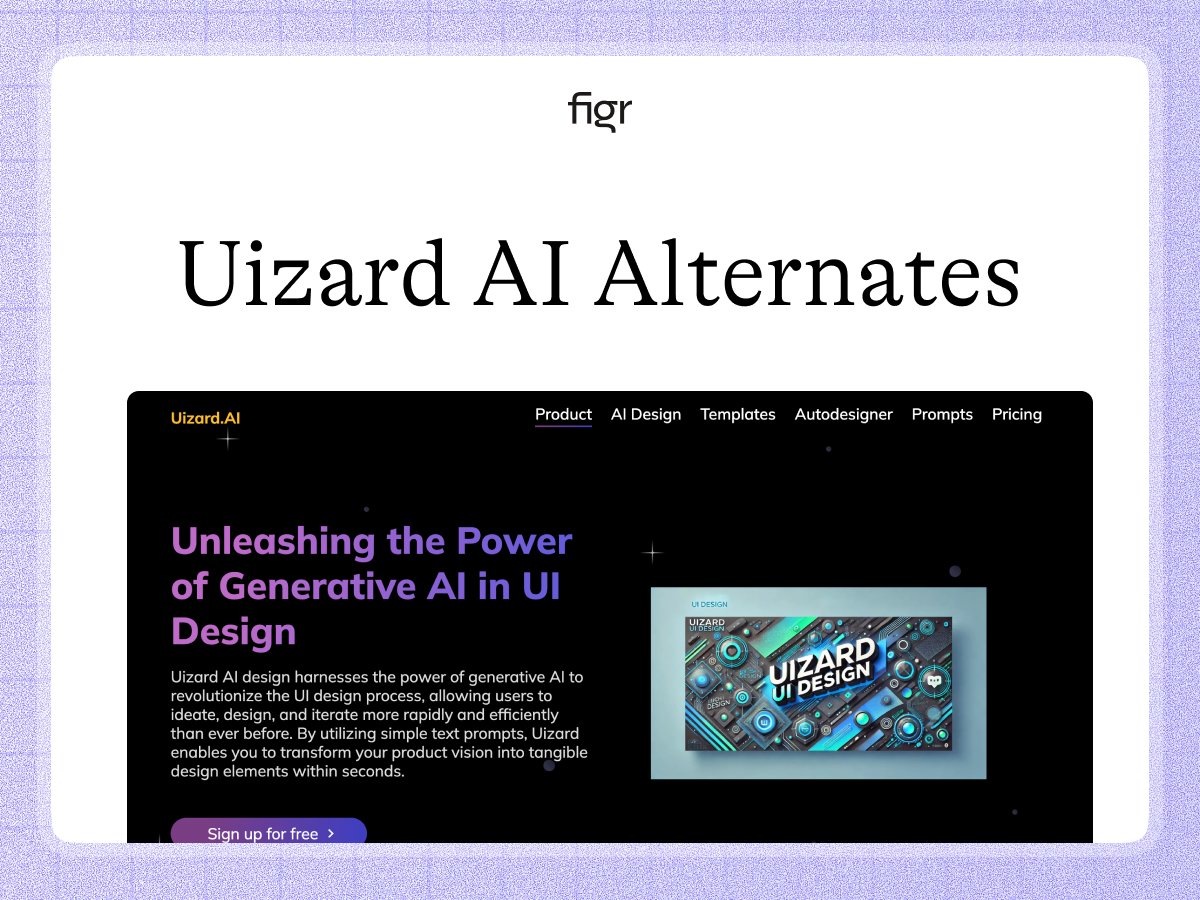
The Uizard alternative for designing within a real product
Uizard turns prompts and sketches into mockups quickly, and it is approachable enough for non-designers. That is great for early ideas and fast wireframes. It is less suited to designing within an existing product, with your real components, flows, and constraints.
Figr starts from your product. It learns your screens, flows, and design system, reasons through the UX, and produces Figma-ready design that fits what you run. This page compares the two, and is fair about where each one wins.
Quick mockups and product design are different jobs
Both tools generate interfaces with AI, so they look comparable. What they are for differs, and that difference is the decision.
Uizard is built for speed and approachability. It turns a prompt, or even a hand sketch, into a mockup fast, which is excellent for getting an idea visible and for people without a design background. What it does not center is your existing product. The mockup is a quick generation, not a screen grounded in your components and the reasons your product works the way it does.
That is the real distinction, and it is about depth and starting point. Uizard is for fast mockups from scratch. Figr is for designing within a product you already have, which is where most ongoing product work happens.
What Uizard is genuinely good at
Uizard has clear strengths, and credit where it is due. It is approachable, so non-designers can produce something usable. It turns prompts and sketches into mockups quickly, which is great for early ideas, wireframes, and getting a concept in front of people. It is now part of Miro, which broadens where it fits.
If your need is a fast, low-barrier mockup, Uizard has a real answer. The trade is depth: a quick mockup is not the same as design grounded in your product and design system, and Uizard's design-system handling is lighter than what a complex product needs.
What Figr is, and the job it is built for
Figr is an AI product designer that starts from your product. It captures your screens, flows, design system, and docs, reasons through the UX, and produces Figma-ready design that fits what you run.
The difference is grounding and depth. Uizard gives you a quick mockup. Figr gives you design rooted in your real product, with components, states, and constraints considered, then hands the result to Figma.
That makes Figr strongest where you are improving a real product and the output has to match what is already there.
A worked example: a feature on an existing product
Take adding a notifications screen to a product that already has a design system.
With a quick-mockup tool, you describe it and get a clean mockup fast, which is a good way to align on direction. But it is a generic mockup, not your product, so someone matches it to your real components and adds the states it skipped, the empty state, the muted-notification case, the error. The mockup was quick, and the reconciliation is not.
With Figr, you show it the current product and describe the screen. It reasons through the flow and returns design on your system, with the states included, ready to refine in Figma. The win is not a faster mockup. It is that the output is your product's design, not a concept to rebuild.
Where each one wins
| The job | Uizard | Figr |
|---|---|---|
| Fast mockups from prompts or sketches | Built for it | Capable |
| Approachable for non-designers | Strong | Capable |
| Start from your existing product | Limited | Yes |
| Deep design-system handling | Lighter | Yes |
| Reason through edge cases | Limited | Yes |
| Design ready to refine and ship | Mockup-level | Figma-ready |
When Uizard is the right call
Use Uizard, not Figr, when the job is a fast mockup from scratch, or when a non-designer needs to produce something quickly. Early ideas, wireframes, sketch-to-mockup, a concept you want visible in minutes.
That is a real and useful case, and Uizard's approachability is a genuine strength. Figr earns the edge when the work moves from a quick mockup to designing within a real product, where output has to fit a system and handle real states.
How to choose between Uizard and Figr
The question is not which tool is better. It is whether you want a quick mockup or product-grounded design.
If you want a fast, low-barrier mockup, Uizard fits. If you are improving a real product and need design that matches your system and is ready to refine, Figr fits, because it starts from that product. Since Uizard is now part of Miro, the Miro comparison is also worth a look if collaboration is part of your decision.
The signal is simple. If the mockup's main next step is rebuilding it in your real product, that is the work Figr removes.
What Figr is not
To be fair, Figr is not the fastest way to sketch a throwaway mockup, and it is not the most beginner-oriented tool for someone with no product. It is not a free-form idea generator.
It is built to design within a real product and produce Figma-ready design that fits. If your need is a quick mockup or a low barrier for non-designers, Uizard is a reasonable choice. If your need is product-grounded design with real design-system depth, that is where Figr is strongest.
Why Figr designs from the product: the Visual Context Graph
Figr grounds design in your product because it treats product work as visual and contextual, not as a quick mockup. That is the Visual Context Graph, which connects five layers:
- Visual: your screens and frames
- Behavioral: recordings and real user flows
- Design system: tokens, components, variants, and rules
- Product knowledge: PRDs, research, and past decisions
- Implementation: the code constraints around the design
A quick-mockup tool starts from a prompt or sketch. Figr reasons across all five, which is why its output fits your product and is ready to refine. Output moves into Figma as editable layers.
Pricing, briefly
Uizard has a free tier and paid plans from roughly $12 a month (Pro, billed annually) to $39 a month (Business), with custom enterprise. Figr is metered by credits: a free tier, Starter at $39 a month, Max at $149 a month, and custom enterprise. The two price differently because one makes quick mockups and the other designs from your product, so compare on fit. See pricing.
Design for your product, not just a mockup
If you are improving a real product, Figr produces design that matches your system and is ready to refine, not a mockup to rebuild.
FAQ
Is Figr a Uizard alternative?
For product design on an existing product, yes. Uizard makes quick mockups from prompts and sketches. Figr designs from your product and system, then hands off to Figma.
What does Figr do that Uizard does not?
Figr starts from your existing product, handles your design system in depth, reasons about edge cases, and produces design ready to refine, rather than a quick mockup.
What is Uizard best at?
Fast, approachable mockups from prompts or sketches, which is great for early ideas and for non-designers.
Is Uizard part of Miro?
Uizard is owned by Miro, acquired in June 2024, and still operates as its own product. See the Miro comparison if collaboration factors into your choice.
Which is better for an existing product?
Figr, because its output matches your system and is ready to refine. Uizard is better for quick mockups from scratch.
How is Figr priced next to Uizard?
Figr is credit-metered with a free tier, Starter at $39 a month, and Max at $149 a month. Uizard uses its own pricing. Compare on fit first.
Related reading
For more on this space: how to create wireframes without a designer, the best AI design tools, a guide to design systems, and why design is about decisions, not drafts.