

Your team leaves a customer interview feeling optimistic about a feature, but the product discovery questions never established why anyone would change their behavior to use it.
The participant liked the concept, named some useful additions, and agreed the mockup looked promising. Engineering now has a plausible brief, design has a direction, and the roadmap has another commitment. After launch, customers keep using their spreadsheets because nobody checked what those spreadsheets handle, who depends on them, or what switching would cost. The interview produced confidence without enough evidence to justify it.
Product discovery questions are prompts that help teams uncover needs, behaviors, and constraints before committing to a solution. The useful ones connect an answer to a decision: keep investigating, narrow the audience, test a different approach, or stop. The eight questions below follow that logic, from establishing whether a problem exists to identifying the people who can block a change. Each includes signals to trust, answers to question, and a practical next move. Use them as a flexible sequence, not a script you must finish. A detailed account of a failed task can be worth more than completing every prompt.
1. Tell me about the last time you ran into this problem
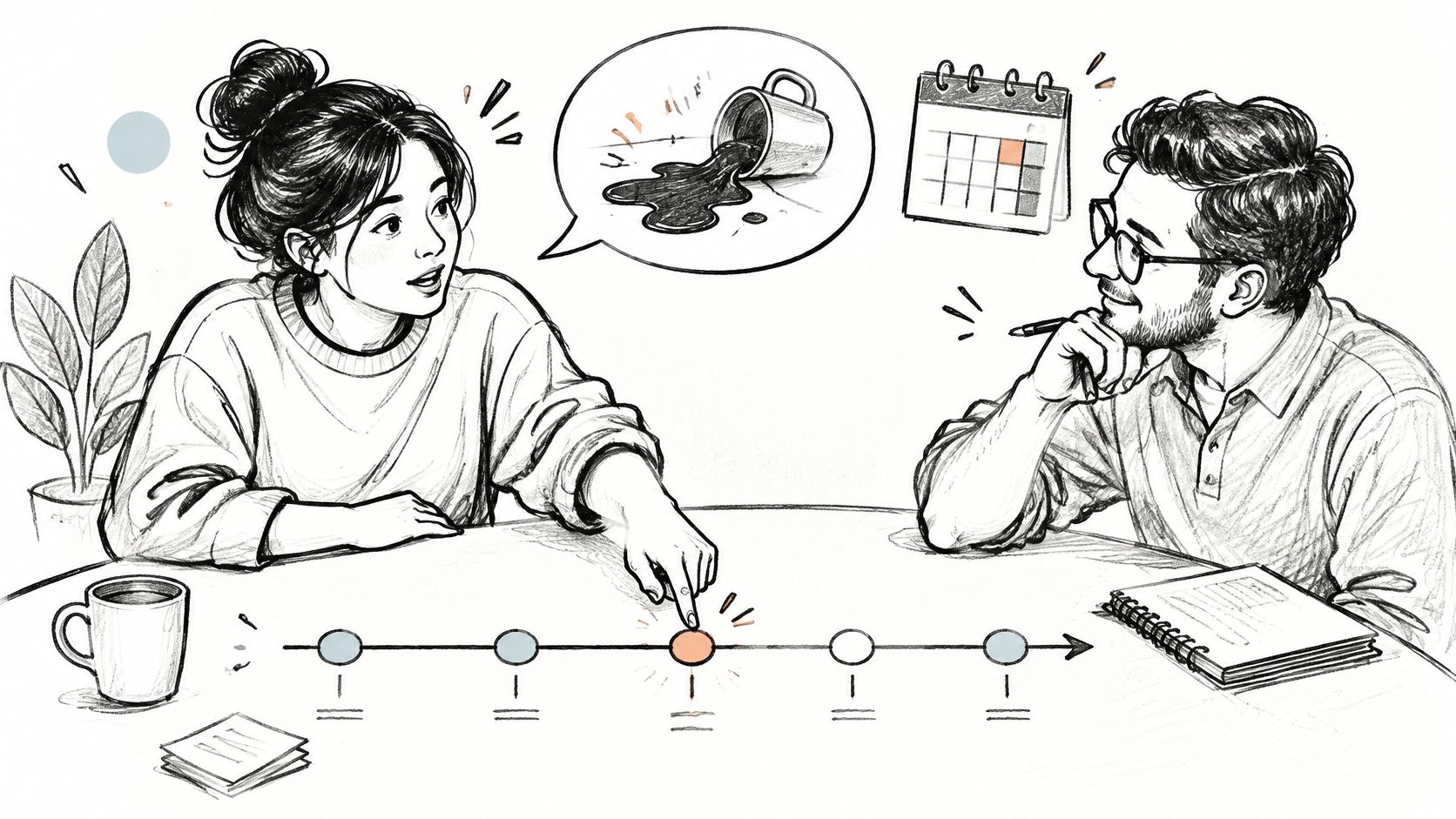
Start with a recent episode, not a prediction. A participant can describe what happened during an actual month-end close more concretely than whether they'd use an imagined reporting assistant.
Teresa Torres's continuous discovery session at UXDX recommends story-based prompts anchored in past events. That gives you somewhere specific to probe: the trigger, the sequence, the workaround, and the consequence.
Listen for a reconstructable event
In a hypothetical finance interview, a manager describes reconciling spreadsheets, requesting approvals in Slack, and waiting for a missing invoice. Those details give the team something to investigate beyond a broad request for better reporting.
- Strong answer. The participant identifies a project, explains what triggered the task, and recalls what happened next.
- Weak answer. They offer general complaints or describe what colleagues probably experience, without recalling an episode.
- Next move. Ask for the sequence and, with permission, the relevant artifact. Compare the account with support records or another participant's experience.
Don't treat poor recall as proof that the problem doesn't exist. The task might be seasonal, sensitive, or outside that person's responsibilities. Change the participant or the time frame before changing your conclusion.
Choose complementary user research methods based on what remains uncertain. An interview can explain a remembered event; observation can reveal steps the participant doesn't think to mention.
Keep their language in your notes, but distinguish what they said from what your team inferred.
2. What have you tried so far to solve this?
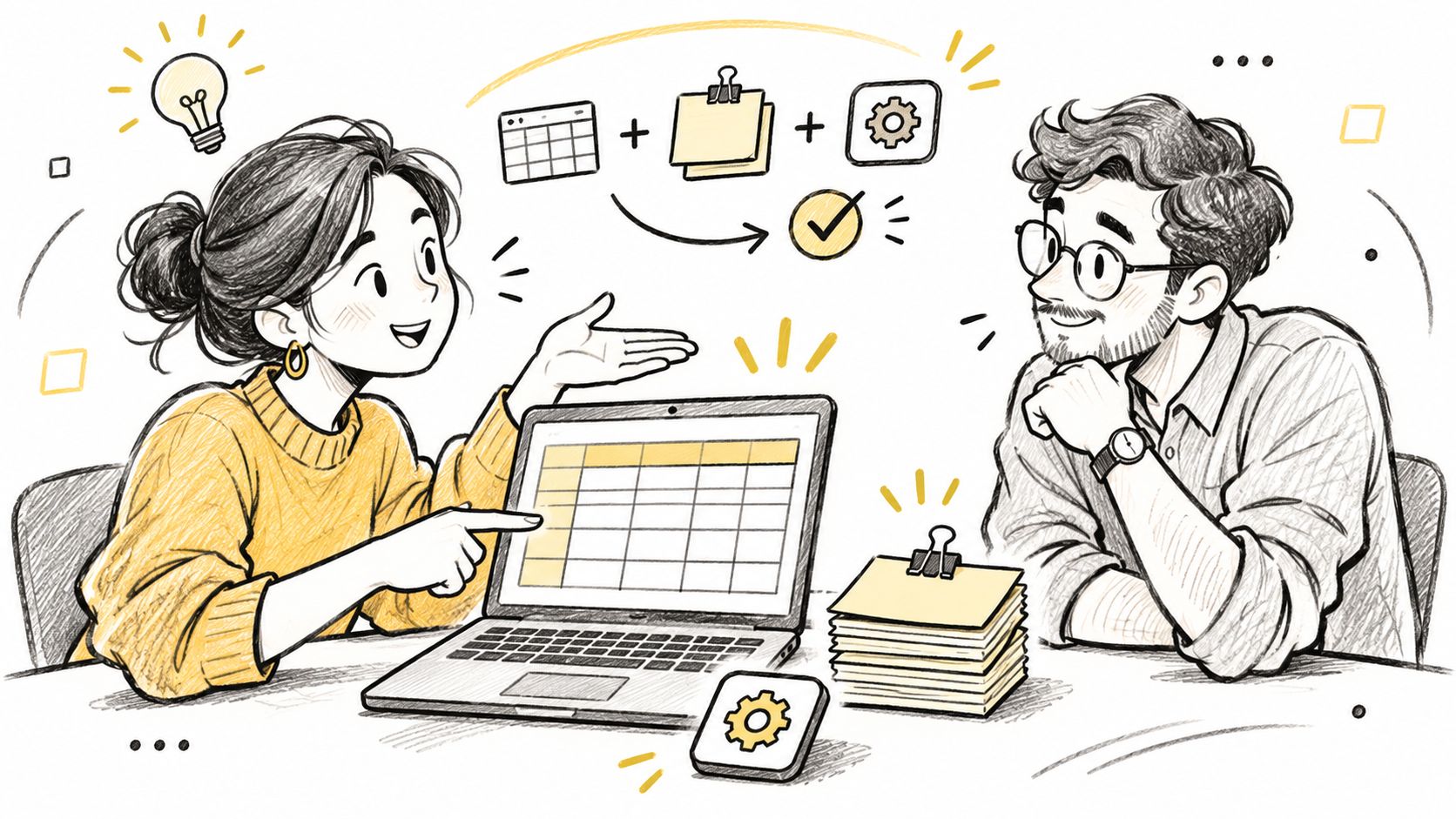
The alternative to your product may be a shared spreadsheet, a Slack reminder, or accepting the delay. Your solution must compete with the current arrangement, including its hidden advantages.
Ask about active workarounds and abandoned attempts. The Syntaqx discovery guide recommends examining what participants already do and quantifying the workaround with their own figures, rather than asking whether they'd buy a hypothetical solution.
Find the baseline you must beat
Consider a hypothetical QA team that copies design specifications into Google Sheets and attaches screenshots of interface states. The process looks clumsy, but testers can annotate exceptions, share it with contractors, and retain a review history.
Replacing the spreadsheet means preserving those useful capabilities, not just automating the copying.
A workaround is evidence of effort. It isn't proof that someone will adopt your replacement.
A strong answer includes a visible artifact, a reason for choosing it, and a clear account of where it breaks. A weak answer names a tool without explaining how it's used, or says the team has considered alternatives without trying them.
- Inspect the workaround. Ask the participant to demonstrate it with non-sensitive material. Note what it handles well alongside the frustrations.
- Investigate abandoned attempts. Find out what prompted the trial and what caused the return to the old process. Switching costs may matter more than missing features.
- Accept doing nothing. Ask what happens when the participant leaves the problem alone. Their answer may reveal low urgency or a barrier they can't remove.
3. Walk me through how you do this, from start to finish
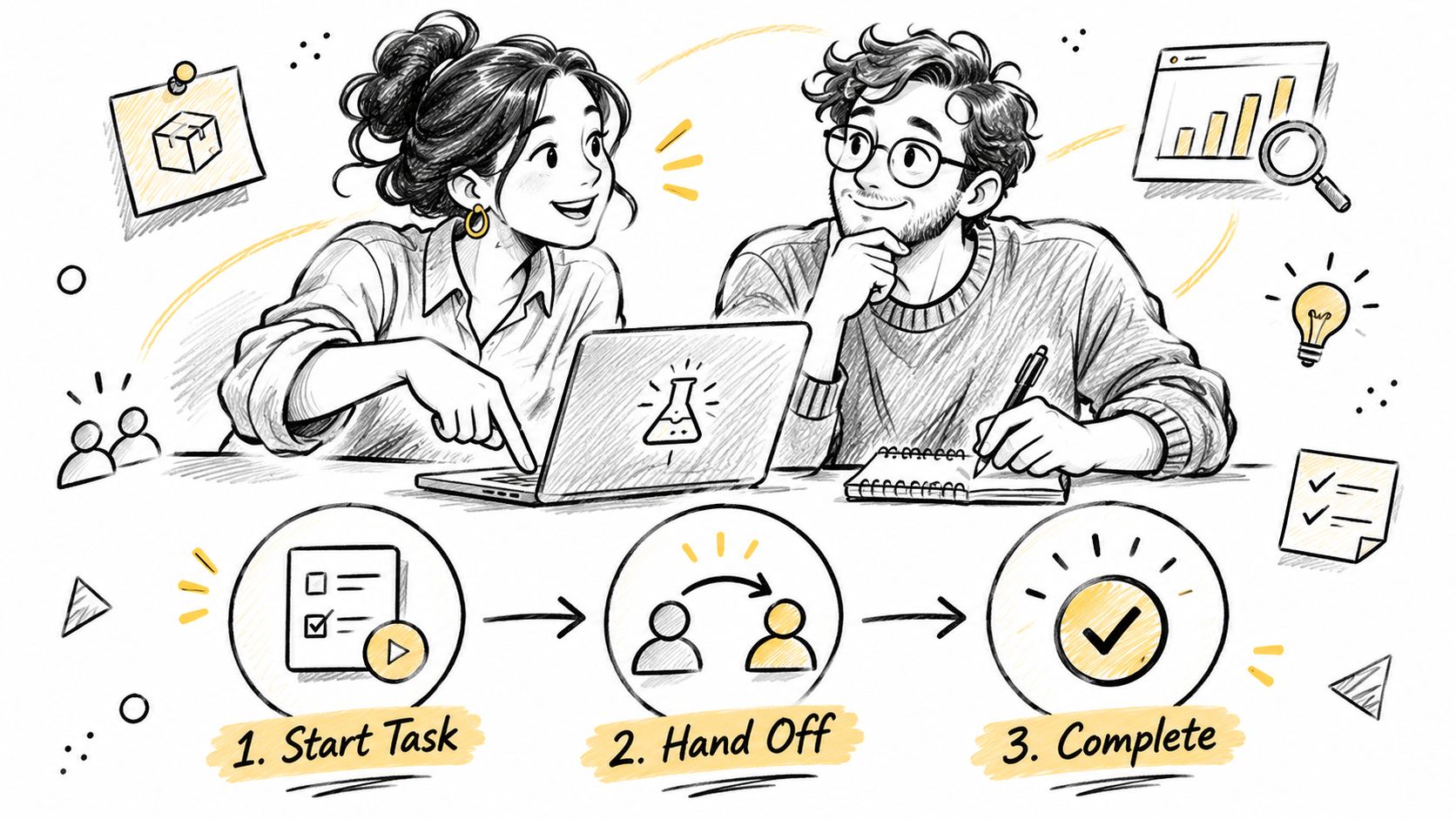
A walkthrough reveals the work surrounding the screen. Ask the participant to perform a recent task when possible, rather than describing the official process from memory.
Suppose a hypothetical account-setup walkthrough shows a user leaving your app to retrieve an API key. They discover that only an administrator can access it, send a message, and abandon setup while waiting. A simpler form won't remove that dependency.
Map branches, not just the happy path
A strong answer exposes handoffs, waiting periods, decisions, and recovery steps. A weak answer sounds like a training document: everything happens in the expected order, and nobody encounters missing information.
Probe the edges without suggesting that failure must have occurred. Ask what happens when data arrives late, a permission is missing, or the participant needs to resume later. Net Solutions' product-discovery overview provides a useful foundation for investigating needs and feasibility; extend that inquiry to accessibility and failure conditions.
- Capture the actual sequence. Record the trigger, tools, handoffs, and finish condition. Mark waiting separately from active work.
- Explore a failure branch. Ask how the participant recovers when the expected path isn't available. Include assistive technology, device, and connectivity constraints where relevant.
- Confirm the map. Show the participant your understanding before ending. Label anything you haven't observed as an assumption.
This is what I mean by evidence before screens: the missing state may be waiting for administrator approval, not another onboarding tooltip.
Use rapid prototyping for product teams to test that specific branch once you understand it.
4. What made that hard, or what was the most frustrating part?
Use this question to locate friction, but don't assume the experience was frustrating. If the participant hasn't expressed difficulty, first ask which parts went smoothly and which required extra effort.
Leading language can change the answer. The Conveo user-interview guide explains how prompts that embed a judgment can steer participants toward the interviewer's interpretation.
Separate the complaint from its consequence
In a hypothetical reporting interview, a manager calls an export slow. Further probing reveals that the delay matters when the report is needed for a leadership meeting. Outside that deadline, the same wait is acceptable.
That distinction changes the opportunity. The team might investigate scheduled preparation or reliable completion notices before attempting a broad performance overhaul.
- Strong answer. The participant identifies the difficult moment, explains its context, and describes what it prevented.
- Weak answer. They repeat a general adjective, such as confusing or annoying, without connecting it to an event.
- Next move. Ask what they did because of the difficulty and what happened afterward. Look for an observable consequence rather than stronger emotional wording.
Practical rule: Record frequency and severity separately. A frequent irritation and an occasional blocked deadline require different judgments.
Don't let a vivid complaint dominate synthesis just because it's easy to remember. Compare its consequences with less dramatic accounts from the same segment.
For cross-functional tasks, understanding user journey maps helps place friction within the broader experience. A frustrating screen may be where users notice a problem caused by an earlier handoff, unclear ownership, or incomplete information.
5. Why does that matter to you?
A feature request tells you what someone has imagined. This question helps uncover the outcome they're trying to protect.
Ask it after establishing the event and the difficulty. Without that context, the conversation can drift into broad aspirations that are hard to test.

Translate the request without dismissing it
Suppose a participant requests dark mode for a dashboard. In this hypothetical scenario, they explain that they present it in a dim meeting room and struggle to read projected labels. The desired outcome is legibility during presentations, which leaves room to test contrast, larger text, or a presentation view.
Don't announce that you've discovered the underlying need and discard their request. Offer your interpretation back and ask whether it accurately describes the episode.
A strong answer connects the request to a task, responsibility, or consequence. A weak answer stays at preference level without explaining when the preference affects work. Preferences still matter, but they don't automatically justify a roadmap commitment.
- Soften the follow-up. Ask what's important about that outcome for them. Keep the conversation curious rather than interrogative.
- Write the goal plainly. Describe the task and the result the participant needs. Avoid embedding your preferred feature in the statement.
- Test competing approaches. Compare possible solutions against that goal. Include the original request rather than assuming your reinterpretation is better.
Griffin and Hauser's customer-needs work, discussed in the LaunchList interview guide, supports examining tasks, outcomes, frustrations, and alternatives instead of collecting feature ideas alone.
The practical payoff is flexibility: teams can debate solutions while staying accountable to the same user outcome.
6. What happens if you don't solve this?
The cost of inaction helps distinguish a real inconvenience from a problem worth changing behavior for. Ask about consequences that have happened, then separate them from risks the participant fears.
Possible consequences include rework, missed commitments, delayed approvals, or customers needing help. Treat claims about financial loss or compliance exposure as leads to verify, not established facts.
Check the stakes against records
In a hypothetical QA interview, a lead says incomplete state coverage caused escaped defects. The PM reviews the linked bug reports and discovers that missing permission states contributed to the failures, while unrelated visual differences didn't.
The decision is to test a permission-state review process rather than build a general design-comparison feature.
A strong answer identifies a recent consequence and points toward corroborating evidence. A weak answer predicts disaster but can't explain a past instance, or relies on an estimate nobody can reconstruct.
Keep observed consequences, estimates, and feared outcomes in separate fields. They support different levels of confidence.
- Verify the consequence. Review relevant tickets, logs, or work records with permission. Check whether they support the participant's explanation.
- Make estimates inspectable. Record the event being counted and how the team estimated its cost. Don't turn a rough recollection into a precise business case.
- Look for disagreement. Compare interview accounts with behavior and support evidence. Investigate contradictions before averaging them away.
Shopify's product-discovery guide describes combining discovery methods. Make that combination useful by recording each claim's source, recency, and limits.
If leaving the problem unresolved has little consequence, deprioritizing it may be the right decision. Discovery should make that outcome acceptable.
7. How do you currently know whether this is working?
Ask for the signal users already trust before proposing your own success metric. Product activity and user success aren't interchangeable.
In a hypothetical checkout study, finance staff judge success by whether invoices reconcile without support intervention. A conversion improvement could still create downstream cleanup that your experiment dashboard misses.
Establish a baseline and a guardrail
A strong answer identifies a report, a repeatable check, or an observable finish condition. A weak answer offers an aspiration, such as better engagement, without explaining how anyone recognizes improvement.
Ask the participant to show the report or demonstrate the check using suitable sample material. Compare that signal with your analytics, including its denominator, time window, and exclusions.
- Define the outcome. State what successful completion means for the user. Distinguish it from intermediate events such as opening a screen.
- Record the baseline. Capture the current measurement method before making a change. Note gaps that could make later comparisons misleading.
- Choose a guardrail. Identify what must not worsen while the primary metric improves. Support demand, errors, and downstream rework may deserve review.
Maze's survey of nearly 500 researchers, designers, and product professionals found that 75% conducted research during problem discovery, compared with 45% during post-launch review. The gap is a reason to plan the follow-up while defining the opportunity.
Use A/B testing best practices when a controlled comparison fits the question. An experiment can compare outcomes, but it won't explain every reason behind them.
If no reliable baseline exists, create one before promising a measurable lift. Missing measurement is a planning constraint, not permission to substitute a convenient metric.
8. Who else is involved when this decision or problem comes up?
A user may feel the pain without controlling the budget, permissions, or rollout. Map who performs the task, who approves change, and who inherits the risk.
In a hypothetical SSO setup interview, an administrator explains that security must review any new login method. The team interviews a security reviewer and adds approval requirements to the flow before designing the setup experience.
Follow the handoff to the next participant
A strong answer names roles, explains their responsibilities, and describes a recent approval or objection. A weak answer assumes that a senior sponsor can handle everyone else without describing the actual process.
- Map influence by role. Record users, approvers, budget owners, and affected teams. Explain what each needs from the change.
- Interview the blocker. Ask the champion for an introduction to someone who might object. Learn their constraints without treating resistance as ignorance.
- Separate the findings. Compare themes within relevant roles and segments. Don't let agreement among end users stand in for buyer or administrator evidence.
Guest, Bunce, and Johnson's 2006 study of 60 interviews, summarized in Yibud's customer-discovery guide, found that 34 of 36 common themes appeared after six interviews. That finding concerns recurring themes within the studied population, not proof that an opportunity is validated across different stakeholders.
As teams grow, more people absorb the consequences of a product change. An automation that saves an end user effort may create review work for an administrator. Ignoring that transfer can make an apparently valuable solution difficult to adopt.
Reflect these dependencies in the product roadmap. Keep confirmed requirements separate from stakeholder assumptions that still need testing.
The 8 Discovery Questions at a Glance
| Question | Research Goal | Best Stage | What It Verifies |
|---|---|---|---|
| Tell me about the last time you ran into this problem | Understand a recent, concrete problem experience | Early discovery | Whether the problem occurs in real contexts and how often |
| What have you tried so far to solve this? | Uncover workarounds and existing alternatives | Early discovery | Whether users invest effort in solving the problem and what a product must replace |
| Walk me through how you do this, from start to finish | Map steps, handoffs, and decision points | Workflow discovery | How the task works and where delays, errors, or drop-offs occur |
| What made that hard, or what was the most frustrating part? | Identify the most painful friction and its impact | Problem prioritization | Which parts of the experience are most severe |
| Why does that matter to you? | Reveal the underlying goal behind a stated need | Problem framing | What outcome the user actually values |
| What happens if you don't solve this? | Assess the cost and urgency of the problem | Opportunity prioritization | The consequences of inaction and whether they justify investment |
| How do you currently know whether this is working? | Learn current success measures and baselines | Before solution testing | Which outcomes users track and how they define success |
| Who else is involved when this decision or problem comes up? | Map stakeholders, approvers, and blockers | B2B discovery and planning | Which roles influence, approve, or depend on a solution |
Turn Answers Into Decisions Before You Design
Discovery becomes useful when the team changes a decision because of what it learned. A transcript archive isn't enough. Synthesize the accounts, verify important claims, and write a problem statement that colleagues can challenge.
In short, make the reasoning inspectable.
- Group evidence by assumption. Bring together episodes, workarounds, consequences, and contradictions. Keep different roles and segments visible instead of blending their answers.
- Verify the consequential claims. Compare interview accounts with support records, product behavior, and observed tasks. Investigate mismatches rather than selecting whichever source favors the current plan.
- Write a challengeable problem statement. Name the user, triggering situation, current response, and consequence. Add what remains uncertain and what would disprove your interpretation.
- Choose the next decision. Decide whether to investigate further, test an approach, narrow the scope, or stop. Name an owner for the unresolved evidence.
A useful problem statement might describe account administrators who cannot complete setup because they lack access to a required credential. It should identify the observed workaround and the evidence linking the dependency to abandonment. Avoid converting that statement into a solution requirement such as adding a better tooltip.
The speed-versus-evidence trade-off depends on the decision. A reversible wording change needs less certainty than replacing an enterprise approval workflow. Spend research effort where being wrong would be difficult to undo.
Discovery also needs continuity. The Headway guide to continuous discovery describes structured interview snapshots and recurring synthesis as ways to keep customer evidence close to ongoing decisions. Carry unresolved questions forward instead of declaring the opportunity permanently validated.
At Figr, we apply this question-first discipline before designing a feature. We ask clarifying questions, map the current flow, identify friction and missing states, challenge assumptions, and explain trade-offs so your team can review the UX logic before committing to screens. Research interpretation and prioritization remain your team's responsibility.
Pick an assumption behind your current roadmap item, write the two questions from this list that would test it hardest, and run one interview this week. Record what would change your mind before the conversation begins.
Figr helps product teams turn research notes, product context, and requirements into clarifying questions, flows, edge cases, and prototypes. Visit Figr to bring a current discovery question into your design work and review the assumptions before committing to screens.