
A roadmap can look precise while resting on a foggy assumption: that customers have the problem, want the solution, and buy in the way the team imagines. Product discovery questions clear that fog by grounding decisions in remembered behavior, observed work, measurable outcomes, and specific choices.
When the assumption goes untested, teams can polish the wrong workflow, prioritize a feature that users praise but don't need, or miss the person who can block a purchase. The cost appears later as rework, stalled adoption, and roadmap debates built on opinions instead of evidence.
Strong discovery questions help teams find the customer's actual story, then turn it into a decision. The eight families below offer practical prompts for interviews, contextual inquiry, and workshops, along with ways to interpret answers and carry the evidence into hypotheses and PRDs.
1. Past-Behavior Anchor Questions
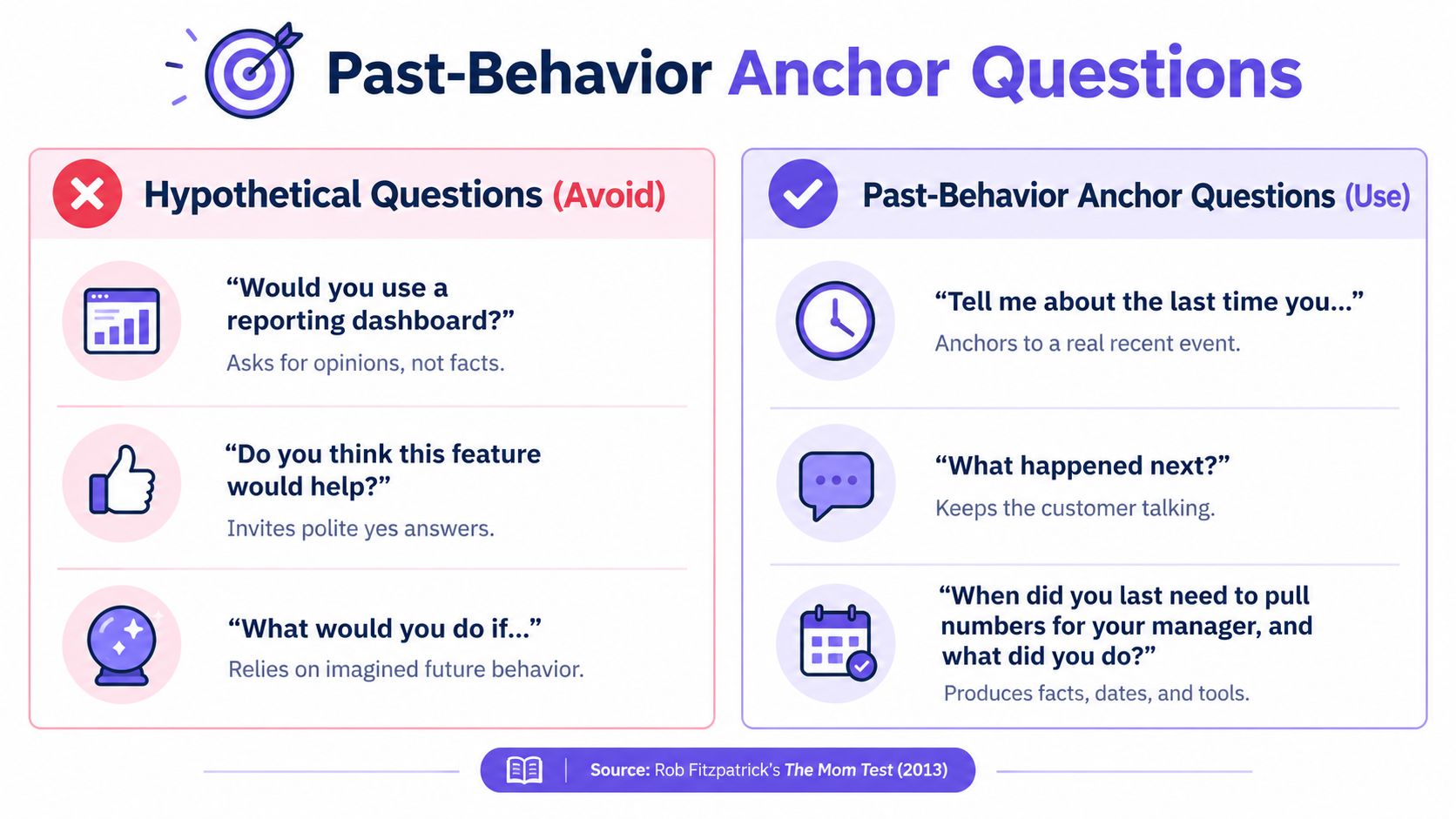
“Would you use a reporting dashboard?” invites a polite prediction. “When did you last need to pull numbers for your manager, and what did you do?” opens a story that can be examined. That difference is the past-behavior anchor: ask about a real event, then follow its sequence.
This is the first filter for product discovery questions for customer interviews. A foundational prompt is, “Tell me about the last time you experienced this problem. What happened?” Follow with “What did you try first?”, “What was most frustrating?”, and “Who else was affected?” Recent behavior gives you context, triggers, and consequences. Stated intent mostly tells you what someone thinks they might do.
A product team once asked users whether scheduled reports sounded useful. One interviewee called the idea “great,” then described manually rebuilding the same report whenever a manager asked. The compliment alone was weak evidence; the recurring task was a stronger signal. Treat praise as neutral until the customer connects it to something they did.
Follow the story, not the pitch
When someone says, “I always do this,” ask for the most recent time. Record their exact language in your notes, since the words customers use can clarify the problem statement and product language. Figr's take on early validation offers related guidance on grounding discovery in customer evidence.
Practical rule: “That sounds cool” is a reaction. A remembered action is evidence.
Keep interview notes separate from interpretation. A user who says they exported data may be describing a workaround, a reporting habit, or a one-off request. Capture what happened before deciding what it means. Qualitative interviews help explain behavior, while analytics and quantitative methods show what happened and how often. Otter A/B's research guide explores that distinction.
2. Switching Story Questions
A new customer rarely switches tools in a single instant. Usually, something changes: a routine breaks, a risk becomes visible, or a colleague loses patience. Switching-story questions reconstruct the timeline from the purchase back to the conditions that made the old approach stop working.
Start with, “What was happening when you first began looking?” Then ask what triggered the search, which alternatives the customer considered, and what finally tipped the decision. Separate passive looking, when someone notices options, from active looking, when they take steps to change. The gap between those moments can reveal how urgent the problem felt.
Clayton Christensen and colleagues' jobs-to-be-done lens asks teams to understand the progress a person is seeking, rather than relying on demographic labels alone. Their Harvard Business Review discussion of customers' jobs to be done includes the milkshake example: morning commuters chose milkshakes in part because they helped occupy a long commute. The purchase made more sense once the team considered the job and setting.
Map the change, not just the choice
A customer might say they chose project-management software because it had a clean interface. The timeline could reveal that they started searching after a client complained about a missed handoff, making visibility across the team more central than appearance.
Draw the story in a shared document or on a whiteboard, and let the customer correct it. Tag each account with the trigger, the job, and the alternative. Compare stories before treating one person's switching reason as a segment-wide pattern.
For broader research approaches that can support this kind of inquiry, see UX research methods. A founder's guide to discovery interviews also offers context for exploring customer problems through conversation.
3. Workflow Walkthrough Questions
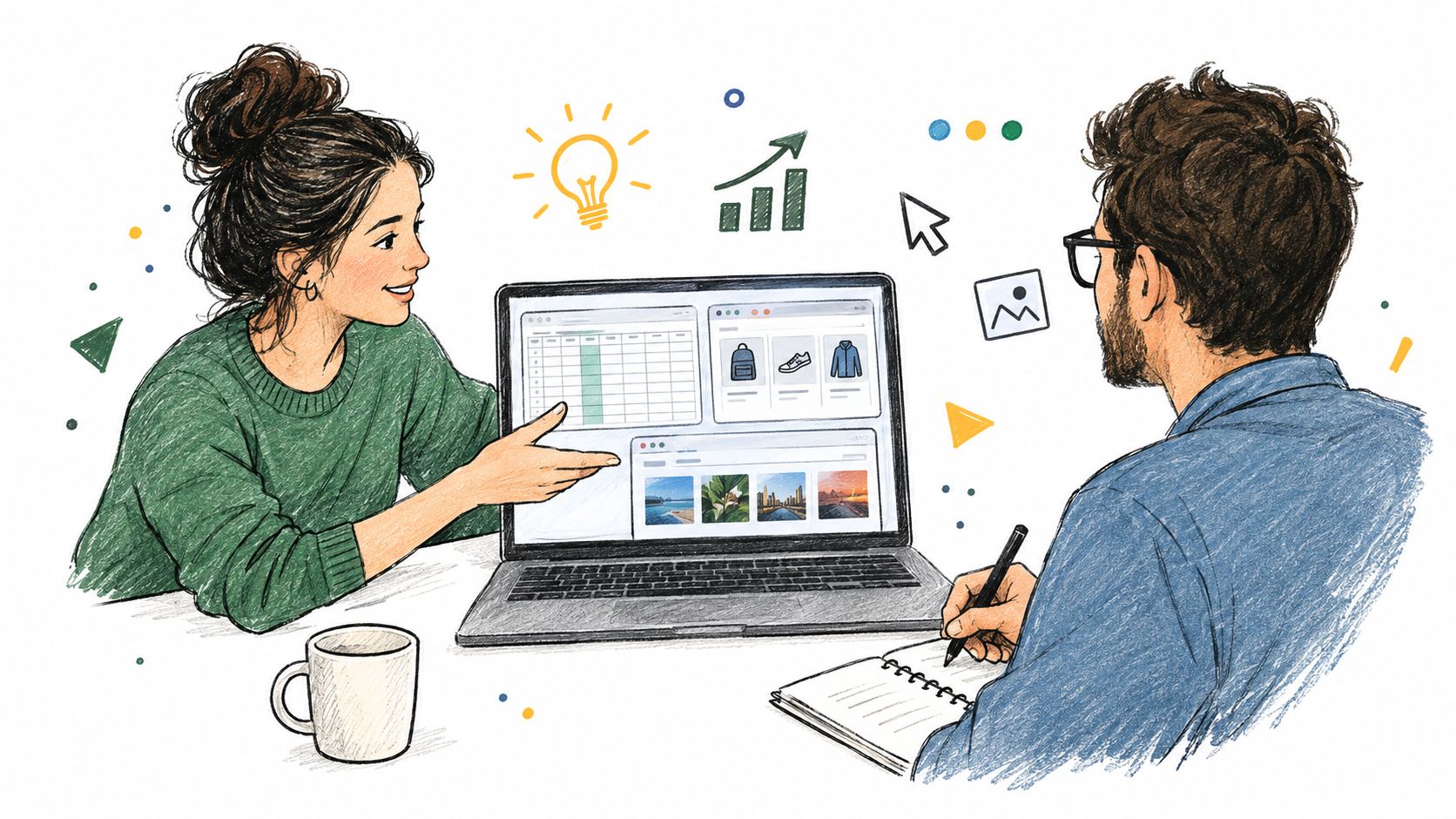
A customer's description of a task is a summary. A live walkthrough is a sequence of decisions, pauses, tools, and small repairs. Ask, “Show me how you did this yesterday,” and let the person drive.
This is contextual inquiry: observe the work in its setting instead of asking someone to reconstruct every detail from memory. Watch where they switch tabs, consult a note, or hesitate before clicking. Those moments often reveal product friction that a feature request won't name.
A finance lead might describe reconciliation as straightforward, then open several browser tabs and a printed checklist to complete it. The task still gets done, but the extra materials show which information the product leaves the user to assemble. That's the kind of gap a roadmap can address more clearly than a request for “better reporting.”
Keep your hands off the controls
Ask the participant to share their screen and perform the task themselves. When they pause, give them room to continue rather than filling the silence with instructions. A simple “Keep going, I'm just watching” can preserve the natural sequence.
Let the customer's hands show you where the explanation runs out.
Capture the tools they use alongside your product, and note the step where the work changes direction. If the walkthrough concerns an existing product flow, bring a record of the relevant screens so you can connect their language to the interface without steering the session. A user journey map can then organize the observed steps, handoffs, and pain points into a view the team can act on.
The useful output isn't a transcript of every click. It's a clear account of the user's goal, the workflow, and the points where the product or surrounding process makes the task harder.
4. Workaround Questions
A workaround is a receipt for an unmet need. Someone has already paid for the gap in time, coordination, repeated effort, or frustration. Ask, “What do you do when that doesn't work?” and listen for the tools and routines that fill the space around your product.
A complaint alone can be hard to prioritize. The workaround makes it concrete. A customer who exports data into a spreadsheet may be using it to reshape a report, share information with a colleague, or keep a manual backup. Those are different needs, even when the initial complaint sounds identical.
Ask what happens next, how often the workaround occurs, and what it costs the person when it fails. “Which other tools do you use alongside ours?” can surface the product that carries a key part of the workflow. In a scheduling product, for example, managers might message employees outside the app to confirm a shift. That behavior may point to a trust problem in notifications, not a need for another calendar view.
Turn a workaround into an opportunity
Write the user's task and difficulty in plain language before suggesting a feature. For instance: “When managers can't tell whether staff saw a schedule change, they contact people individually to confirm it.” That statement keeps the problem visible while the team explores possible responses.
Teresa Torres describes opportunity mapping as a way to connect customer needs to product decisions in Continuous Discovery Habits. The practical link is simple: recurring workarounds can identify jobs the current experience doesn't finish.

Compare interview accounts with product behavior when you can. Exports, repeated retries, and exits at a specific step may help you locate a shadow process. The interpretation still needs care: an unusual event in analytics can signal friction, but customer context helps explain why it happened.
5. Desired-Outcome Questions
Feature requests name a possible answer. Outcome questions clarify what a successful result would change for the customer. Ask, “When you prepare a board update, what would make the process take less time?” Then ask what they would count as a better result.
This distinction matters because tools change, while desired outcomes often remain stable. A customer who asks for a dashboard may want to find the right figures without chasing colleagues. Another might care about reducing the follow-up work needed to resolve an account issue. The feature is one interpretation; the outcome gives the team room to consider alternatives.
Tony Ulwick's Outcome-Driven Innovation method, presented in What Customers Want, turns customer needs into outcome statements. A useful statement begins with a clear verb and direction, such as “minimize the time needed to find relevant data.” Keep the customer's meaning intact, and don't make an outcome sound measurable if the interview hasn't established how to measure it.
Translate without overclaiming
A payroll team hearing repeated frustration about tax checks could write, “Reduce the effort required to verify employee tax details.” That's a candidate outcome, not proof that a particular workflow will solve it. Ask how the customer recognizes success, what makes the current process difficult, and which trade-off they'd accept.
For a discovery session, you might capture:
- Customer outcome: What result are they trying to improve?
- Current signal: How do they know the present process is working or failing?
- Constraint: What can't change, even if the workflow improves?
When the same outcome appears across interviews, it can become a product hypothesis or an acceptance criterion for design and QA. Keep the original wording next to the translated statement. That trace helps reviewers distinguish what customers said from what the team inferred.
6. Assumption-Testing Questions
Every product idea carries beliefs about who has the problem, what causes it, and whether people will change their behavior. Assumption-testing questions make those beliefs visible before they harden into roadmap commitments.
Write a belief in a form the team can test: “We believe [segment] struggles with [problem] because [cause].” Then ask questions that could weaken the claim as readily as strengthen it. “What would have to change for you to leave your current approach?” can expose switching barriers. “What would make this a poor fit?” gives the customer room to describe disconfirming evidence.
A team might assume that administrators choose a new tool, only to find that end users create the pressure for adoption. That changes who needs to understand onboarding and whose concerns matter first. Another team may expect customers to value automated summaries, while interviews reveal that users need a way to check the summary's accuracy. The insight doesn't prove a feature should be built, but it can redirect the next experiment.
Spend interviews on risky beliefs
Prioritize assumptions that could alter the product decision and have little supporting evidence. Ask about recent behavior and concrete constraints, rather than presenting the idea and inviting approval. Carnegie Mellon's customer-discovery guidance recommends making hypotheses explicit, asking about recent behavior, and distinguishing primary questions from backups.

After each interview, record whether the assumption held, weakened, or failed, and attach the evidence. A guide to product discovery for product leaders can help connect that learning to the decisions and artifacts that follow. Keep the distinction clear: one compelling conversation can reveal a risk, but it can't establish how common that risk is.
7. Buying Process and Stakeholder Questions
In B2B, the person who uses a product may not control the purchase, and the person who signs may never use the workflow. Discovery that follows only the end user can miss the security review, procurement requirement, or internal objection that determines whether a product can be adopted.
Start with the customer's account of a real purchase. “Who else needed to approve this, and what did they check?” reveals the decision path. “What did you compare it against, and why?” can surface the actual alternative, which might be another vendor, an internal tool, or staying with the current process.
A product manager might hear that a department liked a tool, then learn that an IT administrator stopped the rollout over data handling. That isn't a minor sales detail. It may point to a product constraint, missing evidence, or a communication gap that affects future adoption.
Trace the decision system
Ask about a purchase that stalled, not only a deal that closed. A completed purchase shows which concerns were resolved; a stalled one can clarify which requirement remained unanswered. Keep the customer's own role and the roles of other decision-makers distinct in your notes.
In short, buying questions help product teams separate feature preference from adoption conditions. Security, procurement, and internal trust can shape whether a solution gets used at all, even when the main workflow fits.
A useful interview record distinguishes the evidence from the interpretation:
- Participant's role: User, approver, evaluator, or blocker.
- Decision evidence: What each person reviewed or required.
- Open product question: Which constraint or unanswered need could change adoption?
Don't treat a single deal story as a universal buying process. Compare accounts across customers, then turn recurring blockers into hypotheses for product, onboarding, or product information. That keeps discovery useful beyond the immediate sales conversation.
8. Friction and Drop-Off Questions
Analytics can show where users leave a flow. It can't explain what they expected, which instruction confused them, or why they decided to stop. Pair the data with a question tied to the exact step: “Where did you hesitate or give up in your last session?”
Choose the relevant funnel step before the interview, then ask what the person thought would happen next. If users abandon an integration setup, the issue might involve unclear permissions, uncertainty about connected data, or a mismatch between the screen and the customer's system. The same drop-off can have different causes, so avoid jumping from the chart straight to a redesign.
Google's HEART framework connects product goals to user behaviors or attitudes and then to measures tracked over time. It organizes those measures across Happiness, Engagement, Adoption, Retention, and Task Success. The distinction is useful: users may say a process feels easy, while observed task success shows where they still struggle. The HEART framework paper describes this goal-signal-metric approach.
Bring the explanation back to the flow
Ask, “What were you expecting to happen at that point?” and “What information would have helped you continue?” Compare the answers with funnel behavior, and check whether the same explanation recurs before changing the interface.
Evidence works best in pairs: the funnel locates the friction, and the interview helps explain it.
A customer might pause at an address form because they don't know whether the system will fill in the remaining fields. That's a testable explanation, not a license to assume every abandoned form has the same cause. Use behavioral analytics for product teams to connect observed behavior with the questions your team asks. For another product-management perspective, see this guide to AI tools for PMs.
8 Product Discovery Question Types Compared
| Method | Implementation Complexity | Resource Requirements | Expected Outcomes | Ideal Use Cases | Key Advantage |
|---|---|---|---|---|---|
| Past-Behavior Anchor Questions | Low; requires interviewer discipline | Short customer interviews; basic note-taking | Specific examples of past actions, tools, and costs | Validating whether a problem occurs in customers' real lives | Reduces false positives from hypothetical enthusiasm |
| Switching Story Questions | High; requires timeline-based interviewing | Recent switchers; longer interviews; careful scheduling | Triggers, alternatives, and decision criteria behind a change | Understanding why customers adopted or switched solutions | Reveals real purchase triggers and indirect competitors |
| Workflow Walkthrough Questions | Medium to high; involves observation | Screen sharing or in-person access; time for observation and documentation | Step-by-step workflows, interruptions, and hidden tools | Finding usability issues and workarounds in real tasks | Exposes gaps between reported and actual behavior |
| Workaround Questions | Medium; requires follow-up on frequency and cost | Customer interviews; optional analytics review | Ranked unmet needs and the effort spent addressing them | Prioritizing workflow gaps, manual tasks, or product failures | Workarounds signal problems customers already invest effort to solve |
| Desired-Outcome Questions | Medium to high; outcomes need clear phrasing | Interviews plus a follow-up survey | Measurable needs prioritized by importance and satisfaction | Setting durable product priorities independent of specific features | Supports more objective prioritization than feature requests |
| Assumption-Testing Questions | Medium; requires explicit hypotheses | Assumption mapping; interviews; follow-on experiments | Evidence that key product beliefs hold, weaken, or fail | Testing high-risk beliefs before committing to a product bet | Connects discovery directly to experiment design |
| Buying Process and Stakeholder Questions | Medium to high; requires access to multiple roles | Interviews with users, buyers, and approvers | Approval paths, evaluation criteria, and purchase blockers | B2B and enterprise product planning | Reveals decision-makers and requirements beyond the end user |
| Friction and Drop-Off Questions | High; depends on reliable funnel data | Analytics, defined funnel steps, and access to users who dropped off | Explanations for hesitation, abandonment, or conversion loss | Improving onboarding, activation, checkout, or other funnels | Combines behavioral evidence with customer explanations |
Turn Answers Into Decisions
A discovery question earns its place when the answer changes a decision. After each conversation, capture what the participant did, the outcome they sought, the evidence behind your interpretation, and the assumption that remains uncertain. Separate observed behavior from a customer's opinion and from the team's inference. That simple discipline makes synthesis less vulnerable to the most confident voice in the room.
Then connect stories to product evidence. Tag recurring patterns, compare them with analytics or funnel data, and write opportunity statements in language that stays close to the customer's work. If interviews reveal repeated difficulty at a specific step, check whether the product data shows related friction. Qualitative interviews explain why behavior may occur; quantitative evidence helps establish what happened and how widely it appears.
The operating rhythm matters too. Discovery works best as a continuing practice, with questions suited to the decision at hand. Ask about recent behavior to understand a problem, current alternatives to assess how it's handled, trade-offs when shaping a solution, and barriers before release. After launch, ask what changed in the customer's workflow or outcome. Research shouldn't end when a team starts building.
Turn the strongest recurring pattern into a PRD hypothesis that states the customer, problem, desired outcome, evidence, constraints, and open questions. Keep uncertainty visible. If the evidence is thin, write the next experiment rather than presenting the assumption as a requirement. A prototype, usability session, or further interview can help the team decide what to change before engineering commits to a full implementation.
Figr can carry discovery context into product artifacts by grounding PRDs, user flows, edge cases, prototypes, and QA cases in the live product. Its Chrome capture, Figma design-system connections, and analytics connection can help teams keep those artifacts aligned with their existing interface and funnel evidence. The tool doesn't replace careful interviewing or judgment about what the evidence means. It can help preserve the thread from customer observation to design and testing.
Before your next roadmap review, choose one customer story that repeats and write down the decision it changes. Then name the assumption you still need to test. That's a manageable next step, and it gives the team something stronger than a feature request to discuss.
FAQ
What are product discovery questions?
Product discovery questions are prompts teams use to learn how customers actually experience a problem, handle it today, and decide whether a solution is worth adopting. The strongest questions focus on recent behavior, real workflows, desired outcomes, and buying constraints instead of opinions alone.
Why are past-behavior questions better than hypothetical questions?
Past-behavior questions are usually more reliable because they reveal what someone actually did in a real situation. Hypothetical questions often produce polite guesses, while remembered actions can show urgency, workarounds, triggers, and consequences.
How many product discovery questions should I ask in one interview?
Most interviews work better when you explore a small number of themes deeply rather than rushing through a long list. In practice, teams often choose 3 to 5 question areas, then use follow-up prompts to understand the timeline, workflow, constraints, and outcome.
What is the difference between discovery questions and usability questions?
Discovery questions help you understand the customer's problem, context, alternatives, and desired result before committing to a solution. Usability questions focus on how easily someone can use a specific product flow, prototype, or interface.
How do I turn discovery interview answers into product decisions?
Start by separating what the customer said from what your team inferred. Then tag repeated patterns, compare them with analytics or funnel data, and translate the strongest evidence into hypotheses, opportunity statements, or PRD inputs.
Which product discovery question type should I start with?
If you're early in research, start with past-behavior anchor questions and workflow walkthroughs. If you already know the problem area, workaround, desired-outcome, buying-process, and friction questions can help refine priorities and reduce risk before delivery.
Bring your discovery findings into product work with Figr, which connects live product context to PRDs, user flows, prototypes, edge cases, and QA artifacts. Use the evidence from customer conversations alongside product analytics to make the next roadmap decision more traceable.