

Last week I watched a Designer discover three versions of the same dropdown living across three product teams, all shipped in good faith, all slightly different, and none connected by a shared decision process.
That's what design system governance problems look like in the wild. They rarely begin as open rebellion against the system. They begin when a Product Manager needs a release, engineering has a deadline, a Designer makes a local override, and nobody knows who can approve a new pattern, who owns the old one, or how exceptions are supposed to expire. The result is familiar: detached components in Figma, token overrides in code, duplicate variants, and a product suite that slowly loses its visual memory.
A working operating model fixes that by giving teams a way to decide, contribute, and enforce consistency without turning the system into a checkpoint queue. Governance becomes the layer that keeps design intent, implementation, and product change in sync.
What Is Design System Governance (and What Is It Not)?
A few years ago, I joined a product organization that thought it had a design system governance problem. What it had was a decision problem. The team had a polished Figma library, a detailed style guide, and a long list of component rules. Yet the same questions kept resurfacing: Who can approve a new pattern? When is an exception acceptable? Who cleans up the temporary fix that became permanent?
That distinction matters.
Design system governance is the operating system for shared decisions. It defines how change enters the system, who is accountable for quality and consistency, how exceptions get handled, and how the system adapts when product needs outgrow the current patterns. The library, the documentation, and the tokens are artifacts. Governance is the process that decides what belongs in them and what happens when teams disagree.
I use a simple test with leadership teams. If people can point to the component library but cannot explain the approval path for a new component, they do not have governance. They have assets.
Governance is the mechanism behind the rules
A healthy governance model answers a set of practical questions:
Ownership: Who makes the final call on shared patterns?
Contribution: What makes a proposal ready for review?
Exceptions: When can a team diverge, and when does that exception expire?
Maintenance: Who deprecates stale components and removes duplication?
Accountability: Who follows through after a decision is made?
Those answers matter more than the tool where the component lives. Figma can distribute a library. A style guide can record standards. Neither one can resolve conflict between speed, accessibility, brand consistency, and engineering constraints. Governance handles that tension.
This is why I describe governance as a flexible operating system, not a book of laws. Good governance gives teams a reliable way to make decisions under pressure. It explains the why behind the rules, so teams know when to follow the default, when to ask for an exception, and when the system itself needs to change.
What governance is not
Governance is not the Figma file. It is not the style guide. It is not a monthly review meeting with vague authority. It is not a system team acting as the approval desk for every design choice.
In practice, weak governance usually shows up in quieter ways:
Parallel components: multiple teams solve the same problem with near-identical patterns
Unclear authority: designers and engineers are unsure who can approve or reject shared changes
Permanent exceptions: product teams ship workarounds that never return to the system
Documentation drift: the written guidance no longer matches product reality
I have seen teams blame their tooling for all of this. The root issue is usually simpler. The organization never defined how decisions should move from local need to shared standard.
For teams working through the structural side of a system, design system architecture best practices is a useful companion. For a broader foundation on process and adoption, Figr has a solid guide on mastering design system practices.
The point is straightforward. Governance exists to help teams make repeatable, defensible decisions without turning the design system into a blocker.
Why Do Most Governance Models Fail?
I have seen the same failure pattern more than once. A company writes a careful governance process, announces it in a design review, and feels better for a week. Then a release gets tight, a product team needs a small variation, and nobody follows the process because the process does not help them ship.

That is the core reason governance fails. It gets treated like a policy document instead of an operating system for decisions.
Once that happens, the mechanics break in predictable ways. Teams copy a local component because waiting is slower. Engineers override tokens because no one knows who can approve a narrow exception. Designers keep a side library because the official path feels disconnected from product reality. The issue is not rebellion. The issue is throughput.
A working model has to answer three questions quickly: what can a team decide on its own, what needs shared review, and how does a local exception either expire or become part of the system. If those answers are fuzzy, governance turns into ceremony.
I usually see four failure modes:
Everything routes through one team: minor changes, urgent fixes, and strategic decisions all sit in the same queue
Exceptions have no lifecycle: a one-time deviation ships, stays in production, and gradually becomes a second standard
Decision criteria stay implicit: reviewers rely on taste or tenure instead of shared principles
Support is missing: the system team reviews work but does not help product teams shape a viable path
The trade-off is real. More central control can improve consistency for a while, especially in younger systems. It also raises the cost of every request. Past a certain point, consistency on paper creates inconsistency in product because teams work around the process to protect delivery dates.
That is why governance needs to separate low-risk changes from high-impact ones. Teams should be able to handle routine decisions without asking permission every time. Shared review should focus on changes that affect multiple products, shared primitives, naming, accessibility risk, or long-term maintenance cost. If you want a useful comparison of structures that support that split, this guide to design system governance and models is a good reference.
The failure is rarely about people not caring. Product teams are responding to incentives that make sense locally. Governance breaks when the approved route is slower, less clear, and less supported than improvisation.
Good governance feels lighter than ad hoc decision-making because it reduces rework, shortens debates, and makes ownership visible. Bad governance creates theater. The meetings happen. The templates exist. Actual decisions move somewhere else.
How to Choose Your Governance Model
I have seen teams spend months arguing about whether they need a council, a central owner, or a federated model, while a deeper problem sits underneath. Nobody has agreed on which decisions are local, which ones affect the whole product, and who steps in when those collide.
That is the choice.

A governance model is an operating system for decisions. It sets where decisions start, how they escalate, and what kind of review shared changes need. It is not your Figma library structure. It is not your style guide. Those are delivery artifacts. Governance is the human system behind them.
Companies rarely choose a model cleanly. They inherit one. A strong system lead centralizes decisions to stop drift. A set of product teams grows independently and creates a de facto federation. Later, someone documents the current state and calls it governance. That usually explains why the process feels brittle. It was shaped by org history, not by the kind of decisions the company needs to make.
Match the model to the decisions you need to make
I look at four things first: how many teams change shared UI, how different the products really are, how mature the system is, and how much review overhead the organization can tolerate.
A few patterns show up repeatedly:
Centralized model: One core team owns standards, releases, and approval for shared changes. This works well when the product surface is still fairly unified, the system is young, or accessibility and brand risk are high enough that tighter control is worth the slower queue.
Federated model: A core team owns the foundations, and product teams contribute changes within a clear framework. This works better when multiple teams have legitimate variation and the system team cannot stay close to every product decision.
Council model: A standing review group handles cross-team decisions, especially when authority is spread across product areas and no single team can make credible calls alone. This can improve alignment, but it also adds coordination cost and can drift into debate if the council has no clear decision rules.
Networked model: Domain owners make more decisions locally, with shared standards for escalation, exceptions, and maintenance. This fits larger organizations with strong local ownership, but only if the underlying principles and contribution mechanics are already stable.
The label matters less than the pressure on the system. A centralized model can work for a long time if one team still owns the majority of the surface area. The same model breaks down fast when six product teams are shipping distinct workflows and each request has to wait for a small central group.
Here's a useful visual reference on models in practice:
Run a short governance audit
Before picking a structure, answer a few practical questions:
Where do shared decisions originate? In a system team, inside product squads, or in both?
How often do local needs turn into shared patterns? If that happens every sprint, a heavy approval model will create workarounds.
What is the cost of inconsistency? Brand drift, accessibility regressions, duplicated engineering effort, and token fragmentation do not carry the same risk in every company.
What is the cost of delay? Some organizations can afford slower review for shared quality. Others will bypass the system if approval takes longer than the sprint.
How much product variation is real? Teams often overstate uniqueness. Sometimes the workflow is different. Sometimes it is the same pattern with different content and a stronger opinion.
Those answers usually point to the model faster than org theory does.
If the system is early and teams are still aligning on basic primitives, centralize more. If the foundations are stable and the variation is legitimate, federate more. If ownership is distributed and the hard part is resolving cross-team trade-offs, add a council with narrow scope and explicit decision rights. If you want a closer companion to this topic, Figr's article on design system governance and models is a useful reference.
One warning from practice. Teams often choose the most democratic-looking model too early. Broad participation sounds healthy, but a federation without clear standards becomes a polite version of fragmentation. The opposite mistake happens too. A central team keeps control long after the organization has outgrown it, and governance turns into a queue.
Choose the model your current operating reality can sustain, then adjust it as the product and team structure change. Governance should absorb growth and disagreement without freezing the work.
Defining Roles and Responsibilities
I can usually tell whether a governance model will hold by one meeting. A product team brings a reasonable request. Design says it affects consistency. Engineering says it affects implementation cost. Brand wants a review. Accessibility wants a review too. Ten minutes in, nobody is arguing about the component anymore. They are arguing about who gets to decide.
That is the core job of roles and responsibilities. Governance needs a clear operating model for decisions. Figma files and style guides support that work, but they do not replace it.
Titles matter less than decision rights. A small company can run well with one system lead and a few contributors. A larger organization may need a system owner, a council, domain reviewers, and delegated approvers inside product areas. The structure can change. The contract cannot.
Define roles around decisions, not status
Use the fewest roles that still cover actual points of friction.
System owner: Accountable for system direction, release decisions, quality bar, and deprecation policy.
Council or review group: Resolves cross-team trade-offs and sets policy for shared patterns that affect multiple products.
Contributors: Designers and engineers who bring product needs, propose changes, and help test whether a pattern should become shared.
Consumers: Product teams that use the system, report gaps, and flag cases where the current guidance does not fit.
Specialist reviewers: Accessibility, content design, brand, security, or frontend platform partners who should weigh in only when their domain is materially affected.
A common challenge for many teams arises at this point. They define who attends the meeting, not who owns the call. Attendance is not accountability.
Write down who decides each recurring case
A lightweight RACI works, but only if it reflects how the company ships. I usually map the decisions that create the most churn first.
New shared component
Responsible: Product team contributor
Accountable: System owner
Consulted: Engineering counterpart, specialist reviewers when relevant
Informed: Teams likely to reuse the pattern
Change to an existing component
Responsible: System team or assigned contributor
Accountable: System owner
Consulted: High-usage consumer teams
Informed: Broader product org if the change affects adoption or migration
Exception request
Responsible: Requesting product team
Accountable: Delegated reviewer or system owner
Consulted: Accessibility, brand, engineering, only if the exception creates real risk
Informed: Council if the exception may set precedent
Deprecation
Responsible: System team
Accountable: System owner
Consulted: Teams with implementation dependencies
Informed: All consumers
The trade-off is straightforward. More reviewers can improve shared quality, but they also slow delivery and train teams to work around governance. Fewer reviewers speed things up, but they increase the odds that local decisions create system debt. Good governance chooses where review is necessary and where trust is cheaper.
One rule helps more than any template I have used. The person accountable for a decision should be singular. Groups can advise. Groups are poor at owning outcomes.
For teams working through the operational side, optimizing design operations helps because governance gets easier once ownership, maintenance, and handoffs are already defined.
Clear roles reduce politics because they reduce ambiguity. Ambiguity is where governance usually breaks first.
Building a Practical Contribution and Exception Workflow
I have seen governance fail fastest at the intake form.
A team needs a small variant for a real product constraint. The request disappears into review, nobody knows who decides, and engineering ships a local version to hit the date. From that point on, the design system has lost the argument. Governance only works when the approved path is faster than improvising.
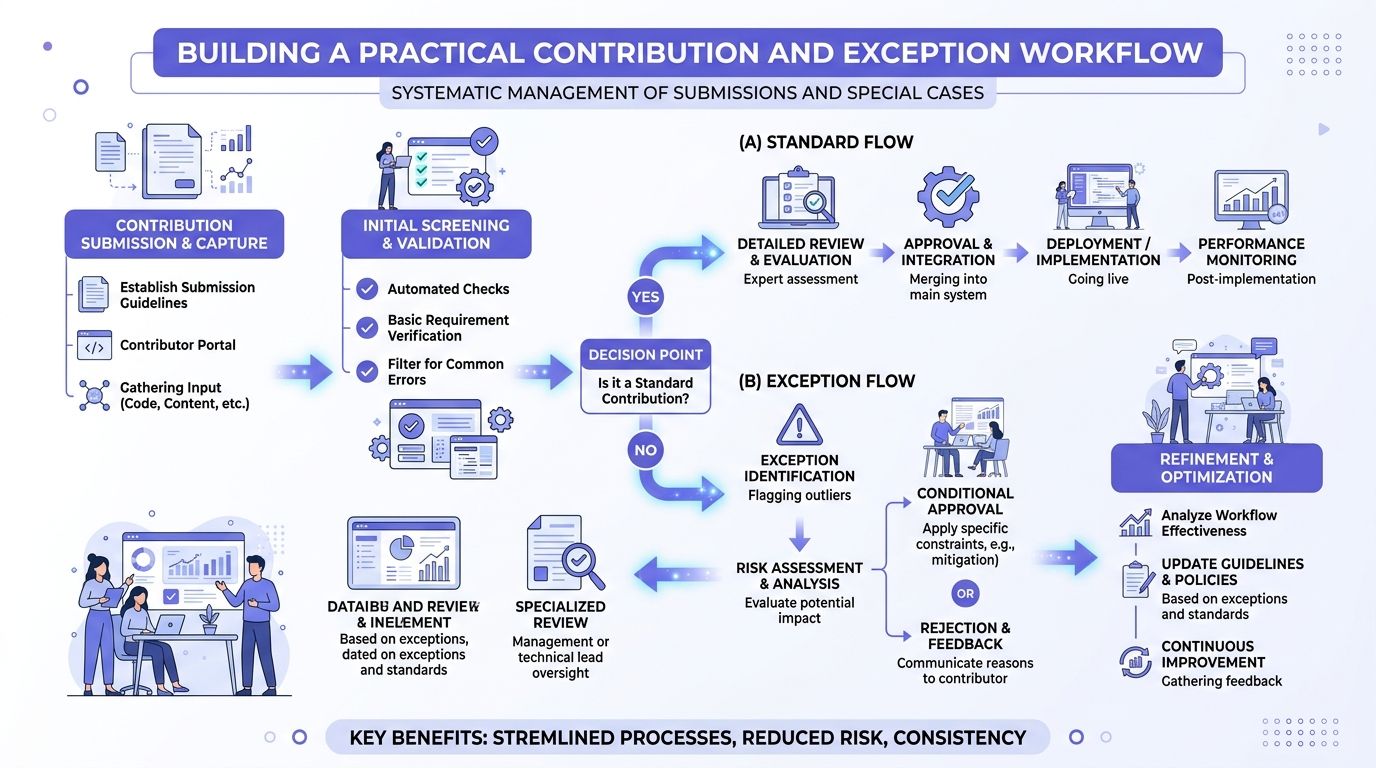
The workflow should function like an operating system for decisions. It should tell teams what kind of request they are making, who reviews it, what evidence matters, and how long the answer should take. Figma files and a style guide support that work. They are not the workflow.
Build a default path that teams will actually use
A practical contribution flow starts by classifying the request before anyone debates the solution. I usually split requests into three lanes: a usage question, a local gap, or a shared system change. That one decision cuts a lot of unnecessary review.
For a shared change, keep the bar high enough to protect the system and low enough that teams still participate:
Define the problem in product terms.
What user or business need is blocked?
Where does the current system fail?
Which screens, states, or platforms are affected?
Check whether the answer already exists nearby.
Review adjacent components, variants, and tokens.
Separate a missing option from a new pattern.
Use contribution review to reduce duplication, especially when teams are focused on shipping and miss obvious reuse opportunities.
Set the review depth by impact.
Minor extensions can move through an async review.
Shared patterns with broad reuse need design, engineering, and accessibility review.
Foundational changes need a clearer decision record because they affect future work, not just the current release.
Build the component contract before release.
Define behavior, states, tokens, responsive rules, and accessibility requirements.
Resolve mismatches between design and code before publication.
Document what teams can change locally and what they cannot.
Publish the decision, not just the asset.
Record why the change was approved.
Note migration guidance if it replaces an older pattern.
Review adoption later to see whether the contribution solved the original problem.
The trade-off is speed versus cleanup cost. A thin process gets more contributions, but it also lets weak patterns into the system. A heavy process protects quality, then drives teams to side channels. The right workflow makes low-risk decisions cheap and high-impact decisions deliberate.
A good test is simple. Could a product designer submit a reasonable request in ten minutes without asking how governance works? If not, the system is too hard to use.
Treat exceptions as time-boxed decisions
Exceptions need their own lane because they answer a different question. A contribution asks, "should the system change?" An exception asks, "can this team depart from the system for now, under what conditions, and until when?"
That distinction matters. Teams should not have to disguise an urgent local need as a permanent system proposal.
A workable exception flow usually includes:
A concrete reason for the mismatch.
Product constraint, legal requirement, market-specific behavior, technical limitation.
Preference is not enough.
A named owner.
- One person is responsible for reviewing whether the exception is still valid.
An expiry or review date.
- Without one, temporary decisions become part of the product by default.
A precedent check.
- If the same exception appears across multiple teams, it is no longer an exception. It is a backlog item for the system.
A record in a visible log.
- Teams need to see what was approved, for how long, and why.
Many systems often lose coherence. The issue is rarely a single exception. It is the pile of untracked exceptions that nobody revisits.
If duplicate patterns are already showing up in code and files, avoiding unnecessary component creation helps teams catch the problem earlier and route requests into the right lane before another one-off becomes permanent.
How Do You Measure Governance Success?
A design system can look healthy from the library side and still be failing in product. I have seen teams with polished component inventories, tidy docs, and weekly governance meetings, while product squads keep detaching components, overriding tokens, and rebuilding patterns to hit deadlines.
That is why governance measurement starts with decision quality in shipped work. Governance is doing its job when teams can make consistent choices with less debate, fewer workarounds, and less cleanup later.
The first signal is adoption. Not library downloads or component count. Actual use across product surfaces, files, and repos. If teams reach for the system by default, the operating model is working. If they avoid it, the issue usually is not discipline. It is fit, speed, or trust.
Adoption on its own is not enough, though. A system can post strong usage numbers and still hide bad governance underneath. Teams may adopt the basics while creating local forks around every edge case. Measure drift alongside adoption so you can see where the rules stop matching reality.
A practical scorecard fits on one page:
Adoption rate: is the system the default path in real product work? Which teams use it willingly, and which route around it?
Detachment rate: where do shared components stop meeting product needs? Which get disconnected most, and why?
Token overrides: where are visual standards under pressure? Valid product constraints, or signs the system is too rigid?
Rework time: what does correcting divergence after delivery cost? How much effort fixes decisions that could have been handled earlier?
Variant sprawl: is growth improving reuse or creating noise? Are new variants reducing exceptions, or multiplying choice?
I would add one more layer. Review these measures with the people who feel the friction, not only with system owners. A spike in overrides might mean poor discipline. It might also mean a component API is too narrow, a token set is missing a common use case, or review latency is pushing teams into local fixes. The number matters less than the reason behind it.
That is the part leaders often miss. Governance success is not strict compliance. It is a system that helps teams make good decisions quickly, with clear trade-offs when they need to bend the rules.
For teams that need a clearer way to track and communicate impact, Figr for design system measurement is a useful reference. The same discipline applies outside components too. Work like auditing font licenses for 2026 follows the same governance pattern. Measure adherence, catch drift early, and review exceptions before they become risk.
Automating Enforcement Without Becoming the Police
A governance model starts to fail the moment enforcement depends on someone remembering the rules during a rushed handoff.
That is why automation matters. Not because teams need tighter control, but because repeated decisions should not require repeated debate. Good automation turns governance into part of the operating system. It checks the routine stuff, explains the rule, and leaves judgment calls to people who understand the context.
The practical shift is simple. Stop treating governance as a PDF, a Figma library, or a style guide that people are supposed to recall from memory. Put the rules where decisions happen. In design tooling, in pull requests, in test pipelines, and in release checks.
A useful enforcement stack usually includes:
Token linting: Catch hard-coded values before they spread
Component usage checks: Flag unsupported props, local forks, or banned patterns
Visual regression tests: Surface unintended UI changes before release
Accessibility checks: Catch repeatable issues early, while fixes are still cheap
Exception logs: Record owner, reason, and expiry date so temporary decisions stay temporary
The trade-off is real. Teams stop trusting automation when it blocks work without telling them what to do next. I have seen that happen with strict lint rules, overloaded design reviews, and CI checks that fail on edge cases no one planned for. People do not call that governance. They call it bureaucracy, then they work around it.
Helpful enforcement has a few consistent traits:
It runs early. Designers and engineers should get feedback before review, not after a week of work.
It explains the rule. A failed check should say what broke, why it matters, and what approved option to use instead.
It offers an exit. If a team has a valid reason to diverge, the system should point to the exception path.
It expires debt. Exceptions need review dates, or they become permanent through neglect.
This is the difference between governance and policing. Policing waits for violations, then punishes. Governance sets teams up to make the right call by default and makes exceptions visible when they are justified.
The same pattern shows up outside components and tokens. Compliance work around brand assets, licensing, and distribution follows the same logic. If your organization manages typography across products, marketing sites, and vendor workflows, auditing font licenses for 2026 is a useful example of governance as ongoing operational control, not one-time documentation.
Manual review still has a place. Use it for intent, trade-offs, and cases where product context matters. Use automation for the repetitive checks that teams should not have to negotiate every sprint.
Why AI Changes the Governance Question
A team used AI to generate a new settings flow on a Friday afternoon. By Monday, parts of it were already in code, the component names did not match the system, and nobody could answer a simple question: who approved this pattern for reuse? That is the governance problem AI brings into focus. It is less about generation itself and more about decision-making under speed.
AI shortens the time between idea and artifact. If governance is only a review checkpoint at the end, it breaks fast. Teams can now produce convincing UI before anyone has agreed on ownership, validation criteria, or whether the pattern belongs in the shared system at all.
The mistake I see is treating AI as a tooling question. It is really an operating model question. Figma files, prompts, and component libraries are only the surfaces where the issue shows up. Governance has to answer why a generated pattern should enter the system, who is accountable for that decision, and what evidence is required before other teams inherit it.
The hard part is that AI blurs authorship without removing responsibility. A generated component still needs a human owner. A generated variant still needs a clear source of truth. If a team adapts AI output for a local need, governance should make it obvious whether that work stays local, becomes a formal contribution, or expires as an exception.
That shifts the work from approval theater to decision design. The useful questions are practical:
Ownership: Which person or team is accountable for generated output that ships or enters the system?
Validation: What checks confirm the output meets product intent, accessibility requirements, and system rules?
Traceability: Where does the final source of truth live after AI-assisted edits?
Scope: Is this a one-off solution, a candidate for reuse, or a temporary exception?
I have seen AI help teams stay more consistent when the system already has clear rules, good naming, and documented rationale. I have also seen it multiply drift when the system is vague. AI follows whatever structure it can find. If the operating system for decisions is weak, AI scales the weakness.
A practical governance response stays simple.
Keep accountability human
Define acceptance criteria before generation
Record why a generated pattern was approved
Separate reusable patterns from local experiments early
Review AI output for intent and risk, not just visual polish
Teams that handle AI well do not write a thicker rulebook. They make decisions easier to trace, easier to challenge, and easier to repeat for the next team facing the same call.
Defending Consistency at Scale Without Freezing Change
A design system usually feels healthy right up until the company grows faster than its decision process. One new product gets a special case. Another team ships a local variant to hit a deadline. Six months later, nobody is arguing against consistency, but the product no longer behaves like one product.
That drift rarely comes from bad intent. It comes from incentives. Product teams are measured on local outcomes. The system exists to protect shared quality across teams. Governance has to handle both realities at once, or the organization gets a pattern I have seen more than once: teams route around the system because waiting costs more than divergence.
The answer is not tighter control. It is a better operating model for change.
Mature systems stay consistent because they make decisions repeatable. Teams know which choices they can make on their own, which ones need broader review, and how to raise a conflict without turning every disagreement into a political fight. The rules matter less than the reasoning behind them. If people understand why a constraint exists, they can apply it in edge cases without asking the system team for permission every time.
A few practices hold up under scale:
Run governance on a cadence: Regular reviews beat ad hoc escalation. Teams should know when decisions get made.
Use explicit criteria for trade-offs: Reuse, accessibility, maintenance cost, user impact, and implementation complexity are better decision inputs than opinion.
Retire patterns on purpose: Old components and exceptions stick around unless someone owns removal.
Create a real escalation path: Cross-team disagreement needs a named forum and a final decision-maker.
The hardest part is usually capacity.
As companies grow, the system team often turns into a review queue. Designers ask for approvals. Engineers ask for exceptions. Product managers ask for fast answers to narrow cases. The team spends the week reacting to tickets and loses the time needed to improve tokens, components, guidance, and adoption support. Governance fails here because the model treats experts like traffic controllers.
I have had to fix that pattern directly. At one company, product teams described the design system group as blockers. The underlying issue was simpler and less dramatic. Every low-risk decision had been routed to the same small team. Once we defined what could ship without review, what needed an asynchronous check, and what belonged in a weekly governance forum, the tension dropped fast. The system team got out of queue management. Product teams got faster without creating as much drift.
Good governance protects consistency by distributing judgment, not centralizing every choice. It gives teams room to solve real product problems while keeping shared standards legible, maintained, and worth using.
Unifying Your Product with a Visual Context Graph
A governance review goes sideways fast when each person brings a different slice of the product. Design has the component spec. Engineering has the implementation caveats. Product has the business rule that created the exception in the first place. Everyone is making a reasonable argument, and the group still reaches a bad decision because nobody is working from the same context.
That is the problem a visual context graph solves.

A useful graph links the parts of the product that usually live in separate places and separate conversations:
Visual Context
Behavioral Context
Design System Context
Product Knowledge Context
Implementation Context
The point is not to create another artifact to maintain. The point is to make decisions with enough surrounding evidence that governance can operate like a decision system instead of a rulebook. Figma files matter here, but Figma is only one surface. A style guide helps, but documentation alone does not explain why a pattern exists, where it breaks, who approved the exception, or what technical constraints shaped the final design.
I use this model when teams keep debating the same UI choice in different rooms. A button variant looks harmless in isolation. In context, it might carry a legal requirement, a funnel dependency, a mobile layout compromise, and an accessibility constraint that never made it into the component page. Once those relationships are visible, review quality improves because the conversation shifts from personal preference to product reasoning.
That is also why governance work starts to feel lighter. Teams do not need more approval steps. They need better visibility into the logic behind previous decisions.
The same operating principle shows up in adjacent disciplines. If you work on data-heavy products, this comprehensive guide for data governance is useful as a comparison point because it shows how governance gets stronger when ownership, context, and enforcement connect across the system instead of sitting in separate silos.
In practice, a visual context graph becomes shared memory. It shows how a pattern is used, what constraints shaped it, which adjacent components it affects, and where an exception should trigger follow-up. That helps product teams make low-risk decisions locally while still preserving coherence across the product.
You can see the effect in review meetings. Fewer abstract debates. Faster exception calls. Better reuse, because teams can judge fit based on intent and surrounding conditions, not just screenshots.
Governance works best when the system can explain itself. A visual context graph gives it that ability.
FAQ
How do I know if my design system needs governance?
You usually see it before anyone names it.
A product team ships a small variant to hit a deadline. Another team copies it because it is faster than asking questions. A month later, design reviews turn into debates about which version is "correct," engineering has two implementations to maintain, and nobody is sure who can make the final call. That is a governance gap.
In practice, I look for a few patterns: repeated local overrides, duplicate components that solve the same problem, unclear ownership, slow approval paths, and recurring arguments about exceptions. Those signs mean decisions are happening, but the system for making them is weak or missing.
Should one central team own everything?
A central team should own the system's direction, quality bar, and decision process. Full centralized control rarely holds up for long.
At scale, one team cannot review every variant, answer every product constraint, and still keep the system healthy. Teams need room to contribute, especially when they are closest to the customer problem. The trade-off is predictable. More local autonomy increases speed, but it also raises the risk of drift if contribution rules and review expectations stay vague.
The model that works in real companies is usually mixed. A core team maintains standards and shared assets. Product teams contribute within clear boundaries. Governance exists to make those boundaries workable, not to force every decision into one queue.
What's the first metric I should track?
Start with adoption, but define it in a way that is hard to fake.
A raw usage number can look healthy while teams are detaching components, modifying tokens, or rebuilding patterns in code. Track whether approved components are being used in production workflows, design files, and shipped UI with limited variation. Then pair that with a second signal such as exception volume, time to review contributions, or duplicate pattern creation.
One metric gives you a surface read. A small set of operational metrics shows whether governance is helping teams make better decisions with less friction.
How should we handle exceptions?
Treat exceptions as temporary decisions with accountability.
Each exception needs a reason, an owner, scope, and a review date. Without those four things, exceptions tend to become shadow standards. I have seen more inconsistency come from untracked "one-off" decisions than from intentional system changes.
Some exceptions are the right call. Accessibility issues, legal copy, market-specific requirements, legacy platform limits, and revenue-critical experiments can justify them. Good governance does not try to eliminate exceptions. It makes them visible, time-bound, and easier to retire or formalize later.
Does AI make governance less necessary?
No. It raises the stakes.
AI can generate screens, flows, copy, and code much faster than a team can review them manually. If naming is messy, ownership is unclear, or component rules are loosely defined, AI will reproduce that confusion at higher speed. You get more output, not better decisions.
The governance question also changes a bit. Teams now need rules for model inputs, prompt patterns, generated component quality, and review responsibility. The companies getting value from AI are not replacing governance. They are tightening the decision system around it so speed does not turn into product entropy.
Governance is the operating system behind the design system. Tools, libraries, and documentation matter, but they do not decide how trade-offs get made. People do. If the rules explain the why, the workflow respects delivery pressure, and ownership is clear, teams can move fast without pulling the product apart.