

A Product Manager at a growth-stage SaaS company once showed me a task approval flow that had already been “approved” three times, and still wasn't ready to build. The designs looked finished. The work wasn't.
When teams can't measure design rework clearly, they confuse motion with progress. Review cycles multiply, engineers reopen design questions during build, QA finds states nobody modeled, and the true cost disappears into calendars, Slack threads, and handoff churn.
That's where a more defensible AI design tool ROI enterprise case starts. Tools like Figr help by grounding design work in actual product context, from live screens and design systems to PRDs and implementation constraints, so teams can reduce wasted cycles, tighten handoff quality, and measure value in terms a CFO will accept.
Why Your Current ROI Model for Design Tools Is Broken
Most enterprise ROI models for design tools are broken because they measure visible output and ignore invisible rework.
A lot of business cases still reduce design productivity to shallow proxies like screens produced, concepts explored, or time to first draft. That logic falls apart in real product teams. A screen that ships after five rounds of clarification is more expensive than a slower draft that gets approved with minimal churn. A polished mockup that triggers engineering questions is not an efficient asset. It's deferred ambiguity.
I call this the Iteration Tax.
The metric leaders miss
The Iteration Tax is the accumulated cost of:
Reopened decisions: Product requirements that weren't fully resolved before design review
Context switching: Designers bouncing between new work and revision work
Feedback drag: Stakeholder comments that arrive without product context or design system logic
Handoff ambiguity: Open questions pushed downstream to engineering and QA
This is what I mean: design rarely fails because designers are too slow. It fails because the system around them keeps stripping away context, then asking the team to reconstruct it.
That matters more now because AI spending is no longer a side experiment. Menlo Ventures estimates enterprise generative AI spend reached $37 billion in 2025, up from $11.5 billion in 2024, a 3.2x increase, and the design segment represented 7% of departmental AI spending, which tells you design workflows are already inside the mainstream AI budget conversation (Menlo Ventures on enterprise generative AI spending).
Why software-style ROI logic misses design reality
Traditional software procurement treats tools like fixed utilities. Buy license, train users, expect productivity. Design work doesn't behave that cleanly. It's nonlinear, collaborative, and heavily dependent on whether product context survives each handoff.
That's why smart buyers make smart choices for AI design platforms differently from normal software evaluations. The useful question isn't “How many assets did the tool generate?” It's “How much expensive rework did the system prevent?”
Practical rule: If your ROI model starts with output volume and ignores revision loops, it will overvalue novelty and undervalue operational impact.
An AI design tool ROI enterprise model should track how often teams revisit the same decision, how long designs stay in review, and how much downstream clarification a “done” design still requires. That's where the money leaks.
How Much Does One Design Cycle Really Cost Your Enterprise
One design cycle costs more than design hours because each revision pulls in product, engineering, review time, and launch delay.
Last week I watched a Product Manager at a Series C company walk through a task approval card that seemed simple on paper. By the end, the team had debated role permissions, approval limits, failure states, and notification behavior across multiple reviews. What looked like a one-week design task became a month of fragmented decision-making.
That story is ordinary, which is the problem.
The real unit of cost is the cycle
Project cost is often tracked at the epic or feature level. That's too coarse to expose waste. The better unit is a single cycle of design and review.
A cycle usually includes:
Designer effort: Revising screens, updating variants, cleaning files, resolving comments
Product Manager effort: Clarifying requirements, summarizing decisions, resolving stakeholder conflict
Engineering effort: Reviewing feasibility, flagging inconsistencies, asking follow-up questions
Stakeholder review overhead: Meetings, async comments, duplicated approvals
Delay cost: Time the feature didn't move forward while the team revisited the same issue
The basic gist is this: one extra cycle rarely looks expensive in isolation. Across a portfolio, it becomes budget drift.
PwC reported that 60% of respondents said AI boosts ROI, while McKinsey's State of AI 2025 found only 39% reported enterprise-level EBIT impact (PwC's summary of AI ROI and enterprise impact). That gap mirrors what product leaders see every day. Teams feel workflow gains quickly, but finance only sees value when those gains connect to a redesigned operating model.
A simple baseline formula
You don't need a finance team to estimate cycle cost. Start with a working model:
Design cycle cost =
Designer revision time
+ Product Manager coordination time
+ Engineering clarification time
+ Review meeting time
+ estimated value of launch delay
Use your own loaded hourly rates internally. Don't guess at industry averages. Your CFO will trust a messy internal model more than a polished external fiction.
To make this visible, review the last five shipped features and calculate rework in product teams. Count how many times a design returned to active revision after it was considered review-ready. Then ask a harder question: how many of those cycles happened because the team lacked product context at the moment the first draft was created?
A lot of “design inefficiency” is really context retrieval performed by expensive people in expensive meetings.
That's why the AI design tool ROI enterprise conversation shouldn't start with speed. It should start with cost per avoidable cycle.
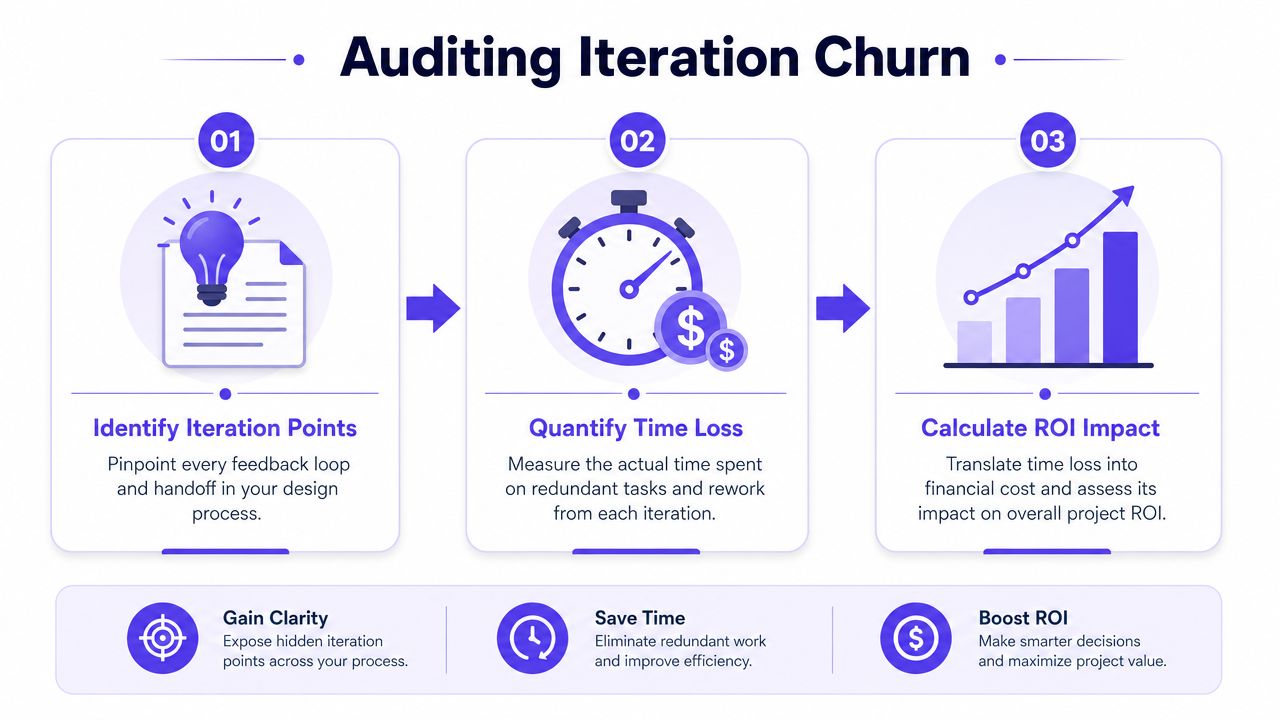
Step 1 Auditing the Time Lost to Iteration Churn
You can audit iteration churn in an afternoon if you focus on where context breaks, not on who to blame.
Teams usually know they have rework. They just can't point to it cleanly. The fastest fix is a lightweight process audit that turns complaints into traceable workflow evidence.
Audit the last real feature, not the cleanest one
Pick one recently shipped flow with enough complexity to expose failure points. Avoid the neat showcase project. Use the messy one.
Step 1. Map the actual journey from brief to handoff.
Pull the PRD, Figma file, Slack threads, meeting notes, and engineering questions.
Mark each moment where work moved between people or systems.
Highlight where a decision had to be re-explained.
Step 2. Tag every churn event.
Note each reopened comment thread.
Mark each design revision triggered by missing requirements, design system mismatch, or unclear behavior.
Separate new learning from avoidable rework.
Step 3. Estimate time lost at each point.
Use calendar history, comment timestamps, and team recall.
Count meeting time, revision time, and clarification time.
Keep estimates directional, but make them explicit.
Look for recurring failure shapes
The pattern usually isn't random. It clusters.
Common churn signatures include:
Brief drift: The requirement changes because the original brief lacked decision detail
State gaps: Teams designed the happy path and discovered real usage states later
Artifact split: Product context lives in docs, designs, tickets, and memory instead of one connected workflow
System drift: A draft looks plausible but doesn't respect existing component logic
Deloitte reports most organizations expect AI payback in 2–4 years, while a separate multi-deployment working paper cited by Deloitte reports a median ROI of +159.8% over 24 months and found that projects under €15K achieved 2.1× higher ROI (Deloitte on AI ROI timelines and narrow workflow pilots). That's a useful benchmark for Product Managers. Start with a narrow workflow where churn is obvious and measurable. Don't try to instrument the whole design organization at once.
The fastest ROI proof usually comes from one painful flow that everyone remembers.
What to record in your baseline
Your baseline should include a small set of operational metrics:
Cycle count: How many revision loops happened before handoff
Elapsed time: How long the flow stayed in design and review
Clarification volume: How many downstream questions surfaced after handoff
Artifact completeness: Whether acceptance criteria, flows, and state logic existed before engineering started
If your current process stores product context in scattered files and human memory, your first ROI opportunity isn't prettier generation. It's fewer reconstructive loops.
Step 2 Quantifying Rework from Missed Edge Cases
Missed edge cases create expensive rework because they surface when the cheapest moment to solve them has already passed.
Teams commonly don't lose time on the main flow. They lose it on the state they didn't model. Approval revoked. Network interrupted. Role changed mid-action. Data missing. Limit exceeded. Empty list after a successful filter. Those are the places where a tidy design becomes a messy delivery conversation.
I've seen a simple approval experience turn into a debate about state logic that had nothing to do with visual design. The hidden work was in the conditions.
Treat state coverage as a cost-control exercise
A practical way to estimate rework from missed edge cases is to compare where the issue was discovered:
Before design review
After design approval but before build
During engineering
In QA
After release planning has already absorbed the delay
You don't need speculative industry multipliers. Your own workflow history is enough. Pull a few recent examples and estimate how much time each late-found state consumed across design, product, engineering, and QA.
That's also why the most useful AI design tooling isn't just generating a screen. It's helping teams reason through state branches before they harden assumptions. Figr, for example, can ingest product context and produce edge case maps, state diagrams, and Figma-ready outputs tied to real product inputs rather than disconnected prompts.
Measure across three ROI horizons
The enterprise mistake is forcing every AI investment to prove itself on the same timeline. The more practical model is the three-tier method outlined in guidance on AI ROI and success metrics:
Realized ROI: Live production gains you can verify now
Trending ROI: Pilot-stage improvements that indicate likely value
Capability ROI: Readiness created by better systems, artifacts, and knowledge reuse
This matters for edge cases because a pilot may not yet show full financial return, but it can still show improved state coverage, cleaner handoff artifacts, and fewer reopened questions. Those are valid leading indicators.
A workable estimation method
Use a small worksheet for each missed state:
State missed: What condition was absent from the original design?
Discovery point: When did the team notice it?
Teams involved: Who had to rework or re-review the flow?
Artifacts changed: Which files, tickets, or tests were updated?
Delay introduced: What work paused while the issue was resolved?
Then review recurring patterns with your team and compare them against the costly edge cases PMs overlook in everyday product work.
If a team keeps “discovering” the same class of states late, that isn't bad luck. It's an input quality problem.
A defensible AI design tool ROI enterprise case gets stronger when you can say, with evidence, that the tool helps the team explore more state logic before build starts.
Step 3 Measuring the Cost of Brittle Design Handoffs
Brittle handoffs cost money because engineers and QA inherit ambiguity that should have been resolved upstream.
A Figma file can show layout clearly and still fail as a delivery artifact. I've seen handoffs that looked polished until engineering asked basic questions about validation rules, permission boundaries, loading behavior, and event sequencing. At that point, the build is already carrying design uncertainty as delivery risk.
Count the questions your handoff creates
If you want a cleaner ROI case, start counting downstream friction directly.
Useful handoff metrics include:
Clarification questions: Design intent questions raised by engineers after handoff
Spec gaps: Missing acceptance criteria, flows, or behavior notes
QA churn: Bugs or tickets rooted in unclear expected behavior
Re-approval loops: Cases where design had to revisit a flow after engineering started building
Adoption discipline matters. Enterprise AI ROI depends on trust and process adaptation, and the market is moving quickly toward purchased solutions, with 76% of AI use cases purchased in 2025, up from 53% in 2024 (Xenoss on AI ROI discipline, trust, and purchased solutions). Buying the tool is easy. Getting teams to rely on better artifacts consistently is harder.
What stronger handoffs look like
The handoff artifact should answer the questions engineers ask under pressure. That usually means packaging more than screens:
Flow logic: What happens before, during, and after the interaction
State behavior: Loading, empty, failure, permission, conflict, retry
Test scenarios: Conditions QA should validate
Acceptance criteria: What counts as complete
When these artifacts are created ad hoc, they lag behind the design. When they're generated from the same context as the design work, the handoff gets sturdier.
A useful internal benchmark is your own handoff playbook. If you don't have one, this guide to design-to-dev handoff best practices is a good reference point for the kinds of artifacts to standardize.
Teams trust AI outputs when those outputs reduce argument, not when they merely look polished.
That's the hidden threshold. An AI design tool ROI enterprise case improves when the tool lowers engineering ambiguity and shrinks QA rediscovery, because those are costs leadership already understands.
The Hidden ROI Multiplier Design System Adherence
Design system adherence multiplies ROI because every compliant screen prevents future cleanup across the portfolio.
Design system consistency is often treated as a craft issue. Finance should treat it as a cost issue. Every off-pattern component, every improvised variant, every token mismatch creates a tiny liability that someone will reconcile later. One screen rarely hurts much. Fifty do.
Drift compounds quietly across teams
The painful part is that drift doesn't usually show up in the original feature estimate. It appears later:
Designers spend time correcting inconsistencies before reuse
Engineers build exceptions that shouldn't exist
QA tests behavior that varies for no defensible reason
New teams inherit a system that no longer behaves like a system
This is the zoom-out moment. Portfolio economics reward reuse, not isolated wins. When a company keeps recreating patterns across products because the original logic wasn't preserved, it pays for the same decision repeatedly.
A lot of ROI writing stops at task automation. That's too narrow. Enterprise frameworks increasingly argue that value also comes from reusable patterns, cross-project knowledge transfer, and reduced technical debt across the portfolio, not just faster first drafts (DX on portfolio-level enterprise AI ROI).
What to measure beyond speed
If you're building a business case, add design system adherence to your model with qualitative and operational signals:
Reuse quality: Are teams starting from approved components or recreating approximations?
Review friction: How often do reviews focus on system cleanup instead of product decisions?
Cross-project transfer: Can one team's solved pattern move into another team's workflow cleanly?
Debt prevention: Does the design process reduce the need for later normalization work?
A friend at a multi-product company told me their design reviews kept circling the same argument in different forms: “Why is this button behaving differently here?” Nobody had budgeted for that conversation. Everyone was paying for it.
Why this matters to a CFO
A CFO doesn't need to love design systems. They need to understand compounding maintenance cost. Consistent component logic reduces duplicate decisions, reduces exception handling, and preserves reusable assets. That's durable value.
The strongest AI design tool ROI enterprise cases don't stop at “we saved designers time.” They show that the team improved portfolio hygiene, made reuse easier, and lowered future coordination load.
Your AI Design Tool ROI Calculator Framework
A useful ROI calculator translates design friction into cost categories your finance partner can challenge, validate, and eventually trust.
Keep the model simple enough to maintain. If it needs a quarterly analytics project to update, nobody will use it. The best version is a spreadsheet your Product Manager, design lead, and finance partner can review together.
How to use it without fooling yourself
Use these rules:
Start with baseline evidence: Pull from shipped features, not aspirational process maps
Model one workflow first: Choose a repeated flow type with clear pain
Separate current savings from projected savings: Don't present pilot signals as proven financial return
Include hidden labor: Product coordination and engineering clarification often matter more than design draft time
The AI design tool ROI enterprise question isn't whether a tool can generate faster. It's whether your team can defend lower rework, better handoffs, and stronger system adherence with evidence.
In short, build the calculator around avoided waste, not generated novelty.
How Figr's Visual Context Graph Underpins This Entire Model
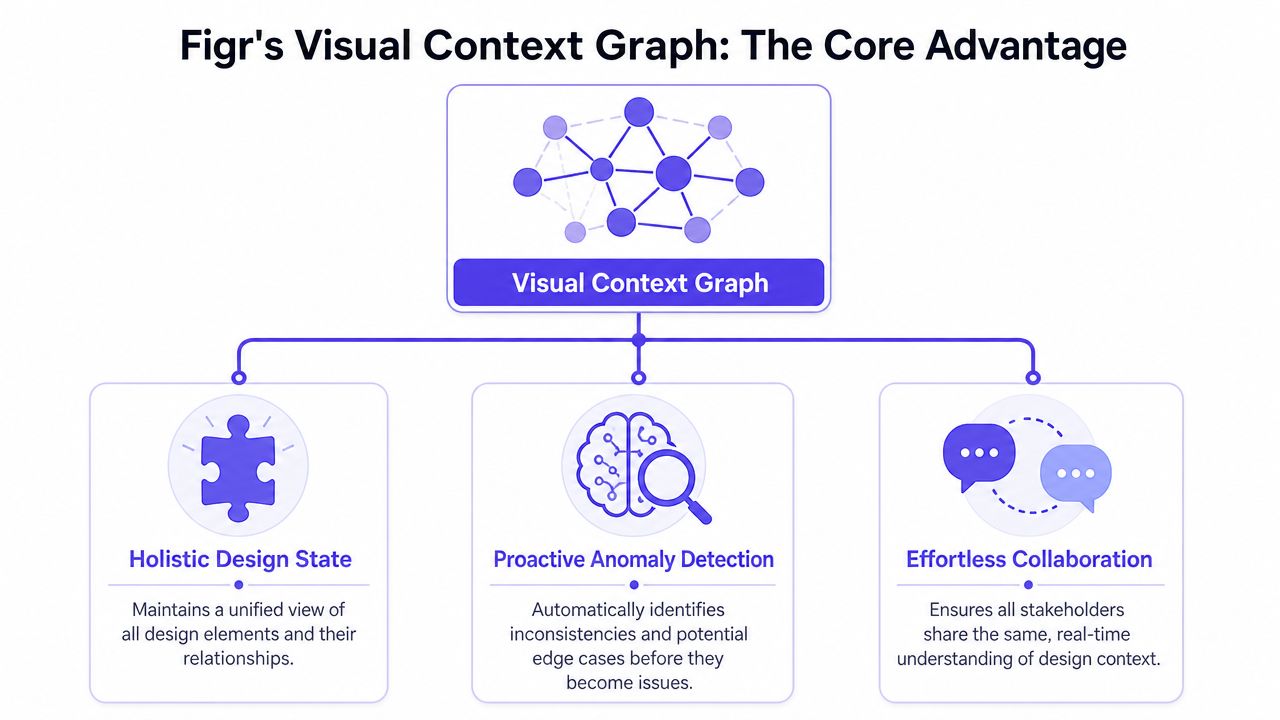
Figr's Visual Context Graph matters because reliable ROI comes from context continuity, not image generation.
Most AI design outputs fail in enterprise workflows for a simple reason. They look plausible but aren't grounded in how the product behaves. That's where review churn comes from. The output needs human correction because the tool never understood the live product, the design system, or the operating constraints.
The answer is grounding AI decisions in product context, which is the operational problem behind most “AI didn't help much” stories.
The five layers that change ROI math
The Visual Context Graph connects five layers of product understanding:
Visual context: Screens, frames, layouts, and interface structure
Behavioral context: Recordings, flows, navigation patterns, and user movement
Design System context: Tokens, components, variants, and usage rules
Product Knowledge context: PRDs, research, decisions, and written rationale
Implementation context: Code constraints and build realities
This is what gives the ROI model teeth. When the tool works from connected context, teams spend less time re-explaining the product to the tool and less time correcting disconnected drafts afterward.
Why that matters in practice
A Product Manager doesn't need another way to make polished mockups. They need a system that reduces iteration churn across the whole delivery chain.
That means:
Fewer context resets: The team isn't reloading requirements from scratch each session
Better state reasoning: The tool can work from flows and prior decisions, not just prompts
Cleaner handoff artifacts: Outputs stay closer to real product and system logic
More reusable knowledge: Decisions become durable assets instead of meeting residue
I've found that finance conversations get easier when you can explain the mechanism clearly. If a tool understands screens, behavior, system rules, documents, and implementation constraints together, then reduced rework becomes a logical outcome rather than a hopeful claim.
What a CFO can believe
A CFO will usually challenge soft productivity language, and they should. But they can believe a model where the team cuts avoidable review cycles because the tool starts from the same product context humans would otherwise reconstruct manually.
That's the crux of the AI design tool ROI enterprise argument. The return doesn't come from replacing designer judgment. It comes from giving that judgment better inputs, better continuity, and fewer downstream corrections.
If you're building a business case this quarter, start with one painful workflow, baseline the iteration tax, and run the calculator against your last few shipped features. Then test whether a context-aware design agent lowers rework where your team feels it most. If you want to do that with Figr, you can try Figr.
FAQ
How do I prove AI design tool ROI to a CFO?
I'd start with avoided rework, not time-to-first-draft. Show current costs in revision cycles, engineering clarifications, QA rediscovery, and review load, then compare them to a pilot workflow with better context continuity.
What should I measure first in an enterprise pilot?
I'd measure cycle count, clarification questions after handoff, and time spent reopening approved designs. Those are easier to verify than broad productivity claims and tie directly to delivery cost.
How long should I expect payback to take?
I wouldn't promise immediate enterprise-wide payback. The more credible path is a narrow, high-friction workflow first, then a broader rollout once the team has baseline and pilot evidence.
Does an AI design tool replace the designer?
No, and I wouldn't buy one on that premise. The value is reducing context loss, surfacing states earlier, and producing stronger artifacts so designers spend more time on judgment and less on reconstruction.
What makes ROI harder than it looks in design teams?
Adoption and trust usually slow things down more than raw model capability. If the team doesn't use the tool consistently inside the workflow, the ROI story stays theoretical.