

You have one designer multiple PMs. Hiring is frozen. The PMs keep shipping anyway, sometimes with you, often without you.
That's the moment most design teams start lying to themselves.
They call it a bandwidth issue. It isn't just bandwidth. It's a resource efficiency issue. If every new roadmap item still needs your direct attention, you don't have a scaling model. You have a queue. And queues don't magically become strategy because everyone is busy.
To scale design team without hiring, you have to stop acting like a service desk and start acting like the person who builds the operating system for product decisions.
The Ratio Problem You Already Live In
The ratio breaks first, then quality breaks, then trust breaks.
A common week looks like this. Three PMs need flows. An engineer needs a clarification. Someone pings for a “quick UX pass.” A sales request shows up disguised as a product priority. You spend the day moving between half-finished decisions, and by Friday nothing systemic changed. Sound familiar?
That's why “just keep up” is a trap.
I watched a PM at a growth-stage SaaS company push a feature without design because review windows kept slipping. Nobody was reckless. They were adapting to scarcity. The feature shipped, support tickets followed, and the designer got pulled into cleanup instead of the work that might have prevented it. That cycle is the actual tax.
Practical rule: If the same class of request shows up every sprint, it's no longer a request. It's a systems problem.
The basic gist is this: design doesn't become scalable when you squeeze more output from the same person. It becomes scalable when fewer decisions require that person in the first place.
That means changing what counts as design work. A polished mock is work. A reusable flow pattern is a force multiplier. A thoughtful review comment is work. A decision framework that prevents ten future review comments is an efficiency driver.
If you haven't quantified where rework starts, use a framework for measuring engineering rework. Many organizations feel the pain long before they can name it.
The Leverage Fallacy What Actually Scales
A new designer joins. For two weeks, calendars get fuller before the backlog gets smaller. More reviews. More context sharing. More pairings to explain why the table pattern works one way in billing and another way in admin. Hiring can help, but it rarely fixes the thing that broke first.
The actual limit is dependency.
If each meaningful decision still routes through a designer, capacity rises in a straight line. Demand does not. PMs add bets. Engineers need answers mid-sprint. Sales pulls in exceptions. The queue fills again.
That's the fallacy. Teams try to scale design by adding more design labor, when the bigger gain comes from reducing how often design has to intervene at all.
What stays linear
Some work always grows with request volume:
Review attendance: good judgment, expensive distribution.
Custom variants: fast to ship, hard to maintain.
Repeat clarifications: each one feels minor. Together they consume real design time.
One-off polish passes: helpful in the moment, gone by the next sprint.
None of this is bad work. It just does not compound.
I've seen teams mistake responsiveness for capacity. They answer everything quickly, stay busy all week, and still create no extra room. That pattern feels productive because the team is visible. It scales badly because every gain expires as soon as the next ticket lands.
What actually compounds
Scalable design work changes the default path.
A component that eliminates ten custom solutions beats ten well-crafted custom solutions. A form rule that engineers can apply without asking beats another round of review comments. A brief template that forces edge cases upfront beats fixing edge cases in QA.
That is the mindset shift. Stop treating design as a ticket queue with taste. Start treating it as a system of decisions, defaults, and constraints.
Systems work is part of it, but only part. building usable design systems matters because it reduces decision load under deadline pressure. So do intake rules, approval thresholds, reusable patterns, and efficient task automation strategies for the repetitive handoffs that drain attention.
Ask a harder question when a request comes in. Does this solve one instance, or does it change how the team handles this class of problem from now on?
That is what scales.
How to Scale a Design Team Without Hiring Three Leverage Layers
Monday starts with six Slack pings, two roadmap reviews, a last-minute sales request, and a bug that "just needs a quick design pass." By Thursday, the team has touched fifteen things and changed almost nothing about how work gets done next week.
That is the trap. Capacity disappears when every request gets handled at the point of need.
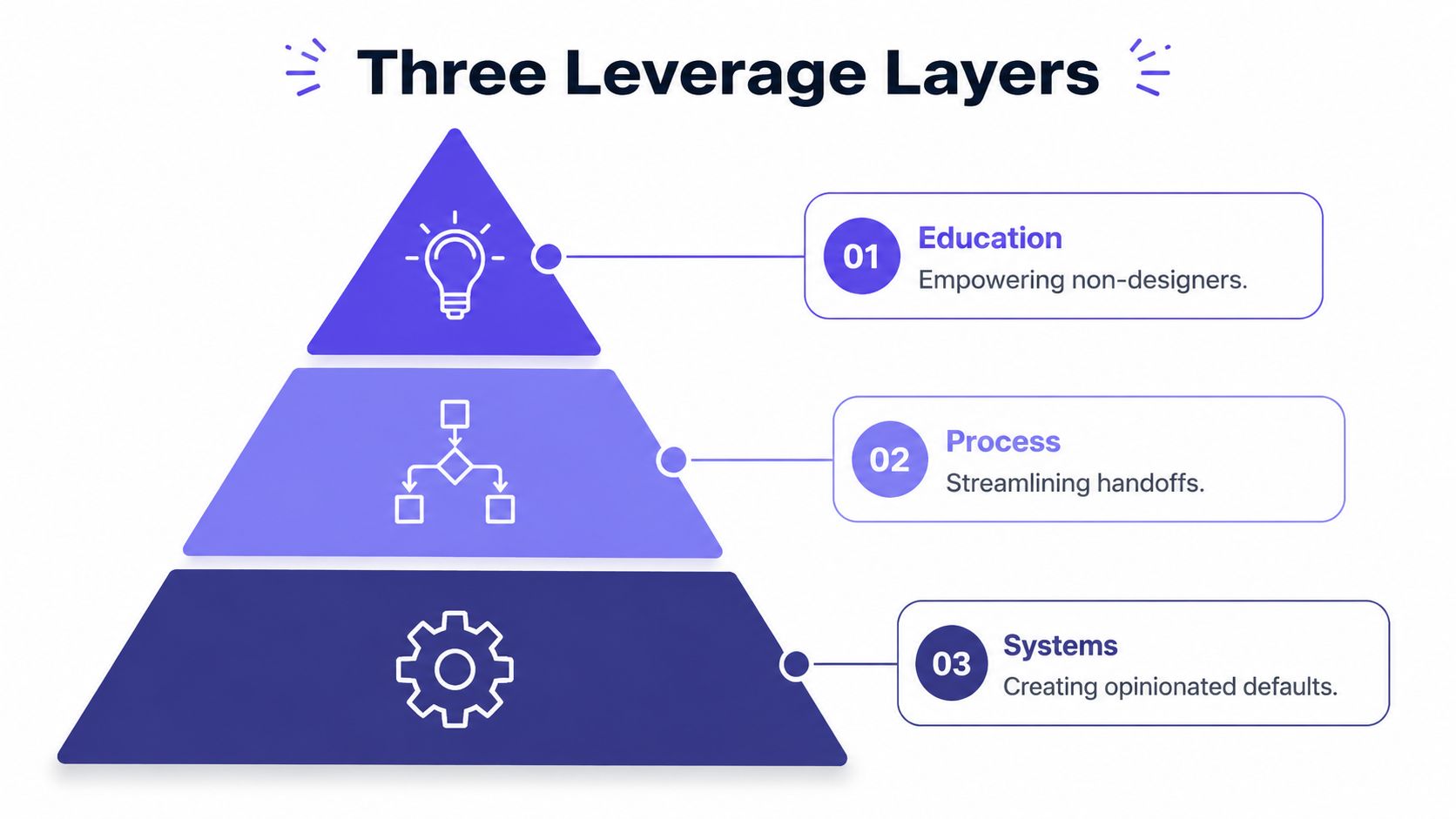
The teams that scale without headcount treat design capacity like an architecture problem. They build three layers that reduce repeat work from the bottom up. Systems at the base. Templates in the middle. AI on top for speed in the parts that should be fast.
The order matters. If AI sits on top of messy inputs and inconsistent decisions, it just helps you produce inconsistency faster. If systems and templates are in place first, AI has something stable to work from.
Systems
Start with the decisions your team keeps remaking.
Button hierarchy. Form validation. Empty states. Permission patterns. Table actions. Error handling. These are not isolated tickets. They are recurring operating costs. Every time a designer redraws them from scratch, capacity gets spent on work the product already knows how to do.
Strong systems remove avoidable choice. A PM should not need a designer to decide whether a dangerous action is red, where helper text sits, or what an empty table says when filters wipe out results. Those answers should already exist.
Use one test. Can a PM or engineer ship a low-risk flow correctly without waiting for design?
That is the practical value of optimizing people and processes in design operations. It reduces dependency on designer time by making the right path the default path.
Templates
Once the recurring UI decisions are stable, fix the recurring ambiguity.
A surprising amount of design time goes to interpretation. The brief is vague. Edge cases appear late. Success metrics are missing. Accessibility gets checked at the end. Then everyone calls the extra cycles "collaboration" when the underlying problem was preventable ambiguity.
Templates cut that waste because they force better inputs.
Use them where requests usually break:
Feature briefs: require user goal, business goal, constraints, edge cases, and event tracking before work starts.
Handoff notes: capture states, content ownership, dependencies, and accessibility checks in one place.
Review requests: require teams to state the decision they need, what changed, and which trade-off they already considered.
This is also the layer where automation pays off. These efficient task automation strategies help strip out status chasing, repetitive documentation, and handoff admin so designers spend their attention on decisions only they should make.
A short walkthrough helps here:
AI
AI belongs at the top because it works best when the lower layers are already doing their job.
Use it for first passes, coverage, and synthesis. Generate variants for a known pattern. Stress-test a flow against edge cases. Draft acceptance criteria from an approved concept. Check copy consistency. Prepare QA scenarios. Speed matters here because the core decision has already been framed.
Keep product judgment close to the team. Push repetitive production outward.
One option is Figr, an AI product agent for UX design and product thinking that ingests your live webapp, Figma files, screen recordings, and docs to learn your actual product before designing, then references 200,000+ real-world UX patterns to design from your product rather than from a blank prompt. If you want to see how teams use it in practice, see what teams have built with Figr, including the Skyscanner accessibility audit for elder users.
That stack changes the team's job. Fewer one-off fixes. More default-setting. Fewer tickets that require a designer. More work that improves how the whole product ships.
Redefining Your Role From Service Provider to System Architect
Monday starts with eight Slack pings. A PM wants a quick polish pass. Another needs a new onboarding flow. Engineering asks for empty states. Support wants a fix for a confusing setting. If you treat each request as a separate design task, you become a queue. Queues grow faster than teams.
The role changes before the title does. At some point, your job is no longer to respond well to tickets. Your job is to reduce how many tickets need a designer at all.
I saw this shift clearly on a team with one designer supporting several PMs. The work did not slow down. The requests kept coming. What changed was the filter. Every ask got the same question first: is this a one-off artifact, or evidence of a repeat problem we should solve once?
That question separates production from architecture.
A service model optimizes for local output. One PM gets a screen. One squad gets a flow. One launch gets across the line. A system architect optimizes for repeat decisions, clearer ownership, and fewer design-dependent handoffs across the product.
When to say no, delegate, or centralize
Use a simple triage rule.
Say no when the request is low impact, unlikely to teach the team anything, and expensive to maintain later.
Delegate when the decision can be made safely by PMs or engineers using documented defaults, examples, and constraints.
Centralize when the choice will repeat, affect multiple surfaces, or create inconsistency that spreads.
Don't accept a ticket until you know whether the deliverable is a screen, a rule, or a reusable asset.
That sounds strict. It saves time.
It also changes the conversation with product. Instead of asking, “Do you need design?” ask, “What kind of design problem is this?” Those are different questions. The first creates a dependency. The second clarifies ownership.
Org structure matters here too. Conway's Law still applies. If your team works through serial handoffs, the product will reflect those seams. More waiting. More reinterpretation. More cleanup later. Teams organized around bounded product areas usually make faster, cleaner decisions because fewer choices bounce between functions.
That is why scaling without hiring often looks like role redesign, not more process. PMs own more low-risk product shaping. Engineers build from clearer constraints. Designers spend more time setting standards, reviewing exceptions, and fixing repeat failure modes.
If leadership needs a clearer view of that shift, start integrating design data into product dashboards. It makes systems work visible before headcount conversations start.
Making the Case and Measuring True Design Capacity
A familiar planning meeting goes like this. Design asks for headcount. Leadership asks how much more shipping that buys. The room falls back to ticket counts, screens shipped, and review volume because those are easy to pull. None of that shows actual capacity.
Capacity is not how many mocks a team produces. It is how much product change the organization can absorb without adding confusion, rework, or waiting. That is the number leadership is trying to understand, even if they ask for it badly.
If you want support for systems work, measure outcomes at the operating level.
What to measure instead
Track the places where design stops being a bottleneck and starts changing how the org works:
PM-led time to ship: Do low-risk features move from brief to release faster without pulling design into every step?
System adoption: Are product teams using the patterns, templates, and guidance you already created, or bypassing them?
UX bug volume: Are repeated interaction mistakes, accessibility misses, and edge-case fixes dropping over time?
Review load: Is the design team spending fewer hours on reversible decisions and more time on exceptions that carry real product risk?
Rework rate: How often does work come back because the original decision framework was missing, unclear, or inconsistent?
One of the strongest signals is disappearance.
The same question stops showing up in Slack. The same bug stops reaching QA. The same design review stops needing a designer in the room. That is capacity. It just does not look impressive in a screenshot.
This is also where many teams lose the argument. They report activity. Leadership cares about throughput, quality, and predictability. Different frame, different answer. A designer who turned ten recurring tickets into one rule may look less busy this sprint and make the product org meaningfully faster next quarter.
Make that shift visible. Start integrating design data into product dashboards so design decisions show up next to cycle time, bug trends, and release health. That is how you make the case for scaling capacity without reducing the work to screen counts.
Your First Move Beyond Headcount
Monday starts the same way it ended on Friday. A PM wants help with another empty state. An engineer pings about table behavior. A new brief lands with no real problem statement, no constraints, and no success metric. If design handles each request one by one, the queue stays full no matter how hard the team works.
Make one rule this week. Any request that has appeared three times stops getting a custom answer.
Turn it into a reusable asset. Write the empty-state pattern. Define table behavior with examples and edge cases. Replace the vague brief with a form that forces the right inputs before work starts. One fix is enough to prove the shift.
That is how you scale design team without hiring. Capacity grows when the same decision does not need to be made twice.
A useful test is simple. Will this work reduce future dependency on designers, or does it only help the current ticket move faster? Speed matters. Independence matters more. The first saves a sprint. The second changes the ratio.
If you want a practical place to look next, review these AI tools for product management teams with one filter. Do they help your team produce reusable rules, better inputs, or clearer decision paths? Or do they just help everyone generate more work for design to clean up later?
As noted earlier, this is bigger than adding patterns. The fundamental shift is role definition. Stop operating like a design help desk. Start acting like the person who designs how decisions get made.
If your team is buried in reviews, rework, and vague requests, Figr is worth evaluating as part of the strategic layer, especially when you need product-aware UX exploration, audits, flows, and prototypes grounded in your actual app rather than generic prompts.