

A product manager career path looks tidy on paper, but many feel the mismatch long before they can name it. They're shipping, juggling stakeholders, and still wondering whether they're operating at the level their title implies.
That mismatch creates quiet problems. A Product Manager can spend months polishing feature delivery while missing the key promotion signal, which is scope. Another can look senior on a résumé and still avoid the decisions that Directors make every week.
The way through is to read the ladder as a change in impact, not a change in busyness. Once you see how Product Manager, Senior Product Manager, Director, VP, and Chief Product Officer differ, the next move gets much clearer.
The Product Manager Career Ladder Explained
A product manager career path changes how you decide, not just what you deliver. I once watched a PM walk into a roadmap review with a stack of finished stories and a polished demo, only to realize the room was asking a different question, which problems deserved attention next.
The ladder is a sequence of scope changes
The standard progression usually starts at Associate Product Manager or Junior Product Manager, moves into Product Manager, then Senior Product Manager, and often continues into Director of Product or a similar leadership role. That pattern shows up across career guides, and it is useful because it frames the path around expanding scope rather than a single fixed title list airfocus career stats. A common formal ladder also names VP of Product and Chief Product Officer as the upper tiers ProductPlan career path.
The useful lens is simple. Each rung changes the unit you own.
Associate Product Manager, you learn the craft on a small surface area.
Product Manager, you own a feature area or product slice.
Senior Product Manager, you shape a product area or portfolio of related problems.
Director of Product, you lead other Product Managers and own a broader portfolio.
VP of Product, you carry organizational strategy and often product line accountability.
Chief Product Officer, you sit at enterprise level, connecting product vision to company direction.
The shift is about impact. Early career Product Managers are judged on whether they can execute cleanly. Senior and leadership roles are judged on whether they can choose the right work, align the right people, and steer a larger system. That is why the same person can feel overqualified for shipping and underqualified for leadership at the same time.
What changes at each rung
At the bottom, value comes from learning the fundamentals and becoming reliable. Mid-path, value comes from making good trade-offs and defending them with evidence. Higher up, value comes from portfolio thinking, coaching, and organizational influence.
Practical rule: if your work still lives mainly inside one project, you are probably not operating at the senior layer yet, even if your title says you are.
That same maturity shift shows up in how you use product artifacts. When a Product Manager works from live screens, design systems, docs, and analytics, the artifact starts from real context instead of guesswork. Figr's product context workflow and planning workflow fit that shift, because stronger Product Managers do more than ask for output, they define the context that makes the output usable.
For a broader craft view, Figr's no-fluff PM guide stays closer to the actual job than title inflation does. It also pairs well with developer posts that go viral), since both reward clarity about audience, context, and the decision you want people to make.
Breaking Into Product Management Without a Traditional Background
The entry point into Product Management is rarely a clean staircase. People often arrive through a side door, then prove they can think in products before anyone gives them the title.
Adjacent experience often matters more than a perfect résumé
Industry guidance makes this plain. There are no specific undergraduate degree requirements and no certification requirements for the role, which is one reason Product Management has become a cross-functional career path rather than a single-track profession airfocus career stats. Indeed also notes that candidates often come from engineering, computer science, marketing, or business administration, and Coursera adds that some advanced roles benefit from an MBA or certifications like PMP or Scrum Indeed career path.
That sounds open-ended because it is. The filter is credibility. Have you already shown product judgment in an adjacent role? Have you worked with customers, made trade-offs, or turned messy input into a decision?
A career-change path gets real when the candidate can show evidence, not just intent. I've seen people do that through side projects, volunteer work, startup roles, internal transfers, and freelance product-adjacent work. The title on day one matters less than the pattern of decisions they can already explain.
Proving PM ability without the title
A smart bridge looks like this.
Build a visible artifact, such as a product brief, teardown, or roadmap proposal.
Anchor it in customer evidence, not just opinions from your own head.
Show trade-offs, so the work reflects prioritization instead of a wish list.
Use small public proof points, like writing or sharing a product analysis that demonstrates judgment.
If you want a useful adjacent example of how public work builds credibility, read developer posts that go viral. The mechanics are different, but the lesson is the same, repeated public evidence beats vague aspiration.
The wrong move is waiting for permission. The right move is building proof that looks like the work already.
Figr can support that kind of proof when you're assembling product thinking into something concrete. Its PRD and docs output is one way to turn scattered observations into a structured artifact, which is exactly what career changers need when they're trying to show they can think like Product Managers before they hold the title.
A good anchor for interview readiness is Figr's tips for PM interviews, because the interview is where your credibility gets tested under pressure.
Early Career Roles and What They Actually Involve
Early Product Management is a training ground, but only if the company treats it that way. The day-to-day is less glamorous than the title suggests, and that's the point.
What APM and junior PM work really looks like
In large companies, the most common early-career entry point is the Associate Product Manager role ProductHQ technical PM path. Those programs are built to teach the craft through controlled scope, mentor access, and repeated reps. In startups, a junior PM may get broader exposure faster, but the feedback loop can be thinner and the mistakes more visible.
The work usually includes writing PRDs under supervision, coordinating with engineering and design, running user research sessions, and translating feedback into prioritization. That's also where tools and systems start to matter. A junior PM who can capture product context, keep state coverage visible, and hand off a well-formed brief makes life easier for everyone downstream.
Practical rule: if the team waits for your note before they can move, you're adding leverage. If they still need you to explain the basics every time, you're adding labor.
The Figr workflow is useful in a practical sense. A PM can capture live screens, import a Figma file, and ingest docs or research so the next artifact starts from the actual product, not a blank slate. That's a different kind of training, because it teaches context discipline as part of the job, not as an afterthought.
The trigger for the next promotion
The promotion from early-career PM to full Product Manager usually happens when the person stops needing direction on what to build and starts identifying what should be built next. That shift is subtle on paper and obvious in the room. The PM begins to spot patterns, frame options, and bring a recommendation instead of a question.
A helpful internal check is simple.
Execution with supervision still means someone else sets the problem.
Ownership of a small area means you can define the problem and choose the next move.
Promotion readiness shows up when peers start using your judgment to unblock theirs.
A lot of people stall because they keep optimizing for task completion. The more durable move is to practice problem framing. When the PM can explain why a request matters, what evidence supports it, and what trade-off they're making, they start sounding like a real Product Manager.
For a related angle on how product work maps to stakeholder pressure, see stakeholder management for POs. The label is different, the pressure pattern is familiar.
The Shift From Product Manager to Senior Product Manager
The jump from Product Manager to Senior Product Manager is where many careers slow down. The reason is simple, the behaviors that earned the first promotion are no longer enough.
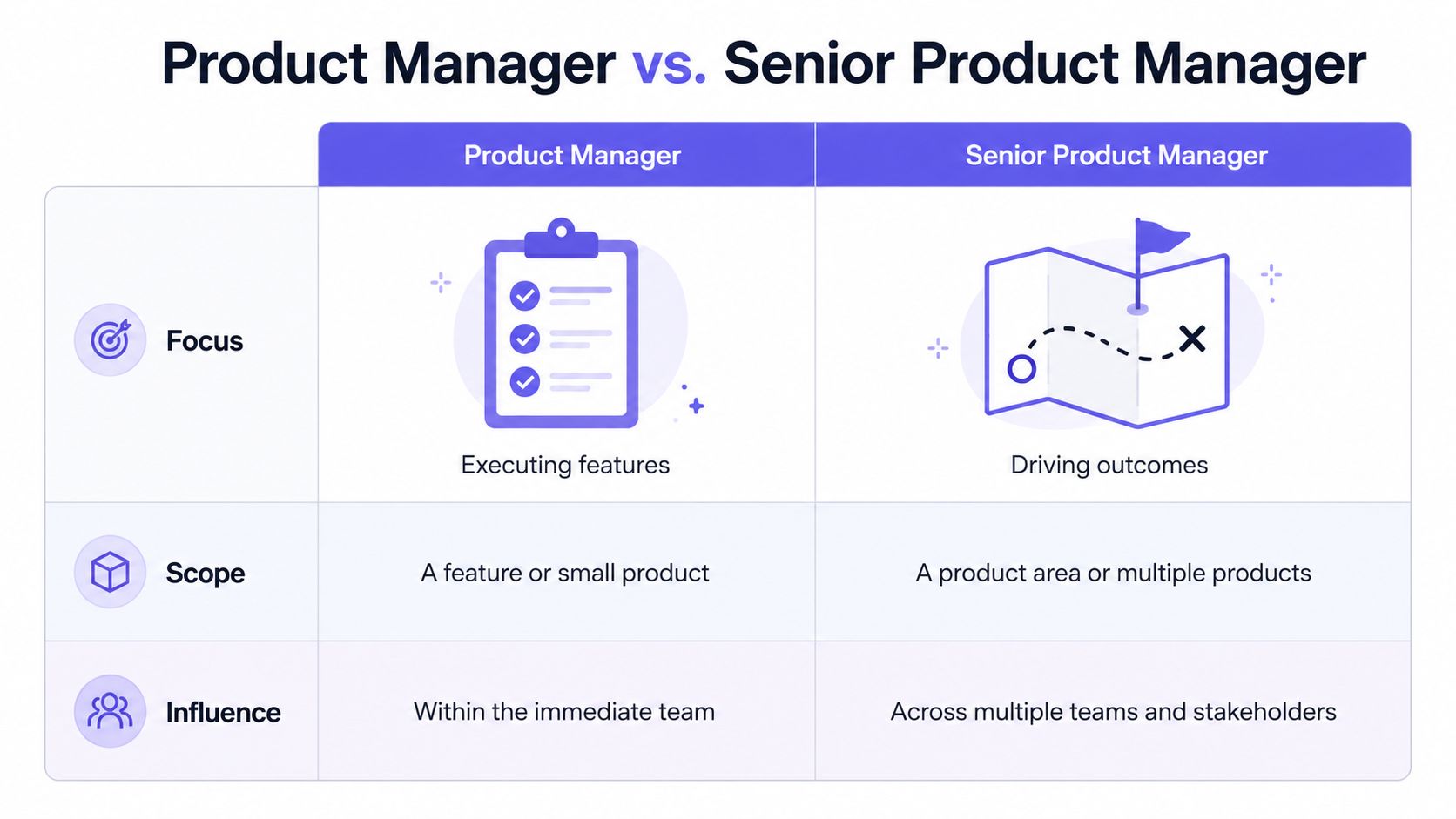
The shift is from feature ownership to product strategy
One source describes Senior Product Manager as a role that typically takes 5 to 8 years of experience and focuses on steering the product management team toward strategic goals through data-driven decisions ICAgile career path. That's useful because it marks the shift as a change in decision quality and scope, not a calendar milestone.
The move often looks like this.
A Product Manager owns a feature area or small product slice.
A Senior Product Manager manages a broader product area or portfolio of related problems.
A Product Manager reacts to requests.
A Senior Product Manager shapes the roadmap before requests arrive.
That progression changes the work in visible ways. The senior person spends more time aligning multiple stakeholders, framing choices, and making sure the roadmap fits the business, not just the team. A strong Senior Product Manager is often the person who can say no cleanly and explain why without burning trust.
What promotion committees actually notice
Promotions at this layer don't usually hinge on charisma. They hinge on whether the Product Manager is already operating above the title. I look for evidence that someone can connect decisions across several initiatives, not just execute one well.
The market data backs up why that step matters. A 2021 survey reported an average U.S. product manager salary of $147,680, while Mint-derived data in the same source listed averages of $69,000 for Associate PM, $112,000 for PM, and $133,500 for Senior PM The Forage career path. More recent 2026 U.S. data cited in the same roundup puts the median base salary at about $135,000, up from $128,000 in 2024 The Forage career path. The message is clear, scope gets priced in.
A useful way to think about it is this. Mid-level PMs get rewarded for shipping the right thing. Senior PMs get rewarded for choosing the right thing, across a larger surface area, with fewer mistakes and less supervision.
If stakeholder friction is where your work breaks down, the guide to stakeholder conflict resolution is the closest adjacent read. Seniority lives or dies in those meetings.
Product Leadership Roles and Organizational Leverage
Director, VP, and Chief Product Officer roles stop being about individual throughput. They're about how many good decisions you can make possible through other people.
Why leadership changes the unit of value
Large-company ladders usually extend from Director of Product to VP of Product and Chief Product Officer ProductPlan career path. In practice, the role changes from managing a product to managing the people, priorities, and systems that produce products. A Director often leads multiple Product Managers and owns a product line or portfolio. A VP usually owns broader organizational strategy and executive coordination. A Chief Product Officer sits on the leadership team and shapes company-wide product direction.
That's not just a title climb. It's a change in organizational impact.
A good senior leader doesn't just answer questions faster. They create an environment where good answers appear more often. That means better staffing, cleaner decision rights, sharper portfolio choices, and more coherent communication across engineering, design, sales, support, and the executive team.
What the market tends to reward
Compensation and responsibility widen as the role rises, but the work also gets less personally visible. You spend more time on talent calibration, portfolio trade-offs, and organizational design. That's the hidden cost of the role, and it's why some strong Product Managers never want to cross into management.
A useful external voice on promotion behavior is the Text Lauren promotion playbook. It's not a Product Management guide, but it's a practical reminder that promotions are usually earned through visible patterns of impact, not private effort.
Zoom-out: at scale, companies pay more for people who can reduce decision friction across teams than for people who can simply move one project forward. That's why senior product leadership is partly a coordination job and partly an economics job.
This is also where Figr becomes more than a design helper. When a product leader works from product context, planning artifacts, and grounded docs, the organization spends less time debating what the current state is. That matters because leadership time is the scarcest resource in the room.
The Individual Contributor Track Versus the Management Track
The assumption that management is the only path up is outdated. For many Senior Product Managers, a significant fork is between deep craft and people leadership.
The IC track is a real path, not a consolation prize
Career coverage often stops at familiar ladder names, but senior product people can stay hands-on, move into Director or VP roles with management responsibility, or even exit into General Manager or CEO roles Product Leaders career paths. That means the long-term path isn't a single staircase. It's a branching structure.
The individual contributor route typically shows up as Staff Product Manager, Principal Product Manager, or Distinguished Product Manager. Those titles carry major influence without direct reports. They tend to work well for people who are strongest when they're solving hard problems, shaping systems, and carrying complex decisions themselves.
The management path is different.
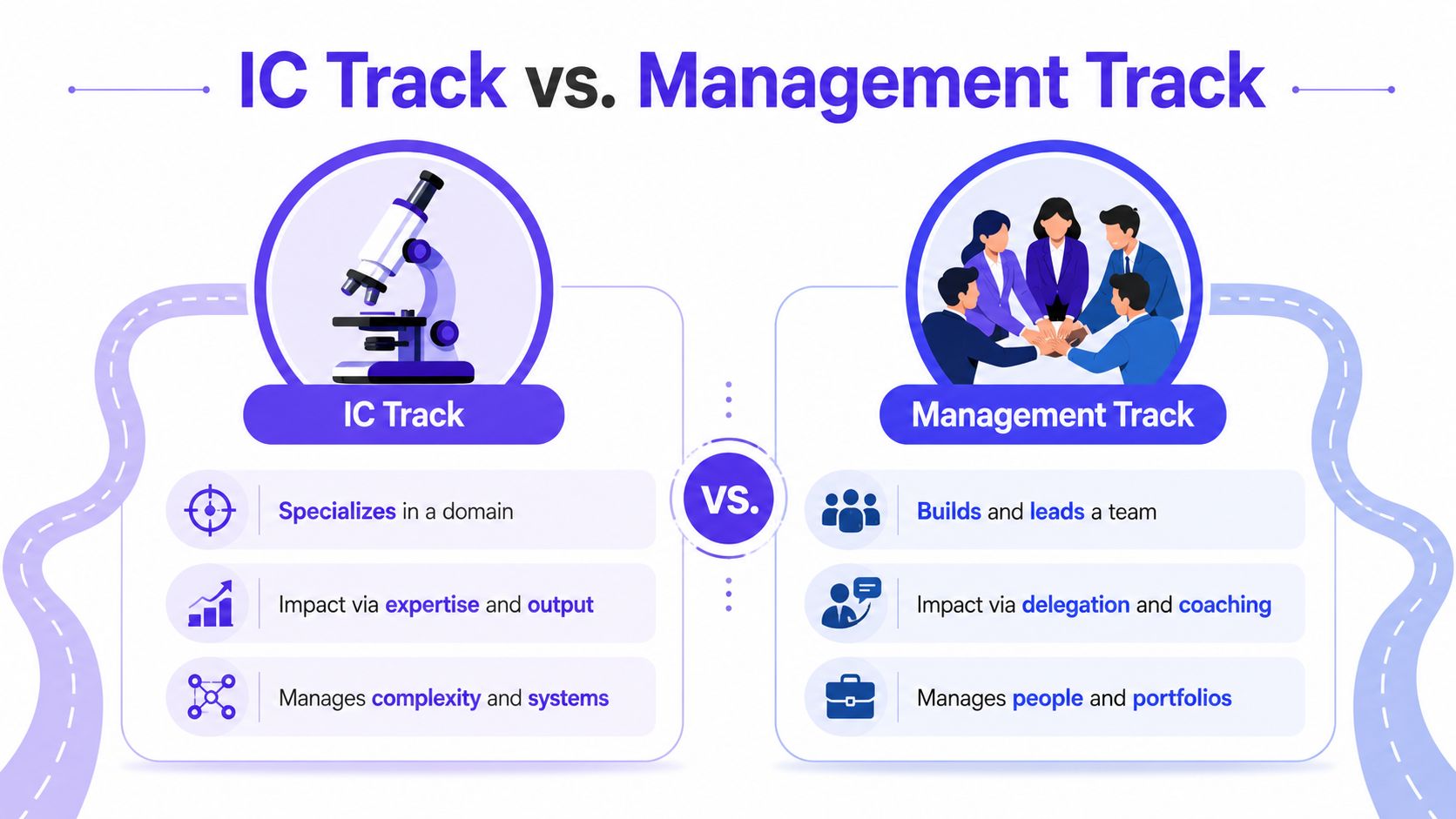
IC track, you deepen expertise, influence through judgment, and manage complexity directly.
Management track, you build teams, coach people, and influence through delegation.
IC track, your impact often comes from solving the hardest product systems.
Management track, your impact often comes from multiplying other Product Managers.
The wrong choice here creates drag. A gifted builder who wants coaching and breadth can thrive in management. A sharp systems thinker who hates people issues can become miserable there. Why force the wrong shape into the wrong job?
Figr's gallery is a useful reference point here, because it shows the kinds of artifacts strong product teams work from, not just abstract mocks. If you want to see one example of how a real product context can become a tight output, the Linear digest gallery example is a good place to start.
How to Assess Your Actual Operating Level
Titles are noisy. Operating level shows up in what you own, what you decide, and who comes to you for judgment.
Five signals tell the truth faster than the title
A self-assessment works best when you look at behavior instead of aspiration. The five dimensions that matter most are scope of ownership, decision-making autonomy, stakeholder complexity, strategic input, and mentorship of others.
Problem identification
Product Manager: Receives a defined problem.
Senior Product Manager: Helps define and refine the problem.
Director: Frames multiple problems across a portfolio.
Solution formulation
Product Manager: Produces the solution path for one area.
Senior Product Manager: Shapes options and trade-offs across initiatives.
Director: Sets the strategy that guides several teams.
Stakeholder alignment
Product Manager: Coordinates the immediate team.
Senior Product Manager: Aligns across functions and competing priorities.
Director: Aligns managers, peers, and executives.
Impact measurement
Product Manager: Tracks feature-level outcomes.
Senior Product Manager: Connects outcomes to product-area goals.
Director: Uses outcomes to steer portfolio decisions.
The matrix above mirrors what strong product organizations care about. It also exposes a common trap. Some PMs spend years in execution mode and call it experience. Others are doing senior-level work but haven't documented the evidence.
What to do if your title lags your operating level
If you're already functioning at a higher level, make the case with examples, not frustration. Show the decisions you influenced, the ambiguity you resolved, and the people you helped unblock. Then connect those moments to business outcomes and team impact.
I'd also look at how your current workflows support that story. Figr's research PRD solution is relevant here because many promotion conversations stall when the evidence is scattered across docs, chats, and memory. When the product context is organized, the case for promotion gets easier to tell.
The best signal you can give a manager is simple. You're already solving the kinds of problems the next title owns.
Planning Your Next Career Move With Intention
Career progress in Product Management depends on demonstrating the next level before you're handed the title. Waiting for the title first usually means waiting too long.
Build proof before you ask for the move
A practical plan starts with the gap between your current operating level and your target level. If you want to move from Product Manager to Senior Product Manager, you need more than clean execution. You need a portfolio of evidence that shows you can shape direction, manage ambiguity, and influence beyond your immediate team.
Use this sequence.
Name the gap, using the operating-level signals above.
Create next-level opportunities inside your current role.
Document your decisions, so your impact is visible later.
Time the conversation after you've already shown the behavior repeatedly.
That approach works better than generic networking advice because it makes your readiness observable. A promotion committee can argue about potential. It has a harder time arguing with a pattern.
Stay or move, based on what the company can actually offer
Sometimes staying is the smarter move. If your company has real room for scope expansion, you can grow faster by taking on broader problems where people already trust your judgment. Sometimes leaving is the smarter move too, especially when the organization has no higher scope left and the ladder is blocked by structure instead of performance.
For readers who want to sharpen the move itself, find product manager resume templates can help you translate product impact into a story recruiters recognize. And if you're thinking about how AI is reshaping the craft around you, the AI trends in product management piece is a good companion read.
The practical takeaway is straightforward. Don't chase titles in isolation. Chase the kind of problems the title is meant to solve.
If your next move is about proving stronger product judgment, Figr can help you turn real product context into the artifacts that make that judgment visible. It pulls together live screens, docs, research, and planning context so your PRDs, flows, and prototypes start from the product you ship. If that's the gap you're trying to close, try Figr.
FAQ
What is the typical Product Manager career path?
It usually runs from Associate Product Manager or Junior Product Manager to Product Manager, then Senior Product Manager, then Director of Product and above. The exact titles vary by company, but the scope expands in that order.
Do I need a specific degree to become a Product Manager?
No. There are no specific undergraduate degree requirements for the role, and people enter from different academic and professional backgrounds airfocus career stats.
How do I know if I'm ready for Senior Product Manager?
I look for broader problem framing, stronger stakeholder alignment, and decisions that affect more than one feature area. The best signal is when others start relying on your judgment for direction.
Is the management track the only way to advance?
No. Many product people move into the individual contributor track through Staff, Principal, or Distinguished PM roles. That path is rarer, but it's real.
Should I move companies to grow faster?
Sometimes. If your current company can't give you broader scope, the move may be the cleanest way to get the next level of experience. If the scope is there, staying can be the faster path.