
A product manager at 11 pm, staring at a blank slide titled Competitive Overview before a roadmap review at nine, needs evidence more than another market analysis template. Say you're that PM: browser tabs open, sales notes scattered, a competitor's pricing page beside an unfinished spreadsheet. You've got material, but you can't yet explain which segment deserves investment or why customers would switch.
Leave that gap unresolved and tomorrow's discussion becomes a contest of confident opinions. Someone mistakes an industry forecast for your reachable market. A feature comparison becomes a roadmap commitment. You spend the meeting defending a polished slide instead of discussing the uncertainty behind it. What evidence would change the decision?
The template is not the analysis. Its value depends on the job you need done: positioning, sizing, primary research, or intake. The options below are grouped by those jobs in the recommendations, because several span categories. Some help teams frame a competitive argument, others collect customer evidence or standardize opportunity submissions. None supplies the market data itself. Choose the structure that gets you closer to a decision, then keep the evidence, assumptions, and interpretation visibly separate.
1. Smartsheet, Industry Analysis Templates
Your product lead wants to know whether an adjacent category is attractive, while sales wants a competitor comparison. Those questions need different frameworks. Smartsheet fits positioning work when you need familiar documents rather than another specialist platform.
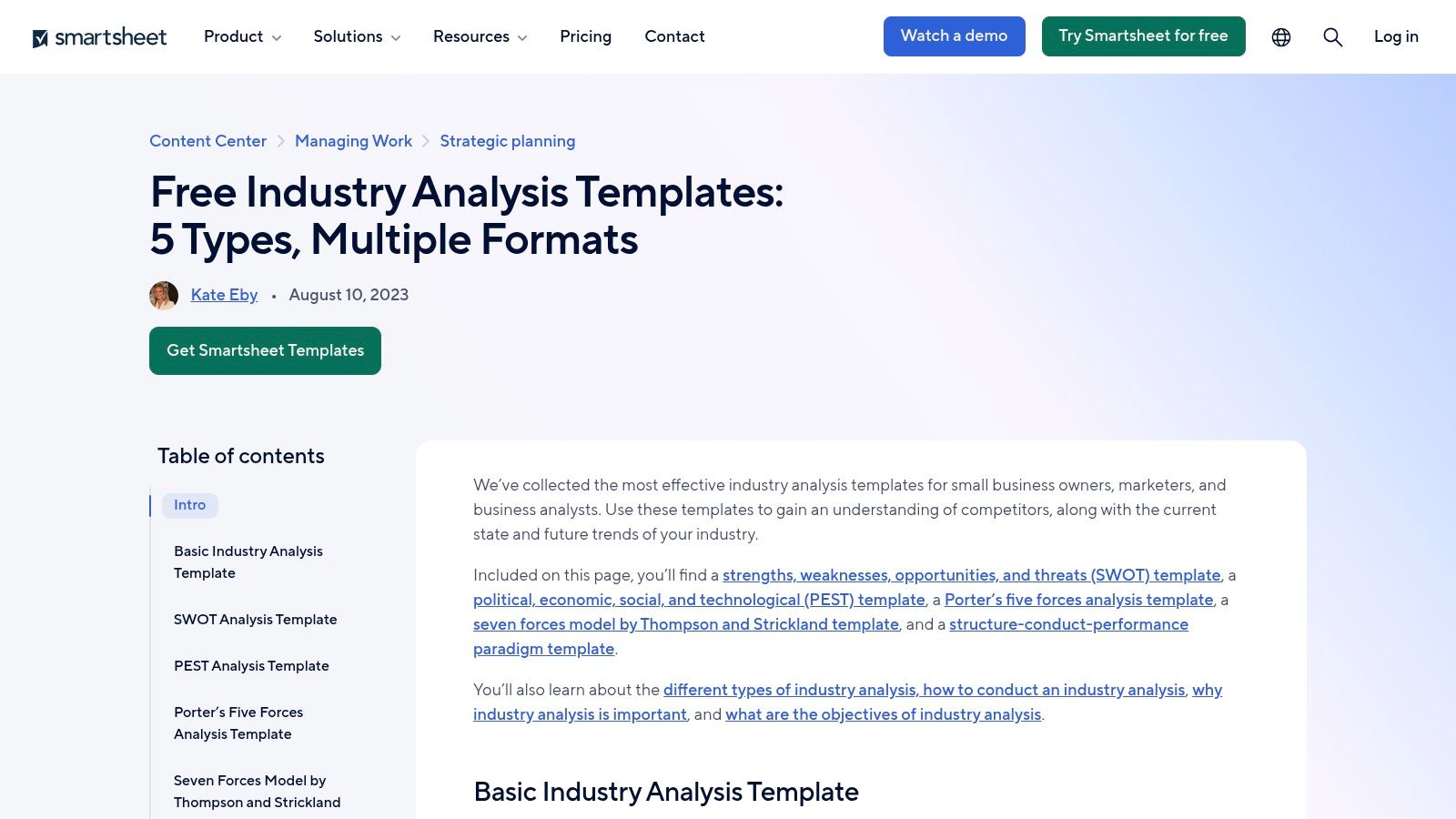
The Smartsheet industry analysis collection offers free downloads covering SWOT, PEST, Porter's Five Forces, and related frameworks in Excel, Word, PowerPoint, and PDF. That flexibility matters when finance wants a spreadsheet and leadership expects slides.
Best for a defensible strategic argument
Use the framework that matches the uncertainty. Supplier dependence belongs in an industry-structure discussion; your onboarding limitations belong in an internal capability assessment. Why force both into a competitor grid?
A historical review of SWOT published through the University of South Florida traces its corporate-planning roots and explains the distinction between internal strengths and weaknesses and external opportunities and threats.
The missing work is evidence collection. Smartsheet won't verify competitor claims, interview buyers, or reconcile conflicting estimates. Add a source, observation date, and business implication beside each substantive finding.
The same discipline applies when using artificial intelligence in product management: generated synthesis needs traceable inputs. I'd choose Smartsheet for a customizable stakeholder deliverable, provided someone owns the underlying research.
2. Miro, Market Analysis Template Collection
During a workshop, the researcher describes customer workarounds while the account executive names an entirely different competitor. Miro helps positioning teams make that disagreement visible before they prematurely settle on a market definition.
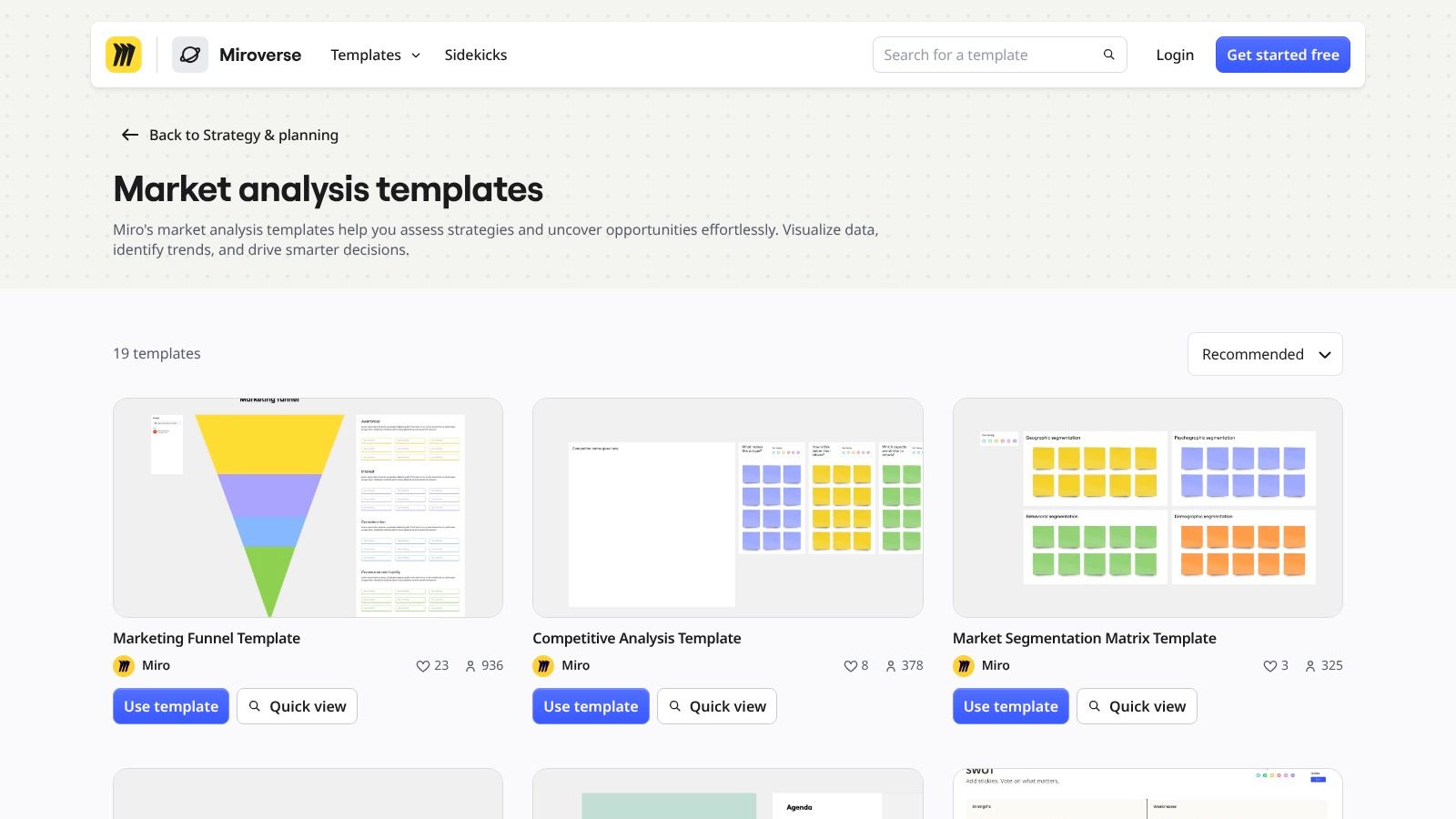
The Miro market analysis collection includes 19 templates spanning competitive analysis, segmentation, target audiences, market opportunities, and sizing. Customizable visual canvases support collaborative editing and presentation-oriented synthesis, although access and collaboration features depend on the plan.
The useful decision is often narrower than market attractiveness: Which segment and alternative should we investigate next? A board lets participants compare interpretations without hiding disagreements inside separate documents.
A workshop agreement becomes useful evidence only when the team can explain what supports it.
Keep observations separate from votes
Create distinct areas for observed behavior, interpretation, and unanswered questions. Attach interview excerpts or screenshots to claims rather than treating a cluster of sticky notes as validation.
For digital-product comparisons, make quality criteria measurable. WCAG 2.1 sets minimum contrast at 4.5:1 for normal text and 3:1 for large-scale text, giving teams a concrete accessibility comparison.
Miro won't supply those audits or customer findings. Your team still researches buyer priorities, competitors, and switching barriers. Large boards also become difficult to maintain, so move consequential assumptions into an owned evidence register.
3. Aha!, Market Requirements Document Template
Engineering asks why a proposed capability belongs in the launch, and the PM answers with a market-growth slide. The conversation stalls because market context hasn't become a product requirement.
Aha! suits positioning-to-product alignment.
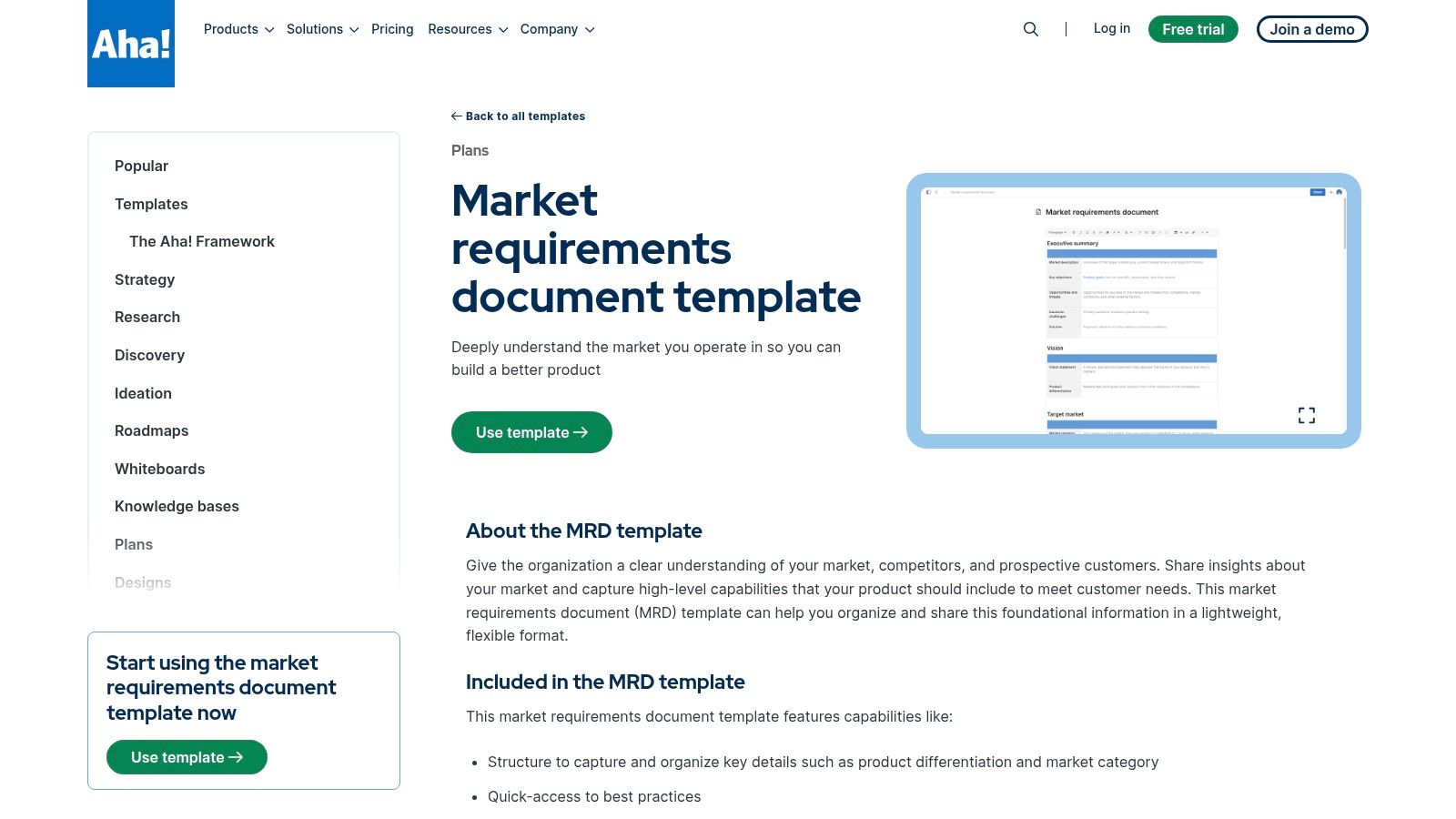
The Aha! Market Requirements Document template connects market size, target personas, competitors, differentiation, required capabilities, and success measures. Its software includes guidance, an AI writing assistant, and inline comments; the guide also offers Word and PDF downloads.
Best for deciding what the product must enable
An MRD helps distinguish the market need from a preferred implementation. Say buyers need auditable approvals. That doesn't automatically mean they need the dashboard layout a stakeholder has already sketched.
Use the PRD writing guide when translating the market requirement into behavior, constraints, and acceptance criteria. What must users accomplish, and what would demonstrate that the capability works?
Your team must still validate the requirement. Customer interviews, lost-deal notes, observed workflows, and purchasing constraints need to support the proposed capability. An organized document can make an unsupported conclusion look settled.
The in-product template requires an Aha! account, and its broader workflow may be excessive for a one-off assessment. Choose it when stakeholder alignment and the handoff into product planning justify that structure.
4. HubSpot, Market Research Kit and Templates
A launch team has competitor screenshots but no explanation of why buyers begin searching. HubSpot fits primary research when the missing ingredient is a research plan, not another comparison chart.
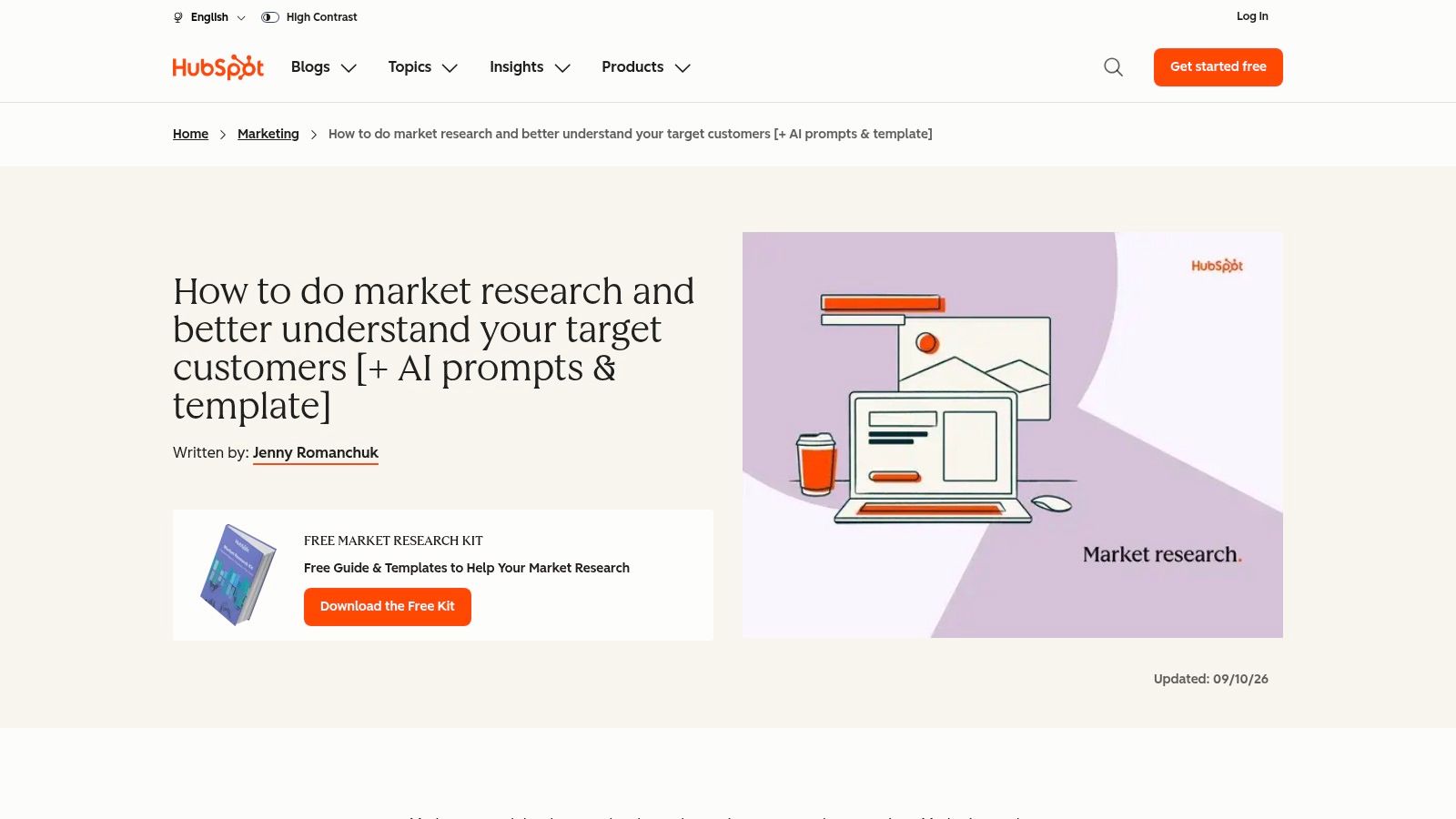
The HubSpot market research kit combines editable Five Forces, SWOT, survey, and focus-group materials with instructions and a mock presentation. It's offered as a free download, though download pages may request contact information.
The practical advantage is continuity between collecting evidence and communicating findings. A survey can uncover patterns, while a discussion guide helps investigate the circumstances behind them. Neither method deserves automatic priority.
Adapt the kit to a product decision
The basic gist is this: start with the uncertainty that could change your plan. For a pricing question, investigate buying authority and alternatives. For a roadmap question, investigate the workflow and consequences of the current problem.
Guidance on researching B2B buyers and markets is a useful companion when the user, evaluator, and budget holder are different people.
HubSpot's broad marketing orientation needs adaptation for software decisions. Your team still recruits relevant participants, writes neutral questions, and validates findings against behavior. Does enthusiasm come from people who can buy, or merely people who like the concept?
I'd choose this kit for a research effort that needs both customer input and a clear readout.
5. Asana, Market Research Template
The interview guide is ready, recruitment is stuck, and nobody knows who owns the pricing analysis. Your immediate problem is coordination. Asana supports primary research delivery by making responsibilities and dependencies explicit.
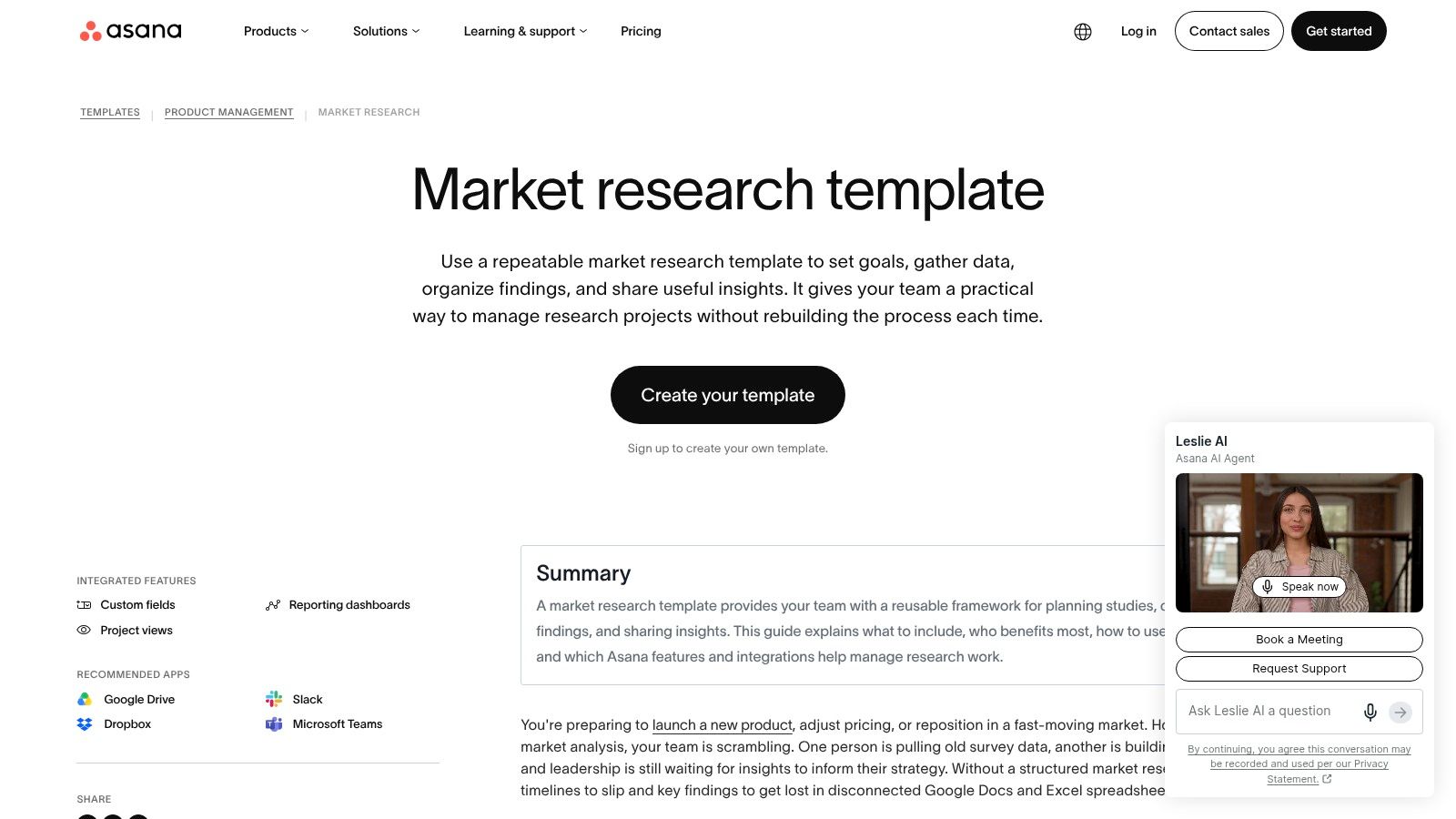
The Asana market research template organizes objectives, audiences, methodology, collection, and findings through collaborative task tracking. Teams can pair it with Google Sheets for datasets and Canva for report visuals.
Its best decision is operational: What research must happen before we commit? It's less useful when you already have the evidence and only need a downloadable report.
Give assumptions an owner
- Define the question. Connect each research task to a launch, pricing, or customer decision.
- Name the evidence. Specify the audience, method, and expected output using appropriate product research methods with Figr.
- Set the review rule. Record who interprets the findings and what result would change the recommendation.
The Rival Group market research trends report describes a shift toward continuous research, small tests, pilots, and learning loops. Task ownership makes that approach practical, provided the team updates assumptions rather than merely closes tasks.
Asana doesn't provide market data or perform the analysis for you. An account is required, functionality depends on the plan, and completed tasks shouldn't be mistaken for validated conclusions.
6. SCORE, Target Market Data Worksheet
A SaaS founder says the product serves small businesses, but the PM needs a segment narrow enough to recruit and reach. SCORE supports initial sizing and target selection without demanding a full strategy report.
The free SCORE Target Market Data Worksheet is a downloadable DOCX covering distribution channels, customer characteristics, income, spending habits, market size and share, and location. Its small-business framing may be particularly useful for an initial United States market scan.
Turn a broad audience into a reachable segment
For software, adapt demographic prompts into relevant firmographics: industry, organization size, operating model, buying authority, and existing tools. Keep location when it affects regulation, language, service delivery, or distribution.
A segment description still needs a sizing model. The Stratrix TAM, SAM, and SOM guide recommends bottom-up customer counts tied to a defined buyer profile and realized annual pricing, with explicit serviceability filters and capacity-constrained obtainable demand.
That changes the conversation. Can your sales motion reach these accounts, and can the product serve their requirements?
Your team must source account counts, test channel access, and establish credible pricing assumptions. SCORE won't deliver a competitor assessment or evaluate your product capabilities.
The resource is older, so review its prompts and any suggested data sources before reuse. I'd use it to sharpen an initial segment hypothesis, then move consequential revenue assumptions into a separate model.
7. Zoho Survey, Market Analysis Survey Template
Your researcher needs comparable answers from prospective buyers, but the draft questionnaire mixes demographics, feature requests, and hypothetical purchases. Zoho Survey supports primary research collection, provided you edit around a precise question.
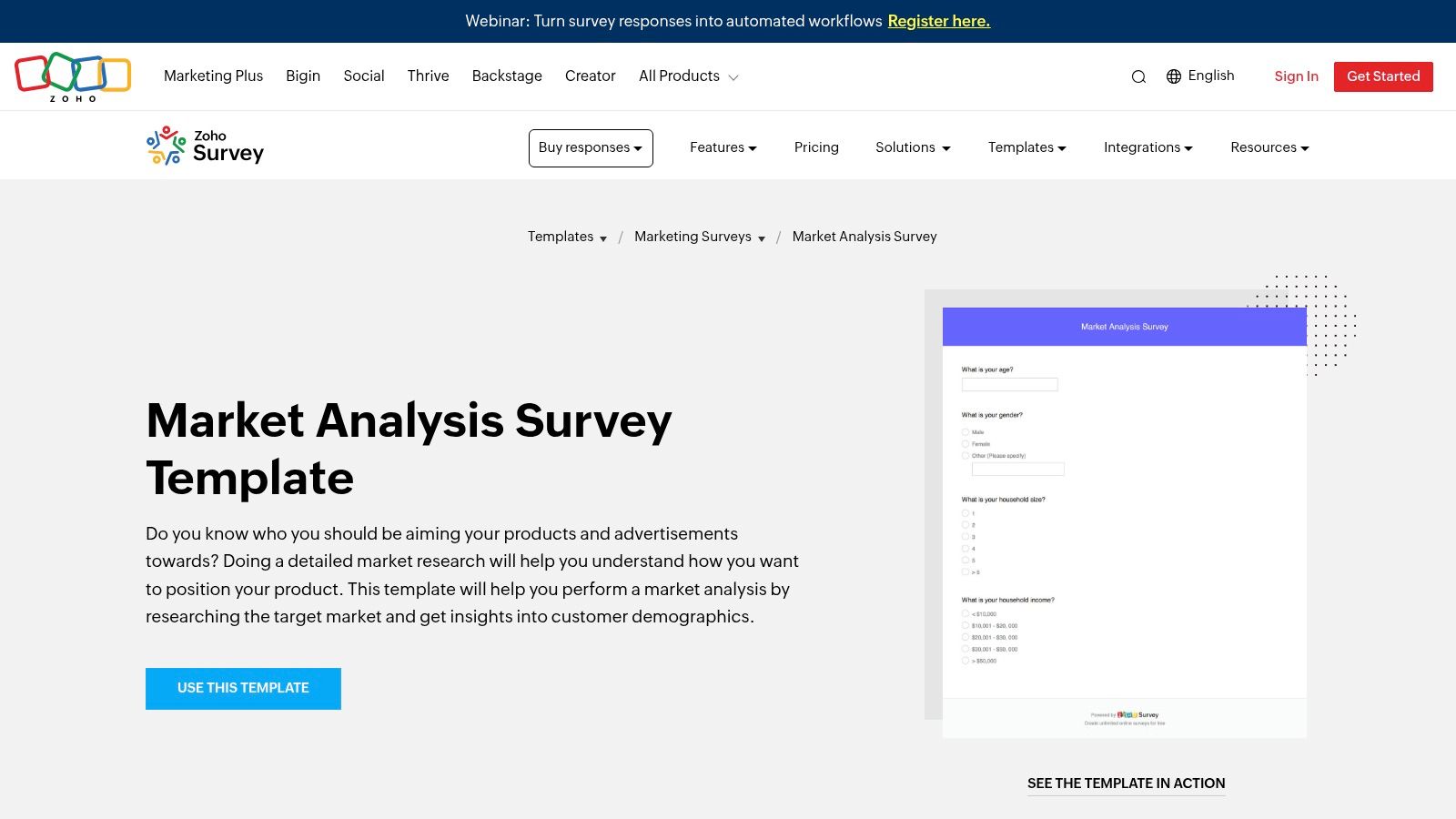
The Zoho Survey market analysis template offers a customizable questionnaire for gathering target-customer and demographic information. Its workflow helps standardize questions across respondents, but service access and plan limits affect distribution.
The useful decision might be which audience warrants deeper investigation. Survey responses alone can't establish market size, competitive position, or demonstrated demand.
Research safeguard: Define who qualifies and which responses you'll exclude before collecting answers.
Audit the sample before interpreting it
In industry reporting summarized by Voxpopme's State of Insights, fraudulent or low-quality respondents were the leading data-quality concern at 41%, while 28% of researchers reportedly discarded or re-fielded a study because of quality problems in the previous year.
Record recruitment sources, eligibility checks, exclusion rules, and any synthetic-data use. Compare stated preferences with observed product behavior where possible.
Your team still designs the sample and determines what the answers mean. A questionnaire can be consistently administered and consistently misleading. Choose complementary methods for user research when you need to explain an unexpected pattern rather than count it.
8. Jotform, Market Analysis Worksheet Form
Regional product leads submit opportunity proposals in incompatible formats, leaving leadership to compare polished narratives against spreadsheet fragments. Jotform fits intake, where consistency matters before deeper assessment begins.
The Jotform Market Analysis Worksheet Form captures project details, target markets, customer segments, competitors, trends, value propositions, pricing, channels, opportunities, and challenges. Its no-code builder lets teams customize fields and organize submissions for later review.
That helps answer a practical question: Which proposals contain enough evidence to deserve investigation? It won't automatically verify accuracy or produce a defensible market assessment.
Ask for provenance alongside the claim
- Capture the source. Request the originating document or dataset, not just a copied conclusion.
- Separate confidence from enthusiasm. Give submitters room to describe uncertainty and contradictory evidence.
- Record the decision needed. Distinguish a request for discovery resources from a request for launch investment.
Woodstone Research's overview of global research statistics distinguishes market research, research software, and reporting as separate parts of the insights ecosystem. Your intake form should likewise distinguish collected evidence from the interpretation attached to it.
At scale, this is an incentive problem: teams seeking funding have reasons to emphasize upside. Explicit uncertainty fields make cautious submissions easier to compare fairly.
Your reviewers still validate sources and challenge assumptions. For a one-off analysis, a form-builder workflow may add unnecessary overhead; available features also depend on the account and plan.
9. Prodability, Four-Part Market Analysis Template
A PM has room for a short market section in a strategy memo, not an appendix nobody will read. Prodability fits compact sizing and positioning synthesis, especially when stakeholders need a clear investment argument.
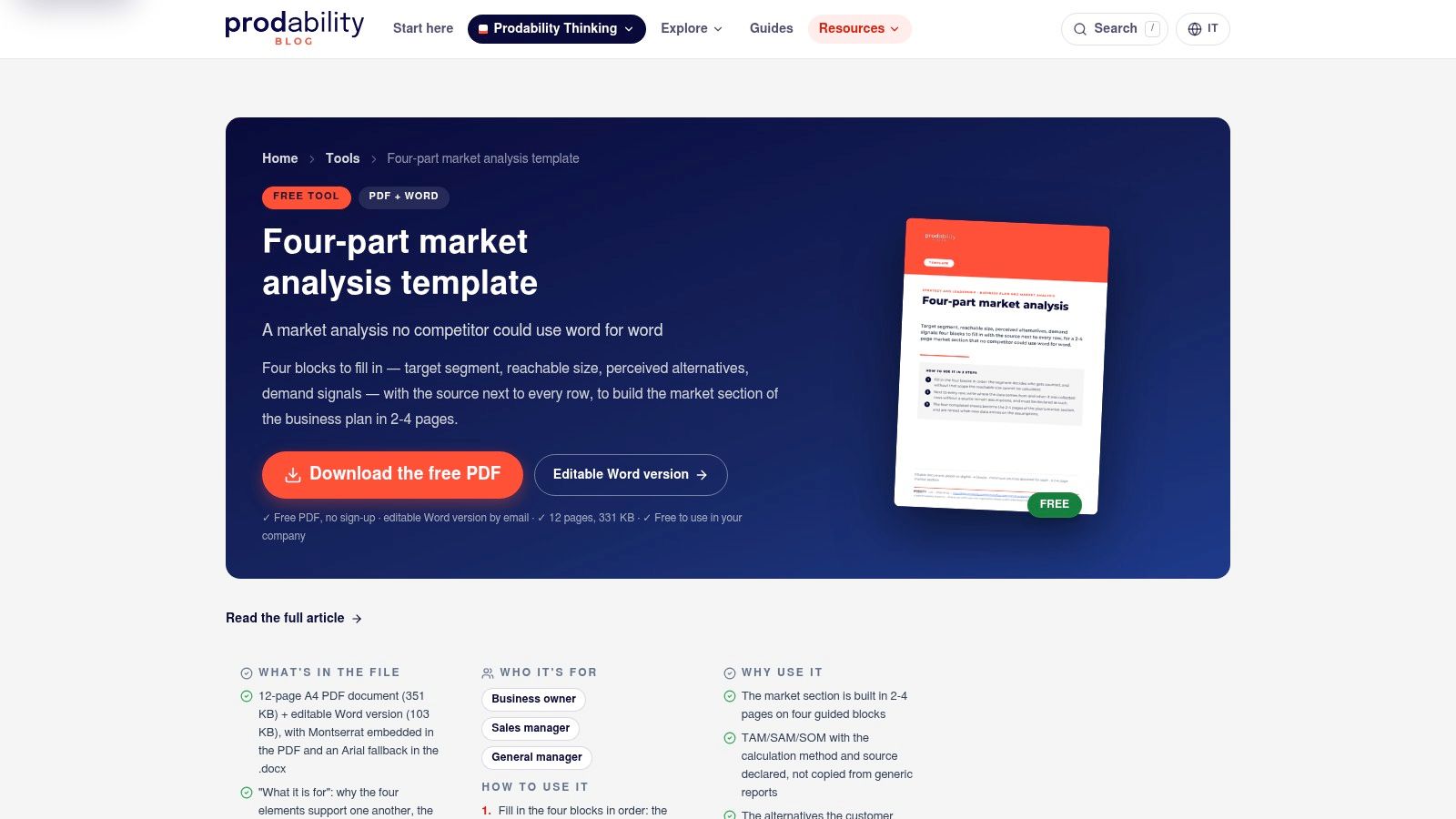
The Prodability Four-Part Market Analysis Template organizes target segment, reachable market size, perceived alternatives, and demand signals. PDF and editable Word versions are available, with an email required for the Word version according to the provider.
Its strongest prompt concerns customer-perceived alternatives. A buyer might compare your software with an outsourced service, an internal spreadsheet, or leaving the problem unresolved. A direct-competitor list can miss the purchasing decision.
Keep the summary short and the model traceable
The PM Skills market-sizing guide recommends presenting estimates as ranges and triangulating at least two independent methods, rather than relying on a single point estimate.
Keep the supporting calculation outside the memo. Document market definition, geography, pricing unit, assumptions, and sensitivity so reviewers can challenge the result without expanding the summary.
Your team still researches demand and alternatives. Source and collection-date prompts help preserve traceability, but they don't establish that an interview sample represents the market.
I'd choose Prodability when the underlying investigation already exists. Its brevity encourages clarity, but it can also conceal weak assumptions if the supporting evidence remains inaccessible.
10. Business in a Box, Market Analysis Template
An investment review needs a complete market assessment, including regulatory exposure and strategic implications. Business in a Box suits formal sizing and reporting when a short opportunity memo won't answer the reviewers' questions.
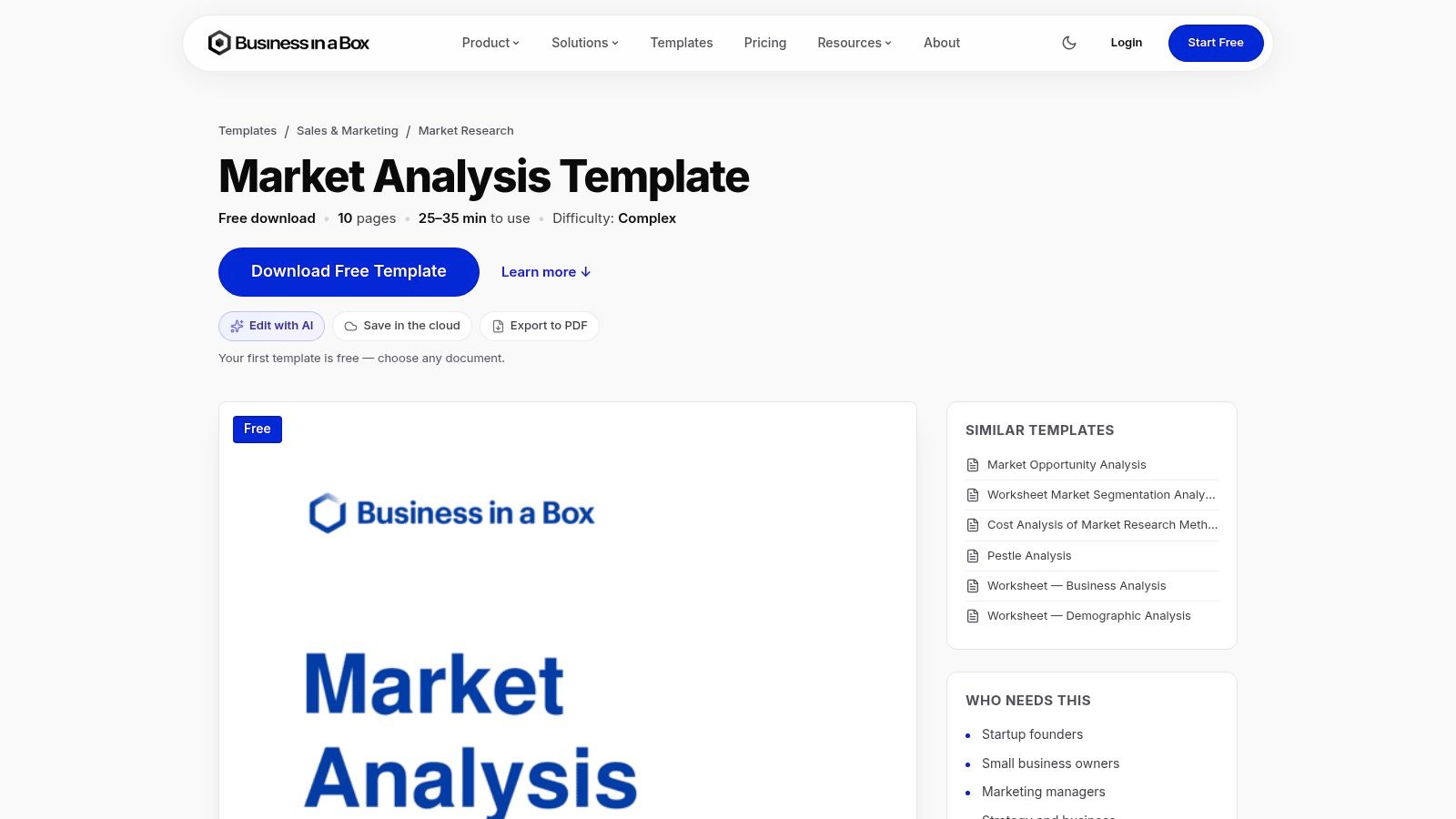
Business in a Box describes its market analysis template as a 10-page document requiring 25–35 minutes to use. Treat that as a description of template use, not the time required to conduct the research.
Its editable Word structure covers market definition, TAM/SAM/SOM, segmentation, personas, competitors, trends, regulatory context, and strategic implications, with PDF export for sharing.
Best for a reviewable investment case
The breadth helps prevent omissions. A compelling market-size estimate matters less if purchasing restrictions prevent access to the customers counted.
A finished report should make the unsupported assumptions easier to find.
Your team must still build the sizing model, collect competitor evidence, validate customer needs, and investigate applicable constraints. The framework can be excessive during early exploration, when a narrower test could resolve the immediate uncertainty.
For lean teams evaluating AI tools for early-stage SaaS startups, the same trade-off applies: drafting assistance is useful after you define the evidence needed. Faster prose won't resolve an unknown buyer population.
Choose this template when completeness serves a real review process, rather than using document length as a proxy for confidence.
Which market analysis template fits which decision
| Item | Format | Best for | Access | Main limitation |
|---|---|---|---|---|
| Smartsheet, Industry Analysis Templates | Office documents: Excel, Word, PowerPoint, and PDF | Comparing an industry through multiple strategic frameworks | Free downloads | Teams must gather and validate evidence themselves |
| Miro, Market Analysis Template Collection | Collaborative visual boards | Team workshops and visual synthesis | Miro plan required; features vary by plan | Boards can be hard to maintain as data grows |
| Aha!, Market Requirements Document Template | MRD document; Word and PDF guides | Connecting market research to software product requirements | In-product template requires an Aha! account; guide offers downloads | Organizes conclusions but does not validate assumptions |
| HubSpot, Market Research Kit and Templates | Editable research templates and presentation | Conducting research and presenting findings | Free download; may request contact information | Broad marketing focus may need adaptation for product-roadmap decisions |
| Asana, Market Research Template | Project workflow template | Coordinating research tasks and contributors | Asana account required; functionality depends on plan | Organizes research but does not supply market data |
| SCORE, Target Market Data Worksheet | Downloadable DOCX worksheet | Clarifying target segments and customer characteristics | Free download | Limited coverage of competitors, trends, and product capabilities |
| Zoho Survey, Market Analysis Survey Template | Customizable online survey | Gathering consistent customer and demographic responses | Zoho Survey access required; plan limits may apply | Survey responses alone do not establish market size or competitive position |
| Jotform, Market Analysis Worksheet Form | Customizable online form | Standardizing market-analysis submissions across contributors | Account and plan affect available features | Collects inputs but does not verify them or produce a robust assessment |
| Prodability, Four-Part Market Analysis Template | PDF and editable Word document | A concise market section for a memo or business plan | PDF available; editable Word version requires email | Short format does not replace detailed research |
| Business in a Box, Market Analysis Template | Editable Word document, exportable to PDF | Preparing a fuller market assessment for plans or strategy reviews | Template access through Business in a Box | Requires substantial effort and does not provide supporting data |
Pick One Template and Date Your Assumptions
Choose the market analysis template that matches the decision on your desk this week, then record three assumptions with a date and source for each. That single action is more useful than downloading a folder of frameworks and leaving the central uncertainty unnamed.
A positioning decision requires evidence about alternatives and switching criteria. A sizing decision requires a defined buyer population, pricing logic, and access constraints. Research and intake decisions need different structures again. Why maintain an all-inclusive document when the immediate question is whether you can recruit the right buyers?
Make the assumptions usable
- Write the assumption plainly. State what must be true for the recommendation to hold, such as a buyer having authority to purchase without a separate procurement process.
- Attach the date and source. Identify the interview, dataset, pricing page, or product observation. Label an unsupported belief as unverified.
- Name the consequence. Explain what changes if the assumption fails, whether that means narrowing the segment, revising pricing, or postponing a capability.
These are working notes, not a demand for certainty. A dated assumption lets a colleague distinguish a recent observation from a belief inherited from an earlier strategy discussion.
In short, the template gives structure; your team supplies the evidence and judgment. Keep raw observations accessible, separate them from interpretation, and preserve contradictions instead of smoothing them away.
Carry the evidence into product work
A PRD or test scenario is where the market argument starts affecting what the team builds. If buyers need delegated approval, the requirement should describe authority and permissions. The test scenarios should examine rejection, missing access, and incomplete information, alongside the expected path.
Figr can draft PRDs and test scenarios from research and documents, while final research interpretation and prioritization remain with your team. That boundary matters: an artifact can organize a hypothesis without proving it.
Return to the late-night roadmap slide. The useful improvement isn't a fuller grid or more confident wording. It's a recommendation whose assumptions someone else can inspect.
Choose your template, write those dated assumptions, and bring them into the next product discussion alongside the recommendation.
Frequently Asked Questions
What should a market analysis template include?
Include the decision you need to make, your target customers, relevant alternatives, market-size assumptions, evidence sources, and open questions. The right sections depend on the task: a research plan needs methods and recruitment criteria, while an investment case needs a traceable sizing model.
Which template should a product team choose first?
Start with the decision blocking progress. Use a positioning framework to compare alternatives, a sizing worksheet to define a reachable market, a research template to gather customer evidence, or an intake form to standardize proposals. Choose the smallest structure that helps the team test its most consequential assumption.
Can a template calculate TAM, SAM, and SOM for us?
No. A template can organize the calculation, but your team must define the buyer population, pricing unit, serviceability constraints, and realistic reach. Record the source and date of each input so reviewers can inspect the estimate.
How do we keep a market analysis from becoming a feature wish list?
Keep observations, interpretations, and proposed requirements separate. Ask what buyers need to accomplish and what evidence supports that need before selecting an implementation. Revisit the recommendation when new research challenges its assumptions.
Figr helps product teams turn research notes and product documents into PRDs, test scenarios, and structured UX recommendations. Visit Figr to bring your market analysis into product work, with the evidence and open questions available for your team to review.