

Your VP just asked for something visual to anchor tomorrow's board discussion. You have a PRD. You have bullet points. You have 16 hours and no designer availability.
This is the invisible work of product management. It's the constant, manual translation of ideas into artifacts, of data into direction. Most product managers spend their days as human switchboard operators, manually connecting calls from customers, engineers, and the market. Your brain is the central processing unit for everything. But what happens when the information firehose overwhelms your capacity?
You start to guess.
The Shift from Manual to Augmented Synthesis
The real value of AI in product management isn't about replacing your intuition. It's about giving it a super-powered lens. The job is no longer to be the processor. The job is to ask better questions.
This is a fundamental shift from manual synthesis to what I call Augmented Synthesis.
The basic gist is this: you automate the tedious, low-judgment work of gathering and connecting information so you can focus on the strategic calls that only a human can make. Instead of you personally reading 50 user interview transcripts, an AI summarizes the top three pain points with direct quotes. Instead of you guessing which competitor is gaining traction, an AI analyzes market signals to show you their momentum.
AI tools act as an extension of your mind, turning mountains of noise into a clear signal. This isn't a far-off future. Recent industry analysis shows that over three-quarters of product leaders are increasing AI investments, using it to slash the time needed for writing product briefs and aligning roadmaps. You can discover more about these product management trends to see how teams are adapting.
The New Product Management Workflow
This new approach changes the day-to-day reality of the job. A friend at a fintech company recently told me about a file upload feature they estimated at two weeks that ended up taking six. The PM specified one screen, but engineering discovered eleven additional states during development: everything from network drops to permission errors.
With an AI agent, you can feed it the primary user flow and ask it to generate all the unhappy paths and edge cases automatically. For instance, an AI can analyze a simple "card freeze" flow and instantly generate dozens of test cases covering every scenario. You can see how this works by exploring these test cases for the Wise card freeze feature. This moves the PM from being a generator of specs to a validator of comprehensive, AI-generated artifacts.
Your role becomes less about being an individual contributor and more about being the conductor of an orchestra, where AI handles many of the instruments. Your focus shifts up a level, to the bigger picture:
- Strategic Alignment: Does this feature truly support our quarterly goals?
- Customer Empathy: What is the underlying emotion behind this user feedback?
- Cross-functional Leadership: How do I best communicate this vision to engineering and marketing?
The goal is to stop being an operator and start being an architect. It’s about using AI to build better, faster, and with more confidence.
Your New Co-Pilot For Product Discovery
Product discovery has always felt like an art. But what if you could ground that art in science, instantly?
Last week I watched a PM do something remarkable. She used to spend two full weeks drowning in user interview notes, manually highlighting and tallying everything into themes. This time, she fed all that raw data into an AI tool. Within minutes, it gave her back a prioritized list of user needs, complete with verbatim quotes and frequency counts.
This is the new reality of AI in product management. It’s not just a research assistant; it's a discovery engine.
The Sonar System for Your Product
Think of AI in this phase as a sonar system for your product. You're the captain of the ship. Your current tools, like analytics and surveys, are like looking at the surface of the water. You see the waves, but you can’t see what’s lurking beneath.
AI is the sonar ping that travels into the depths. It scans the unseen territory of qualitative data: thousands of support tickets, sales call transcripts, and open-ended feedback. It maps the ocean floor, revealing hidden obstacles a human might miss.
This is what I mean: you can point an AI at an existing flow, like this AI-driven analysis of a Shopify checkout redesign, and it will instantly pinpoint areas of high user friction. It doesn't just guess; it shows you where users are dropping off and provides data-backed recommendations.
The economic incentive here is powerful. The less time a PM spends on manual data synthesis, the more time they can spend on strategic action. AI collapses the time between data collection and decision-making.
This is quickly becoming a critical capability. As analyst Amy Mitchell notes in a 2023 briefing, by 2026, many products will be discovered and evaluated by AI agents before a human ever sees them, which demands unprecedented explainability. You can read more on her analysis of these product management trends to understand the full scope of this shift.
The job is no longer just to build something a human loves, but to build something an AI understands. Our products need to be machine-readable and logically structured just to get in the game.
In this context, discovery must become more rigorous. AI tools help enforce that rigor by turning messy, unstructured data into clear, organized outputs. You can learn more about how specific AI assistants built for product managers are designed for this transformation. This also includes understanding insights from tools for Mastering ChatGPT Tracking.
Your next step is to test this yourself. Take a dozen user reviews. Feed them into an AI tool and ask it: “What are the top three user needs mentioned in this text?”
The speed of the answer might surprise you.
From Vague Ideas to Tangible Artifacts
The journey from a whiteboard sketch to a developer-ready artifact is often paved with miscommunication. A PM specifies a feature. A designer interprets it one way. An engineer finds eleven edge cases the PM never considered.
This is the Translation Gap. It’s the space where ambiguity thrives and timelines stretch. AI is a powerful translation layer that can turn abstract requirements into concrete artifacts, closing the gap between idea and execution.
The Problem of Undiscovered States
No PM can possibly hold every potential state of a complex system. Think about Dropbox's file upload. The happy path is simple, but what about the dozens of ways it can fail? Network drops, size limits, duplicate file conflicts?
Manually documenting these takes days. I saw a team estimate a file upload feature at two weeks. It took six. Why? The PM specified one screen, but engineering discovered eleven additional states during development.
An AI agent acts as an exhaustive cartographer for your product's territory. Give it a simple prompt or a screen recording of the core flow, and it automatically maps out all potential user flows and forgotten edge cases. For instance, you can use AI to analyze a simple task assignment component and instantly see all critical states. You can explore this in an interactive example of component states.
From Prompt to Production-Ready Spec
The real power is moving directly from a high-level concept to a detailed artifact. The analogy is this: you are no longer just the architect drawing a blueprint. You are the architect who can now press a button and have the AI generate the detailed electrical and plumbing plans based on your vision.
A PM can go from a one-sentence idea, like "Create a new AI-powered playlist curation feature for Spotify," to a complete PRD with detailed user stories and updated user flows.
Your job moves from document generator to strategic editor. You guide the AI, refine its output, and ensure the final artifact aligns with business goals. You can explore our guide on AI tools that turn product ideas into wireframes to see more examples.
The next step is to put this into practice. Take a single feature your team is working on. Give an AI agent the core user story and ask it to define every possible failure state. The speed of the result will make the value instantly clear.
Building The AI-Powered Product Organization
Bringing AI into your product team isn't about buying a single piece of software. It’s about rewiring your entire operating system.
Let's zoom out. Companies that truly embed AI into their core workflows aren’t just a little faster.
They build a compounding advantage.
Their feedback loops get tighter with every cycle. Their data gets smarter. Their capacity to experiment grows exponentially. Building this capability is the actual prize.
A Phased Approach To Integration
This change doesn't happen overnight. Think of it as a journey from individual efficiency to organizational intelligence.
The first phase is individual PM productivity. This is the low-hanging fruit: automating the first drafts of PRDs, user stories, and release notes. It’s about giving every product manager hours back in their week.
Next, you expand to team-level collaboration. This is where AI becomes a shared brain. It can generate a comprehensive user flow that gets everyone: product, design, and engineering, on the same page. This is where a tool like Figr shines, mapping out complex interactions so the whole team sees the same picture.
The final phase is organizational intelligence. Here, AI graduates from a task-doer to a strategic partner. It can inform your roadmap by analyzing market trends against your own product data. This is the endgame.
The Human And Technical Infrastructure
Making this work takes more than good intentions. On the technical side, you need clean data and secure integrations. But the human side is just as critical. Your PMs must become expert prompt crafters and discerning editors of AI-generated content.
So how do the roles of UX and QA shift? When AI can generate a baseline UX audit or hundreds of test scenarios in seconds, their focus moves up the value chain to validating those outputs and tackling more nuanced problems.
"A bad system will defeat a good person every time."
– W. Edwards Deming
The goal is to design a system where AI is the default co-pilot, making good people even better. This isn't a theory. The problem is that many teams are struggling to get past small-scale pilots. Data shows that while teams save hours on grunt work, only 12% feel their use of AI is driving significant business results.
This tells us that building an AI-powered organization means creating a new operating system for your product team. You can dive deeper into how to measure the ROI of AI integration to help justify the investment.
Navigating The Pitfalls And Promises
The promise of AI in product management is huge, but so are the traps. It’s easy to get seduced by generic tools that offer the illusion of speed, spitting out bland work that has no real connection to your product.
This is the central problem: not all AI is created equal. It’s a common mistake to think that AI assistants are not search engines, and the same idea applies here. AI assistants are not product experts, unless you make them one.
The Apprentice Analogy
The best way to think about this is the Custom-Trained Apprentice analogy.
A generic AI tool is like a brand-new intern. They’ve read every textbook but know nothing about your business. Ask them to write a user story, and you’ll get a perfect template that is contextually useless.
A context-aware AI is different. It’s an apprentice you’ve personally trained on your product. It knows your brand colors, your component library, and your customers' pain points. When you ask for help, its suggestions are grounded in your reality. This distinction is everything. You can dig deeper into the common challenges and pitfalls when implementing AI in product management workflows to prepare your team.
From Generic Advice To Grounded Intelligence
Let's make this concrete. A friend at a B2B SaaS company used a generic AI to brainstorm a new dashboard. The AI produced a clean layout, but it used UI patterns that looked nothing like their actual product. This created a massive translation headache.
Contrast that with a context-aware agent like Figr, which can ingest your live application data. When tasked with creating a feature for a fintech platform, it doesn't invent a generic UI. It uses the platform's actual components to produce a context-aware forecasting UI that feels native.
This is the difference between an AI that creates more work and an AI that accelerates it.
Enterprise Trust and The Problem of Model Drift
Beyond output quality, there are deeper pitfalls. One of the biggest is model drift, where the AI's understanding becomes outdated as your product evolves. The other is enterprise trust. You can’t plug sensitive product data into any old tool.
Look for these signals of an enterprise-ready tool:
- SOC 2 Compliance: An independent audit that verifies a provider securely manages your data.
- Zero Data Retention Policies: An assurance that the provider does not store your proprietary data on their servers.
In short, the promise of AI is only realized when you move past generic templates to tools that become deeply, securely embedded in your product’s unique context.
Your First Step Into the Augmented Future
The theory is clear. The potential feels massive. But where do you actually start?
This isn’t about launching some huge "AI initiative." The most effective way to start is to find one high-leverage task that’s currently a bottleneck and apply a tool to it.
In short, the first step is to pick a single point of pain.
From Theory to Tangible Action
Is it the time you sink into documenting unhappy paths? Is it the struggle to get alignment on a new user flow? Forget about "implementing AI" as a grand strategy. Start by solving a real, nagging problem.
A bad system will defeat a good person every time. Adding AI to a flawed process just makes chaos happen faster. The real win comes from using AI to fix a specific, broken step in your workflow.
For example, a friend told me their team used to spend a full week manually mapping competitor user flows in Figma. It was tedious, and the diagrams were often out of date by the time they were finished. This is the perfect task for a first experiment.
Your Grounded Takeaway
The most practical action you can take this week is this: identify one repetitive, time-sucking task in your current workflow.
It could be any of these:
- Writing the first draft of user stories from a PRD.
- Mapping a competitive onboarding flow for inspiration.
- Generating a comprehensive list of test cases for a feature.
Once you have your task, find a context-aware AI tool to perform that single action. For instance, take a screen recording of a competitor's app and use an agent like Figr to automatically generate the user flow map. For one project, we analyzed the setup speed between Cal.com and Calendly in exactly this way.
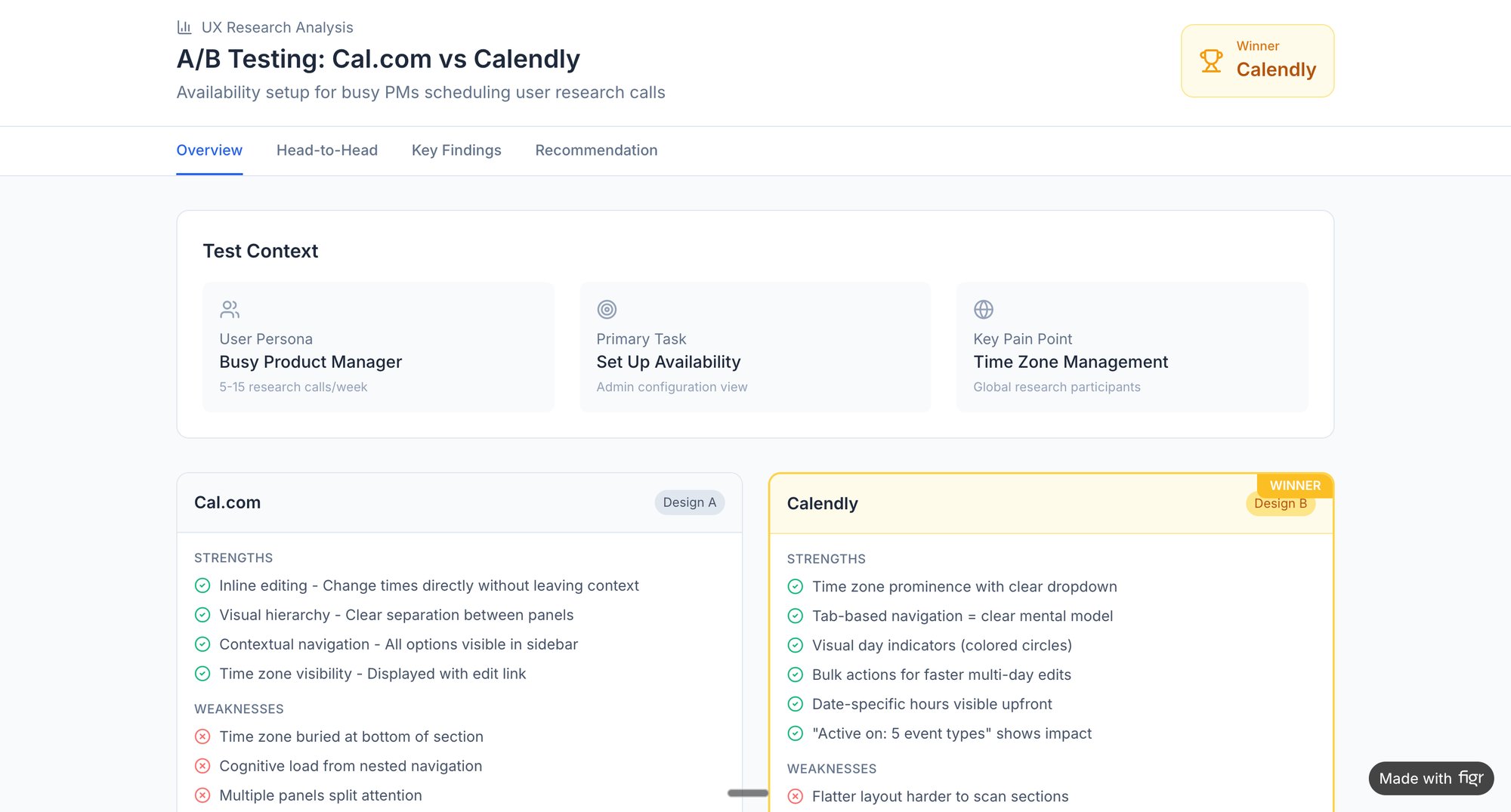
Then, measure the difference. How much time did it save? This small, concrete experiment will do more to demonstrate the power of AI in product management than any strategy document ever could. It makes the abstract real.
Got Questions About AI in Product Management?
Product managers are rightly curious, and maybe a little skeptical. Let's tackle the questions I hear most often.
Will AI Replace Product Managers?
No. But it will absolutely change the job. The role is shifting from a 'process manager' to a 'strategic architect' who uses AI for synthesis and execution.
AI is becoming brilliant at the tedious work: summarizing research, drafting documents, and flagging edge cases we might miss.
This frees you up for the high-judgment work only a human can do. Setting a compelling vision. Understanding subtle customer nuances. Negotiating with stakeholders. The PMs who thrive will be the ones who master using AI as an indispensable co-pilot. To find the right co-pilot, explore our curated list of AI product manager tools or our breakdown of the top AI tools for product managers.
How Do I Get Started With AI If My Company Has No Formal Strategy?
You don’t need a top-down mandate. Start by solving a real, personal pain point and show your work.
First, find a nagging problem in your own workflow. Is it the time you sink into creating exhaustive test cases? Or mapping a complex user journey? Grab a free trial for a tool and point it at that one task.
Document what happened. How much time did you save? Share that small, tangible win with your team. A bottom-up approach grounded in real results is the most powerful way to build momentum.
What Is the Difference Between Generic and Context-Aware AI?
This is a critical distinction. A generic AI like ChatGPT operates on broad, public data. It knows nothing specific about your product, your users, or your design system.
A context-aware AI agent, on the other hand, is grounded in your product’s reality. It ingests your live app’s UI, your design system, and even your analytics data.
So when it generates a user flow or prototype, it speaks your product's language. It uses your real components and branding, like this AI-generated runway forecasting UI for Mercury. This grounding gets rid of the "rework tax" and ensures the artifacts are immediately useful. Looking for specific tool recommendations? See our curated list of AI tools for product managers, or explore AI assistants built specifically for PMs.
Ready to move from generic advice to grounded intelligence? Figr is the AI agent that learns your product's context to help you ship UX faster and more confidently. Start your free trial at Figr.design.