
Your roadmap has become a crowded departure board, with every feature assigned a destination and nobody sure which flights can leave. You're probably looking at a slide full of launch windows, stakeholder requests, and engineering estimates that don't quite agree.
Leave that unresolved and sales starts promising tentative work, engineers split attention between competing commitments, and discovery becomes something squeezed in before development. You can ship everything on the slide and still struggle to explain what improved for customers.
A useful product roadmap makes the reasoning visible. Treat each initiative as a testable hypothesis, attach the evidence behind it, and name what would make the team stop or change direction. That creates a decision roadmap, a shared way to choose work without pretending uncertainty has disappeared.
Roadmap Formats and Planning Horizons Compared
Choose the format according to the commitment your stakeholders need. Before selecting a layout, ensure a finished roadmap entry contains enough information to support a decision.
This copyable template gives you a starting point:
| Theme | User problem | Segment | Outcome with baseline | Horizon | Owner | Evidence grade | Next decision date |
|---|---|---|---|---|---|---|---|
| Checkout confidence | Buyers abandon checkout when delivery costs appear | New buyers | Hypothetically, completion from 61% to 70% this quarter | Next | Checkout PM | Observed support-ticket signals | In 30 days |
Those figures are illustrative targets, not performance benchmarks. The row shows an opportunity under investigation, with a named owner and a deadline for deciding what happens next.
Roadmap formats and what each one commits you to
Use these review rhythms as operating recommendations, then adjust them to your team's delivery cycle.
| Format | Best for | Date commitment | Review rhythm |
|---|---|---|---|
| Quarterly timeline | Teams with fixed launch windows | Specific quarters | Quarterly |
| Now, Next, Later | Teams where discovery changes the order | Horizons only, no dates | Every two to four weeks |
| Theme-based | Aligning several squads on goals | Themes, no dates | Monthly |
| Outcome-based | Teams measured on metrics | Target date per outcome | Monthly |
A quarterly timeline helps when launch coordination matters more than flexibility. For example, teams rolling out production scheduling software need to account for operational dependencies, training, and readiness alongside software delivery.
Now, Next, Later works when discoveries regularly change the order of work. A theme-based view gives several squads direction without prescribing identical solutions. An outcome-based view makes sense when leaders need to inspect whether investment moves a business metric.
Which decision must your reader make after opening the roadmap? Use that answer to choose among these roadmap formats for product teams.
Choose the shortest honest horizon
In 2023, 48% of surveyed product professionals planned roadmaps for six months or less, while 53% planned for a year or more, according to Gartner's product management findings, collected between November 2022 and August 2023.
Neither horizon is better. Your evidence might support an immediate checkout improvement while an infrastructure migration requires longer-range coordination.
Planning farther ahead than your evidence supports encourages premature promises. Planning inside your dependency window leaves partner teams repeatedly rebuilding their schedules.
Practical rule: Pick the format that matches the decisions stakeholders need to make, then choose the shortest horizon your dependencies allow.
Keep distant work broad enough that learning can still change the solution.
How to Create a Roadmap in Six Steps
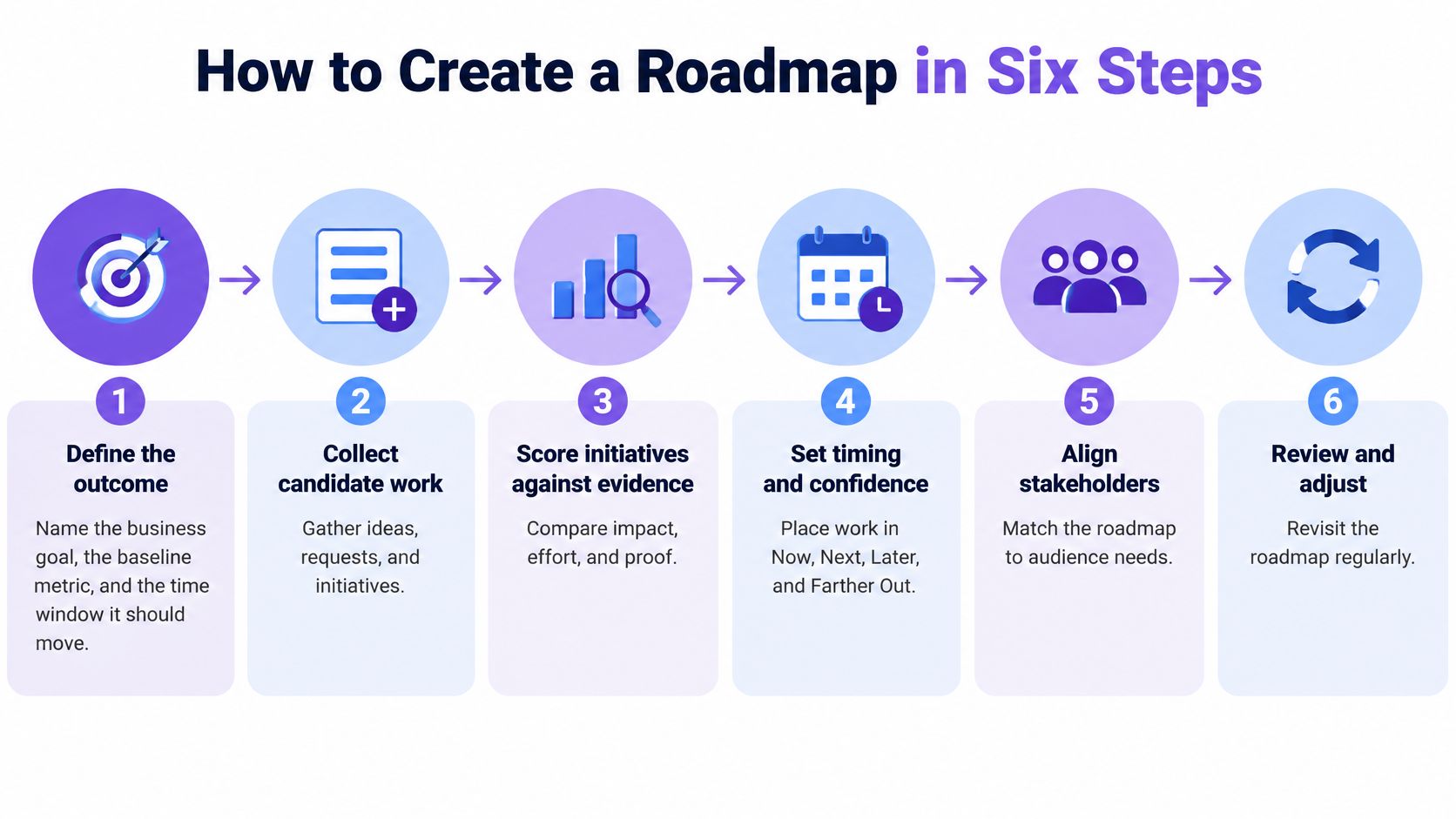
The sequence is straightforward: define the outcome, gather evidence, describe candidate problems, score and sequence them, attach ownership, then publish with a review rhythm. Each step produces something the next step needs.
Skipping ahead usually creates rework. What good is a prioritization score if nobody agrees on the problem being scored?
Build the decision before the presentation
Step 1. Define the outcome. Name the business goal, current metric baseline, and evaluation window.
Establish the destination before considering solutions. The common slip is treating a broad ambition, such as improving engagement, as a measurable goal.Step 2. Gather evidence. Bring support tickets, interview notes, analytics funnels, and sales objections into a shared evidence log.
Capture the affected segment and the original observation. Don't convert every request directly into a development task.Step 3. Write the candidate items. Describe each opportunity as a user problem affecting a specific group.
Write that new administrators can't complete setup without assistance, rather than announcing a setup wizard. Naming the solution too early narrows discovery.Step 4. Score and sequence. Apply consistent criteria, then place candidates into Now, Next, or Later.
Compare the same kind of benefit over the same evaluation window. Scoring unsupported assumptions with confident-looking numbers creates a ranking you can't defend.Step 5. Attach owners and decision dates. Give each initiative an accountable person and a date for reviewing its evidence.
The owner coordinates the decision across functions. Avoid assigning ownership to an entire department, which leaves nobody responsible for resolving ambiguity.Step 6. Publish and set the review rhythm. Share the roadmap, its commitment labels, and a visible change log.
Agree when updates happen and where stakeholders can find the current version. Exported slides without a maintained source quickly produce conflicting expectations.
Check whether strategy reaches execution
In a worldwide survey of 796 executives conducted in July and August 2006, only 56% said their company tracked execution of strategic initiatives, according to McKinsey's strategic planning survey. That historical finding identifies a basic planning failure worth guarding against: agreeing on direction without checking execution.
Use a spreadsheet, Notion database, or your existing product planning tool. The important connection is between the roadmap entry, its evidence, and the delivery work beneath it.
For example, link a setup initiative to the relevant interview synthesis, funnel analysis, and engineering investigation. Keep detailed implementation tasks in Jira or Linear rather than copying them into the strategic view.
In short, a finished roadmap lets someone inspect any visible item and identify its outcome, owner, and next decision date.
Before sharing it, ask an engineering lead to explain the proposed sequence back to you. If they can't describe the dependency logic, improve the roadmap before polishing its colors.
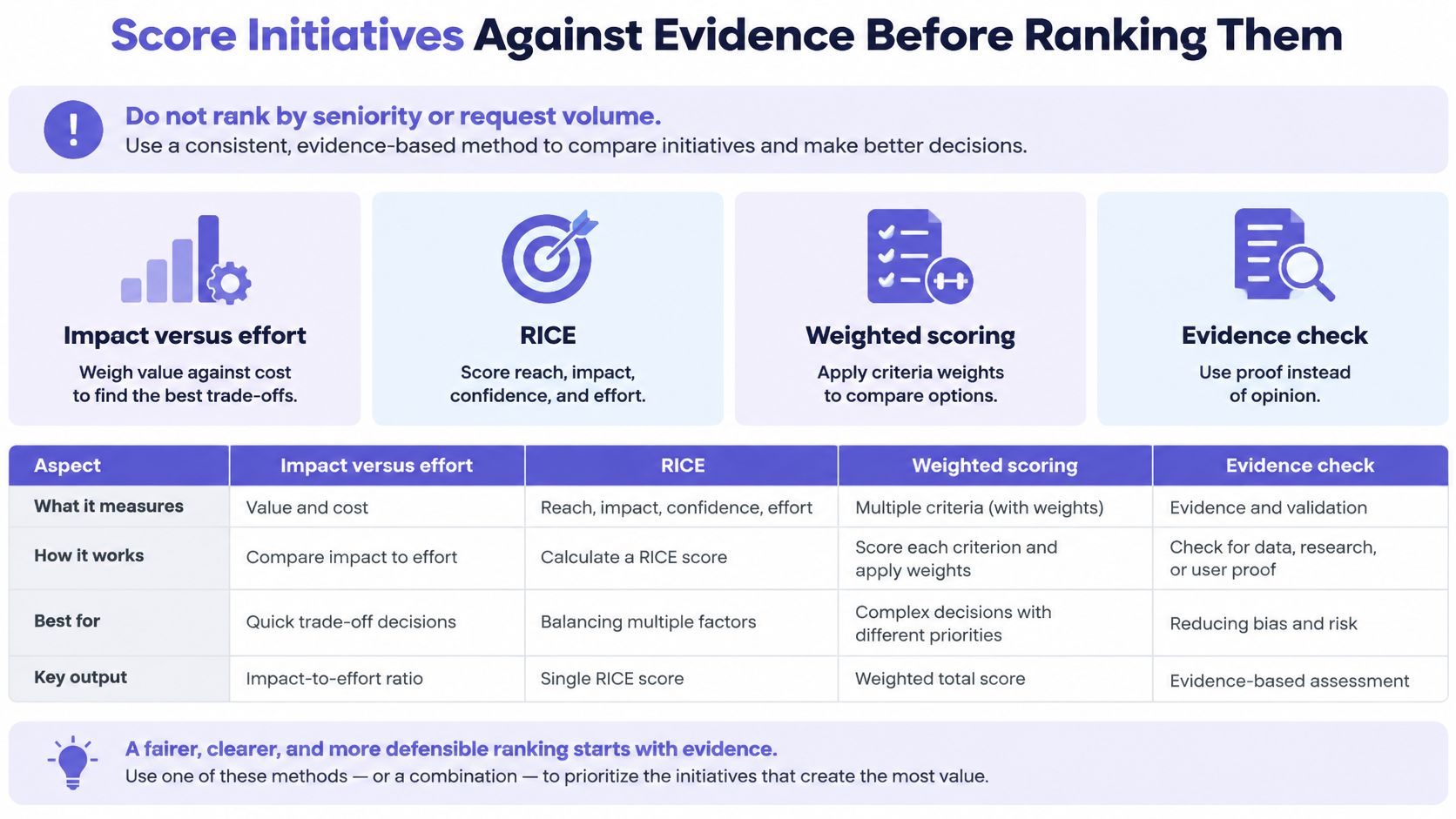
Score Initiatives Against Evidence Before Ranking Them
Prioritization methods compared
| Framework | Inputs | Best when | Main risk |
|---|---|---|---|
| Impact vs effort | Two scores from 1 to 5 | Triaging a short backlog | Hides how confident the scores are |
| RICE | Reach, impact, confidence, effort | Many comparable features | False precision in the estimates |
| Weighted scoring | Custom criteria with set weights | Strategic fit matters most | Weights become political |
| Evidence-graded Now, Next, Later | Evidence grade and effort | Mixing discovery and delivery | Requires honest grading |
Treat the scoring scale above as a chosen working convention. It isn't an empirical measure of product value.
Seniority and request volume tell you who has influence inside the company. They don't establish how widespread a customer problem is, whether the proposed solution addresses it, or what delivering it will displace.
A framework helps only when people can inspect the assumptions beneath the score. Otherwise, you've given an internal negotiation a mathematical costume.
Separate evidence quality from enthusiasm
For a practical evidence ladder, distinguish validated findings, systematic investigation, observed signals, and judgment. Dovetail's product roadmap guidance supports comparing opportunities through explicit prioritization criteria rather than leaving the reasoning implicit.
Use these grades consistently:
- Validated evidence: Production analysis or statistically significant experiments support the relevant assumption.
- Systematic research: Structured interviews or surveys reveal a recurring problem within the target segment.
- Observed signals: Support tickets, sales notes, or isolated behavioral observations suggest an opportunity.
- Hypothesis: The case rests mainly on judgment and needs deliberate investigation.
High-confidence evidence can justify near-term commitment when effort and dependencies also fit. Observed signals belong in Next with a research plan. Judgment-led hypotheses stay in Later until the team reduces uncertainty.
Evidence must support the actual claim. An interview can establish that a workflow is confusing without establishing the revenue impact of redesigning it. Likewise, production usage can demonstrate frequency without explaining why customers struggle.
A sales request beside competing work
Say a sales lead requests an executive reporting dashboard. They believe it could help a large prospect segment, but the evidence consists of a conversation with a potential buyer.
Compare it with other candidates using explicit editorial judgments:
| Candidate | Claimed reach | Impact | Evidence | Effort | Illustrative rank |
|---|---|---|---|---|---|
| Recover failed payment attempts | Existing paying customers | High | Validated production analysis | Moderate | Highest |
| Clarify administrator setup | New administrators | High | Systematic research | Moderate | Next |
| Explain export failures | Customers contacting support | Moderate | Observed tickets | Low | Investigate |
| Executive reporting dashboard | Large prospective segment | Potentially high | Hypothesis | High | Later |
The dashboard's apparent reach doesn't disappear. Its confidence discount prevents speculative reach from outranking demonstrated customer pain.
What would move it upward? Evidence that the problem repeats across the target segment, blocks meaningful buying decisions, and can be solved within an acceptable effort envelope.
That gives the sales lead a productive assignment: validate the opportunity rather than campaign harder for the feature.
A visible score should expose disagreement, not conceal it behind a formula.
AI tools for product feature prioritization can help organize customer signals and compare candidates. Keep a human accountable for checking whether repeated requests represent distinct customers, whether the sample is biased, and whether the inferred impact follows from the evidence.
The practical test is simple: can each item explain its evidence in a sentence?
Set Timing and Confidence Without False Dates
Adding an exact date doesn't remove uncertainty. It changes how other people interpret it.
A sales manager reading a date may prepare a customer promise. An engineer may read the same date as a provisional estimate. Unless you label the commitment, both interpretations can survive until someone gets disappointed.
Canva's product roadmap guidance distinguishes high-level product direction from detailed delivery planning. Keep that distinction explicit: use the roadmap for outcomes and sequencing, and a release plan for implementation coordination.
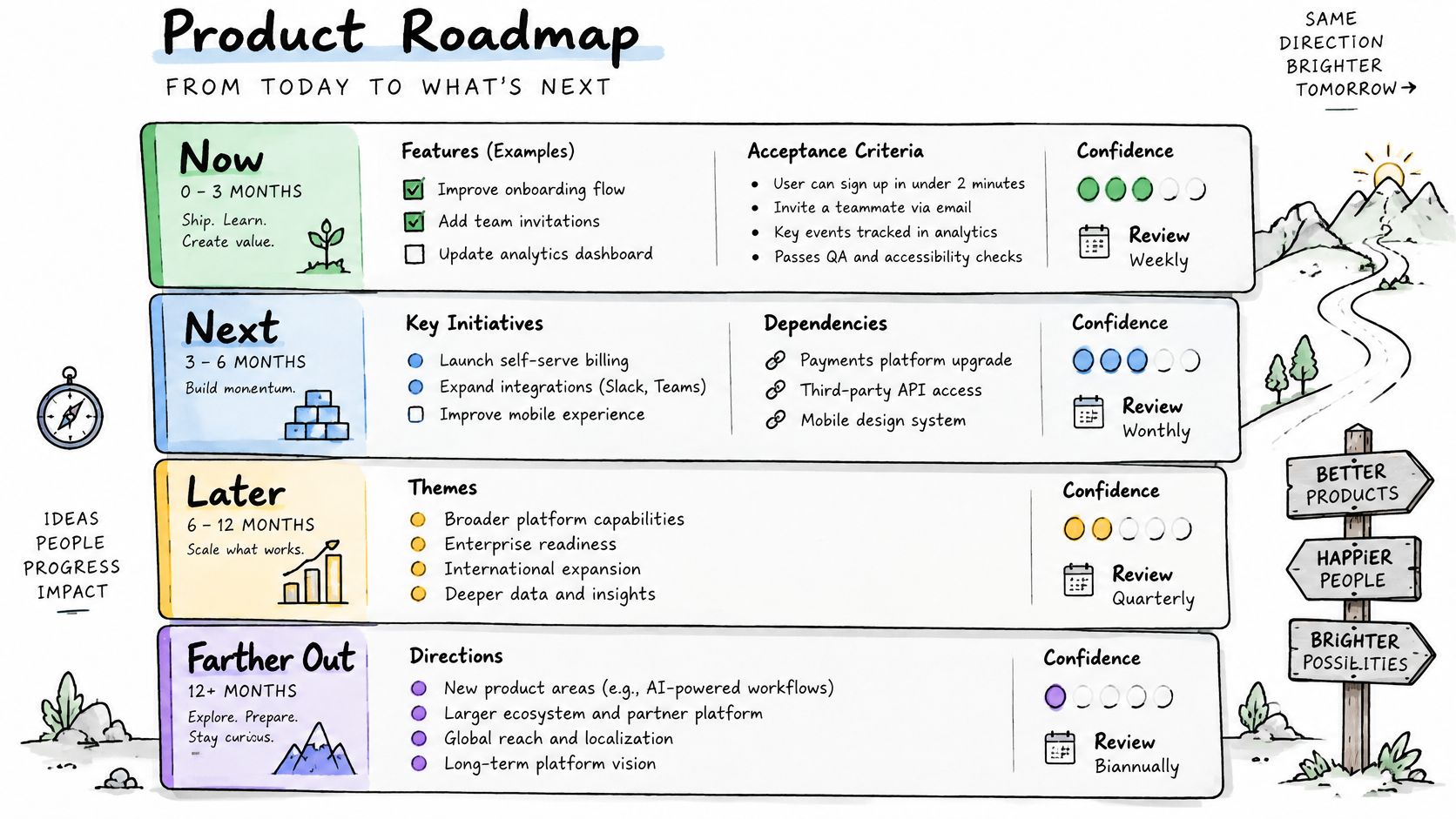
Granularity and confidence by horizon
These are recommended operating cadences, not universal delivery rules.
| Horizon | Granularity | Confidence needed | Review cadence |
|---|---|---|---|
| Now | Features with acceptance criteria | High, backed by validated evidence | Every sprint or two weeks |
| Next | Epics with a research plan | Medium, backed by observed signals | Monthly |
| Later | Themes and hypotheses | Low, based on judgment | Quarterly |
Attach high, medium, or low confidence to each item, together with the reason for that label. Confidence should describe the claim being made, including uncertainty about the problem, solution, or delivery approach.
Broad horizons leave room for research findings and technical constraints. Milestones still help when they mark observable checkpoints, such as completing a migration rehearsal or deciding whether an experiment warrants expansion.
For coordinated launches, use the agile release planning guide to translate selected work into a more detailed delivery sequence. Don't force that level of precision onto every distant idea.
Give each hypothesis an exit
Mixpanel's product roadmap guidance recommends treating roadmap work as hypotheses and defining how results will be evaluated. Make the exit condition part of the initiative before development begins.
This is what I mean by a kill criterion: a pre-agreed condition under which the team stops, pivots, or removes the initiative.
For a hypothetical onboarding redesign, write:
- Problem and target group: New workspace administrators encounter friction before completing setup.
- Outcome and baseline: Increase activation from 42% to 50% within one quarter.
- Assumption: First-session setup friction materially contributes to non-activation.
- Evaluation: Run experiments against the existing experience with an agreed observation window.
- Kill criterion: Drop the redesign approach if the first two adequately evaluated experiments show no movement.
- Guardrails: Don't worsen setup errors or increase support demand.
Those example figures define a testable proposal, not an expected lift.
The word adequately matters. Agree on instrumentation and evaluation quality before interpreting a flat result. A broken tracking event or inconclusive experiment doesn't justify declaring the underlying problem solved or irrelevant.
Stopping the redesign also doesn't mean abandoning activation. The team may investigate a different explanation, such as missing permissions or unclear value.
Which evidence would make your team change its mind?
Align Stakeholders and Hold the Scope Line
Projects reporting scope creep slipped by more than two months on average in PMI's PERIL database analysis. Separately, 52% of projects completed during the prior twelve months experienced scope creep or uncontrolled changes, compared with 43% five years earlier, according to PMI's 2018 Pulse of the Profession.
Those findings concern projects, rather than a forecast for your product team. They nevertheless support a concrete operating choice: make additions visible alongside their consequences.
Make the tradeoff discussable
Consider a hypothetical mid-quarter conversation. You're reviewing onboarding progress when a VP asks for a reporting feature needed for an upcoming prospect discussion.
The awkward moment comes when everyone looks at you for an immediate yes. You want to help, and the request sounds commercially reasonable.
Instead of negotiating the feature in isolation, open the roadmap and identify the shared constraint. The reporting work needs the engineer currently handling setup reliability; bringing it forward would move that committed outcome and push its delivery checkpoint back.
Then ask what evidence would justify the exchange. Is there a documented buying blocker across the intended segment, or a preference expressed during a sales conversation?
The request can be legitimate without being ready for commitment.
Use these operating rules:
- Name the displacement. Every addition identifies what moves, what loses capacity, or which objective changes.
- Record the reason. Log validated customer evidence, a regulatory deadline, a dependency, or stakeholder preference without disguising one as another.
- Recheck capacity. Review available engineering, design, research, and QA capacity whenever priorities shift, and preserve the change log.
Show commitments beside discovery
Put committed outcomes and discovery candidates on the same review page, labeled separately. That lets leaders compare options without interpreting every visible item as approved development.
The useful zoom-out is economic: stakeholders receive benefits from their requests, while delivery teams absorb much of the coordination cost. If requesting work feels free, people will keep requesting it. Visible displacement makes the cost available to the person authorizing the change.
Decision discipline: Approve the tradeoff at the same time as the new request.
Practical scope control for product teams also requires understanding the work before accepting it. A seemingly small screen change can introduce permissions, empty states, recovery paths, and downstream behavior.
At Figr, we ask clarifying questions, map the current flow, identify friction, list missing states, and explain tradeoffs. That gives the team a way to review the UX logic before committing to screens.
Close the stakeholder review with a short process:
- Confirm outcomes. Reaffirm what the team remains accountable for achieving.
- Review evidence changes. Identify which assumptions have strengthened or weakened.
- Approve tradeoffs. Record the decision, displaced work, and accountable owner.
Schedule Your First Roadmap Review This Month
In 2023, 54% of roadmaps were designed around outputs, while only 44% communicated outcomes, according to ProductPlan's survey of more than 1,500 product managers worldwide.
Start your review by rewriting an output into the customer or business result it serves. A reporting dashboard becomes a proposal to help a defined audience answer an important question without manual reconciliation.
That rewrite changes the conversation. Should the team build the dashboard, simplify an existing report, or first establish whether reconciliation is the actual problem?
Make the review produce a decision
Use this suggested meeting format to turn roadmap maintenance into an operating habit:
Step 1. Rewrite a live roadmap item. Add its outcome, metric, owner, and next decision date.
Include a guardrail so the proposed improvement can't hide damage elsewhere. Use guardrail metrics for product teams to choose what must remain healthy.Step 2. Book a 45-minute review with the owners of the top three items. Ask them to bring changed evidence, current constraints, and a recommendation.
Keep status reporting in the written update. Spend the meeting resolving decisions that require cross-functional judgment.Step 3. Set a recurring review date and log the first change. Record whether the initiative was retained, resequenced, sent for validation, or removed.
Capture the reason and the person responsible for the next action. A review without a recorded decision leaves the next meeting starting from memory.
Pulselake's research-to-roadmap guidance makes a useful distinction: research informs the problem and uncertainty, while leadership still has to reconcile strategy, feasibility, resources, and dependencies.
Apply that distinction during the meeting. Gather the new evidence, update confidence, compare the opportunity with available capacity, and inspect dependencies before deciding its next state.
Share the same decision in different views
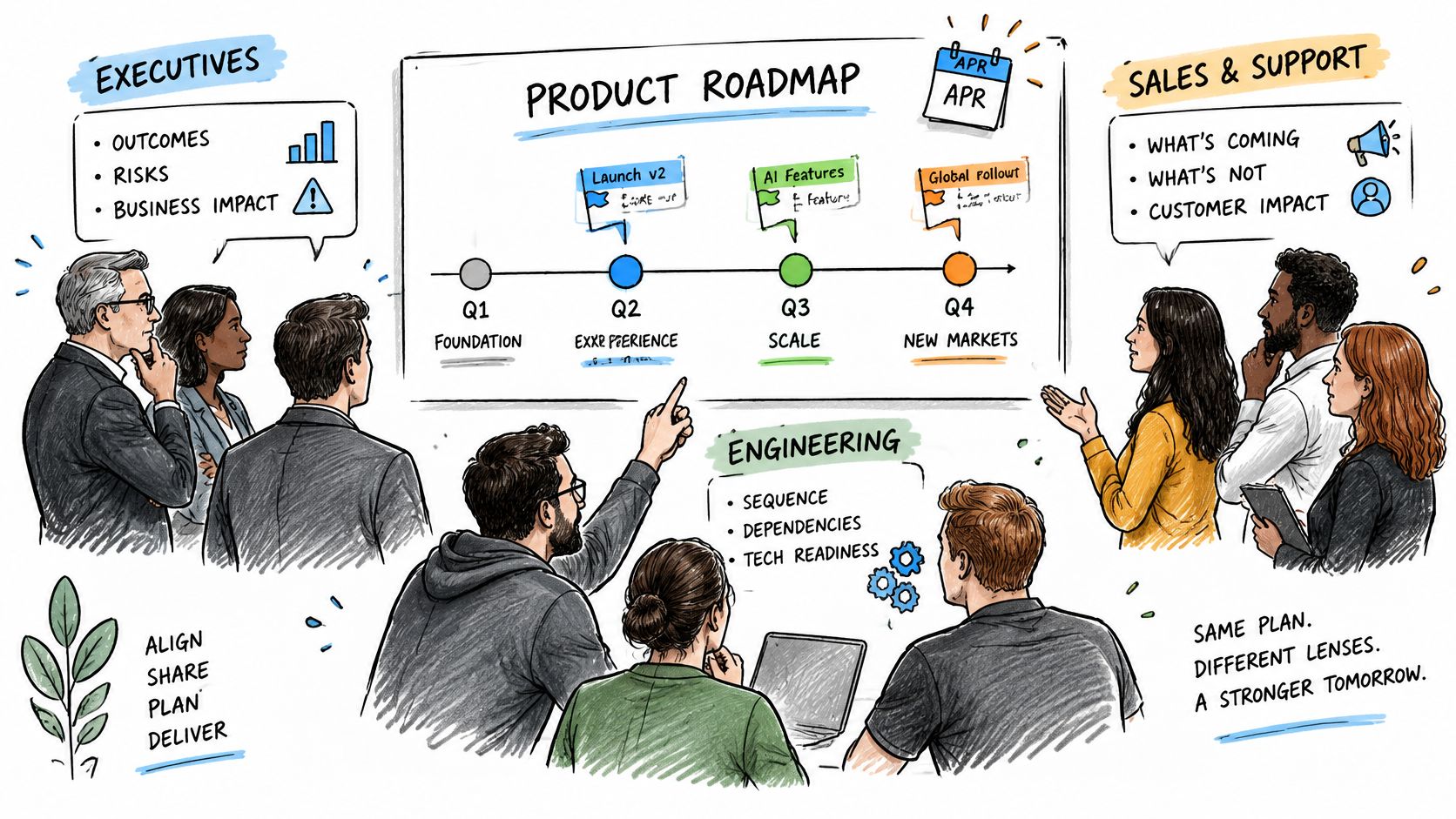
Executives need outcomes, material risks, and investment choices. Engineering needs sequencing and dependency changes. Sales and support need a clear account of what's coming, what remains exploratory, and what they shouldn't promise.
Maintain those as views of the same roadmap. Separate files with separate commitments invite avoidable arguments.
Keep the decision connected to the work that follows, too. In Figr, a written PRD can become a mapped UX flow. A research note can inform a user flow, a PRD can inform edge cases, a product walkthrough can inform a redesign, and a design decision can shape future screens.
By the end of the review, put the revised initiative, its supporting evidence, its owner, its next decision date, and the approved tradeoff on paper. Book that first session this month, then send the decision record to everyone whose plans changed.
Figr helps you turn requirements and research into user flows, edge case maps, acceptance criteria, and prototypes grounded in your product context. Bring an uncertain roadmap initiative to Figr and map its UX logic before your team commits to screens.