

Your VP just asked for something visual to anchor tomorrow's board discussion. You have a PRD. You have bullet points. You have 16 hours and no designer availability. That feeling? That’s the entry point for scope creep.
To beat scope creep, you need more than a firm "no." The real defense is an airtight scope definition with crystal-clear boundaries, a formal change control process for every single new request, and a proactive hunt to uncover hidden work before a single line of code is written. It's this mix of upfront clarity and disciplined adaptation that actually protects your timeline and budget from that slow, painful expansion.
The Slow Leak That Sinks Product Timelines
That late-afternoon request from your VP feels harmless, right? A minor adjustment. But this is exactly how the trouble starts.
Scope creep isn’t a sudden catastrophe that blows up a project. It’s a slow, quiet leak that methodically drains your resources, morale, and momentum. It's the project equivalent of death by a thousand paper cuts.
This gradual expansion of requirements is so common it feels inevitable. The Project Management Institute found that a staggering 52% of all projects fall victim to scope creep. It’s not an exception: it’s the default experience for most teams. You can read the full research on PMP scope creep to see just how pervasive this is.
But why does this happen so consistently?
Redefining the Problem
We usually blame scope creep on a failure of planning or a simple lack of discipline. But what if it's really just a symptom of unarticulated assumptions?
That “small tweak” from your VP isn’t just a tweak. It’s a brand-new requirement born from an assumption that never saw the light of day during planning. Was the original goal a little fuzzy? Did the initial user flow miss a critical step?
The basic gist is this: Preventing scope creep isn’t about building higher walls to say "no." It's about creating such intense, shared clarity from the beginning that those "small tweaks" are immediately seen for what they really are: a change in scope.
This demands a real shift in mindset.
From vague goals to quantifiable success metrics.
From focusing only on the "happy path" to mapping every possible edge case and failure state.
From informal "drive-by" requests to a structured change evaluation process.
A friend at a Series C company told me their biggest project delays came from what they called “agreement debt.” It’s that thing where everyone nods along in meetings but walks away with a completely different picture of the final product. The work wasn't in building the feature, it was in repeatedly rebuilding it to close that gap between expectations.
This guide moves past the generic advice. It’s a playbook for teams who need to protect their roadmap, their budget, and their sanity.
Crafting an Airtight Scope Definition
A vague scope document is an open invitation to chaos. It’s like giving a builder a napkin sketch and telling them to construct a house, only to show up midway through and ask why they didn't include a second floor. You wouldn't do that, would you?
This is why a scope definition must act less like a suggestion and more like an architectural blueprint. It’s a binding agreement on what will be built, how it will be measured, and, just as critically, what will not be built.
Last quarter, a PM at a fintech company shipped a file upload feature. Engineering estimated 2 weeks. It took 6. Why? The PM specified one screen. Engineering discovered 11 additional states during development. Each state required design decisions. Each decision required PM input. The 2-week estimate assumed one screen: the 6-week reality was 12 screens plus 4 rounds of 'what should happen when...' conversations.
From Vague Ideas to Concrete Boundaries
To stop scope creep, you have to move from abstract goals to concrete boundaries. The initial project brief is often where the problems begin.
An effective scope definition isn't a wish list; it's a contract with reality. It must contain three non-negotiable components:
Explicit "In Scope" Deliverables: List every key feature, screen, and user story. Be specific enough that an engineer knows exactly what to build and a QA tester knows exactly what to test.
A Ruthless "Out of Scope" List: This is your shield. Clearly state what will not be included. "Future enhancement," "Phase 2 feature," or "V2 improvement" are your best friends here.
Quantifiable Success Metrics: How will you know you've won? Define success with numbers: "Reduce average checkout time by 15%," or "Increase user sign-ups from the new landing page by 10%."
Making the Invisible Visible
The most dangerous assumptions are the ones you don't even know you're making. This is where proactively mapping every possible user interaction becomes essential. By visualizing the entire journey, including every potential failure, you uncover the hidden work.
A friend at a fintech company calls this "pre-mortem mapping." Before writing a line of code, they map out every state a user could encounter. For example, they built a comprehensive map of every possible Dropbox file upload failure state to ensure nothing was missed during estimation. To go even deeper, check out this interactive prototype that simulates the various edge cases in a card-freeze flow.
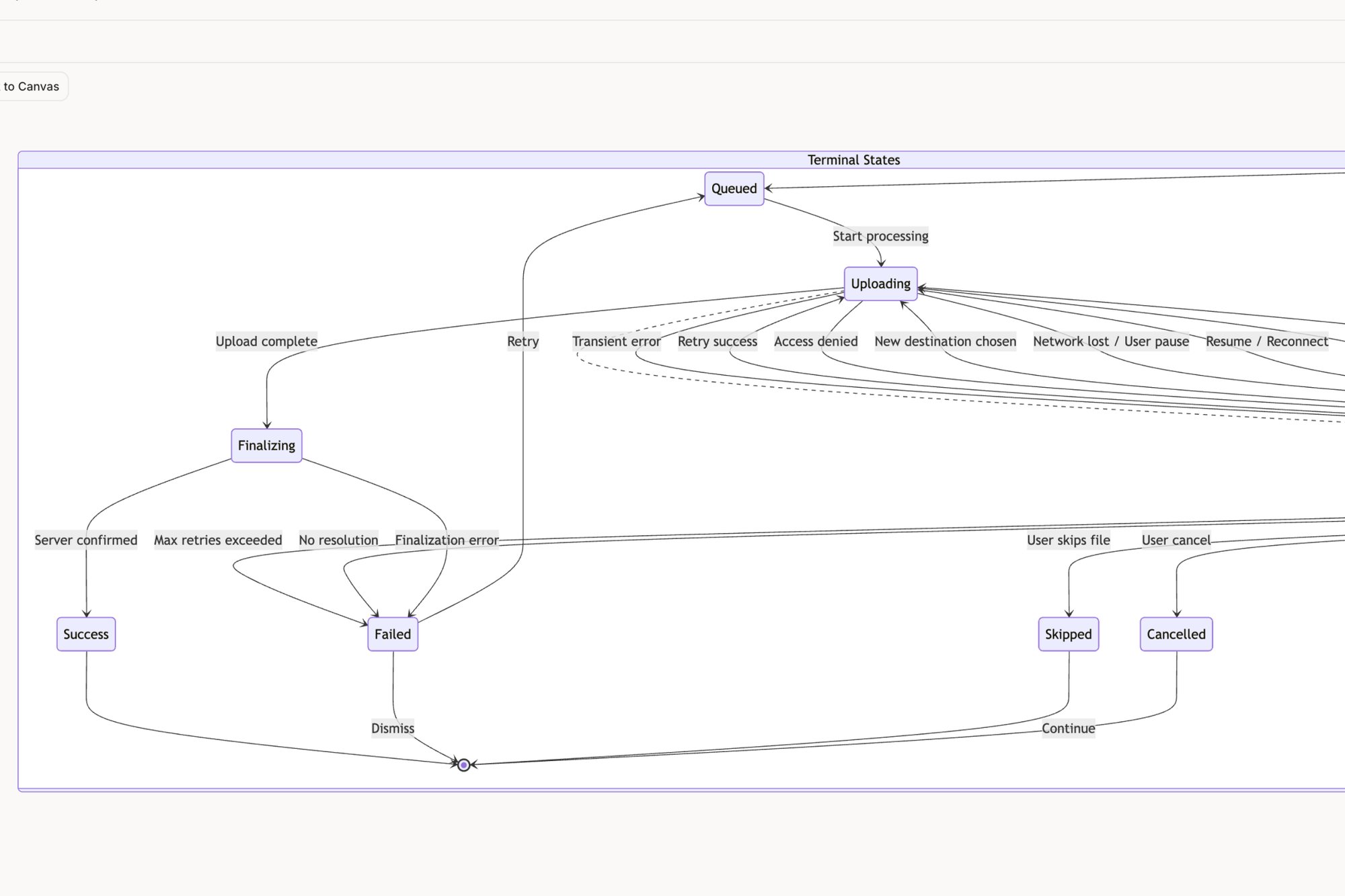
This level of detail transforms conversations with stakeholders. It shifts the discussion from vague desires to the concrete trade-offs required to deliver on time. Integrating contract management best practices also ensures that all project agreements are consistently defined and enforced. And critically, you need to formalize who makes the final call on scope decisions, a key aspect you can explore further in our guide to understanding stakeholder mapping.
Mastering the Change Control Process
Change is inevitable, but chaos is optional. Stakeholders will always have new ideas and market conditions will always shift. Your goal isn't to freeze a project in amber; it's to manage change with intention.
Too often, teams see a change control process as a bureaucratic hurdle, a wall of "no" designed to slow things down. But that’s the wrong way to look at it.
Think of it less like a wall and more like a prism.
It takes a raw request and refracts it, revealing the true spectrum of its impact on your timeline, your budget, and your team's focus. It's about making the true cost of "yes" visible to everyone involved.
Introducing the Change Budget
One of the most effective tools I've used is the Change Budget. This is a pre-agreed capacity for minor adjustments that doesn't require a full, painful re-scoping process for every little thing.
It might be a small block of hours per sprint or a few low-effort tasks per month. This gives the team flexibility without sacrificing control. It acknowledges that small pivots are necessary while preventing a constant stream of undocumented tweaks from completely derailing the project. When the budget is spent, any new request must go through the full change control process or wait.
It's that simple.
A Lightweight but Effective Workflow
An effective change control process doesn't need to be heavy. It just needs to be consistent. Every single request should follow the same path, which ensures fairness and clarity for everyone.
This starts with a rock-solid scope definition from day one.
This discipline, defining constraints first, then clearly separating what’s in from what’s out, is the foundation.
From there, the workflow is straightforward: a change request is submitted, its impact is assessed, stakeholders review it, and then a decision is made. Approve, deny, or defer.
A simple change request form can work wonders. It forces the requester to articulate the "why" behind their idea, which sometimes is enough to make them realize it's not a priority after all.
This structured approach also forces teams to get much better at prioritization. When every change is weighed against its true cost, it becomes painfully clear which adjustments are critical and which are just "nice-to-haves." You can learn more about how to prioritize your product backlog to keep your team focused on what actually matters.
Last week, I watched a PM field a request to add a new filter to a reporting dashboard. Instead of giving an immediate answer, she sent back a one-page impact assessment. It showed the change would add four days of engineering time, two days of QA, and push back another committed feature.
The stakeholder quickly decided the filter could wait for the next release. She didn't say no. She just made the trade-offs visible.
That’s how you master change control.
Uncovering the Hidden Work Below the Surface
The most dangerous kind of scope creep doesn't show up in a formal change request. It's the invisible work, the stuff lurking just beneath the surface of what everyone agreed to.
We're talking about all the unhappy paths: the error states, empty states, loading screens, and network failures that almost never come up in a project kickoff. This is the hidden complexity that quietly blows up timelines and sinks sprints.
A friend at a Series C startup told me their team's single biggest source of delay was something they called design debt by omission. Why? Because the original scope only ever accounted for the perfect journey, the one where the user never makes a mistake and the server never drops a connection.
This is the classic iceberg problem. The requested feature is the 10% you see above the water. The edge cases are the 90% below that can rip a fatal hole in your project plan.
Championing State-First Design
To avoid this ambush, you have to flip the process on its head. Instead of defining the feature and then stumbling upon the states later, you define the states to truly understand the feature. This is the heart of state-first design.
Before a single story point gets estimated, the product, design, and engineering trio must map out every conceivable state the user might hit.
What happens if an upload fails halfway through?
What does the screen look like before a user has entered any data?
What message pops up if their session times out?
This isn’t just some engineering box-checking exercise; it’s a fundamental product and design responsibility. Each state represents a decision to be made, a screen to be designed, and code to be written and tested.
A simple "card freeze" feature might feel like one task. But when you map it out, you quickly find a dozen states: card frozen successfully, freeze failed, card already frozen, card not found, and so on. Exposing this hidden work is the only way to create an honest estimate.
Making the Invisible Visible
When you visualize these complex user flows and system states, the abstract suddenly becomes concrete. A vague requirement transforms into a detailed map of the actual work ahead. This is how you force the critical conversations to happen before a single line of code is written.
By surfacing the hidden work early, you give stakeholders a realistic picture of the effort involved. This doesn't just lead to better estimates; it dramatically cuts down on those mid-sprint "surprises" that burn out teams and destroy deadlines. This is a core part of learning how to manage product backlogs and design tasks in a unified system.
In short, theory is one thing, but you need to know where to start. Moving from talking about scope creep to actually preventing it happens the second you decide to act. The next step isn't some massive, soul-crushing organizational change. It's a quick, focused look at the project sitting right in front of you.
First thing tomorrow, run a Scope Clarity Audit on your most critical project. This isn’t a formal, drawn-out meeting. Think of it as a ten-minute self-assessment designed to find the cracks where scope creep loves to hide.
The Five-Question Clarity Audit
Pull up your project brief or PRD and ask yourself these five questions. Be honest. The point isn't to assign blame for past decisions; it's to spot immediate risks before they blow up.
Is the "out of scope" list explicit? Does it clearly name the features and functionalities you've all agreed not to build? If that list is missing, you've left the door wide open for "just one more thing."
Are the success metrics quantified? Can you measure the finish line with a hard number? I'm talking about things like "increase conversion by 10%" or "reduce support tickets by 25%." Or are your goals fuzzy, like "improve the user experience"? Vague goals are scope creep's best friend.
Have all user and system states been mapped? Look beyond the happy path. Has anyone actually documented the error states, empty states, and loading states? For a real-world example, check out this detailed map of every component state for a task assignment feature. This is where hidden work lives.
Is there a documented change control process? Seriously. If a key stakeholder came to you today with a new idea, does every single person on the team know the exact steps for submitting, evaluating, and approving that request? If not, you have no process.
Do you know your top three project risks? Ambiguity is a risk. Hidden complexity is a risk. Proactively identifying these is a non-negotiable part of your action plan. Techniques like a pre-mortem can be invaluable here. This guide on Mastering Project Pre-Mortems with AI is a great place to start.
Ultimately, this isn't a one-time fix. It’s about building the organizational muscle to value clarity before you start building, knowing that this initial focus pays for itself tenfold in predictable, successful delivery.
Your audit is the first rep in that workout. And if you're looking for structured ways to document all this, our guide on templates and frameworks for product requirements documents has you covered.
Got Questions About Scope Creep?
It's one thing to talk about preventing scope creep in theory. It's another thing entirely to deal with the messy reality of a live project. Stakeholders are unpredictable, priorities shift, and no two teams work exactly the same way.
Let’s get into the most common questions that pop up when you're in the trenches, trying to keep a project on the rails.
How Do I Handle a Stakeholder Who Always Pushes for More?
Ah, the classic. We’ve all been there. The key is to stop making it a personal "no" and start making it a data-driven "if-then" conversation about trade-offs.
When that person insists on cramming in just one more feature, don’t argue. Instead, pull up your change control log and impact assessment. Walk them through the cause-and-effect: "That's an interesting idea. For us to build that, it's going to add two sprints of engineering time, which means the analytics dashboard gets pushed back a month. Are you comfortable with that trade-off?"
By framing it this way, you're not the bad guy; you're the responsible project steward making the true cost of their request visible. It puts the ownership of the decision right back on them.
Is It Even Possible to Prevent Scope Creep in Agile?
This is a huge misconception. People hear "Agile welcomes change" and think it means "Agile welcomes chaos." Not at all. In fact, scope management is even more critical in an Agile world because everything moves so fast.
Your "scope" in Agile is simply smaller and more focused: it’s the sprint backlog.
You still need an iron-clad definition of what's in that sprint. You absolutely need a process for dealing with new ideas that pop up mid-sprint. And you have to be ruthless about using your product roadmap as a filter to make sure every sprint moves you toward the bigger prize.
Agile is about controlled, intentional adaptation, not directionless additions.
How Do I Know When a Change Is Necessary vs. a Distraction?
This is where all that hard work you did upfront, defining the project scope and success metrics, really pays off. That document is your North Star.
Every single proposed change should be run through a simple filter: does this get us closer to our primary objective?
A necessary change directly improves a core success metric or fixes a major risk you just discovered. For example, if user testing reveals a critical flaw in your checkout flow that's tanking conversions, fixing it isn't scope creep. It's a vital course correction.
A distraction is a "nice-to-have" idea that doesn't really move the needle on your main goal. It might be a cool feature, but if it doesn't impact your key metrics, it belongs in the backlog for another day. This is where discipline is everything.
Bringing this level of clarity and discipline to your process is hard, but it’s the only reliable way to protect your team’s focus and deliver on your promises. It requires visualizing every state, documenting every decision, and making every trade-off explicit. Figr is designed for exactly this, helping teams map complex flows, uncover hidden edge cases, and generate the artifacts needed to prevent scope creep before it starts. Explore how Figr can help you ship UX faster and with more confidence.