

Every quarter you promise to clean up design debt. Every quarter the roadmap eats the time. Three years later, the empty states still look like 2021, onboarding uses three button styles, and one critical admin flow feels like it was designed by a different company.
That cycle has a name. I call it roadmap gravity.
It pulls every conversation toward net-new delivery because new features are easy to defend and cleanup work rarely is. The result is familiar to any PM in B2B SaaS: slower QA, longer design reviews, more exceptions in code, more “just this once” decisions, and a product that gets harder to change every quarter.
If you're trying to figure out how to reduce design debt without slowing delivery, the answer isn't a grand cleanup initiative. Those die fast. The answer is a repeatable operating system: define the debt clearly, audit it lightly, score it ruthlessly, and reserve capacity for it every sprint.
The Promise You Can't Seem to Keep
Last week I watched a PM walk into sprint planning with the right intention and the wrong plan. She had a list of design issues everybody agreed were hurting the product: duplicated patterns, brittle forms, inconsistent error handling, stale copy, accessibility gaps. By the end of the meeting, every one of those items had been pushed again.
A new integration won.
A customer escalation won.
A sales commitment won.
This is the trap. Design debt gets framed as “cleanup,” which sounds optional. The roadmap gets framed as “delivery,” which sounds existential. So the debt sits there, taxing every future release.
Practical rule: If design debt lives in a side doc instead of the delivery system, it isn't being managed. It's being postponed.
The painful part is that teams usually know the problem. They just don't have a method that survives contact with sprint planning. They also don't share a useful design debt definition. One person's “polish issue” is another person's usability blocker. One designer sees inconsistency. One engineer sees duplicated front-end logic. One PM sees a backlog graveyard.
This is what I mean by reducing design debt without slowing down delivery. Not a heroic reset. Not a design system committee that meets for months. A practical system you can run with your current team, your current sprint cadence, and your current product mess.
Design Debt vs Tech Debt The Invisible Tax
Design debt vs tech debt is the same tax paid from different ledgers.
Tech debt usually shows up in engineering effort, fragile architecture, duplicated logic, and slower releases. Design debt shows up in user friction, inconsistent UI, accessibility issues, copy drift, and endless edge-case decisions. Both reduce velocity. Both create rework. Both make teams slower than they look on the roadmap.
The economics matter here. New features have obvious owners and visible deadlines. Debt paydown often has diffuse ownership and delayed payoff. So teams keep borrowing against future clarity.
That logic breaks once the tax gets big enough.
According to research on the ROI of mature design systems, mature systems reduce design debt by 60–75% and technical debt by 55–70%. The same analysis shows a mid-size SaaS company saving $17,520 annually from a 73% reduction in design inconsistency work on design rework alone.
The four flavors of debt
You can't reduce what you lump together. Most product teams are dealing with four distinct flavors:
Component debt, buttons, fields, modals, tags, and tables that all look close enough until implementation starts.
Pattern debt, conflicting flows for the same job, like three different ways to invite a teammate or configure billing.
Content debt, labels, helper text, and empty states written at different moments by different people with different assumptions.
Accessibility debt, interactions that technically ship but create barriers, confusion, or expensive remediation later.
Design debt isn't aesthetics. It's product friction with compound interest.
If your team is also wrestling with old architecture and migration constraints, this piece on managing legacy systems for innovation is worth reading because the organizational pattern is the same. Teams under delivery pressure defer foundational work until the foundations start dictating the roadmap.
How to Run a Design Debt Audit That Gets Results
A useful design debt audit is not a census. It's a decision tool.
The mistake I see most often is over-auditing. Teams create giant spreadsheets, argue taxonomy, and burn two weeks documenting everything. Then nobody uses the output. Good audits are smaller, faster, and tied to active product surfaces.
Start with one journey, not the whole product
Pick one high-traffic or high-stakes flow. Onboarding. Billing. User management. Support escalation. Audit the screens people touch, not the theoretical architecture of the experience.
Use four columns only:
Issue
Type of debt
Where it appears
What it breaks
That last column matters most. “Inconsistent spacing” is weak. “Causes handoff ambiguity and duplicated implementation choices” is useful. “Error message lacks recovery guidance” is useful. “Keyboard navigation breaks in modal” is urgent.
For teams trying to tighten the process, Figr's guide to auditing user experience is a practical reference because it keeps the audit anchored in observed product problems instead of abstract taste debates.
Prevent new debt before you clean old debt
The most effective move isn't cleanup. It's interception.
The most effective teams run pattern audits before building new features. According to Headway's write-up on managing design debt, that practice prevents 40% of new debt accrual. The same source notes that teams allocating about 15% of sprint time to continuous refactoring report 50% less burnout and 2x faster iterations.
That should change how you think about “extra work.” Preventing debt is delivery work.
A simple review loop helps:
Compare the new feature against the current component library and live product.
Flag any proposed new pattern that already exists in another form.
Decide whether to reuse, update, or formally replace the old pattern.
If you want a visual testing layer after release, an automated UI safety net by e2eAgent.io can help catch regressions that reintroduce inconsistency after the design review is over.
A quick walkthrough can help teams align on what “good enough” looks like in practice.
One more thing. Use your existing product design best practices as the standard for the audit. If your team doesn't connect debt findings to explicit standards, every review turns into opinion theater.
A Scoring Framework That Forces Prioritization
Organizations often do not have a debt problem. They have a prioritization problem disguised as a debt problem.
They know the product is messy. They don't know what to fix first, how to defend that choice, or how to explain it to engineering and leadership in terms that survive planning. That's why UX debt prioritization fails so often.
According to this argument for measuring design debt more concretely, many designers and developers fail because they can't quantify the debt in sprint-by-sprint terms. They make it visible, but not actionable.
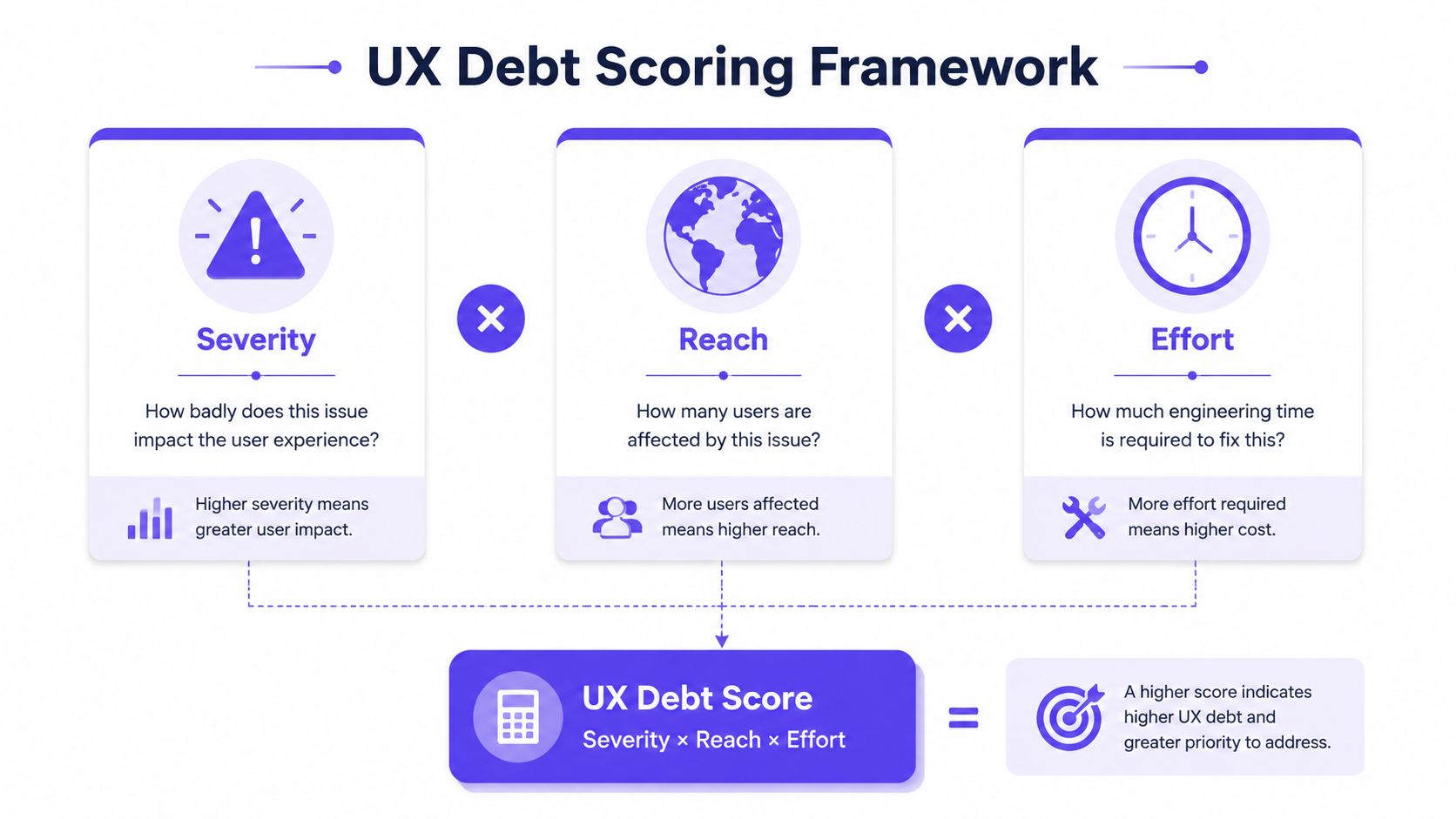
Use severity, reach, and effort
The basic gist is this: you can't argue with a number as easily as you can argue with taste.
Score each issue on three axes:
Severity: How badly does this hurt the user experience or team execution?
Reach: How widely does this problem show up across users, screens, or workflows?
Effort: How hard is it to fix, in real implementation terms?
I like using this formula:
Priority score = severity x reach x effort-adjusted value
Implementation is straightforward. High-severity and high-reach issues rise. High effort lowers urgency unless the issue is severe enough to justify a deliberate investment. The exact math matters less than consistency.
What strong scoring looks like
A few examples make the model real.
A broken keyboard path in a common admin flow scores high because the severity is high, the reach is material, and the fix is often bounded.
Three different secondary button styles might feel annoying, but if they rarely appear and require broad refactoring, they may rank lower than a single error-state pattern that repeatedly causes failed task completion.
If every debt item is “important,” the scoring model is lying or the team isn't being honest about trade-offs.
This framework also gives PMs a common language with design and engineering. If you're already using prioritization methods elsewhere, this action priority matrix for product teams pairs well with debt scoring because it forces the conversation toward impact and cost, not volume of complaints.
How to Reduce Design Debt with Two-Track Delivery
If you want the answer to how to reduce design debt, stop treating it like a side quest.
Treat it like rent.
A friend at a Series C company told me their team calls it “the 20% tax.” It is a fundamental requirement. Every sprint, some fixed capacity goes to debt. Not when things calm down. Not after launch. Every sprint.
This works because it removes the recurring argument. You're no longer asking whether debt matters. You're deciding which debt deserves the reserved capacity.
The 80/20 model that survives sprint planning
Keep roughly 80% of delivery capacity on roadmap work and 20% on debt. You don't need purity here. Some teams sit closer to the lower end of reserved capacity and increase it when the product starts creaking. What matters is consistency.
According to Debt Design's process for paying off design debt, teams that explicitly allocate 10–20% of sprint capacity to design debt report 40% faster feature delivery after the initial reduction period. The same source warns that 75% of teams see debt slide back into the backlog without tracking and OKR linkage.
So don't create a debt lane without instrumentation.
The operating cadence
Here's the simplest version I've seen work:
During planning, pull one or two scored debt items into the sprint alongside features.
During review, confirm whether the shipped change removed the debt or just reshaped it.
During retros, check if the same category keeps recurring. That's usually a system issue, not a one-off bug.
This is also why why design systems fail to get adopted matters. Teams often build the library but don't change the operating model. Without reserved capacity, review discipline, and explicit ownership, the design system becomes a reference doc while debt keeps growing in production.
One more practical point. Pair debt cleanup with active roadmap work whenever possible. If a team is already touching permissions, fold in the permission pattern cleanup. If they're revisiting onboarding, fix the content hierarchy and states there too. That's where rapid prototyping for product teams helps, because it shortens the loop between identifying a fix, validating it, and getting it into the sprint without turning the effort into a mini redesign project.
Using AI to Accelerate the Cleanup Calculus
AI changes the effort side of the equation.
Not the need for judgment. Not the need for priorities. Effort.
That matters because many teams already know what's wrong. They stall because audits are slow, pattern comparisons are tedious, and cleanup design work competes with roadmap design work.
A useful AI workflow doesn't start from a blank prompt. It starts from your actual product. Figr is an AI product agent for UX design and product thinking that ingests your live webapp, Figma files, screen recordings, and docs to learn your actual product before designing, then references 200,000+ real-world UX patterns to design from your product rather than from a blank prompt. If you want to see the shape of that output, see what teams have built with Figr, including this Intercom analytics enhanced support hub.
What AI should actually do for debt work
It should help with three jobs:
spotting inconsistency across screens faster than a manual pass
proposing fixes that align with your existing patterns and tokens
generating artifacts that make review and implementation easier
That's where the workflow gets interesting. The same system you use to identify low-value surfaces can support reducing UX debt by shrinking the cost of triage and redesign. This is a helpful lens for how Figr optimizes product UX debt, especially when the primary bottleneck isn't awareness. It's design bandwidth.
The Only Way to Win is to Play Continuously
Design debt doesn't get solved. It gets managed.
That's the mindset shift. Not a campaign. A standing discipline. The teams that get ahead of it build cleanup into the weekly mechanics of product development, then keep doing it when the product looks healthier.
Book one hour with your lead designer and lead engineer this week. Bring three debt items from one product journey. Score them together. Pull one into the next sprint. Then set the rule that some debt work ships every cycle.
If you're thinking about this at the company-building level, this piece on strategic AI design for pre-seed founders is useful because it frames design quality as an operating choice, not a decorative layer. The same principle holds later in scale-stage SaaS. You need a system for shipping better UX with continuous improvement.
For the complete framework on this topic, see our guide to design system best practices.
If you're serious about reducing design debt without slowing the roadmap, Figr is worth evaluating as part of your workflow. It helps product teams audit real product experiences, generate grounded UX artifacts, and move from vague cleanup intentions to concrete design decisions that can ship.