At 4:47 p.m., a PM posts a polished prd document in Slack. There’s a tidy summary, a link to the spec, maybe even a cheerful “comments welcome.” Then the channel goes quiet. One engineer drops a thumbs-up. Design skims it later. A stakeholder reads the first screen and asks a question the document already answered. By sprint planning, half the room is still operating from memory.
That silence tells you something.
Most ignored PRDs aren't failing because the writer is lazy. They fail because the document behaves like homework instead of a decision tool. It asks people to read a lot, but it doesn't help them act. If you've ever wondered how to write a prd document that survives contact with real teams, this is the part people usually skip: the problem is rarely formatting alone. It's trust, clarity, and whether the document respects how engineers work in practice.
The Sound of a PRD Landing in an Empty Room
I've seen this pattern enough times that it has a name in my head: ceremonial documentation. The team creates a product requirements document because the process says they should. Everyone nods. Nobody uses it when trade-offs get painful.
Last week I watched a PM at a growth-stage SaaS company walk through a spec that looked complete on paper. It had goals, requirements, screenshots, and a long list of stakeholder notes. But every section read like it had been written for approval, not execution. Engineers left with the same questions they brought in: What problem matters most? What can we cut if integration gets messy? What is explicitly not part of this release?
That's when a PRD turns into dead weight.
The real reason PRDs get ignored
Unread documents usually share a few traits:
- They narrate everything, prioritize nothing, so readers can't tell what matters when time gets tight.
- They prescribe implementation details too early, which makes engineers tune out or argue with the wrong layer of the problem.
- They hide the trade-offs, so the first real conversation happens midway through delivery.
- They try to sound complete, but never feel usable.
A team doesn't reject a PRD because they hate documentation. They reject it because the document doesn't reduce uncertainty.
A useful PRD lowers the number of follow-up meetings. A bad one creates them.
When I see teams complain that engineering “won't read docs,” I usually look upstream. Are they being handed a decision-making artifact or a polished archive? Those are not the same thing.
When the document is a symptom
Sometimes the PRD problem isn't even a PRD problem. It's a signal that the broader operating system is off. Product is writing in isolation. Design is attached too late. Engineering is asked to estimate before the edges are visible. If that sounds familiar, it's worth reading these signs your product development cycle is broken and how to fix them.
The point isn't to write longer specs.
The point is to write one that gives the team a shared frame before work starts getting expensive.
What a Modern PRD Document Actually Is
A modern prd document is not a hundred-page relic that tries to freeze reality before development starts. It isn't a legal contract between product and engineering either. The useful version is lighter, sharper, and much more alive.
The format has history. The Product Requirements Document originated in the late 1990s at Microsoft and became standard by the early 2000s. Early case studies showed that well-structured PRDs could reduce development misunderstandings by up to 40%, and by 2010 the format had adapted to Agile, with concise, living PRDs associated with 25% faster time-to-market in reported cases, as summarized by GeeksforGeeks.
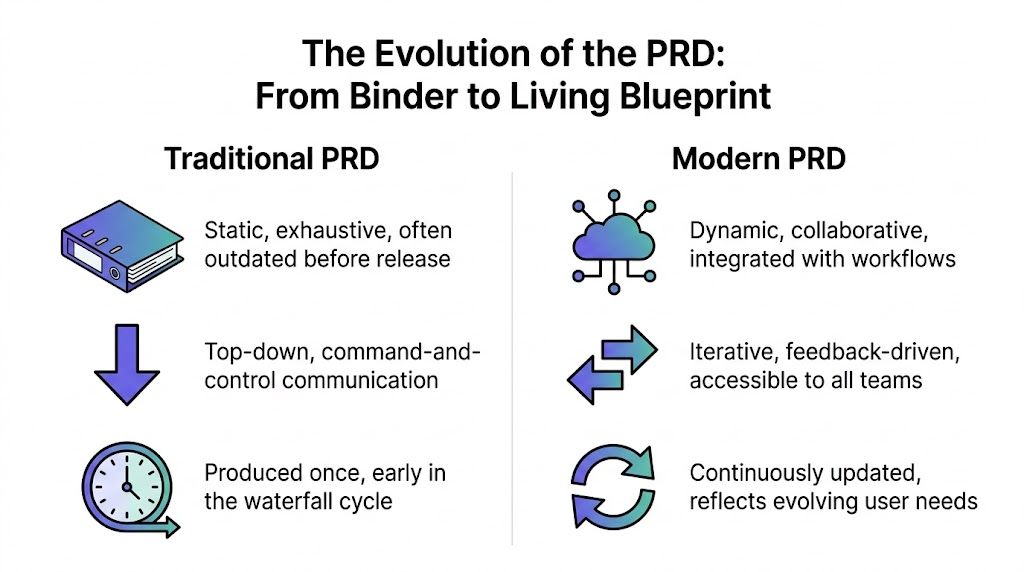
From binder to living blueprint
That shift matters because the old model assumed certainty. Teams gathered requirements once, wrote everything down, and hoped reality would cooperate. Reality never does.
The modern PRD works more like a narrative backbone. It answers the durable questions:
- Why are we doing this now
- Who is this for
- What outcome are we trying to create
- What constraints matter
- What does success look like
- What is not included
It should not answer every implementation question in advance. Once a PM starts dictating architecture or interaction minutiae that belong to design and engineering, the doc stops aligning the team and starts crowding it.
What engineers actually need from it
The basic gist is this: a modern PRD provides context and decision boundaries.
That means the document should be opinionated where ambiguity is expensive, and deliberately open where expertise should shape the solution. Engineers need to know the user problem, the key flows, the constraints, the risks, and the release criteria. They do not need a PM pretending to be a staff engineer in paragraph seven.
Working definition: A good PRD tells the team what must be true when the work ships, not every step of how to build it.
This is also why static templates disappoint people. A prd document template can help you start, but if it doesn't reflect how your team decides, it becomes another artifact that gets filled in and forgotten.
The test I use
A product requirements document is modern if it passes three tests:
- It can survive change because priorities, assumptions, and dependencies are visible.
- It can be read quickly because the core decision logic is obvious.
- It can be discussed cross-functionally without translating it into three other documents.
If you're comparing approaches, these templates and frameworks for product requirements documents prds and design specs are useful reference points, but its true value comes from how your team uses the document in motion, not how clean it looked on day one.
The Anatomy of a PRD Engineers Will Use
Most advice about prd format starts with sections. That's fine, but engineers don't read sections. They read for answers. Every part of the document should help them resolve a practical question before build time gets expensive.
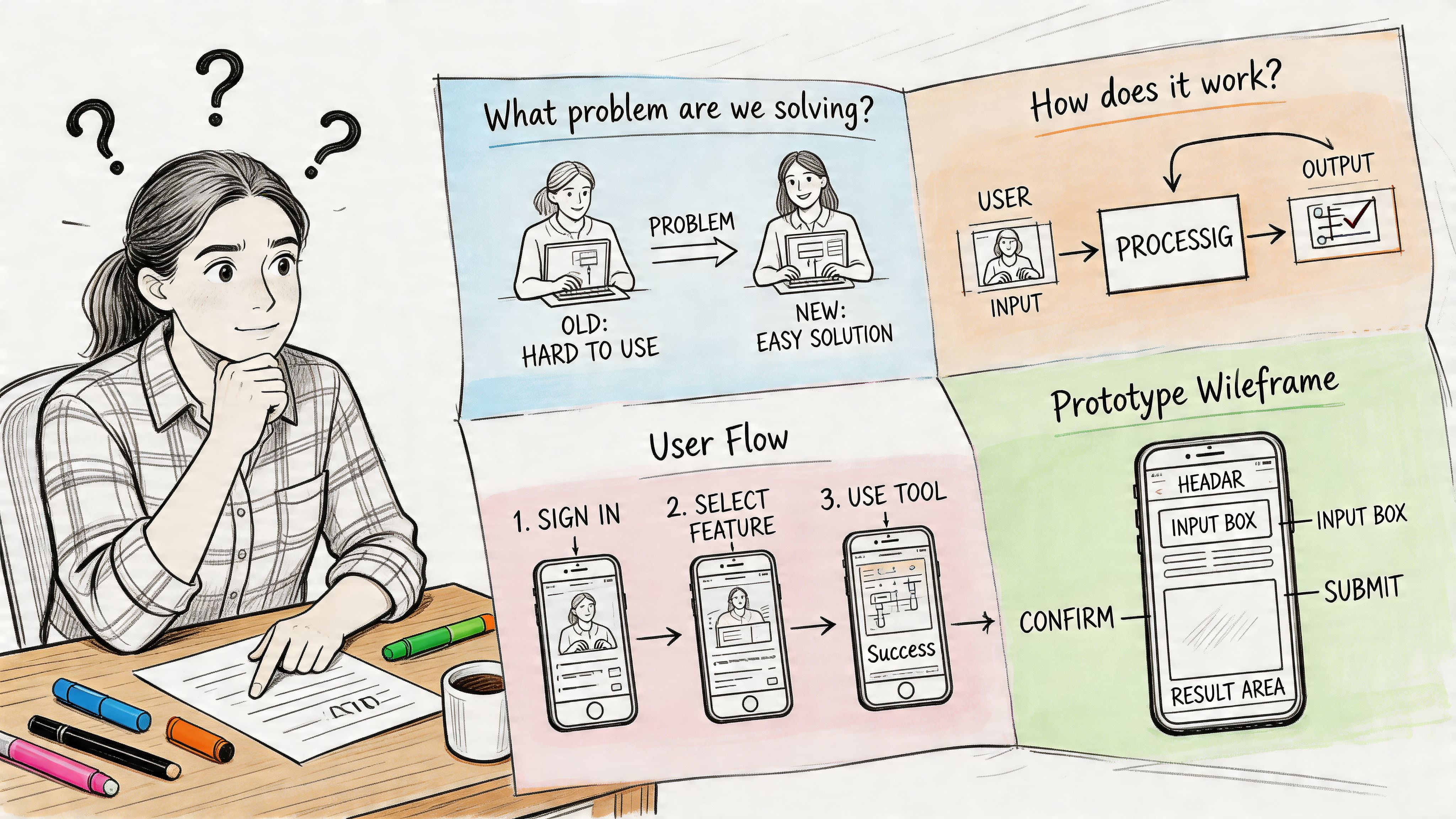
A strong structure matters. Teams using well-structured PRDs experience 30-40% less scope creep and up to 50% fewer production bugs, while Agile PRDs have been associated with 35% higher user satisfaction scores and 90% stakeholder alignment before development begins, according to Perforce's summary of PRD practices.
Start with the decision, not the background
The first screen should answer four things fast:
- The problem: what is broken, missing, or newly important
- The user: who feels that pain most directly
- The objective: what change in behavior or outcome you're aiming for
- The release boundary: what counts as the first viable version
If the opening reads like a history of prior meetings, you've already lost half the room. Engineers want the shape of the problem before they absorb the nuance.
The sections that earn their keep
Here’s the version I trust most in practice.
Problem statement and goals
This tells engineering why the work matters. Keep it tight. If this section is vague, the team will build to local optimization instead of product intent.User context and key scenarios
Show the moments that matter. In these moments, a feature ceases to be abstract and begins to feel real. One or two concrete flows usually beat a page of persona language.Requirements and acceptance criteria
This is the backbone. Write requirements in language a designer, engineer, and QA lead can all use without reinterpretation.Constraints, dependencies, and risks
This section saves calendar time. If legal review, platform dependencies, data limitations, or migration concerns exist, surface them now.Out of scope
This is the trust-building section. It prevents stealth expansion and gives engineering cover when someone tries to smuggle in “one small addition” during the sprint.
Practical rule: If your out-of-scope section feels thin, your scope probably isn't clear enough yet.
For adjacent work, a solid design document template can complement the PRD when the team needs deeper implementation or system reasoning after product intent is settled.
What not to do
A PRD starts to decay when it includes too much of the wrong detail. Watch for these failure modes:
- Specifying UI at pixel level too early, before design exploration has done its job
- Mixing assumptions with approved decisions, so nobody knows what's settled
- Burying open questions at the bottom, where they turn into sprint surprises
- Listing features without priority, which guarantees conflict later
That handoff gap is where many teams bleed time. Good documentation works best when paired with disciplined collaboration. These developer handoff best practices are a useful companion if your PRD is decent but execution still feels noisy.
A quick walkthrough helps here:
The hidden psychology
Engineers use documents they trust. Trust comes from precision, clear boundaries, and visible reasoning. When a PM writes a PRD that says, in effect, “Here is the problem, here is the decision frame, and here is what we are not doing,” the document becomes usable.
Not impressive. Usable.
That's what gets it read.
From Theory to Practice with PRD Examples
Teams don't need more abstract advice. They need to see a prd document example that feels like something they could ship from.
Last week I watched a PM at a fintech company prevent a week of rework because her out-of-scope section was crystal clear. Mid-discussion, a stakeholder tried to fold in admin controls that sounded related but would have changed the permissions model. She didn't argue from memory. She opened the PRD, pointed to the boundary, and the room moved on.
That is the whole game.
Two examples worth studying
If you want to calibrate your eye, start with this Mercury PRD and this Spotify PRD. They work for a simple reason: they don't confuse completeness with usefulness.
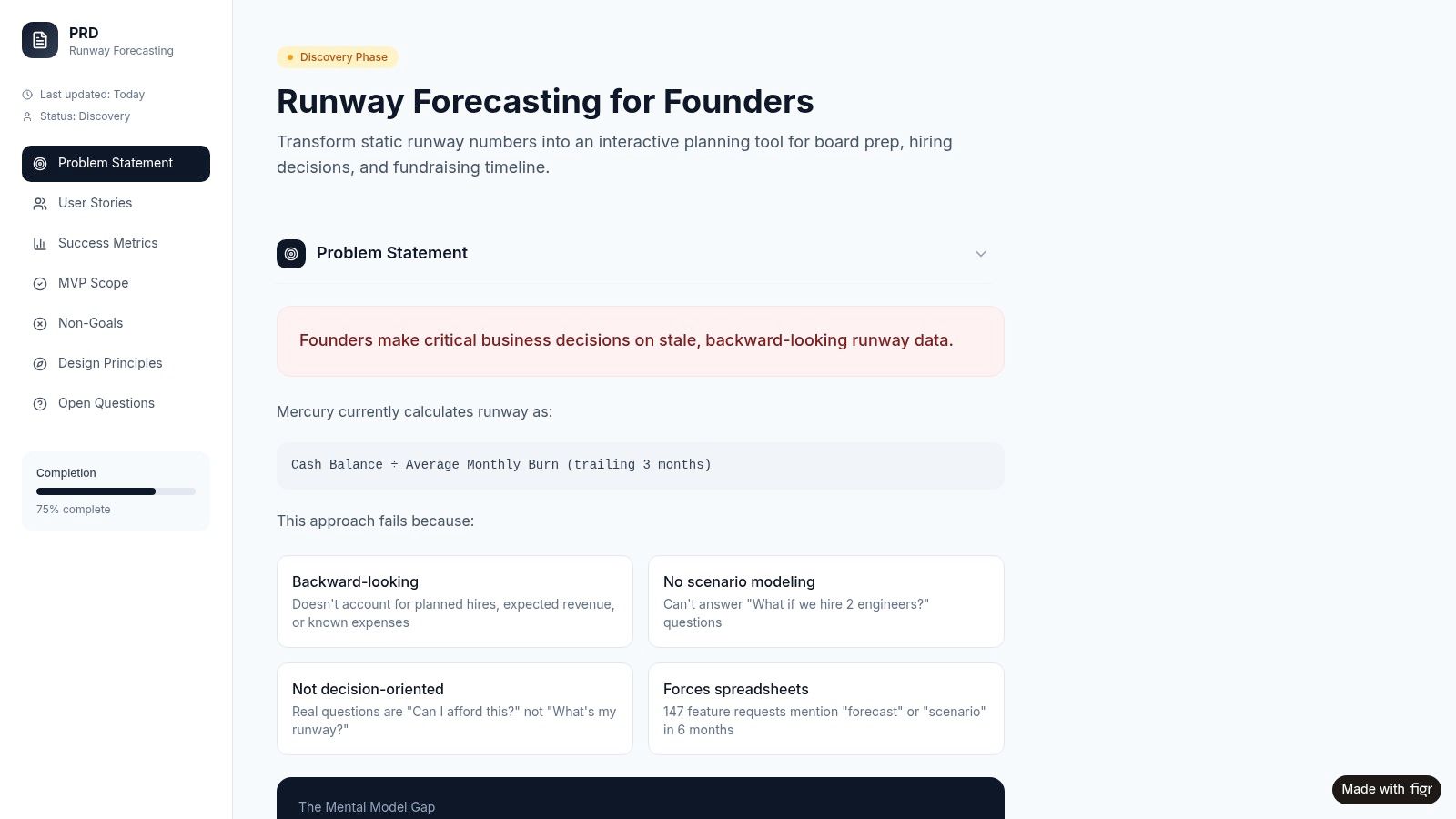
What stands out in good examples?
- The opening is fast to parse, so a busy engineer can get the gist without digging.
- The logic is visible, meaning you can trace requirements back to user or business intent.
- The edges are named, especially assumptions, dependencies, and exclusions.
- The supporting artifacts are connected, rather than scattered across ten tools with no narrative thread.
The difference between a template and a starting point
A lot of PMs search for a prd document template when what they really need is a better way to think. Templates help, but only if they force better questions. Otherwise they produce immaculate junk.
A useful PRD template should help you surface decisions, not just fill space. If your current template has sections your team never reads and lacks the one section that repeatedly saves you from chaos, change the template. Process should serve delivery.
Good examples don't give you wording to copy. They show you what clarity feels like.
If you want to compress the path from document to execution, this workflow on from PRD to prototype in 2 hours the workflow that changed how I ship is useful because it keeps the spec tied to something testable.
A practical reading method
When reviewing any PRD example, ask three blunt questions:
- Can I explain the problem after reading only the first section?
- Could engineering challenge this intelligently without opening six other docs?
- If scope pressure hits, does the document tell me what to protect first?
If the answer is no, the format isn't the problem. The thinking is.
Beyond the Static Page The Living PRD Workflow
Monday morning, engineering starts building from the PRD, design is working from a newer prototype, and analytics is tracking a funnel nobody linked in the spec. By Wednesday, people are saying the PRD is stale. Usually that means the document was never part of the workflow in the first place.
A PRD fails when it sits off to the side while the actual product conversation happens across folders, dashboards, tickets, and mockups. Research lives in one tool. Flows live in another. Analytics stays trapped in dashboards only a few people open. Prototypes keep changing. Then the team blames the document for being out of date, when the underlying problem is that nobody designed a system that keeps evidence, decisions, and implementation tied together.
The teams that get value from documentation treat the PRD as one artifact in a connected operating system. Marty Cagan's Inspired argued for shared understanding over document theater years ago, and that point still holds. The page matters less than the connections around it. If the PRD is not attached to discovery, decisions, and delivery, it becomes a stale summary the minute someone ships a new design.
Connect the PRD to how users move
A useful spec gets stronger when it is anchored to behavior. Pull in the evidence that changes decisions. Leave out the dashboard spam.
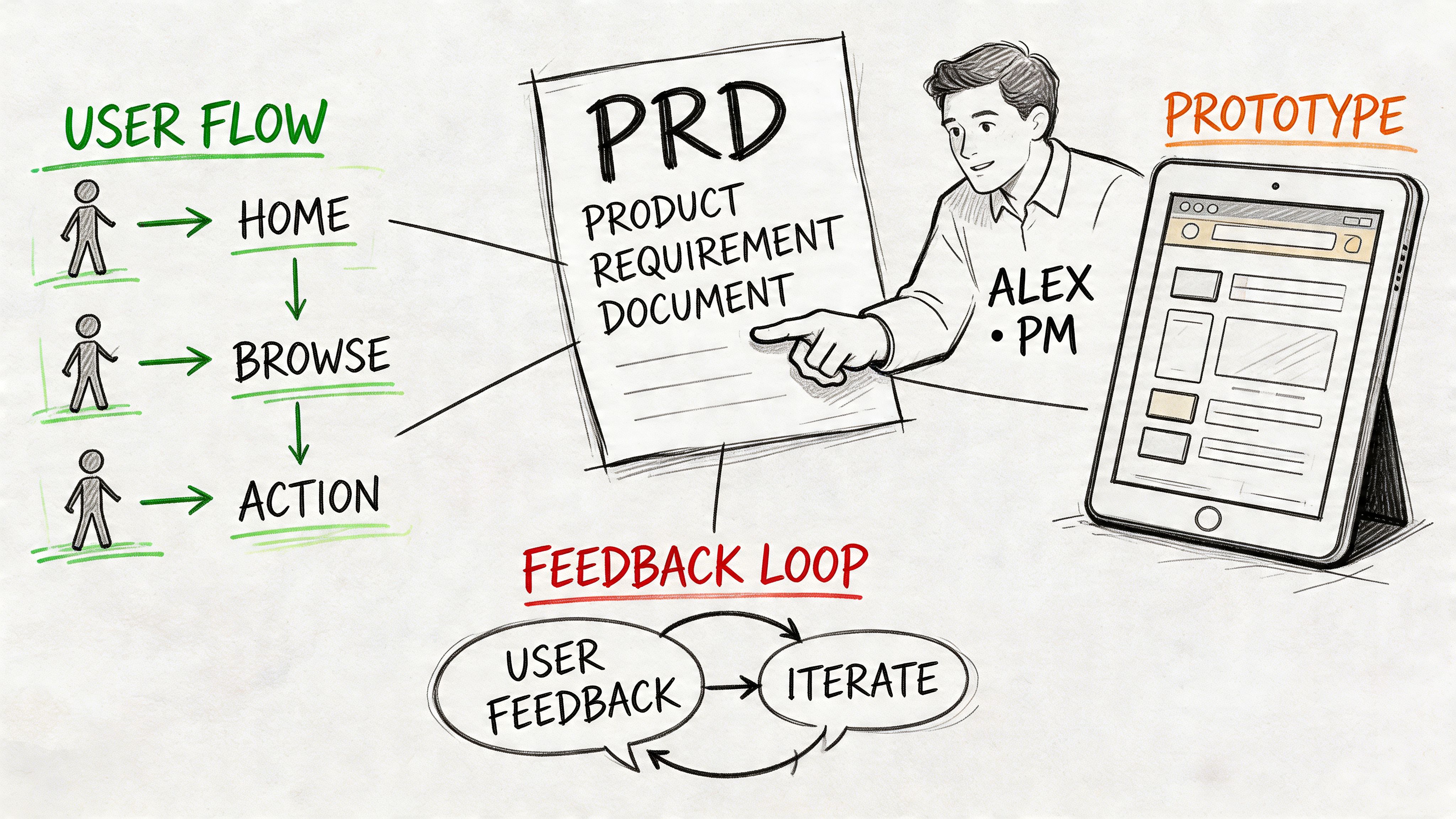
If the document covers a checkout improvement, it should connect to the relevant digital customer journeys, the critical user flow examples, and the underlying user experience flows. Once those artifacts support the same story, trade-off discussions change shape. Engineers can challenge the requirement against real friction points. Design can test alternate paths. Stakeholders have a harder time arguing from anecdotes.
Why static PRDs miss edge cases
Late edge cases are usually a workflow failure, not a writing failure.
They show up in QA or after launch because the PRD was drafted from memory, stakeholder requests, and a clean happy-path mockup. Meanwhile, the messy parts of the product were sitting in support tickets, funnel drop-offs, session recordings, and old implementation notes. A static document cannot protect the team from information it never absorbed.
Good teams solve this by treating the PRD as a current decision layer. Core requirements stay in the doc. Supporting signals stay linked to it. When evidence changes, the requirement changes with it. The document gets shorter in some places and sharper in others.
The best PRDs do not grow by accumulation. They improve by staying tied to the latest evidence.
Where newer tools fit
A newer layer of tooling helps with this maintenance problem. Some teams use AI assistants for product documentation to gather context from research, analytics, and design systems instead of asking a PM to manually stitch everything together every time the spec changes. Others use broader AI tools for product strategy documents earlier in discovery, before requirements are ready to lock.
Figr is one product in that category. It generates PRD documents from product context by ingesting a live web app, analytics, and research, then structuring a PRD around how the product works. The useful part is not speed alone. It is the tighter connection between the spec, the user flow, and the prototype, which reduces the usual drift between what was written and what gets built.
Teams should still be skeptical. Automation can produce polished nonsense if the inputs are weak or the tool hides assumptions. A good buying process starts with criteria, not demos. This framework for evaluating AI tools that automate product documentation, PRDs, and internal knowledge is a better filter than vendor claims.
A workflow that holds up
The pattern is simple, even if the discipline is not:
- Start from the problem and observed behavior, not from a blank template.
- Link each requirement to the relevant flow, so intent and interaction stay connected.
- Revise assumptions when evidence changes, instead of leaving stale language in place.
- Keep one current source of truth, then point outward to deeper detail only when needed.
That is the shift. The PRD stops being a bureaucratic artifact and becomes shared working memory for the team. Engineers use documents like that because they reduce guesswork, surface trade-offs early, and keep the same argument from restarting every week.
The Art of the PRD Review
Writing the doc is half the job. The rest is getting people to engage with it before the expensive misunderstandings begin.
Too many PRD reviews are staged like approval rituals. A PM presents. Everyone scans the page. A few comments appear about wording. The meeting ends with vague agreement, and actual objections emerge later in Slack or during implementation. That review wasn't alignment. It was theater.
Run the review as a problem-solving session
The best review is not “please read my document.” It's “help us pressure-test this decision frame.”
Invite the people who will either shape the solution or inherit the consequences: engineering lead, design lead, relevant data or QA partner, and the stakeholder who can settle a business trade-off. Skip the audience that only wants status. Bigger rooms create softer feedback.
Then ask direct questions:
- What here feels under-specified for build confidence
- What requirement creates the most technical ambiguity
- What assumption is least trustworthy
- What would you cut first if timing gets tight
- What edge case is most likely to surprise us
Those questions get you out of passive review mode. They pull hidden concerns into the open while the document is still cheap to change.
Reviews fail when people are asked, “Any thoughts?” Reviews work when people are asked to challenge specific assumptions.
Use evolving sections in hybrid environments
A lot of teams don't work in pure Agile, no matter what the ceremonies say. They operate in a hybrid world where some functions need upfront clarity while product and engineering still learn as they go.
That is not a niche case. A common challenge is adapting PRDs for hybrid Agile-Waterfall environments, a reality for 70% of software projects. Atlassian's 2024 survey found that hybrid PRDs with evolving sections for MVP priorities can reduce rework by 35%, as summarized by Leanware.
That finding matches what many product leaders see in practice. Some parts of the doc should be stable early, such as problem, constraints, dependencies, and release boundaries. Other parts should remain explicitly flexible, such as deferred features, open questions, and assumptions under validation.
What works better than sign-off theater
If you want a review process engineers respect, use this cadence:
Pre-read for core participants
Ask for comments on risk, ambiguity, and missing context, not copy edits.Live session for contested decisions
Spend the meeting on trade-offs, not on reading the document aloud.Written resolution afterward
Update the PRD with decisions made, owners assigned, and unresolved items named.
A review should leave the team with fewer open loops than it started with. If it doesn't, the ritual is broken.
A Pact Not a Prescription
The PRD usually gets tested the moment reality stops matching the plan. A dependency slips. Sales brings in a customer request nobody accounted for. Engineering finds an ugly edge case halfway through implementation. In that moment, a useful document settles the argument fast. A useless one sends everyone back to Slack to reconstruct what they thought they agreed to.
A good PRD works as a pact between product, design, and engineering. It records the problem, the user, the boundary, and the bar for success in language the team can effectively use under pressure. It does not need to predict every turn. It needs to hold up when context is fragmented, memory is selective, and every function is optimizing for something slightly different.
That balance is harder than it sounds.
A rigid spec goes stale the first time the team learns something important. A loose spec invites each function to fill in the gaps with its own assumptions. The practical middle ground is firm intent with named uncertainty. Be clear about what is decided, what is still open, and who will resolve it. That is the version engineers come back to, because it helps them make decisions instead of forcing them to guess what product meant three weeks ago.
AI can help here, but only if you use it for the boring parts and keep human judgment on the hard ones. Let it help draft the first pass, pull in existing context, and expose missing sections. Do not let it fake alignment. A polished document that no one argued through is still a bad PRD.
What to do next
Pull up your last PRD and sit down with your lead engineer for thirty minutes.
Ask a single question: what created the most confusion once work started? Then stop talking. Do not explain your intent. Do not defend the wording. Listen for the place where the document failed to carry shared understanding.
That answer will teach more than another checklist.
If your team is tired of writing specs from scratch and then watching them drift from the product, Figr is worth a look. It helps teams generate PRDs, flows, prototypes, and related artifacts from real product context, so the document starts closer to reality and stays connected to the work around it.