

It’s 9 PM on a Tuesday. You're staring at a spreadsheet that has become a monster. It started as a simple feature request tracker but now it's a tangled web of user feedback from Intercom, feature ideas from Slack, sales team pleas from Salesforce, and half-formed hypotheses from the last leadership offsite. You’re trying to connect a customer’s pain, expressed three months ago, to a line item on the Q3 roadmap. The links are broken, the context is gone, and your confidence in the plan is fading.
This is the moment of Strategy-to-System Mismatch.
This is what I mean: great product management isn't just about having good ideas. It's about building a system of record for your strategy. It requires a central hub where customer needs, business goals, and development capacity can meet and make sense. Without it, product teams operate on stale information and gut feelings, leading to feature-factory behavior instead of value creation. This is precisely the problem a dedicated product management platform like productboard is designed to solve.
This article provides a deep dive into productboard, exploring its core features, pricing, and strategic use cases. We'll analyze its strengths in consolidating feedback and building data-backed roadmaps. More importantly, we’ll then critically examine seven of the best productboard alternatives for 2026: Jira Product Discovery, Aha! Roadmaps, airfocus, and others. For each platform, you’ll find a breakdown of its ideal user, tactical strengths, and specific scenarios where it might serve you better. The goal is to move you from spreadsheet chaos to strategic clarity.
What is Productboard?
Productboard is a dedicated product management platform that helps teams understand what customers need, decide what to build next, and align everyone around the roadmap. Think of it as a central nervous system for your product organization. It connects unstructured feedback from sources like email, Intercom, and Zendesk to structured feature ideas and roadmap initiatives.
A friend at a Series C company told me their "aha" moment with productboard was when they could finally answer a CEO's question, "Why are we building this feature?" by showing a single view linking the roadmap item directly to 50 customer requests and $200k in ARR from the sales pipeline. That's the power it promises: a single source of truth that defends your strategy with data.
But is it the right tool for every team?
Productboard Features
Productboard's ecosystem is built on a few core pillars.
Centralized Insights: This is the heart of the platform. It aggregates feedback from countless sources, like Zendesk, Slack, email, and Intercom, into a single "Insights" inbox. PMs can then highlight key pieces of feedback and link them directly to feature ideas.
Prioritization Frameworks: The platform helps you move from a pile of ideas to a ranked list. You can score features based on value vs. effort, or create custom drivers and scores that align with your company's OKRs. This is a practical application of frameworks like an action priority matrix.
Dynamic Roadmapping: Build and share tailored roadmaps for different audiences. You can create a high-level, theme-based roadmap for executives and a more granular, feature-based timeline for the development team.
Customer Portal: A dedicated portal where you can share what you’re working on, validate ideas with key customers, and gather new feedback directly, closing the loop between user needs and product strategy.
Productboard Pricing
Productboard’s pricing model can feel complex, with multiple tiers and add-ons. As of early 2026, the structure is generally as follows:
Essentials: A basic plan for individuals or small teams just starting out.
Pro: Designed for growing teams, this plan unlocks more integrations and advanced roadmapping features.
Scale: Aimed at larger organizations, offering features like objectives-based roadmaps, custom fields, and more robust integrations.
Enterprise: A custom plan for large corporations needing advanced security, dedicated support, and portfolio management capabilities.
The pricing is primarily per "maker" (i.e., product managers, designers), with more limited and often free access for "contributors" and "viewers." This productboard pricing model encourages collaboration but can become costly as the number of "makers" on your team grows.
Productboard Pros and Cons
So, what’s the verdict on this productboard review?
Pros:
Excellent Feedback Consolidation: Its ability to unify customer feedback from disparate sources is arguably best-in-class.
Strong User-Centric Focus: The entire workflow is designed to tie development work back to specific user needs.
Flexible Roadmapping: The ability to create multiple, audience-specific roadmap views is a powerful communication tool.
Cons:
Cost at Scale: The per-maker pricing can become a significant expense for larger product organizations.
The Handoff Problem: The connection between productboard vs Jira can sometimes feel like a one-way street. While you can push features to Jira, keeping the two systems in perfect sync requires disciplined effort. This is a classic challenge when comparing roadmap tools vs prototyping tools.
Can Reinforce Silos: If not implemented carefully, it can become another silo that design and engineering feel disconnected from, especially when it comes to the tangible aspects of user experience and flow.
This brings us to a critical zoom-out moment. The economics of software tools often incentivize platform lock-in. A tool wants to be the center of your universe. However, the reality of product development is a network of specialized tasks: feedback analysis, strategic prioritization, UI/UX design, and engineering delivery. The most effective teams don't find one tool to rule them all. Instead, they build a 'toolchain' with clean handoffs.
This is where exploring a productboard alternative becomes a strategic exercise, not just a feature comparison.
Top 7 Productboard Alternatives in 2026
1. Jira Product Discovery (Atlassian)
For teams already breathing Atlassian air, the friction of adding another, separate tool for discovery can feel like a tax on momentum. You’ve got ideas in Confluence, tickets in Jira Service Management, and delivery epics in Jira Software. Jira Product Discovery was built to fill that gap.
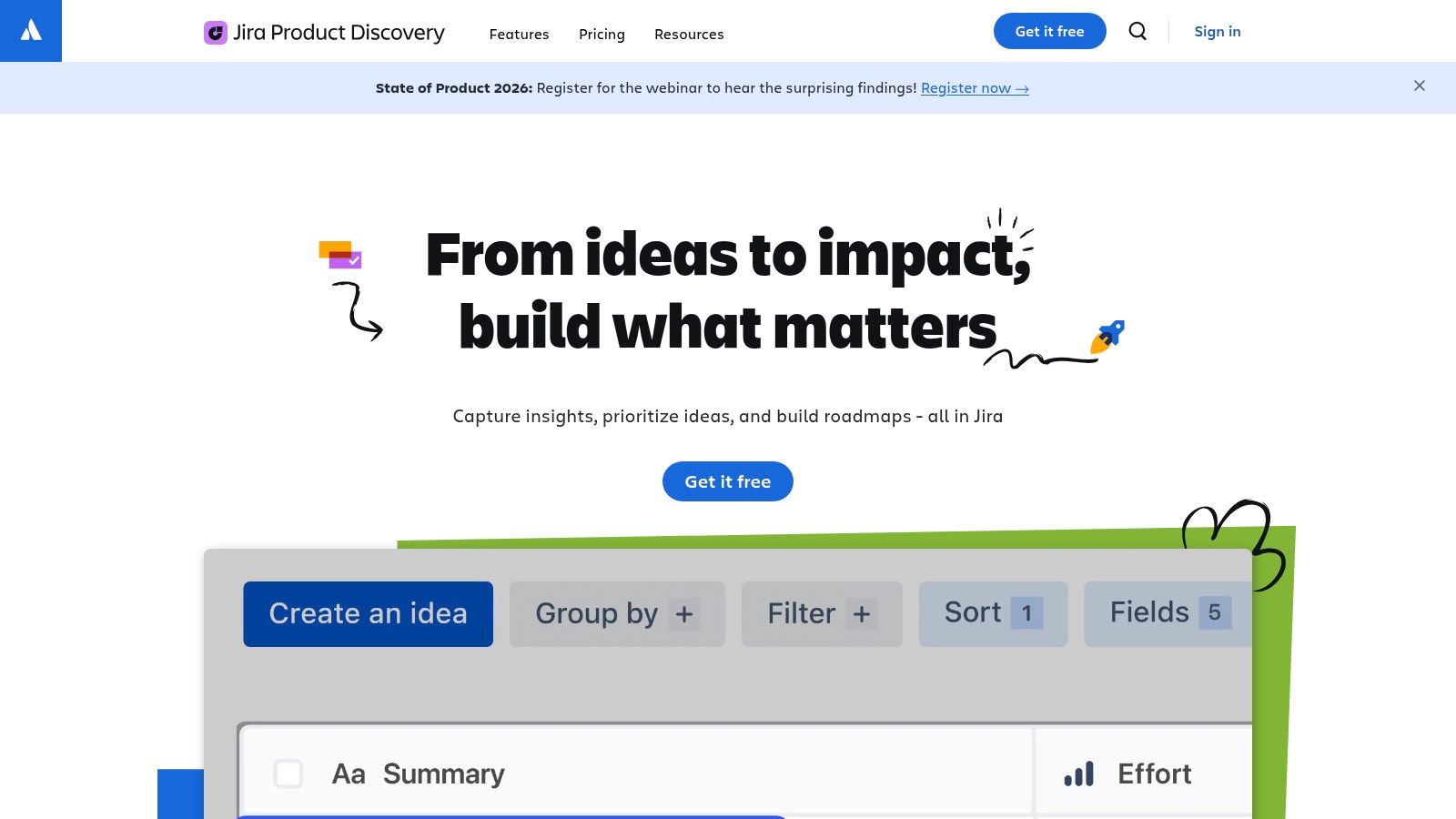
Why it’s a strong Productboard alternative: Its core value is its seamless integration. An idea in Product Discovery can be linked to customer feedback, fleshed out in Confluence, and then converted into a Jira epic with a single click. This creates a traceable path from concept to code, a core tenet of modern product management best practices.
Ideal for: Teams heavily invested in the Atlassian ecosystem.
Pricing: A free tier for up to 3 creators and a Standard plan at $10/creator/month. Unlimited free contributors.
Key Advantage: Lowest possible friction for Jira shops.
2. Aha! Roadmaps
If Jira is the native answer, Aha! Roadmaps is the enterprise-grade command center. It’s built for complexity. Where productboard excels at connecting feedback to features, Aha! connects those features to overarching strategic goals, initiatives, and multi-product portfolios.
Why it’s a strong Productboard alternative: Its philosophy is top-down strategic clarity. You define your company vision and goals first, then build roadmaps that directly support them. Its powerful reporting is designed for C-suite visibility across multiple products, making it a great choice for creating artifacts detailed in a product roadmap guide.
Ideal for: Large organizations managing multiple product lines that require cross-team dependency management.
Pricing: Starts at $59/user/month, positioning it as a premium, professional suite.
Key Advantage: Unmatched for portfolio-level strategic planning and executive reporting.
Visit Aha! Roadmaps
3. airfocus
Where some platforms feel like rigid filing cabinets, airfocus presents itself as a set of modular building blocks. It’s designed for teams who refuse to be forced into a one-size-fits-all workflow. This flexibility is its core identity.
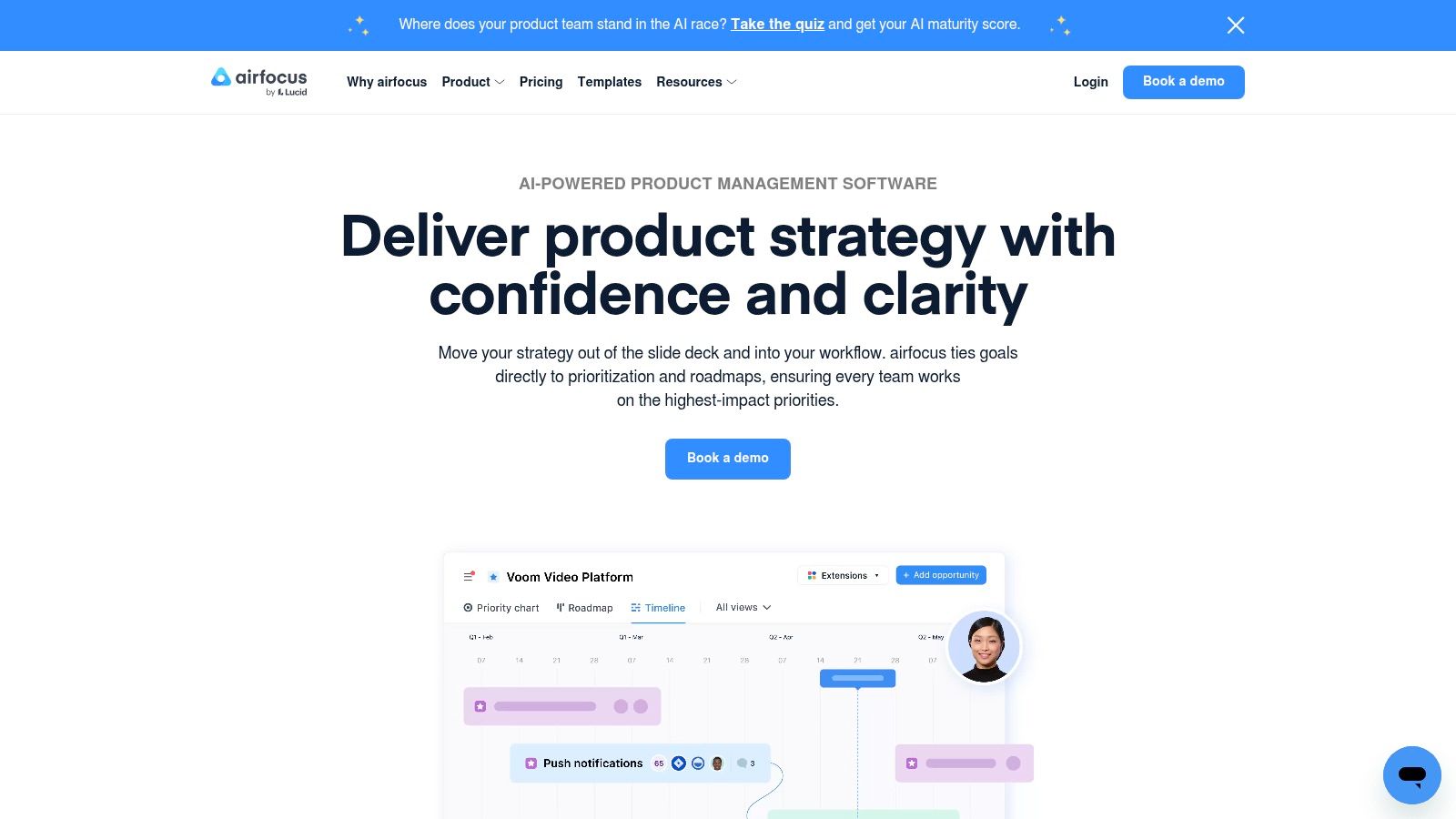
Why it’s a strong Productboard alternative: Its adaptability is its main strength. You can define your own product hierarchy and create custom prioritization scoring. The platform's emphasis on security, with SOC 2 Type II and ISO 27001 certifications, makes it a compelling choice for finance, healthcare, and other regulated industries. This is a level up from basic scoring, enabling teams to even explore AI tools for product feature prioritization.
Ideal for: Product teams in regulated industries or those needing highly customizable prioritization models.
Pricing: Sales-led, requiring a demo for a quote. This is common for enterprise-focused tools.
Key Advantage: High flexibility combined with enterprise-grade security and compliance.
4. Craft.io
Craft.io aims to be a unified workspace, a single pane of glass bridging discovery, feedback, prioritization, and planning. It’s an all-in-one platform competing with productboard by offering a similarly broad feature set but with its own philosophy on collaboration.
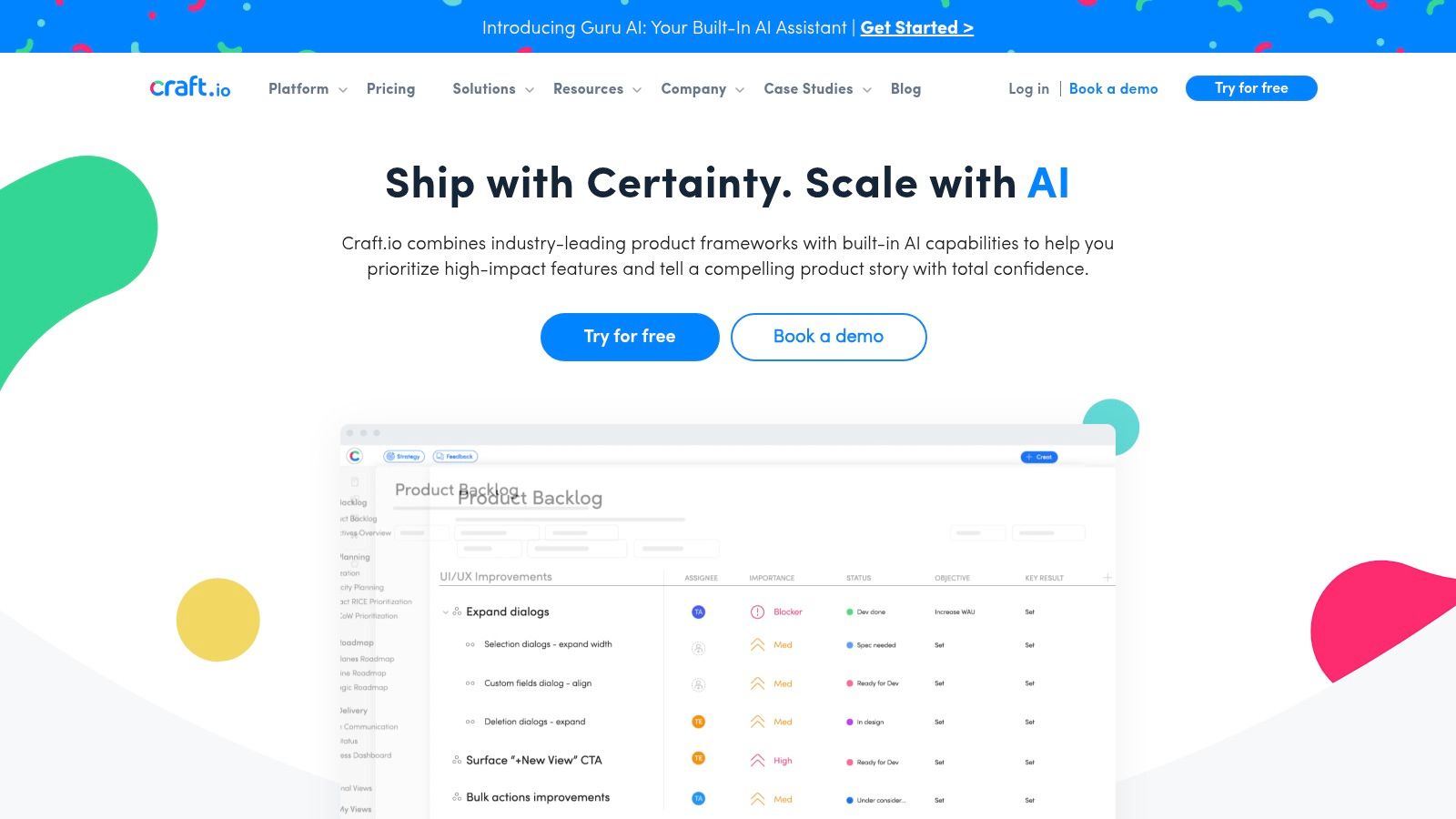
Why it’s a strong Productboard alternative: It provides a structured environment for the entire product lifecycle, combining a feedback portal, story mapping, and a robust prioritization engine. This means a PM can capture an idea, validate it, break it down visually, and spec it out, all in one place—a critical step before learning how to write a PRD.
Ideal for: Teams seeking a single source of truth with strong story mapping and planning tools.
Pricing: Built around a per-editor model. The Pro and Enterprise plans include unlimited free "Contributors."
Key Advantage: Cost-effective collaboration model and a broad, integrated feature set.
5. ProdPad
If productboard is a structured blueprint, ProdPad is the creative sandbox. It’s built around discovery first, delivery second. It nudges you to collect messy, unstructured feedback and ideas first, then guides you toward connecting them to concrete business outcomes.
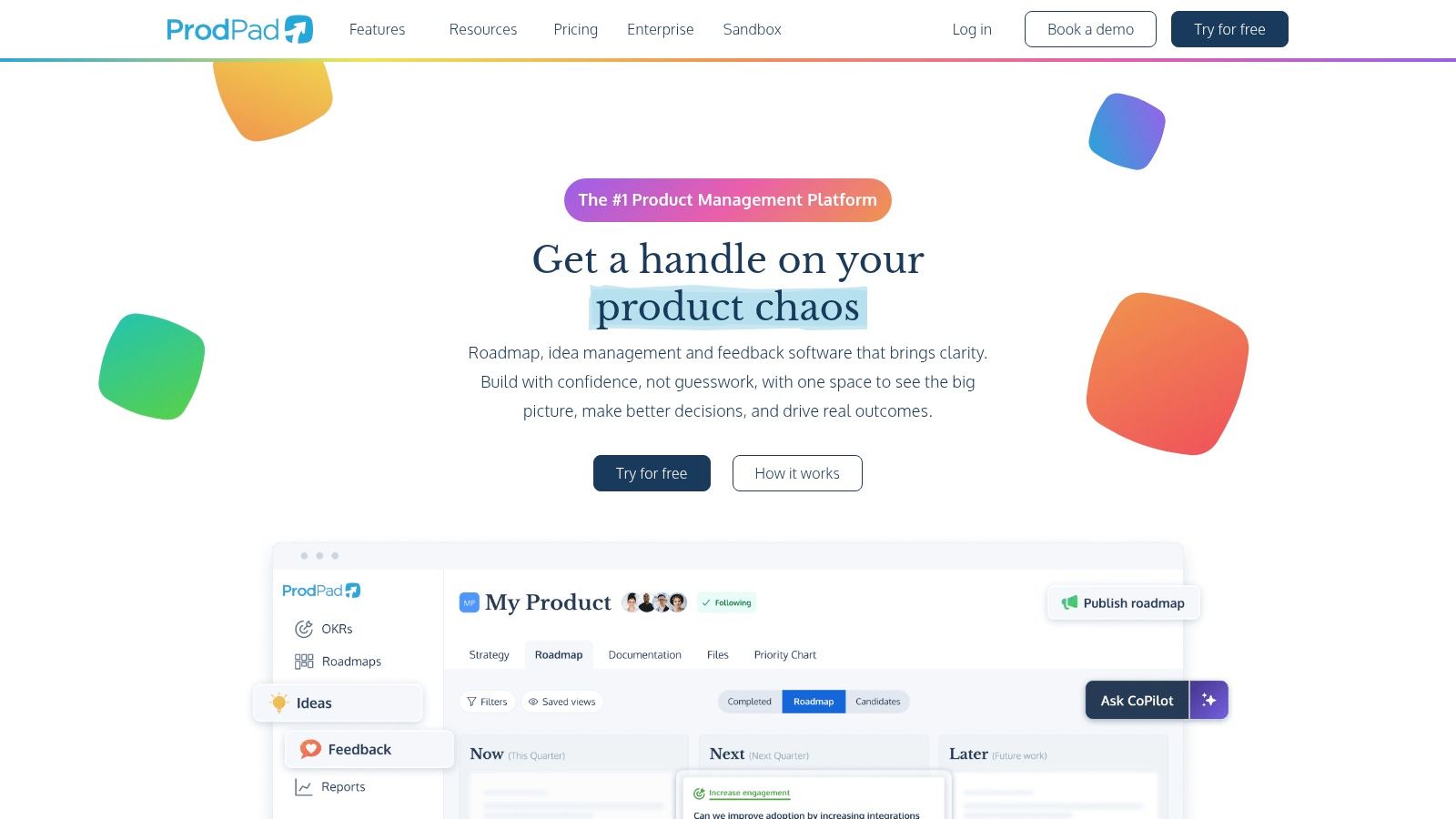
Why it’s a strong Productboard alternative: It separates the "idea space" from the "delivery space." ProdPad encourages a continuous flow of input without immediately cluttering the backlog. This methodology is a strong fit for organizations trying to shift from a feature-factory mindset to an outcome-driven one, a common challenge in managing product backlogs and design tasks.
Ideal for: Teams focused on shifting to an outcome-driven, discovery-centric culture.
Pricing: Custom, modular pricing requiring a sales conversation.
Key Advantage: Strong discovery workflows and an emphasis on lean, outcome-based roadmaps.
6. ProductPlan
ProductPlan makes a focused bet on the power of a perfectly communicated roadmap. It operates on the principle that alignment is the highest leverage activity a product manager can perform. It’s a specialist tool for visual strategy and high-stakes communication.
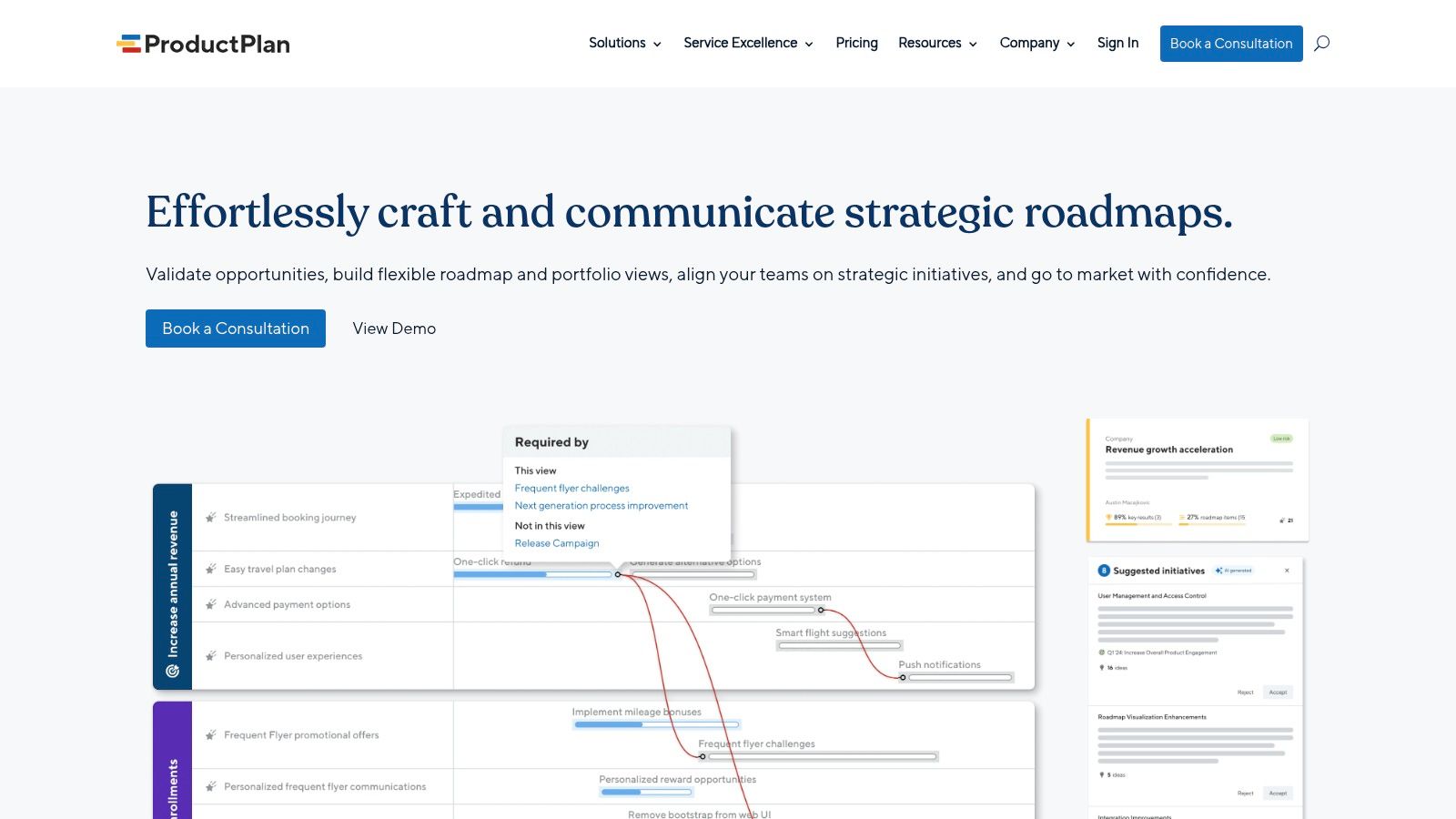
Why it’s a strong Productboard alternative: Its core strength is creating tailored, presentation-ready roadmaps that speak the language of each specific audience. Last week I watched a PM use it to create three views of the same roadmap in under five minutes: one for execs (themes and OKRs), one for sales (launch dates and key benefits), and one for engineering (initiatives and dependencies). That’s its magic.
Ideal for: Product managers who need to create stunning, easily understood roadmaps for stakeholder alignment.
Pricing: Sales-led, with unlimited free viewers included in all plans.
Key Advantage: Best-in-class visual communication and roadmap presentation.
7. Figr
While the previous tools focus heavily on the "what" and "why," Figr tackles the critical handoff to the "how." It's not a direct competitor for feedback management but a powerful, complementary tool that picks up where productboard leaves off.
Why it’s a unique Productboard alternative: While Productboard focuses on roadmap prioritization and feedback management, Figr picks up where Productboard ends: turning prioritized features into interactive prototypes and PRDs grounded in your actual product context. It excels at visualizing complex user flow examples and user experience flows, bridging the gap between a feature on a roadmap and an experience in the user's hands. For instance, you could take a prioritized item from Productboard and immediately map its entire flow in Figr, from PRD to final UI, as seen in this Mercury PRD to UI example. This helps clarify requirements for design and engineering in a way a static roadmap cannot. It focuses on crafting better digital customer journeys.
Ideal for: Teams who have their priorities set but struggle with translating them into clear, actionable design and engineering specs.
Pricing: Offers a free tier and team plans that are accessible for startups and enterprises alike.
Key Advantage: Seamlessly connects prioritized features to interactive flows and developer-ready documentation.
A Grounded Takeaway: How to Choose
The basic gist is this: selecting a tool is an act of strategy. It’s a declaration of what part of your process you intend to fix first. Don't fall into the trap of a feature-by-feature comparison without context.
Your next step should be a diagnosis.
Map your current process. Where does information get lost? Is it between customer support and product? Between product and design? Between design and engineering?
Identify your biggest pain point. Are you drowning in feedback? Are your roadmaps ignored? Do developers constantly ask for clarification?
Pilot a solution for that specific pain. Choose the tool that most directly addresses your primary bottleneck. Run a small, time-boxed experiment with one initiative.
The goal isn't to find a perfect tool. It’s to find the right lever to pull that will make your team more aligned, effective, and ultimately, more customer-focused. A 2018 study in the Journal of Product Innovation Management by C. H. Loch et al. found that formal product development processes significantly correlate with project success, but only when they are adapted to the organization's context. The tool you choose is the embodiment of that process.
In short, the right platform won't invent a great product strategy for you, but it can clear away the administrative fog, giving you the focus and clarity needed to build one yourself.
For a deeper dive into the principles behind these decisions, it's worth understanding the core tenets of modern product work. For the complete framework on this topic, see our guide to product management best practices.
Once your priorities are set in a tool like productboard, the next challenge is translating that "what" and "why" into a tangible "how" for your design and development teams. Figr is purpose-built for this exact handoff, helping you move from a prioritized feature idea to a fully-realized PRD and interactive user flow, all grounded in your product's real UI.