It’s 11:42 p.m. A PM has marked the feature “ready.” The designer has shared the final file. Then an engineer drops a message into Slack: what happens on timeout, empty state, permission error, partial save, mobile overflow, loading retry, and keyboard navigation?
That’s the moment a product design engineer becomes visible, usually by their absence.
I’ve watched this play out more times than I can count. Nobody is failing individually. The PM isn’t careless. The designer isn’t vague. The engineer isn’t being difficult. The team is hitting a structural gap between design intent and production reality. And once that gap opens, everyone starts doing reactive work.
That gap has a name. I call it design-to-dev friction.
It shows up as ambiguity disguised as alignment. A prototype looks polished, but the behavior model is incomplete. The handoff looks clean, but the system underneath hasn’t been translated. What gets missed? Usually the exact things users hit first.
The Ghost in the Prototype
Late-night handoff threads have a certain tone. You can feel the confidence draining out of the room line by line. Someone says the design is final. Someone else points out that “final” only covers the happy path. A third person asks whether the state logic exists anywhere besides the designer’s head.
That ghost in the prototype is missing behavior.
A static screen can hide a lot. Error recovery. Permissions. latency. Conditional rendering. The weird branch where one user has data and another doesn’t. Teams often discover these gaps after build has started, when changing direction costs more attention, more trust, and more time. If you’ve ever shipped a feature that looked elegant in review and awkward in production, you know the feeling.
One of the fastest ways to see this problem is to study the kinds of conditions product teams routinely overlook in 10 edge cases every PM misses and why they cost 50-100x more after launch. Not because PMs are weak. Because modern products have too many state transitions for a linear document or a polished mockup to hold by itself.
Why this friction keeps repeating
The root issue isn’t handoff etiquette. It’s role design.
Work is often still split into neat boxes. Product defines requirements. Design shapes experience. Engineering implements. On paper, that sounds efficient. In practice, the seams between those boxes are where costly ambiguity collects.
Practical rule: If your team discovers interaction logic mainly during implementation, you don’t have an execution problem. You have a translation problem.
A product design engineer closes that translation gap. Not by replacing a designer or an engineer, but by making the interface between them explicit, testable, and operational. They care about fidelity in a way often articulated as important, but not typically backed by staffing.
What changes when the gap has an owner
A strong hybrid operator does something subtle but powerful. They convert visual intent into behavioral truth before build gets expensive. That means the prototype isn’t just persuasive. It’s inspectable. It can answer the annoying questions early.
Can this component handle long data?
Does this flow survive interruption?
Will the design system token hold up in code?
Are we treating accessibility as a principle or as cleanup?
That’s why the rise of the product design engineer role matters. It’s not a trend title. It’s a response to a bottleneck that product teams have normalized for too long.
The System Thinker in the Middle
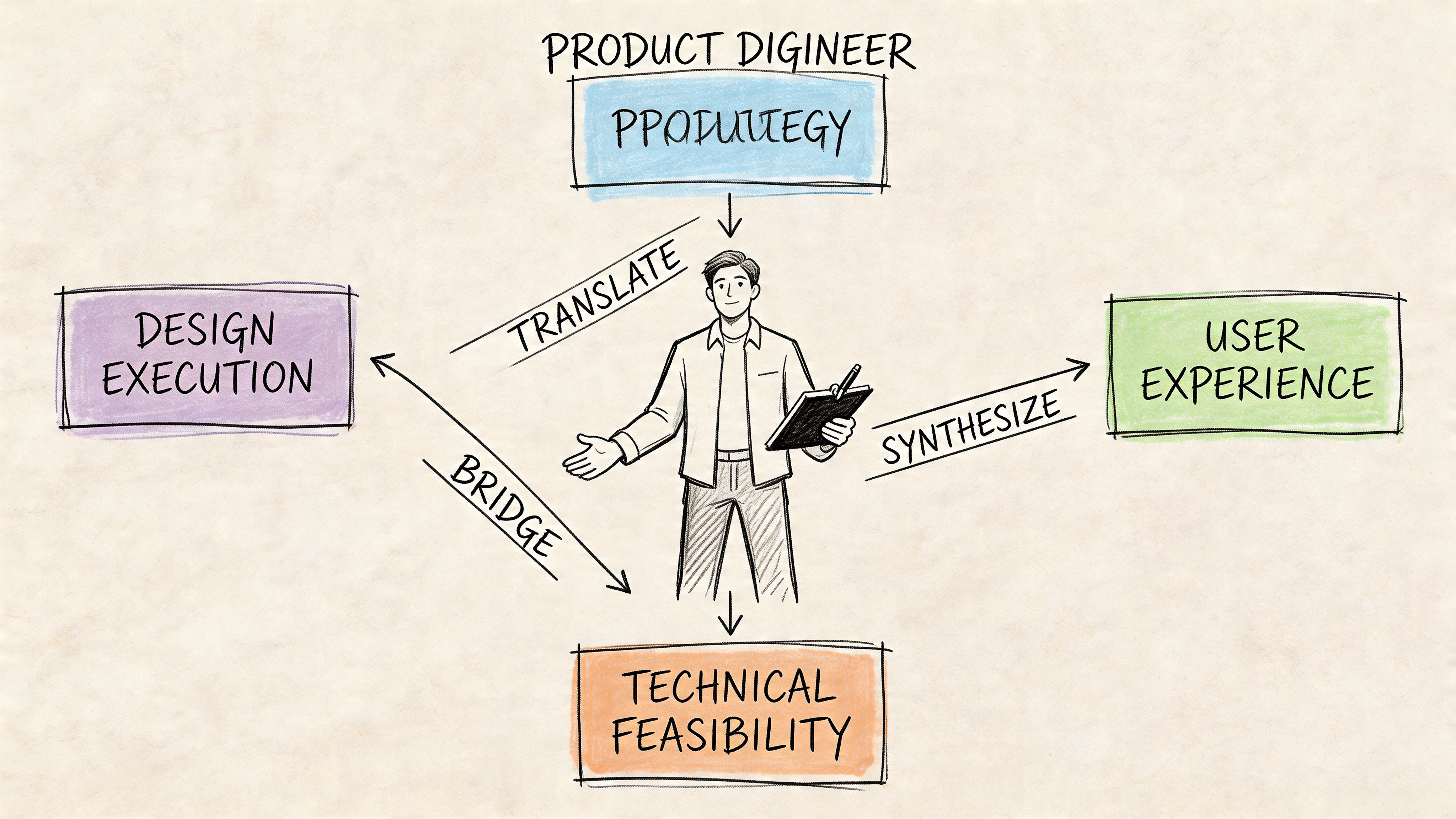
The cleanest definition I know is this: a product design engineer role exists to manage the seams. Not the glossy center of the process, and not the deepest implementation layer. The seams, where user intent meets component logic, where design quality meets technical feasibility, and where speed usually breaks down.
A friend at a Series C company calls these people “friction absorbers.” I like that. They don’t just make prototypes or write front-end code. They reduce the number of interpretation steps between idea and shipped experience.
A role with older roots than most teams realize
This isn’t some sudden software invention. The engineering design graphics profession, central to this kind of work, traces back over 6,000 years, and its modern internationalization had already surged by 2005, when 59% of firms were engaged in global product design. The main pressures were cost at 79%, competition at 58%, and skills gaps at 49%, while post-1979 work in Design Studies helped push the field toward more human-centered thinking, as documented in the Engineering Design Graphics Journal.
That matters because it reframes the role. The product design engineer isn’t an odd hybrid born from startup chaos. They’re the current expression of a much older economic need: someone has to carry intent across systems without losing precision.
For software teams, that same problem shows up in state management, component behavior, accessibility, and implementation detail. If you’ve mapped a feature using a system context diagram example, you’ve already seen why this middle layer matters. Every product decision lives inside dependencies, constraints, and side effects.
The business reason the role keeps surfacing
When leaders say they want to move faster, what they usually mean is they want fewer loops of reinterpretation.
That’s the zoom-out.
The pressure isn’t just creative. It’s economic. More stakeholders, more platforms, more edge cases, more global collaboration, more shipping pressure. Teams don’t slow down because they lack talent. They slow down because design intent gets re-explained too many times before it becomes real.
The teams that win aren’t always the ones with the most specialists. They’re often the ones that lose the least meaning between specialties.
This is what I mean when I say the product design engineer is a systems role. Their value doesn’t sit in one artifact. It compounds across decisions. A better prototype changes a roadmap conversation. A stronger component model changes engineering estimation. A clearer interaction contract changes QA outcomes.
That’s not “someone who does two jobs.” It’s someone who prevents three teams from doing the same job twice.
The Anatomy of a Product Design Engineer
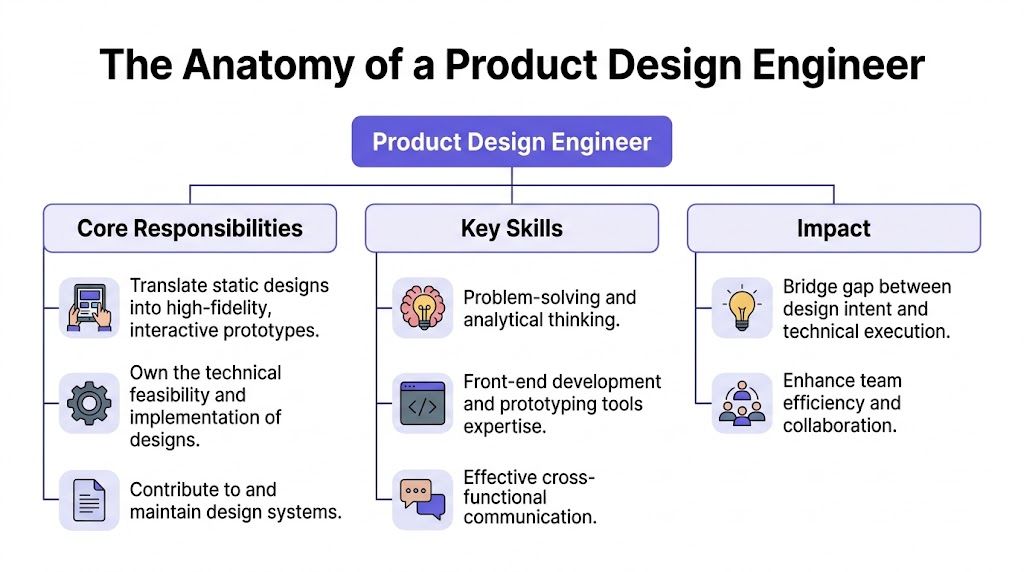
On a typical week, a product design engineer moves between three kinds of work. They make ideas testable, they make systems usable, and they make implementation safer. If that sounds broad, it is. But the work is more concrete than many teams assume.
They turn static intent into living behavior
The first responsibility is prototype fidelity. Not visual polish alone, but behavioral accuracy. A product design engineer often takes a flow that exists as static screens and turns it into an interactive model that exposes dependencies, transitions, and failure states.
That changes the quality of review. Stakeholders stop reacting to pixels and start reacting to behavior. Engineers can test assumptions earlier. PMs can spot requirement gaps without waiting for implementation.
CAD-like principles, applied in code and high-fidelity prototyping, can significantly reduce prototyping rework. In manufacturing contexts, this kind of workflow has been associated with a 40% reduction in rework, according to Freelancermap’s write-up on product design engineers. Software teams shouldn’t copy that claim blindly into every context, but the principle holds: the closer your prototype gets to real behavior, the fewer surprises survive into build.
They operate inside the design system, not outside it
A lot of teams still treat the design system as a library owned by design and consumed by engineering. That split is one reason systems drift.
The product design engineer usually works closer to the component boundary. They help define how a component behaves in code, how variants map to real use cases, and where the abstraction breaks. That might mean maintaining Storybook entries, building React components, or catching where a token works in Figma but fails under production constraints.
Some of the strongest product design engineer skills are less glamorous than people expect:
- Interaction modeling: mapping not just screens, but state changes and user consequences.
- Component judgment: knowing when a pattern belongs in the system and when it should stay local.
- Front-end fluency: enough code depth to prototype credibly and collaborate with engineers without hand-waving.
- Research translation: turning user evidence into implementation decisions. If your team needs a sharper foundation here, this guide to essential user research methods is worth keeping close.
- Constraint communication: explaining tradeoffs early, before they become deadline drama.
They de-risk ideas before the roadmap hardens
The third responsibility is advisory. Good product design engineers get involved before a feature is fully shaped. They can look at a concept and say, “This interaction is elegant, but the state model is unstable,” or “This can work if we simplify the variant logic.”
That’s very different from saying no.
It’s saying yes with structure.
For teams trying to understand what that impact looks like in practice, The 100x designer is a useful framing device. Not because one person magically does everything, but because a few people know how to collapse ambiguity at exactly the right points in the workflow.
A product design engineer earns trust by making risk visible while it’s still cheap to change.
In short, product design engineering is the discipline of carrying experience quality across the last mile into implementation. It’s not just prototyping. It’s preemptive clarity.
And because these people often shape flows before they solidify, they need to think in user movement, not just UI fragments. That’s why strong practitioners spend time with user flow examples, study user experience flows, and trace the broader digital customer journeys their components live inside.
Distinguishing the Hybrids From the Specialists
The confusion around design engineer vs product designer usually starts with titles and ends with politics. One team thinks the hybrid role is just a designer who codes. Another thinks it’s an engineer with design taste. Both definitions are too small.
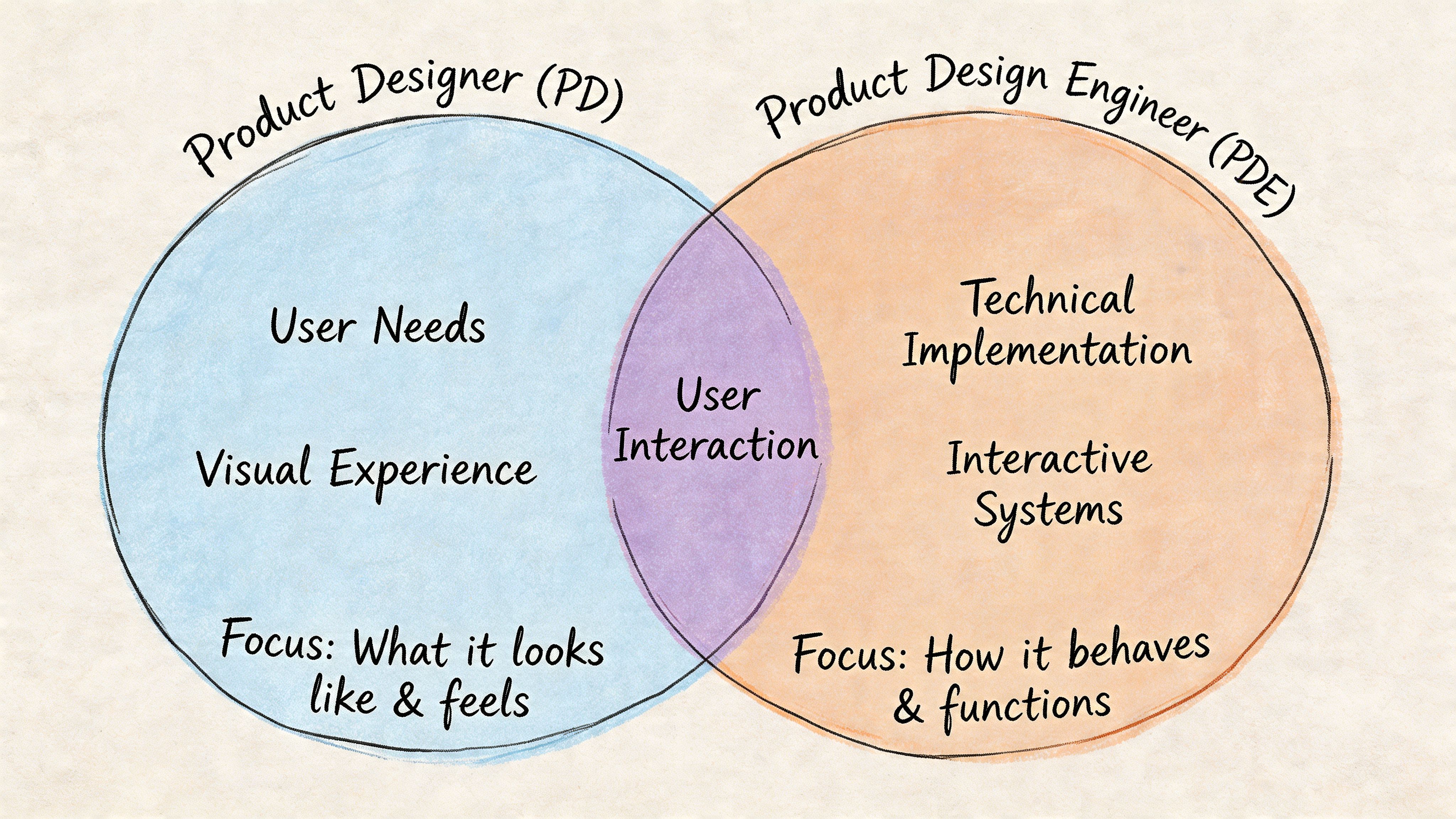
The focus framework
The basic gist is this: product designers usually own the problem framing and the experience model. Software engineers usually own solid implementation. Product design engineers own the translation layer between those two.
It's like building a house.
The architect decides how people will move through the space and what the experience should feel like. The structural engineer ensures the building stands up over time. The master builder understands how design intent becomes something real without losing integrity in the process. That middle craft is where the product design engineer sits.
Here’s how I’d separate the center of gravity:
- Product designer: owns the why and the what, user problem, journey shape, information hierarchy, and interaction vision.
- Product design engineer: owns the behavioral translation, interactive fidelity, component logic, and design system integrity.
- Software engineer: owns the how at production scale, architecture, performance, reliability, data flow, and maintainability.
None of these roles outrank the others. They protect different failure modes.
Where overlap is healthy, not confusing
A mature team wants overlap. Not ownership confusion, but literacy overlap. Product designers should understand constraints. Engineers should care about UX details. Product design engineers should be able to speak both languages without flattening either.
That’s why the best collaboration models don’t force perfect boundaries. They create clear centers of responsibility and then encourage shared visibility. If your PM-design relationship is already under strain, this guide to the complete guide to PM-designer collaboration in the AI era is a helpful companion.
A lot of people also benefit from seeing the role discussed out loud, with examples of how the overlap works in practice.
A simple test for role clarity
Ask one question: who owns the last responsible moment before a design becomes code?
If the answer is “kind of everyone,” your team probably has a seam problem. If the answer is “the front-end engineer, after the ticket is picked up,” you’re probably finding issues too late. If the answer is “the product design engineer, in partnership with design and engineering,” you likely have a healthier translation layer.
The role becomes obvious when you stop asking who made the mockup and start asking who made it real enough to trust.
How Product Design Engineers Change Team Dynamics
I saw this most clearly on a team building a permissions-heavy admin feature. The designer had done strong flow work. The PM had a crisp objective. Engineering was aligned. And still, the first build review felt wrong. Too many states were implied rather than specified.
Then the team changed the workflow.
Instead of moving from design review straight into tickets, a product design engineer paired with the designer and modeled the feature as an interactive component set. They worked through empty states, disabled actions, role-based variations, and save behavior before implementation started. The conversation changed from “what did you mean here?” to “do we want this rule at all?”
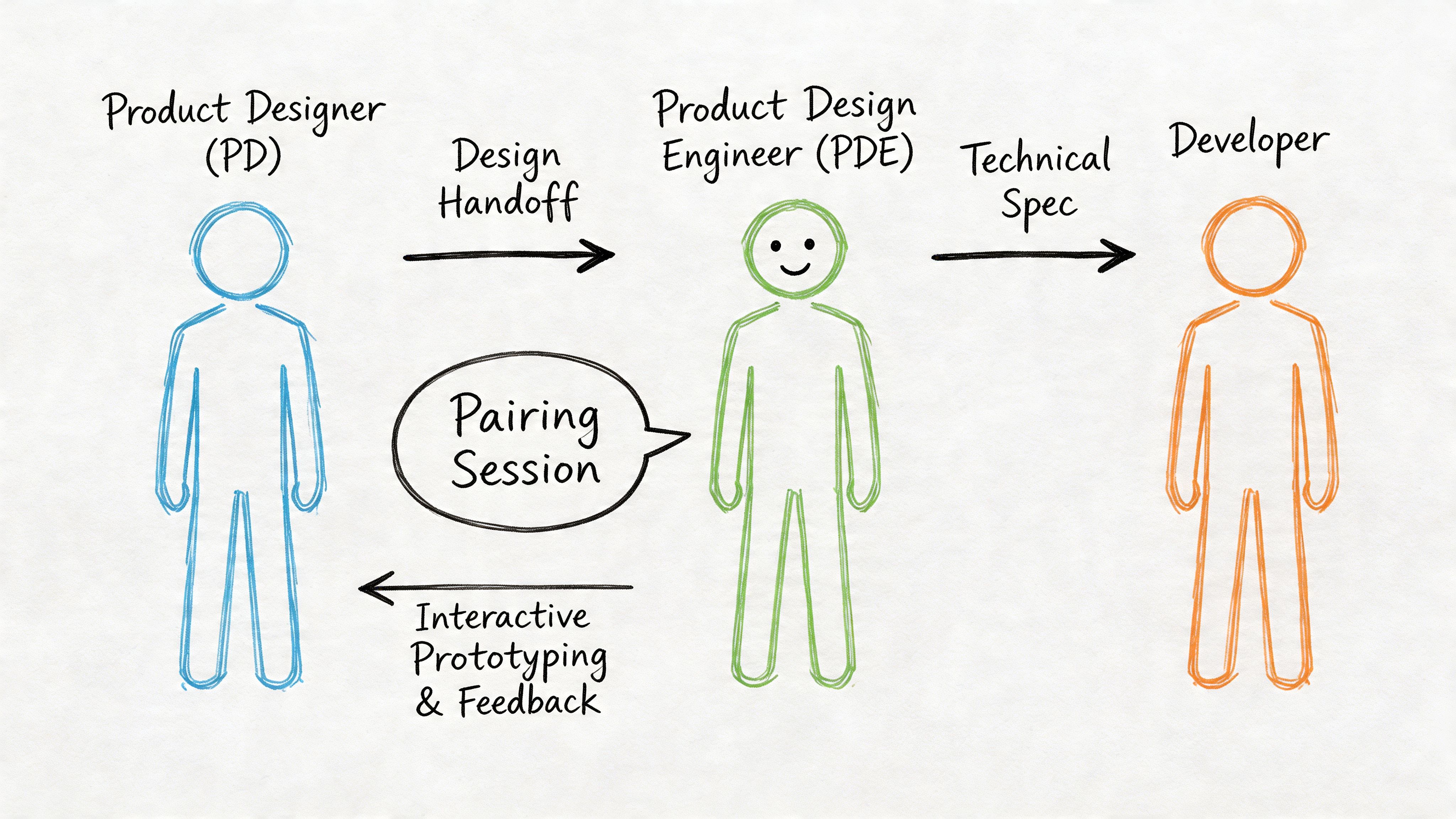
The pairing patterns that actually help
This role changes collaboration because it creates new pairing habits, not just new deliverables.
With designers, the product design engineer pressure-tests interactions. With PMs, they turn ambiguous requirements into testable flows. With developers, they convert intent into implementation-ready detail without losing nuance.
Three collaboration patterns show up repeatedly:
- Designer plus PDE: useful when a feature has complex states or new interaction patterns. The output is often a prototype that behaves like the product, not just a persuasive mock.
- PM plus PDE: useful when roadmap confidence is high but feasibility is fuzzy. A quick proof of concept can expose hidden complexity before commitments calcify.
- Engineer plus PDE: useful late in the cycle, when implementation quality matters and edge conditions can still be fixed before release.
If your team wants the operational version of this, the developer handoff playbook is one of the better ways to formalize the handoff moments that usually stay messy.
What the team stops arguing about
The biggest shift isn’t speed alone. It’s argument quality.
Without this role, teams spend energy debating interpretation. What did the design imply? What did the spec mean? Was that state intentionally omitted or just forgotten? With a strong product design engineer, the debate moves upstream toward better questions.
Do we support this behavior?
Should this component carry that logic?
Is the user helped by this branch?
A lot of the friction product managers describe as execution drag is really role mismatch, which is why this role also helps solve some of the common PM challenges that show up around clarity, prioritization, and cross-functional trust.
When a team has a healthy translation layer, review meetings stop being archaeology.
You can see the artifact quality this produces in detailed examples like task assignment component states. What matters isn’t the visual polish by itself. It’s that the behavior is explicit enough for design, product, and engineering to reason from the same object.
The Modern Toolkit and AI-Powered Workflows
The modern stack for this role isn’t really a stack. It’s a bridge.
At minimum, a product design engineer usually works across design tools, component environments, and front-end frameworks. Figma for system and interface definition. Storybook for component behavior. React or similar frameworks for interactive prototypes and production-adjacent implementation. Sometimes docs. Sometimes analytics. Often all of them in the same week.
The point isn’t tool collecting. The point is preserving intent while changing medium.
AI is changing leverage, not replacing judgment
That’s where AI starts to matter. Not because it removes the need for craft, but because it reduces the cost of moving from concept to something testable. Recent 2025 to 2026 data indicates that AI has reduced product development time by 30% to 50% in engineering firms, while LinkedIn reported a 40% increase in searches for “AI product design” and only 15% of job listings mentioned AI training, according to Neural Concept.
That gap is the true story. The work is changing faster than most hiring patterns.
For hardware-adjacent readers, this also tracks with broader shifts in design engineering and additive manufacturing technologies, where digital iteration and production awareness increasingly shape one another from the start. Software teams face the same structural lesson, even if the medium is different.
The new workflow is contextual
AI tools like Figr are changing what product design engineers can do. Instead of waiting for a designer to prototype a feature, design engineers can feed their product context into Figr and generate interactive prototypes themselves, bridging the gap between engineering and design.
That shift matters because context is finally becoming portable. The old workflow asked the hybrid operator to manually recreate system logic, conventions, and patterns every time. The new workflow can start from existing product structure, design tokens, and flow history.
Two useful paths to study here are AI for cross-functional communication and an overview of best AI design tools. The first helps explain why teams misalign in the first place. The second shows how tooling is beginning to close that gap.
If you want to see the variety of artifacts this workflow can support, the Figr gallery is a useful reference point.
The winning tool isn’t the one that generates the most screens. It’s the one that helps the team make fewer wrong assumptions.
That’s the modern shape of product design engineering in 2026. Less waiting. More simulation. Faster translation. But still a deeply human role, because judgment stays stubbornly non-automatable.
Hiring and Growing a Product Design Engineer
A lot of hiring managers make the same mistake first. They write a design engineer job that secretly asks for a senior product designer, a staff front-end engineer, and a design systems lead in one body. Then they wonder why the search feels impossible.
The role gets easier to hire for when you define it by bottleneck, not fantasy.
What to hire for first
Start with the operational pain your team already feels. Is the issue prototype fidelity? Design system drift? Repeated ambiguity in handoff? Poor interaction quality once features reach code? You don’t need every flavor of hybrid strength on day one. You need the version that removes the most costly friction.
A practical role definition usually includes work like this:
- Prototype complex interactions: build high-fidelity, interactive models that expose state logic before implementation.
- Partner across design and engineering: act as the translation layer for behavior, components, and feasibility.
- Strengthen the design system: contribute to reusable components, implementation guidelines, and variant logic.
- Reduce execution ambiguity: identify hidden states, constraints, and implementation risks early.
- Raise shipped quality: improve consistency between intended UX and built UX.
The evaluation should match. Don’t over-index on portfolio aesthetics alone. Ask candidates to walk through a messy flow, identify where ambiguity will appear, and show how they’d make it implementation-ready. That’s the work.
What the career path looks like
For individuals, the path usually starts with one anchor and expands outward. A designer learns front-end and component logic. An engineer develops interaction taste and system thinking. Over time, the role becomes less about artifact production and more about organizational influence.
A junior hybrid might mostly support prototyping and system implementation. A mid-level practitioner starts shaping interaction architecture and cross-functional workflow. A senior or principal operator often changes how the whole team moves, by refining handoff, tightening component governance, and reducing expensive ambiguity across product lines.
The market signal is steady, even if titles vary. In May 2024, the median annual wage for industrial designers, an aligned profession, was $79,450, and employment is projected to grow 3% through 2034, with about 2,500 openings each year in the U.S., according to the U.S. Bureau of Labor Statistics.
The metrics that matter
If you’re hiring this role, don’t measure it only by output volume. Measure whether it changes team behavior.
Useful indicators are usually qualitative or operational:
- fewer UI defects caused by missing states
- tighter alignment between reviewed prototype and shipped behavior
- stronger design system adoption in real product work
- fewer rounds of clarification during implementation
- earlier detection of feasibility risks
For aspiring candidates, the fastest path is to build a portfolio that shows translation, not just taste. Take one real feature. Model the edge states. Prototype the interaction. Show the component logic. Explain the tradeoffs. That’s how you demonstrate product design engineer skills in a way hiring teams can trust.
The Bridge to Better Products
By 2026, the product design engineer isn’t a novelty title. It’s a structural answer to a structural problem. Software teams move through too many states, tools, and interpretations to rely on static handoffs alone. Someone has to make the seams hold.
That’s the strategic advantage.
Not a compromise between design and engineering, but a role that protects quality while teams move fast. The product design engineer gives product teams a more truthful prototype, a cleaner handoff, and a tighter connection between intent and reality.
If you’re an individual, start small. Pick one shipped feature and rebuild its missing states as an interactive artifact. If you’re a leader, ask one uncomfortable question in your next review: where does meaning get lost between approved design and shipped behavior?
That answer usually points straight at the role you need.
For the complete framework on this topic, see our guide to product design best practices.
If your team is trying to close the gap between design intent and shipped reality, Figr is worth exploring. It helps product teams generate grounded prototypes, flows, edge cases, and handoff-ready artifacts from real product context, so fewer decisions get lost on the way to production.