
A feature goes out on Thursday. Engineering nailed the edge cases, QA signed off, analytics is wired, and the release notes look clean. By Monday, everyone can feel it. The feature works exactly as designed, but it solves the wrong problem.
That kind of miss is more common than generally acknowledged. Not because people are careless, but because the document looked finished while the understanding underneath it was still incomplete. Product requirements management exists for that gap.
The teams that ship well don't just write requirements. They keep requirements connected to reality, to user behavior, to design intent, to technical constraints, and to the product that exists in market.
The High Cost of Building the Wrong Thing Right
The most expensive product mistake isn't a bug. It's a feature that is correct in implementation and wrong in intent.
Most experienced product teams have lived this. A stakeholder asks for a dashboard. The PM writes the requirement. Design turns it into polished flows. Engineering builds it faithfully. Then customers barely use it, support keeps getting the same old complaints, and the team quietly moves on to the next priority carrying a little less trust than before.
That failure feels local, but it's systemic. A widely cited figure tied to the Project Management Institute suggests that 47% of projects fail to meet their goals due to poor requirements management, and 11.4% of every project dollar is wasted because of it in this industry summary of PMI data. Those numbers matter because they name what many teams experience but rarely quantify: unclear requirements don't just create confusion, they burn budget and schedule.
What failure looks like in practice
The failure mode usually doesn't announce itself early. It shows up as a series of reasonable decisions:
- A request arrives pre-solutioned: someone asks for a feature instead of naming the underlying user problem.
- The team optimizes for speed: people skip alignment because writing it down feels slower than building.
- Questions get deferred: dependencies, constraints, and edge cases get pushed into implementation.
- Success gets defined too late: everyone knows what to ship, but no one agrees on what would make it valuable.
A lot of teams call this execution risk. It's better understood as a requirements problem, which is why disciplined teams treat it as part of managing software engineering risk, not just product admin.
Practical rule: If engineering can build exactly what you asked for and still disappoint users, your requirements were incomplete.
The rework is rarely measured cleanly. It hides in follow-up tickets, design revisions, bug triage, support escalations, and another round of stakeholder meetings. If you want a sharper lens on that hidden cost, Figr's guide to rework is useful.
Why this matters more than teams think
When requirements are weak, teams don't just waste effort. They train themselves into a dangerous habit: mistaking motion for progress.
That's why product requirements management matters. It isn't paperwork for cautious organizations. It's the discipline that helps teams confirm they're building the right thing before they get very good at building it.
The System for Shared Understanding
A lot of teams still treat requirements as a handoff artifact. PM writes, design interprets, engineering implements, QA checks. That model breaks the moment reality changes, which is to say, almost immediately.
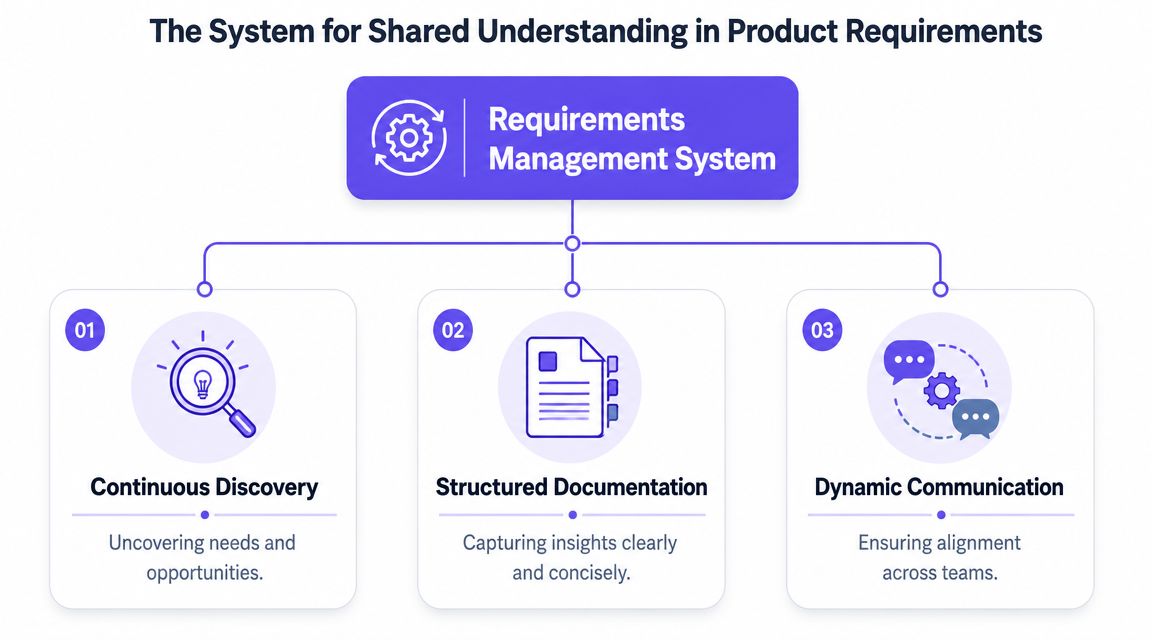
A better model is to think of product requirements management as a system for shared understanding. Not a blueprint. More like a shared GPS for a trip where the route changes, traffic appears, and someone in the back seat keeps suggesting a shortcut.
This is what I mean: the value isn't in having a document. The value is in having a current, testable, cross-functional understanding of what problem you're solving, what constraints matter, and what counts as done.
The four linked motions that make it work
The Project Management Institute frames effective requirements management as four linked processes: requirements planning, development, verification, and change management in its guidance on effective requirements management for project success. That framing is useful because it pulls requirements out of the note-taking bucket and puts them where they belong, inside an operating system for delivery.
Here's how that shows up on real teams:
| Process | What good teams actually do |
|---|---|
| Planning | Decide who contributes requirements, how they'll be reviewed, and what level of detail is needed before work starts |
| Development | Turn raw requests into clear statements of user need, business intent, constraints, and expected behavior |
| Verification | Check whether the requirement is understandable, feasible, and testable before implementation gets too far |
| Change management | Update the requirement when reality changes, without letting every request become silent scope drift |
Why documents fail without conversation
A PRD can look polished and still fail its job. Why? Because alignment is not the same as publication.
The teams that handle requirements well create repeated moments of interpretation. PM explains the intent. Design pressures the workflow. Engineering tests feasibility. QA asks what “done” really means. Support or success surfaces the operational edge cases no one put in the first draft.
Requirements aren't communication because they exist. They become communication when multiple functions can make the same decision from them.
That's the system. Discovery gives the team signal. Documentation preserves the signal. Communication keeps the signal alive.
When one pillar is weak, the whole structure starts drifting.
An End-to-End Requirements Workflow
Requirements don't begin as requirements. They begin as fragments. A sales request. A churn reason. A user complaint. A founder opinion. A suspicious drop in conversion. The job is to turn that mess into something a team can build, test, and maintain without losing the original intent.
The workflow below is a better mental model than the old gather-then-freeze approach.

From signal to specification
The first motion is discovery and elicitation. During this stage, teams collect demand, but the stronger move is to collect context. What user behavior suggests the need? What job is failing? What current workaround already exists? If the input is “customers want export,” the next question is obvious: what are they trying to do after exporting?
Then comes analysis and definition. In this phase, weak teams jump too quickly into screens and fields. Better teams slow down just enough to separate problem from solution. They define the user outcome, business purpose, constraints, dependencies, and the boundary of the work.
A useful companion here is guide for product teams on process mapping. It helps surface where a requirement sits in the actual workflow instead of treating it like an isolated ticket.
Validation before build
Before implementation, the requirement needs pressure. Not endless approval loops, just honest stress testing.
Ask questions like these:
- Can design illustrate the intended behavior without inventing missing logic?
- Can engineering explain the trade-offs and identify hidden dependencies?
- Can QA derive test cases from what's written, not from hallway conversations?
- Can the team name what is explicitly out of scope so every edge case doesn't turn into accidental expansion?
That validation stage is where ambiguity becomes visible. That's a gift, not a delay.
Later in the workflow, video walkthroughs can help teams align on flow-level detail, especially when requirements touch multiple states or paths.
After launch, the work is not over
At this stage, most requirements processes collapse. The feature ships, the team moves on, and the requirement freezes in time while the product keeps changing.
A healthy workflow includes maintenance and change control. That doesn't mean bureaucracy. It means someone updates the requirement when the shipped behavior changes, when analytics shows a mismatch, or when adjacent product changes alter assumptions.
A friend at a Series C company told me about a payments flow that looked simple in Jira and chaotic in production. The requirement had never been revised after a late compliance change, so support, QA, and engineering were all using different definitions of expected behavior. No one had failed individually. The system had.
The basic gist is this:
- Gather the signal.
- Define the actual requirement.
- Validate it across functions.
- Build and test against it.
- Launch with clear release logic.
- Maintain it as the product evolves.
That last move is the one often skipped, and it's why the same requirement keeps coming back as “unexpected” work.
Key Artifacts That Create Alignment
Good requirements management produces artifacts, but the artifacts are only useful when they reduce interpretation error. If they become storage bins for thoughts no one revisits, they create the illusion of rigor while increasing confusion.
The most important artifact is still the PRD. Used well, it becomes the team's operating record. Used poorly, it becomes a polished graveyard of assumptions.

What a modern PRD needs
Expert guidance from Perforce is refreshingly practical: modern PRDs need more than feature descriptions. They should capture constraints, assumptions, and non-functional requirements like performance, security, and scalability, because leaving those out often creates rework when something works functionally but fails operationally, as described in its article on how to write a product requirements document.
That distinction matters. A login flow can be complete on paper and still fail if it doesn't account for accessibility expectations, error states, latency, or role-based permission behavior.
A useful starting point is this product requirements document guide, especially if your team needs a sharper structure for turning raw ideas into buildable specs.
The artifact stack that actually helps
The strongest teams usually rely on a small set of linked artifacts rather than one giant document:
| Artifact | Its real job |
|---|---|
| PRD | Defines purpose, scope, constraints, assumptions, dependencies, and release logic |
| User stories | Translate the requirement into user-centered slices of value |
| Acceptance criteria | Remove ambiguity about expected behavior and completion |
| Wireframes or flows | Show interaction logic that text alone can hide |
| Test cases | Prove the team can verify the requirement as written |
Where most artifacts go wrong
Three failure patterns show up again and again.
- Feature-only thinking: the requirement says what to build, but not what limitations, risks, or conditions shape it.
- Detached user stories: stories are written as template exercises, not as meaningful expressions of behavior.
- Thin acceptance criteria: criteria cover happy paths and miss permissions, states, exceptions, and edge behavior.
A requirement is only as strong as the questions it survives.
Atlassian's guidance, discussed later, is also right on one key point: a PRD works best as a living artifact. That's especially true when user stories and wireframes are changing in active delivery. If the PRD isn't moving with them, it stops being the source of truth and becomes a historical reference.
Roles, Governance, and Guiding Principles
Requirements break down fastest when ownership is fuzzy. Everyone is involved, so no one feels accountable for the quality of the whole.
That's fixable. Product requirements management needs clear role boundaries and lightweight governance. Not heavy process. Just enough structure to stop ambiguity from sneaking into build decisions.

Who owns what
A strong operating model usually looks like this:
- Product manager owns the problem definition, scope boundary, prioritization logic, and business intent.
- Designer owns interaction clarity, usability logic, and the lived experience of the workflow.
- Engineering lead owns technical feasibility, implementation trade-offs, and risk surfacing.
- QA owns verification logic, scenario coverage, and the practical definition of done.
- Business analyst or operations partner, where relevant, sharpens specification detail and traces dependencies across systems.
The title matters less than the coverage. If one of these responsibilities has no clear owner, requirements start accumulating silent assumptions.
For teams clarifying product leadership boundaries, Figr's take on product owner responsibilities is a useful companion.
Lightweight governance beats document theater
Atlassian recommends treating the PRD as a living artifact that is updated regularly, not a frozen specification, because that improves traceability and helps teams avoid over-specifying too early in Agile environments, as outlined in its guide to product requirements and PRDs.
That guidance matters because the danger isn't change. It's uncontrolled change.
Good governance usually includes a few simple rules:
- One current source of truth: everyone knows where the latest approved requirement lives.
- Explicit change logging: when the requirement changes, the reason changes with it.
- Named approvers for material shifts: not every tweak needs a meeting, but major scope or behavior changes need visible ownership.
- Review before build, not after confusion: PM, design, engineering, and QA should all pressure-test the requirement before implementation gets expensive.
Last week I watched a PM juggle feedback from sales, customer success, and an executive who wanted a “quick tweak” to a billing flow. None of the requests sounded unreasonable on their own. Together, they changed the requirement enough to affect design states, backend logic, and test coverage. Without a change check, the team would have absorbed that complexity invisibly.
Why teams skip rigor
Here's the zoom-out moment. Teams often avoid governance because it feels slower in the moment. The incentive is immediate. Ship now, clarify later.
But later is where the cost arrives. Engineering absorbs rework. QA becomes the first place requirements are debated. Design gets pulled back into solved problems. Stakeholders lose confidence because “simple” features keep expanding.
The fastest teams aren't the ones with the least process. They're the ones with the least preventable confusion.
Common Traps That Erode Product Velocity
The biggest trap in product requirements management isn't bad writing. It's context drift. The requirement stays still while the product moves.
That blind spot shows up everywhere. Flows change after release. UX patterns evolve. Analytics reveals different behavior than the team expected. But the PRD still describes the old reality, so new work gets planned on top of outdated assumptions.
Oracle's guidance points to this gap clearly: most requirements content says how to gather, document, prioritize, and track requirements, but gives far less help on keeping them aligned with a product's live UX and analytics over time in its overview of requirements management. That's not a minor omission. It's one of the main reasons complete-looking documents still produce rework.
Five traps worth spotting early
| Trap | What it looks like | What fixes it |
|---|---|---|
| Document and forget | The PRD exists, but no one updates it after design or implementation changes | Tie requirement updates to release reviews and major flow changes |
| Frozen-contract thinking | Teams treat the requirement as untouchable, even when new evidence appears | Allow changes, but require visible reasoning and owner approval |
| Feature-first framing | Work starts from requested solutions instead of user problems | Rewrite requests into problem statements before drafting specs |
| Missing operational requirements | QA finds “bugs” that are really unspoken expectations | Add constraints, assumptions, and non-functional needs early |
| No link to live behavior | The requirement says one thing, analytics and support say another | Review shipped workflows against current product usage and friction points |
The symptom most teams misread
When developers keep asking “what should happen here,” teams often think the issue is detail. Sometimes it is. More often, the issue is that the requirement was written outside the context of the actual product.
If your requirement can't survive contact with the current UX, it isn't ready.
That's why static documentation isn't enough anymore. Modern SaaS products are too interconnected. One change in onboarding affects permissions, notifications, analytics events, help content, and downstream flows. Requirements need to live inside that web of context, not beside it.
How to Implement Better Requirements Management Today
You don't need a full process overhaul this week. Improving product requirements management often involves fixing one habit at the point where confusion usually enters.
For your next feature, start with two moves.
Start with traceability and a real walkthrough
First, create a lightweight traceability line for each requirement. Not a giant enterprise matrix. Just a clear connection between the user problem, business objective, workflow, key requirement, and verification method.
Second, run one dedicated walkthrough before implementation starts. Put the PM, designer, engineering lead, and QA owner in the same review. Walk through the requirement together and force answers to the obvious questions: what's in scope, what's out, what assumptions are still open, and how will we know this is working after launch?
That single meeting prevents a surprising amount of churn.
Use tools that preserve context
Templates help, but only if they keep the team close to the actual product. If your team needs structure, streamlining PRDs with templates is a sensible place to start.
If you want more context-aware support, tools like Jira, Confluence, Linear, Notion, and Figma can cover pieces of the workflow. Figr is one option for teams that want requirements work tied more closely to live product context, design systems, user flows, and generated artifacts like edge cases and test cases.
A practical standard to adopt this sprint
Use this checklist on the next requirement you approve:
- Problem clarity: can the team explain the user need without describing the solution first?
- Scope boundary: is there an explicit statement of what this work will not cover?
- Operational fit: are constraints, assumptions, dependencies, and non-functional expectations named?
- Cross-functional readability: can design, engineering, and QA each act from the same document?
- Post-launch upkeep: who will update the requirement if shipped behavior changes?
That's enough to start.
The teams that get better at requirements management don't become more bureaucratic. They become more honest, earlier. They expose uncertainty while it's still cheap, keep their documentation attached to reality, and treat shared understanding as part of the product itself.
If your team is tired of PRDs drifting away from the product you ship, Figr is worth a look. It helps teams create requirements, flows, prototypes, edge cases, and QA artifacts grounded in real product context, so specs stay closer to the UX, design system, and live workflow they're meant to support.