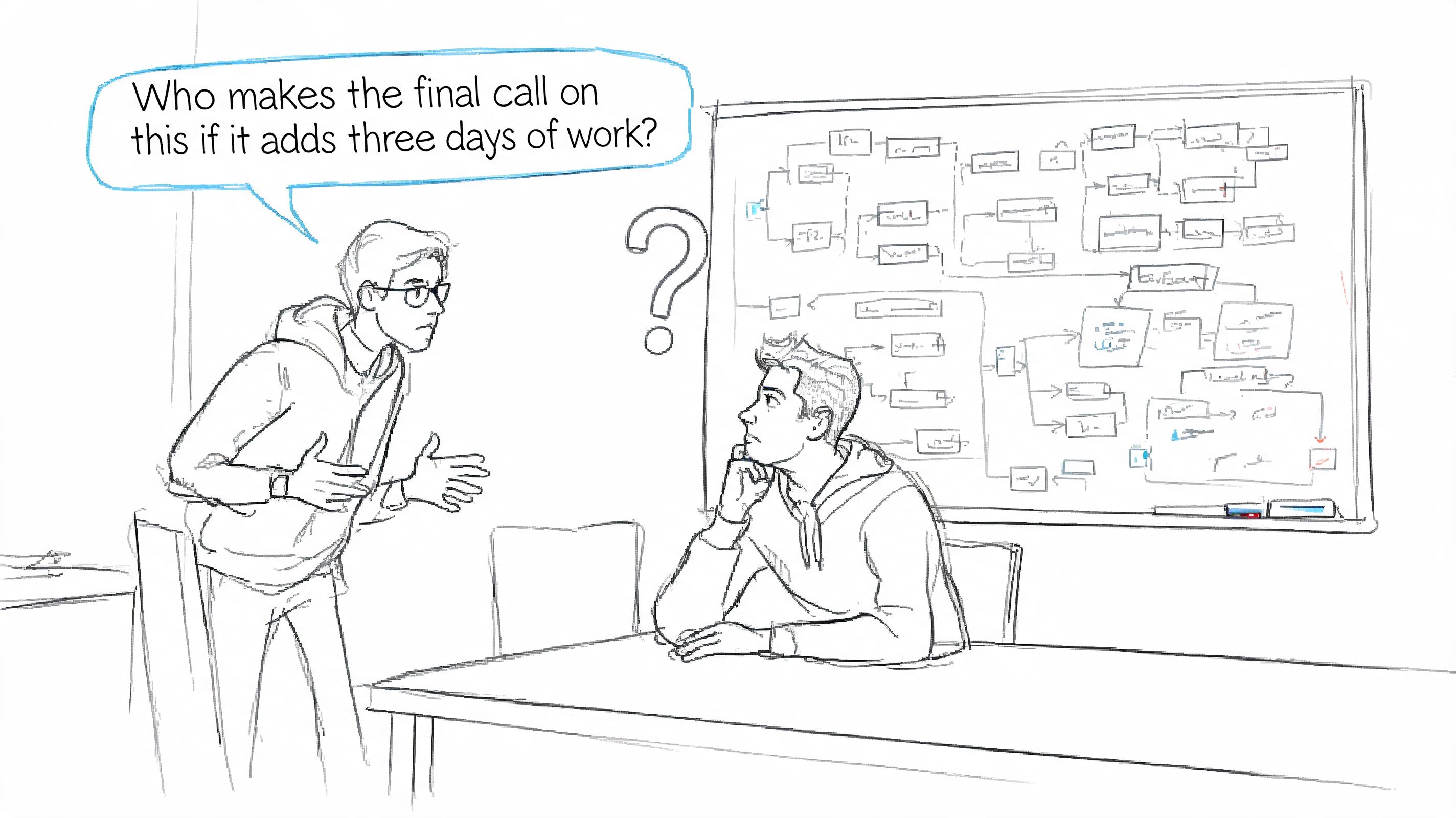
Monday morning, second hour of sprint planning. A designer asks a reasonable question about an edge case that changes the empty state and adds testing work. Then comes the question that freezes the room: who makes the final call if this adds time?
Nobody answers.
The Product Owner looks at engineering. Engineering looks at the Scrum Master. QA starts explaining risk. The designer starts defending the user journey. Someone says, “Let’s take it offline,” which usually means the decision has no owner and the cost will show up later.
That moment is why agile development roles and responsibilities matter. Not as job descriptions. Not as certification trivia. As a system of decision rights.
A healthy agile team doesn’t just know what work exists. It knows who decides priority, who defines process, who judges technical feasibility, who flags quality risk, and who gets heard before work hardens into code. When those rights are fuzzy, teams don’t become flexible. They become political.
I’ve watched strong people fail inside weak role design. Good PMs become backlog clerks. Scrum Masters become meeting managers. Designers get consulted after scope is already locked. QA becomes the messenger nobody wanted to hear from. The result looks like “delivery friction,” but the root problem is usually simpler: accountability was never made explicit.
That’s the unspoken question behind most team tension. Not “What are agile roles?” but “Who decides what, when the trade-off gets real?”
The Unspoken Question Haunting Every Agile Team
A team can survive unclear titles for a while.
It can't survive unclear authority.
The failure mode is familiar. Discovery happens in one lane, delivery happens in another, and then a feature crosses the design-to-development boundary carrying unresolved questions. A developer asks whether the team should optimize for speed or completeness. QA finds a behavior nobody specified. A stakeholder wants a late change. Everyone is involved, but nobody is clearly accountable.
That silence in the room isn't neutral. It's expensive.
Roles are really about decision rights
Teams often treat agile development roles and responsibilities like a checklist. Product Owner writes stories. Scrum Master runs ceremonies. Developers build. Designers design. QA tests.
That framing is too weak for real work.
The basic gist is this: each role exists to reduce ambiguity at a specific type of decision point. If the Product Owner can't make trade-offs on value, the backlog becomes a negotiation forum. If the Scrum Master can't challenge broken team behavior, process decays into ritual. If the Development Team has no real authority over implementation choices, estimates become fiction.
Practical rule: If two people think they have final say, nobody really does.
The hidden dysfunction has a pattern
When teams say, “We need better communication,” they often mean one of three things:
- Priority is unstable: work enters the sprint before the team agrees on what matters most.
- Interfaces are unclear: design, engineering, and QA don’t know when input is required versus optional.
- Escalation is broken: when trade-offs appear mid-sprint, nobody knows who can change scope.
A short vignette makes this concrete. Last week I watched a PM at a growth-stage SaaS company walk through a polished feature plan that looked complete on paper. Then QA raised a simple issue around state transitions. The room didn’t argue about the bug. They argued about who had the right to change the acceptance criteria after the sprint had started. That’s not a testing problem. It’s a governance problem wearing a testing costume.
Clear roles don’t slow teams down. They let teams disagree quickly, then move.
The Core Agile Triad The Engine Room
A sprint goes sideways in a familiar way. Product changes priority on Tuesday. Engineering says the new ask breaks the current approach. The Scrum Master tries to hold the plan together, but nobody can answer the fundamental question: who gets final say on scope, method, and technical compromise?
That is the engine-room problem.
Teams need a clear split between value decisions, workflow decisions, and build decisions. In Scrum, that split sits with the Product Owner, Scrum Master, and Development Team.
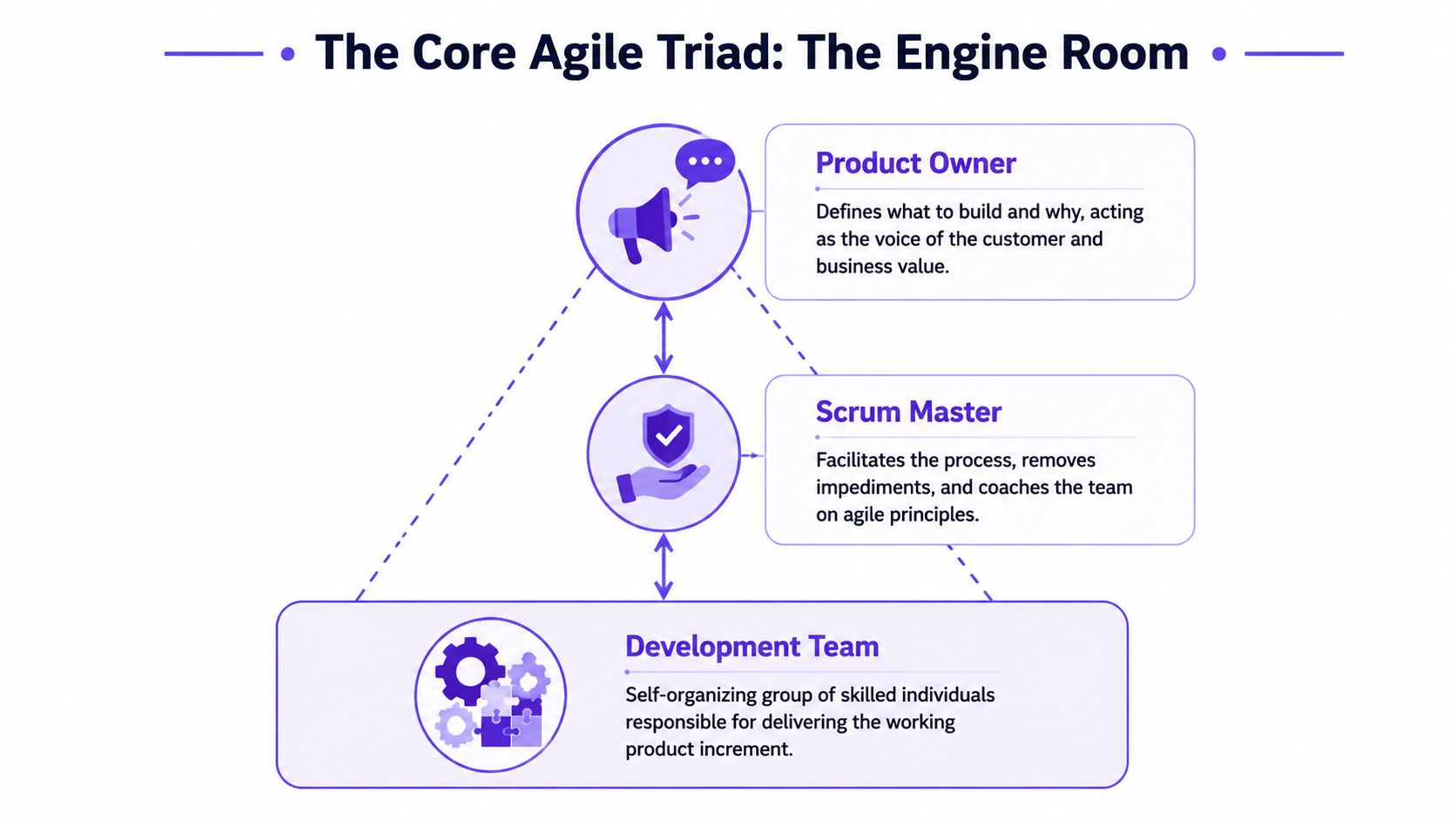
The point is not role theater. The point is decision rights.
When those rights are clear, the team can move fast without reopening the same argument in every ceremony. When they are blurred, backlog refinement turns into stakeholder arbitration, sprint planning turns into a scope fight, and design-to-development handoffs get stuck in a loop of “who approved this?”
The Product Owner owns value and priority
The Product Owner is accountable for maximizing value, but that only matters if the role has real authority at the moments that count.
The Product Owner decides what problem is worth solving now, what can wait, and what trade-off the business is willing to accept. They own backlog order, acceptance intent, and scope calls when new information appears. They do not need to dictate the implementation. They do need to decide whether the outcome is still worth pursuing if cost or complexity rises.
Strong Product Owners do three things well:
- Set one priority order: stakeholders contribute input, but the backlog does not have six owners.
- Make acceptance criteria testable: enough detail to define success, including edge cases that often surface between design and engineering.
- Absorb trade-offs publicly: if a new request enters, something else moves out or down.
Common failure modes are easy to spot:
- Backlog administration without authority
- Stakeholder-by-stakeholder prioritization
- Design approved before feasibility is challenged
- Acceptance criteria rewritten mid-sprint with no explicit scope decision
That last one causes more friction than teams admit. A polished prototype can create false certainty. Then engineering finds state complexity, accessibility gaps, or integration constraints, and the Product Owner has to choose: keep the original behavior, reduce scope, or move the date. If nobody makes that call clearly, the team burns time debating a decision that already has an owner.
If your organization still mixes product strategy, delivery ownership, and roadmap management, the PO vs PM divide explained usually clears up where those boundaries should sit.
The Scrum Master owns team effectiveness and process integrity
The Scrum Master is accountable for how the team works, not for what gets built or how engineers implement it.
That sounds simple. In practice, this role is often diluted into meeting management. Strong Scrum Masters do more than facilitate ceremonies. They identify recurring failure patterns, expose them early, and help the team fix the system causing them.
The work usually shows up in places teams mislabel as “communication issues”:
- sprint goals that are too broad to guide trade-offs
- side-channel requests that bypass backlog order
- unresolved dependencies between design, engineering, and QA
- recurring blockers that everyone can name but nobody owns
A good Scrum Master treats those as operating problems, not personality problems.
What good looks like:
- Ceremonies with a purpose: planning produces commitment, refinement produces clarity, review produces feedback, retro produces changes in behavior.
- Blocked work made visible: impediments are tracked to resolution, not mentioned and forgotten.
- Team boundaries protected: outside requests go through the right path instead of landing directly on individual contributors.
- Conflict surfaced early: the team addresses disagreement before it turns into delay.
What weak looks like:
- Calendar management without coaching
- Process enforcement with no sensitivity to outcomes
- Escalation as a substitute for team problem-solving
I have seen Scrum Masters help teams recover in a month by naming one hidden dysfunction: the team had no agreed rule for who could alter sprint scope after development started. Once that handoff was explicit, half the noise disappeared.
The Development Team owns implementation and delivery quality
The Development Team owns how the work gets built and whether the increment meets the standard to ship.
That includes architecture, sequencing, estimation, testing approach, and the technical trade-offs required to deliver working software. It also includes speaking up when a design is elegant in Figma but brittle in production. Teams get into trouble when engineering is treated as an execution arm instead of the group that judges feasibility and delivery risk.
Modern workflow friction tends to surface at this intersection. Design may intend one interaction. Engineering may see a performance or state-management issue. QA may spot a failure path that neither side modeled. The handoff works only if the decision path is clear:
- The Product Owner decides whether the behavior is worth the cost.
- The Development Team decides how to implement it, or whether the current approach is unsafe.
- The Scrum Master helps the team resolve the blockage without letting process drift or interruption take over.
Quality is shared, but specialists still have distinct authority in their domain. Engineers own build choices. Testers and QA engineers challenge assumptions, coverage, and release confidence. Designers clarify intent and edge-case behavior. The triad works because those inputs reach the right decision-maker at the right time.
Resourcing choices can strengthen or weaken that model. If you extend capacity, add people who can work inside the team’s decision structure rather than outside it. A partner such as Hire LATAM developers can help if the goal is to add engineering capability without creating a second, disconnected delivery lane.
The triad works when authority is clean at the handoff points
A simple framing keeps teams honest:
- Product Owner: what should be built next, and what trade-off is acceptable?
- Scrum Master: what is slowing this team down, and what working agreement needs to change?
- Development Team: how do we build this safely, maintainably, and to the expected level of quality?
The true test is not whether everyone can recite their duties. It is whether the team can answer, in the middle of pressure, who decides value, who decides process, and who decides implementation. When that answer is fuzzy, speed turns into churn. When it is clear, the triad does its job.
The Extended Team Navigators and Specialists
The core triad is necessary. It isn’t sufficient.
Modern product delivery depends on role interfaces that Scrum diagrams often flatten: UX researchers, product designers, QA engineers, engineering managers, and stakeholders who shape direction without sitting inside every daily decision.
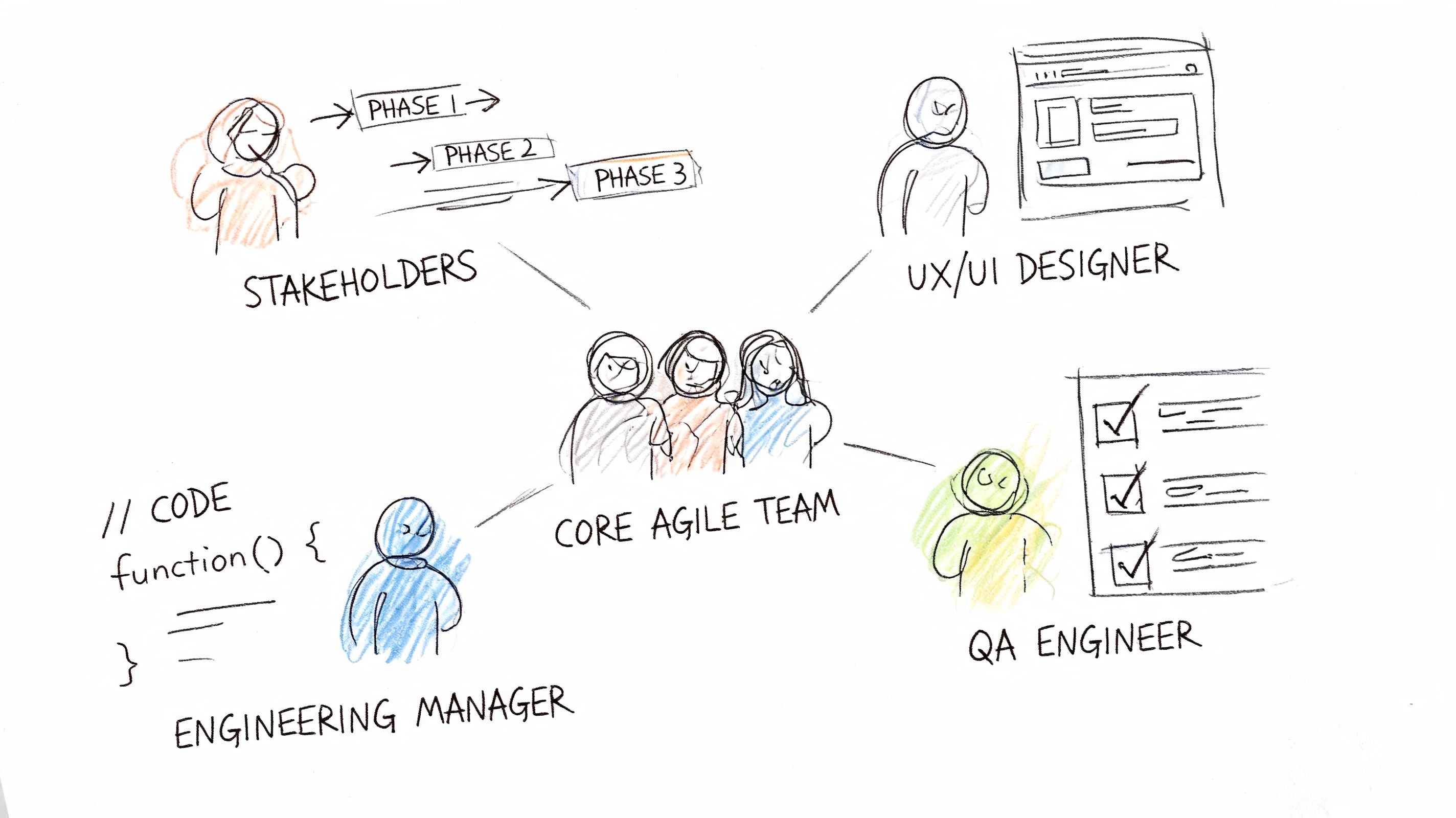
The biggest breakdown usually happens at the handoff points. Existing guidance often misses those design-to-development friction zones, especially around mid-sprint scope calls, system compliance, and how QA discoveries feed back into priorities, as noted in this analysis of agile team role gaps.
Design is not upstream decoration
A designer's job isn't finished when a Figma file looks polished. Design creates decision inputs that shape backlog quality, implementation complexity, and testing coverage.
The practical question is not “Should design attend agile ceremonies?” It’s narrower and more useful: At what point does design input become required for a backlog item to be considered ready?
Teams that handle this well usually do three things:
- Include design in refinement: not just after priorities are locked, but while stories are still being shaped.
- Define handoff criteria: states, edge cases, empty screens, error handling, and design system alignment are made explicit before development starts.
- Keep design available during delivery: because implementation always surfaces questions that prototypes didn’t resolve.
When teams fail here, they fall into throw-it-over-the-wall behavior. Design hands to engineering. Engineering interprets. QA uncovers the gap. Then everyone debates whether it’s a bug, a missed requirement, or an enhancement. That argument is a sign the handoff model is underdesigned.
For teams trying to tighten that transition, these developer handoff best practices are worth using as an operating checklist.
QA doesn't own quality alone
QA should never be the final checkpoint that discovers what the team failed to discuss.
Quality is shared, but QA plays a distinct role. They turn vague confidence into testable reality. They ask the uncomfortable question early: what happens when the user behaves differently than the happy path assumed?
What works in practice:
- QA joins story discussion before build starts.
- Acceptance criteria are testable, not aspirational.
- Mid-sprint findings trigger a defined decision path, not a political argument.
What fails:
- QA gets involved after code is “done.”
- Bugs are separated from product decisions, even when they expose missing requirements.
- Teams expect QA to absorb ambiguity without changing sprint scope.
A useful mental model is this: the whole team owns quality, but QA often owns quality visibility.
Here’s a quick explainer that’s useful if the team needs a reset on role collaboration.
Engineering Managers and stakeholders shape the edges
Engineering Managers often get trapped between people leadership and delivery influence. They usually shouldn't override sprint-level team decisions, but they do matter in staffing, technical capability, coaching, and escalation when the team’s constraints exceed its authority.
Stakeholders matter too, but their role must stay bounded. They influence goals, constraints, and feedback. They should not become a parallel backlog channel.
A stakeholder request is input. It is not priority until the accountable role says it is.
This is what I mean by interface design. The most important agile development roles and responsibilities often live between formal titles. Who must be consulted before a story is “ready”? Who can reopen scope when QA finds a hidden dependency? Who signs off on releasing a risky change? Teams that answer those questions directly create flow. Teams that avoid them create rework.
A RACI Matrix to Map Agile Accountabilities
Teams often discover role confusion only after a sprint slips. By then, the debate is emotional. A simple RACI matrix helps earlier because it converts vague assumptions into visible ownership.
RACI isn’t bureaucracy when used well. It’s a forcing function.
The key is to keep one principle firm: every important activity needs one accountable owner. Not a committee. Not “the team” in a fuzzy sense. One role that can make the final call after hearing input.
Use the matrix as a diagnostic tool
If your team argues over the same issues repeatedly, map the moments where decisions stall:
- backlog prioritization
- acceptance criteria
- sprint goal setting
- bug triage
- release go or no-go
Then ask four questions for each activity:
- Responsible: who does the work?
- Accountable: who has final say?
- Consulted: whose input is required?
- Informed: who needs visibility?
Stakeholder overload makes this harder than it sounds. If every stakeholder believes they are effectively accountable, the matrix collapses. That’s why a good guide for product managers on stakeholder mapping often fixes role confusion faster than another retro about communication.
Agile RACI Matrix Example
| Activity | Product Owner | Scrum Master | Dev Team | UX/Design | QA Engineer |
|---|---|---|---|---|---|
| Backlog prioritization | A/R | C | C | C | C |
| Defining acceptance criteria | A | C | R | C | R |
| Sprint goal setting | A | R | R | C | C |
| Estimation | C | C | A/R | C | C |
| Design readiness before build | A | I | C | R | C |
| Bug triage during sprint | A | C | R | C | R |
| Definition of Done enforcement | C | A | R | C | R |
| Production release go or no-go | A | C | R | C | R |
A few notes matter more than the table itself.
First, acceptance criteria should not be written in isolation by the Product Owner and thrown to delivery. The Product Owner is accountable because this defines what value means in practice, but developers and QA are often responsible for making the criteria testable and realistic.
Second, design readiness deserves its own line. Many teams skip it, and that’s exactly where expensive ambiguity hides.
If your team can't say when a story is ready for build, your sprint is already carrying invisible scope.
Keep the matrix alive
Don’t create a RACI once and pin it to a wiki graveyard. Use it when conflict appears.
A useful cadence is simple:
- Pull it into sprint planning when a story feels underdefined.
- Revisit it after a release incident or handoff breakdown.
- Update it when the team structure changes.
The point isn’t to formalize everything. The point is to remove recurring uncertainty around decisions that should already have a home.
Beyond Scrum How Roles Adapt for Kanban SAFe and Data Teams
Monday starts with a design tweak, a data dependency, and an urgent customer request. By Wednesday, engineering is asking who can override the queue, design is asking whether the changed flow still ships this sprint, and product is asking why a small request now touches three teams. The framework is not the core problem. Decision rights are.
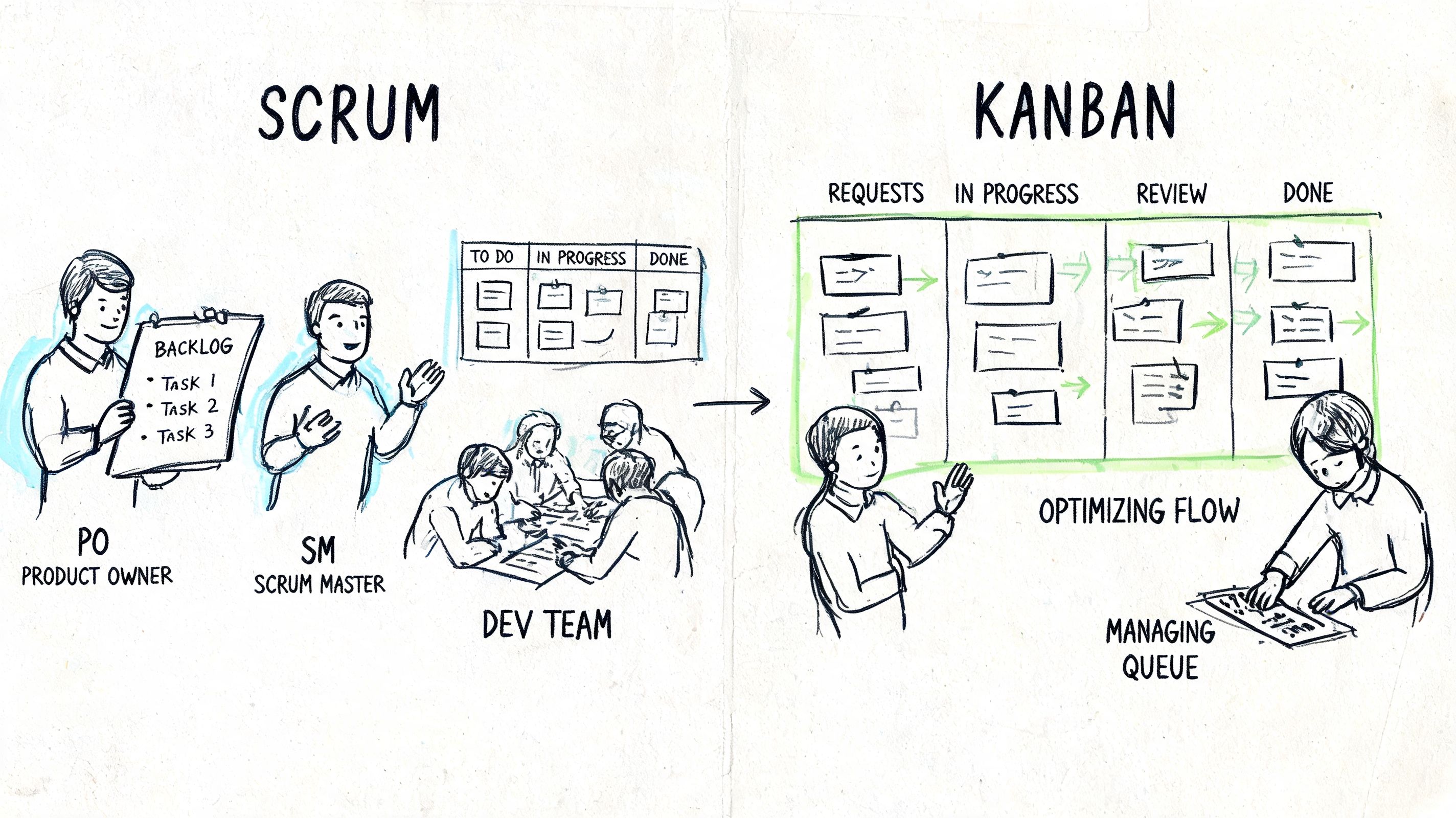
Scrum gives teams a clear starting point, but plenty of teams deliver in Kanban systems, scaled programs, or data-heavy environments where the titles change and the handoffs get messier. The pattern I see across all three is simple. Value decisions, flow decisions, and implementation decisions still need named owners. If they do not, the work keeps moving while accountability disappears.
Kanban shifts the pressure point to flow decisions
Kanban removes the forcing function of sprint ceremonies. The team still needs prioritization, but priority now changes in real time. The team still needs coordination, but there is no planning meeting to expose every conflict before work starts.
That is why weak ownership shows up faster in Kanban.
If nobody owns intake policy, every stakeholder request looks urgent. If nobody owns WIP discipline, teams start five things and finish one. If nobody can say when design is ready for build, cards enter development carrying unresolved UX questions, and the cost of rework in sprints shows up a week later as churn, not learning.
In healthy Kanban teams, role clarity sounds more like operating rules than job titles:
- one person can order the queue
- one person can challenge work entering the system
- one person owns flow health across the board, not just their own ticket
- engineering leads keep technical trade-offs local unless the risk crosses team boundaries
SAFe creates a strategy to execution handoff that can fail quietly
Scaled setups introduce a different failure mode. Strategy and delivery both look "covered," but the handoff between them is weak.
A Product Manager may own portfolio or program priorities. A Product Owner may own the team backlog. On paper, that split is clean. In practice, it breaks when roadmap changes arrive as half-shaped stories, or when a team-level Product Owner keeps escalating ordinary trade-offs upward because they were never given real decision authority.
The fix is not more synchronization meetings. The fix is a sharper contract between roles.
The Product Manager decides why this work matters now, what outcome it serves, and where it sits against competing bets across teams. The Product Owner decides how that intent becomes an ordered backlog, what gets cut to preserve the release goal, and which ambiguities must be resolved before engineers commit. Architects and engineering leads step in when local optimization starts creating system-level risk.
Without that boundary, teams get two forms of waste at once. Strategy leaks into story-level micromanagement. Delivery issues rise to leadership that is too far away from the work to resolve them well.
Data teams expose gaps that generic agile language hides
Data work punishes vague accountability faster than feature work does. A product request that sounds small can affect data definitions, pipeline timing, lineage, permissions, and reporting logic in ways a standard software workflow does not surface early enough.
That changes the role design.
A backlog owner or product lead still needs to decide business priority. But data analysts often shape the meaning of the requirement, data engineers own pipeline implementation choices, and data architects or platform leads decide whether a request fits the wider model and governance constraints. Compliance, privacy, and audit stakeholders may also need explicit approval rights before work is considered ready.
I have seen teams call all of that "engineering detail" and pay for it later. The usual pattern is familiar. Design signs off on a user-facing flow, product assumes the work is ready, and engineering then discovers the request depends on data that is incomplete, delayed, or defined differently across systems. The missed handoff happened long before delivery started.
The framework changes. The accountability test does not.
For Kanban, SAFe, and data teams, four questions sort the noise quickly:
- Who can change priority today without asking a committee?
- Who protects flow and can stop new work entering a congested system?
- Who owns technical and architectural decisions once delivery starts?
- Who must sign off before design, requirements, and dependencies are ready for build?
Teams adapt well when those answers are specific, visible, and respected in day-to-day work. That is what keeps a framework from turning into role theater.
Common Anti-Patterns When Agile Roles Go Wrong
Most role failures don’t begin with bad intent. They begin with a compromise that seemed harmless.
A Product Owner without authority. A Scrum Master measured on ceremony compliance. A designer invited only after engineering estimates are already committed. A tech lead pulled into planning too late to surface architectural risk.
Then the compromise becomes culture.
The Proxy PO
The Proxy PO looks busy and sounds aligned. They capture stakeholder asks, rewrite them into tickets, and maintain the backlog.
But they don't control prioritization.
This role fails because it carries accountability theater. The team thinks product decisions have been made. In reality, those decisions are still floating in executive chat threads, sales escalations, or leadership meetings the Product Owner doesn't control. That’s when sprint planning becomes a ritual for consuming uncertainty rather than reducing it.
You can spot the Proxy PO quickly:
- they need outside approval for ordinary priority calls
- they avoid saying no because they can’t defend the no
- they spend more time documenting requests than deciding among them
The Scrum Police
The Scrum Police confuses fidelity to process with team health.
This person protects the calendar, enforces ceremony attendance, and corrects vocabulary, but they don’t improve the team’s ability to deliver. They can tell you whether the retro happened on time. They can’t tell you why the same blocker appeared three sprints in a row.
That role drift is subtle because it looks disciplined. It’s shallow control.
Process should increase clarity and throughput. If it only increases compliance, the team will start performing agility instead of practicing it.
The Unconsulted Designer and the Late QA Trap
A friend at a Series C company told me about a feature that made it through design review, sprint commitment, and most of implementation before someone noticed a core expectation break in the user flow. The issue wasn’t visual polish. The flow violated how users already understood the product. They spent the next sprint fixing work they had just finished.
That’s the Unconsulted Designer pattern. Design existed, but design judgment wasn’t present when trade-offs got locked.
Its close cousin is the Late QA Trap. QA enters after code stabilizes and discovers not just bugs, but missing decisions. The team then argues about whether to reopen scope. Nobody wins that argument. The schedule absorbs it.
The economic cost is obvious even when teams don’t track it well. The cost of rework in sprints isn’t only engineering time. It’s delayed learning, frustrated teams, and lower confidence in every estimate that follows.
The Missing Technical Expert
One anti-pattern sits underneath several others: no one consistently bridges business intent and technical consequence.
According to Blocshop’s summary of agile software development team roles, teams with dedicated Technical Experts see 35% faster sprint velocities and 28% fewer defects, while weak technical leadership can let technical debt inflate cycle times by 20% to 40%. Those numbers matter because they point to mechanism, not magic. Someone has to surface risk early, shape realistic estimates, and challenge feature definitions that ignore architecture or non-functional demands.
This is the zoom-out moment many teams miss. Role dysfunction is rarely just interpersonal. It’s economic. Organizations reward visible throughput, so teams start work before ambiguity is resolved. They defer hard decisions because starting feels productive. Then hidden complexity arrives later, when it’s more expensive and politically harder to absorb.
That’s why anti-patterns persist. They are often locally convenient, even when they are globally costly.
Your Grounded Takeaway A Checklist for Role Clarity
You don’t need a team redesign workshop to improve role clarity. You need a sharper conversation.
Start with the moments where work slows, rework appears, or trade-offs become personal. Those points reveal where decision rights are muddy.
Ask these questions in your next team review
Use this as a live checklist, not a document exercise:
- Priority authority: Who has final say on backlog order when stakeholders disagree?
- Readiness standard: What must be true before a story can enter a sprint?
- Design involvement: Is design present during refinement, or only after scope is effectively fixed?
- QA influence: When QA finds an unknown unknown mid-sprint, who can change scope?
- Technical judgment: Who is expected to call out architecture or non-functional risk before commitment?
- Definition of Done: Who can say a story is not done, even when pressure to release is high?
- Release decision: Who owns go or no-go, and whose input is mandatory before that call?
- Stakeholder boundaries: Which requests are inputs, and which role turns them into actual priority?
If the answers differ depending on who you ask, that’s your first problem.
Look for the mismatch, not the ideal diagram
Teams often chase the “correct” agile structure when the underlying issue is simpler. Their actual decision flow doesn’t match their stated roles.
A Product Manager may be doing Product Owner work. A senior engineer may be acting as the effective technical lead without formal recognition. A designer may already be carrying product risk decisions because no one else is. That isn’t necessarily wrong. What’s dangerous is pretending the org chart and the work pattern are the same.
For leaders trying to strengthen execution habits more broadly, these high-performance team strategies can be useful alongside role-specific fixes.
Field test: Ask one recent feature team to reconstruct the last major decision change. Who noticed the issue, who made the call, and who learned about it after the fact? That sequence tells you more than your process doc.
Make one change this week
Don’t try to solve all role ambiguity at once. Pick one recurring friction point.
Maybe it’s design readiness. Maybe bug triage. Maybe stakeholder intake. Whatever the issue, define:
- one accountable role
- required consulted roles
- the moment the decision must be made
- the artifact where that decision lives
If strategy is fuzzy, a shared artifact helps. Many product teams benefit from using a simple framework to define product strategy with a canvas, because it forces decisions about value, users, and constraints into one visible place rather than scattering them across decks, tickets, and meetings.
Role clarity isn’t about perfect purity. It’s about reducing the number of times your team stops to ask, “Wait, who decides this?”
When that question disappears, speed improves for a very simple reason. People stop negotiating the operating system and get back to building.
If your team is losing time in the gaps between product, design, engineering, and QA, Figr helps create shared context before handoff pain turns into sprint rework. It generates PRDs, user flows, edge cases, test cases, UX reviews, and high-fidelity prototypes grounded in your real product, so decisions are clearer, handoffs are tighter, and teams ship with fewer surprises.