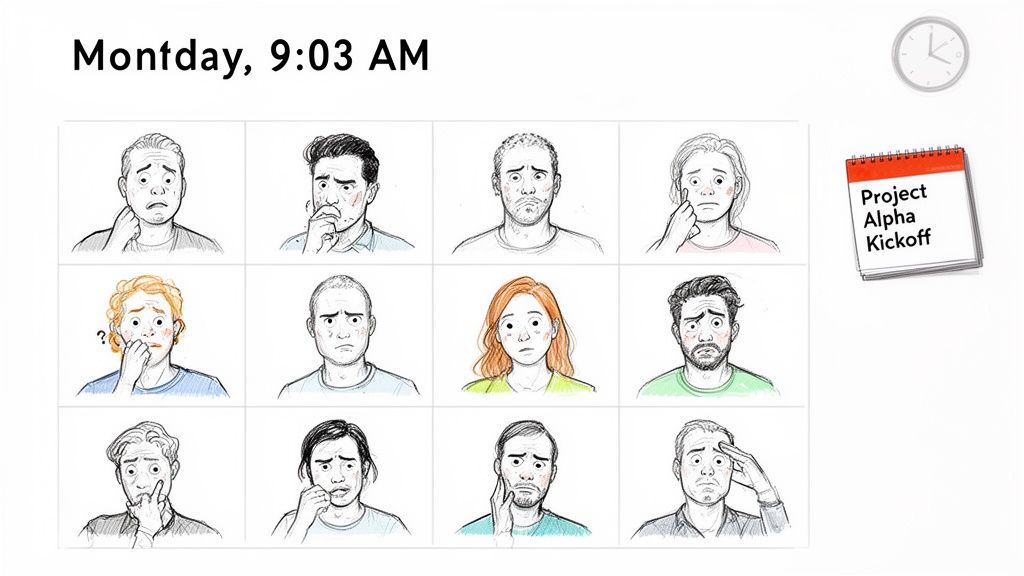
It’s 9:03 AM on Monday. The calendar invite was blunt: ‘Project Alpha Kickoff.’ Ten faces, a mix of confusion and boredom, stare back from the video call. This is the moment a project should ignite, but it feels more like a wake.
An engineer asks about scope, a detail buried on page 12 of a 15-page document no one read. A designer is already multitasking, discreetly reviewing other work on a second monitor. The product manager starts reading bullet points from a slide deck, and you can feel the team's attention evaporating.
This isn’t a launchpad. It’s a slow, expensive drain on energy and budget.
The Momentum Trap
Most kickoffs fail long before the meeting invite is sent. Why? They’re treated like a procedural checkbox, not the project's most critical alignment tool. They fall into what I call the Momentum Trap: a meeting that drains energy instead of creating it.
The trap is sprung by a bad agenda, which is usually just a laundry list of things to talk about.
A powerful agenda isn't a list; it’s a story with a beginning, middle, and end. The beginning sets the scene (the problem), the middle builds the plot (the plan), and the end provides a resolution (the next steps). A list of topics has no narrative arc. It has no momentum.
A weak agenda all but guarantees future misalignment. People leave with different ideas of what success looks like, which is the perfect recipe for failure. Many of the common challenges for product managers are born in these poorly run initial meetings.
Anatomy of a Bad Agenda
So, what does a momentum-killing agenda actually look like? It’s usually full of vague, passive items that invite rambling discussions instead of driving decisions.
You’ve probably seen these culprits:
- "Review Project Goals": This signals a one-way presentation, not a collaborative confirmation. It assumes everyone even agrees on what the goal is.
- "Discuss Timeline": Too broad. A much better item would be "Agree on Launch Date for Phase 1" or "Identify Key Dependencies for the Q3 Timeline."
- "Q&A": Tacking this on at the end is a classic sign of lazy planning. Questions should be woven throughout the meeting to ensure everyone is on the same page at each step.
A friend at a Series B company told me their kickoffs were 60-minute monologues. The team would nod along, then spend the next week asking the exact questions the meeting was meant to answer in various Slack channels. The format never invited real engagement, so it never got any.
From Checklist to Catalyst
To fix this, we have to reframe what an agenda is for. It’s not an itinerary. It’s a machine engineered to produce specific outputs: confirmed decisions, clear roles, and a unified direction. To ensure the team arrives ready and focused, it's worth encouraging a solid clarity morning routine before an early start.
A catalytic agenda turns passive attendees into active participants. It asks probing questions instead of just presenting canned answers. For example, instead of a slide about user personas, you could walk through a real user flow for a critical task, making the user’s experience tangible from the get-go.
This is what I mean.
This guide is your playbook for crafting that catalyst. We'll give you the templates, scripts, and mental models to make sure you never lead a momentum-killing meeting again.
The Kickoff as a Strategic Tool, Not a Ceremony
A kickoff meeting isn't for reading your slides out loud. Its real job is to kill assumptions. It’s an act of Forced Alignment.
Most teams show up with a dozen different ideas about what they’re building. A good kickoff collapses those dozen mental models into one. This is the moment to zoom out before everyone zooms in on their own tasks.
Think of it less like a starting pistol and more like a gyroscope. Its purpose is to stabilize the project against the chaos that's coming: the shifting priorities, the scope creep, the inevitable confusion. It sets the project's center of gravity from day one.
From Information Dump to Project Story
The goal is simple: you're building a shared story. A simple, repeatable narrative about the problem you’re solving, who you’re solving it for, and what winning actually looks like.
When an exec stops a junior developer in the hall, should they both be able to tell the same core story as the product manager?
This story isn't built with dense bullet points. It's built through shared experience. Last quarter I watched a PM at a fintech startup show how this works perfectly. Instead of walking through a PRD for a new "card freeze" feature, she just opened the kickoff by sharing an interactive prototype. It was a tangible artifact, a lot like this Wise card-freezing flow, that made the idea instantly real.
The engineers’ feedback was immediate. They spotted an edge case about temporary freezes that a 20-page document would have completely buried.
The Hard Cost of Misalignment
Why do we obsess over this? Because misalignment is ridiculously expensive. According to Gallup's State of the Global Workplace report, low employee engagement costs the global economy an estimated $8.9 trillion. That’s 9% of global GDP. A kickoff that creates boredom or confusion is a direct deposit into that black hole.
A well-run kickoff is an investment in morale and focus. It’s a statement that the team’s time is valuable and their brains are required, not just their bodies in a chair. By grounding the project in a clear why, you tap into something far more powerful than a task list: intrinsic motivation.
A great kickoff doesn't just start the project. It validates the problem, defines what winning looks like, and clarifies who owns each piece of the victory. It is an act of deliberate, focused alignment.
This is where you shift the team’s focus from "what are we doing?" to "what are we building together, and why does it matter?" This often means navigating a complex web of expectations from different team members and executives. For a structured way to handle these dynamics, our guide on what is stakeholder mapping can help you identify and engage the right people from the very beginning.
Build Your Alignment Toolkit
So, what tools do you bring to this meeting? Choose artifacts that provoke discussion, not just present facts.
Instead of a standard slide deck, try bringing one of these:
- A/B Test Comparisons: Don't just say "we're redesigning the signup." Show a side-by-side comparison, like this one for Cal.com vs. Calendly. This immediately frames the conversation around specific UX trade-offs and their business impact.
- Edge Case Maps: Show, don’t just tell, the team how messy this is going to get. A visual map of what happens when a file upload fails or a network connection dies, like this edge case map for Dropbox, grounds everyone in the real-world challenges ahead.
- Interactive Prototypes: Give the team something to click. A high-fidelity prototype, like this one for a redesigned scheduling page, turns an abstract concept into a physical experience, which invites a much higher quality of feedback.
The takeaway is this: treat your kickoff like the strategic instrument it is. Your goal isn't to check off every item on the agenda. It's to leave the room with a team that isn’t just on the same page, but is genuinely excited to write the next chapter together.
Designing Your Kickoff Agenda Blueprint
Most kickoff agendas are just a list of topics. A glorified to-do list that ensures you talk at people for an hour. A great agenda is different. It’s a blueprint for a specific conversation, engineered to produce a specific outcome: alignment.
Your job as the facilitator isn't to get through the slides. It's to guide the team from a state of individual assumptions to one of shared understanding. You are manufacturing clarity.
This is the simple, powerful flow you're trying to create.
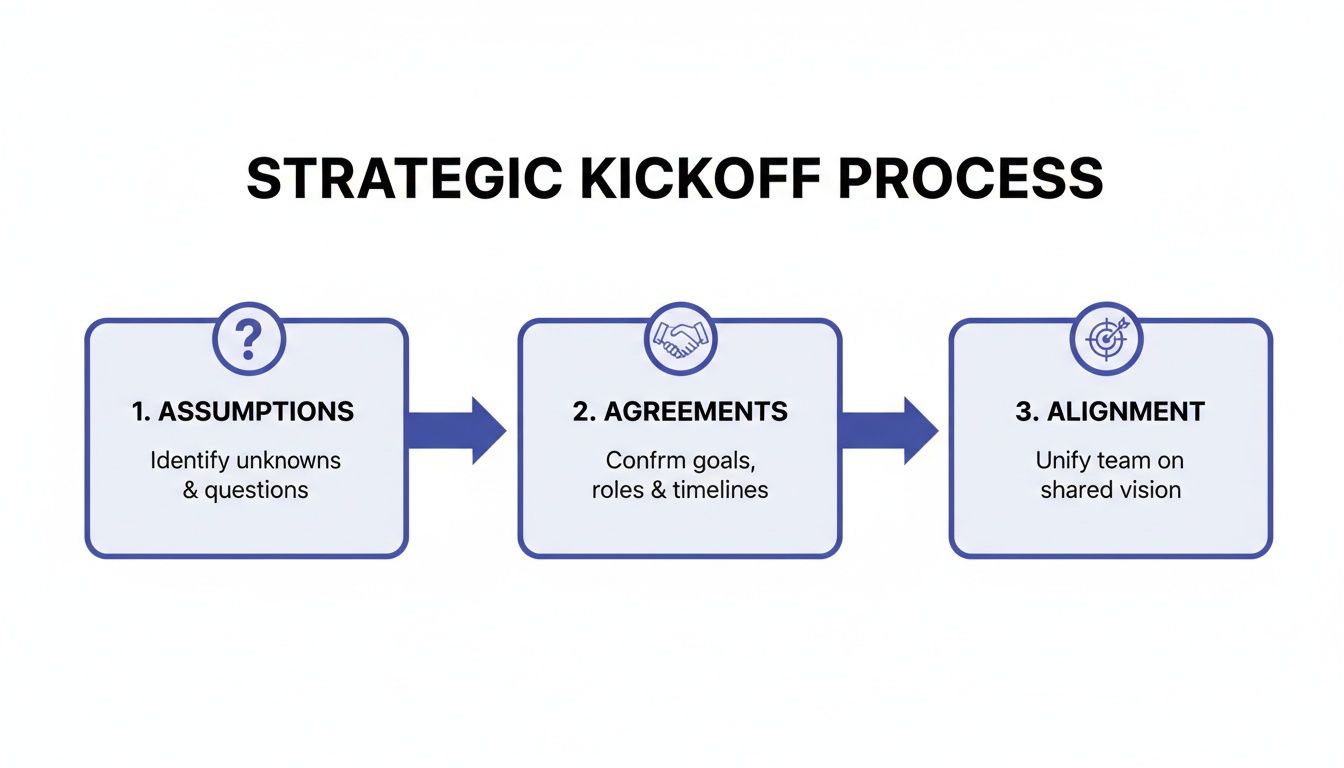
It’s a three-step dance: surface what everyone thinks is true, forge agreement on what is true, and walk away aligned on the work ahead.
The Power of the Pre-Read
The most effective part of your kickoff happens before anyone even joins the call. Sending a thoughtful one-pager is non-negotiable. This isn’t a 20-page document nobody has time for; it’s a primer designed to get everyone’s head in the game.
It should concisely cover:
- The Core Question: Frame the single most important question we need to answer. For instance, "Are we aligned on the primary user problem this feature solves?"
- The Desired Outcome: State what success looks like. Example: "We will leave with an agreed-upon, single-sentence problem statement."
- Key Artifacts: Link to one or two essential documents. A Figr prototype, a PRD, or a user flow diagram. Just the essentials.
This simple act respects everyone’s time. It turns passive attendees into prepared contributors, ready to engage from the very first minute.
Design for Outcomes, Not Topics
This is where most agendas fail. Instead of an agenda item like "Review requirements," your item becomes "Confirm the core user problem." The first is a lecture. The second is a collaborative act with a clear goal.
A friend at a SaaS company recently ran a kickoff to build a new task management feature. The first draft of his agenda was vague. The revised version was a masterpiece of outcome-driven design.
Instead of "Discuss Risks," the agenda item became "Identify Top 3 Dependencies from the Component State Map." This subtle shift changed everything. It forced a focused, tangible discussion instead of a speculative brainstorm.
To make it real, he shared a Figr capture showing all the component states for their new task assignment feature. Suddenly, "risk" wasn't an abstract concept. It was the 11 different states the engineering team would have to build, test, and maintain, right there on the screen. The conversation was immediately grounded in the reality of the work.
Kickoff Meeting Agenda Templates
An agenda without time blocks is just a wish list. Allocating time forces ruthless prioritization. Here are three outcome-focused blueprints you can adapt. Notice how the agenda shifts from a quick internal sync to a complex, cross-functional problem-solving session as the time increases.
These blueprints are starting points, not rigid scripts. The key is to shift your mindset from simply listing topics to choreographing outcomes.
If you’re building out a full project plan, our guide to crafting a complete project proposal outline can provide a helpful structure for the documents that support your kickoff.
Running a Kickoff That Actually Kicks Things Off
A slick agenda is your map. But a map doesn't help much if you can't navigate the terrain. Execution is where the plan hits the real world, and a skilled facilitator is what separates a meeting that just happens from one that actually makes an impact.

Think of the facilitator less like a lecturer and more like a conductor. Their job is to make sure every instrument gets heard at the right moment, from the loudest engineer to the quietest designer, so you end up with music instead of noise. Without that guidance, the meeting just dissolves.
Define the Roles Before You Hit 'Join'
Want to guarantee confusion? Leave roles ambiguous. Before anyone even opens the meeting link, they need to know what part they're playing. This isn't about pulling rank; it’s about making things run smoothly.
Here are the non-negotiable roles for any kickoff:
- The Facilitator: This person drives the meeting but stays neutral on the content. Their one and only job is to get the team to the outcomes laid out in the agenda. It’s often the Product Manager, but it doesn’t have to be.
- The Decider: Who has the final say when the team is stuck? This is your project owner or a lead stakeholder. Naming them upfront saves everyone from the misery of a circular debate.
- The Note-Taker: Their role isn't just to type everything down. They need to capture three very specific things: decisions made, actions assigned (with names and dates), and open questions for the parking lot.
Getting this straight avoids that awkward silence when someone eventually asks, "So... who's actually making the call here?" It replaces that ambiguity with a clear path forward.
Stop Talking, Start Showing
The basic gist is this: people can’t align around ideas they can’t see. The single most effective facilitation move is to anchor every conversation to something tangible. An abstract debate about "the user experience" goes nowhere. A focused walkthrough of a user flow changes everything.
Just last week, I saw a PM kick off a new AI playlist feature for a Spotify-like service. Instead of a slide deck, she shared her screen and pulled up a single artifact: a complete user flow from Figr that mapped the entire journey, which you can check out on the project canvas.
She walked the team through it. Within ten minutes, an engineer spotted a logic gap: what happens if the AI has no listening history to work with? A designer then questioned the UI for when a playlist generation fails. These weren't vague worries; they were concrete problems everyone could see because they were all looking at the same map.
A visual artifact acts as a focusing lens. It forces the team to confront the concrete details of the work, moving the conversation from "what if" to "what happens when."
Guiding the Conversation
As the facilitator, you need a few phrases in your back pocket to manage the room and keep things productive. Your job is to protect the agenda from getting derailed while still making sure everyone feels heard.
Here are a few scripts I use all the time:
- When a discussion veers off-course: "That's a great point for Phase 2. Let's get it in the parking lot so we don't lose it, and get back to our main goal for today: defining the MVP."
- To pull in quieter folks: "Sarah, you've spent a lot of time in this part of the codebase. I’m curious what red flags this approach raises for you."
- To break a stalemate: "Okay, it sounds like we're circling between two options. Let's take two minutes to list the pros and cons of each, and then we'll ask our Decider to make the call so we can move on."
And this kind of alignment isn't just for small product teams. In early 2026, the global IT firm SEIDOR ran a kickoff for over 10,000 professionals in 45 countries to align on its 2026–2030 growth plan. The agenda was built around concrete pillars like AI integration, turning a massive audience into a focused team. You can read more about their global growth strategy kickoff.
Running a strong agenda kick off meeting is a real skill. It takes prep work, confidence, and the ability to steer a room full of smart people toward a common goal. When you get it right, the kickoff stops being a mandatory check-in and becomes the single most powerful moment of your project.
The Post-Kickoff Ritual To Maintain Momentum
The kickoff ends. The team is nodding. For a moment, you’ve achieved perfect alignment and the project feels unstoppable.
That feeling is fragile. It will last about an hour.
Momentum isn’t a solid state; it’s a vapor. It dissipates the second the Zoom window closes. A kickoff's impact fades almost immediately if it isn't cemented by a deliberate follow-up. Without it, all the clarity you just manufactured fractures back into individual assumptions by the next morning. The meeting itself is only half the battle.
The real work starts now.
From Minutes to Mandates
Forget traditional meeting minutes. Who reads those, anyway? A simple list of bullet points has no teeth. What you need is a one-page artifact that becomes the project’s official source of truth, sent within hours, not days.
I call this the “Decisions, Actions, and Open Questions” (DAO) summary. It’s not a record of conversation. It's a record of commitment.
- Decisions: What did we formally agree on? State it plainly. "We will build for iOS first, not Android."
- Actions: Who is doing what and by when? Every action item needs a single owner and a hard deadline. "Priya will finalize the PRD by EOD Friday."
- Open Questions: What did we intentionally not decide? This acknowledges the unresolved issues, assuring the team they were heard. "We will schedule a 30-minute sync to decide on the API integration with the data science team."
The DAO isn't just a summary; it's the project's foundational legal document. It's what you point to in two weeks when someone says, “Wait, I thought we were going to…” You can learn more about how clear documentation helps in our article about how to prevent scope creep on your projects.
Measuring the Echo of a Good Kickoff
So, how do you know if your kickoff was actually successful? You don’t measure it by how good people felt leaving the room. You measure it by what happens next.
There are two kinds of signals to watch for.
A leading indicator is the speed and clarity of the team’s work in the first week. Do engineers immediately start asking specific, second-order questions? Does design start exploring the agreed-upon user flow without reconfirming the core problem? High-quality initial activity is a sure sign of true alignment.
A lagging indicator is a reduction in clarification meetings three weeks from now. If you find yourself in endless follow-ups to re-litigate decisions, your kickoff failed, no matter how great the agenda looked. A kickoff isn't just to start work; it's to make future meetings unnecessary.
In short, a successful kickoff is one that makes the next meeting a progress report, not another alignment session.
I saw a product team last quarter use a Figr-generated prototype of a new LinkedIn Job Posting flow in their kickoff. The leading indicator was immediate: within a day, QA was already using the prototype to draft initial test cases and asking about specific error states they saw. That never would have happened from a slide deck.
Your First Turn of the Flywheel
This might sound like a lot. It’s tempting to think you need to overhaul your entire company’s meeting culture. You don’t.
The U.S. Department of Education doesn't try to solve the entire student loan crisis in a single session; they hold focused negotiated rulemakings. As a recent TICAS report highlights, they create specific agendas on narrow topics like loan limits and repayment plans to make incremental progress.
Your takeaway is much smaller and more achievable.
Pick one upcoming project. Just one. Build a single, outcome-focused agenda for its kickoff. Send one concise pre-read with a core question. Facilitate that one meeting with the explicit goal of producing a DAO summary.
That is your first turn of the flywheel. It’s the small, focused action that begins to build the momentum you actually need.
A Few Questions I Get All The Time
Even with a perfect playbook, a kickoff can go sideways. Things come up. People are people. After facilitating hundreds of these, I’ve seen the same questions and pitfalls appear again and again. Here are my hard-earned answers.
What’s the Single Biggest Mistake People Make?
Easy. Treating the kickoff like a lecture. It’s that classic moment when a leader sends over a 20-page PRD ten minutes before the meeting, then spends the next hour reading slides verbatim. This isn't alignment; it's a one-way information dump that kills engagement on arrival.
The point isn't just to present facts. It’s to forge a shared understanding and walk out of the room with the entire team nodding in agreement on what you're building, and why.
How Do I Handle That One Stakeholder Who Derails the Agenda?
Ah, the agenda-hijacker. This is where a facilitator proves their worth. The move is simple: Acknowledge, Park, and Redirect. When someone brings up a topic that feels urgent to them but is out of scope for the kickoff, you have to validate their point without letting it sink the meeting.
Try this: "That's a crucial point, and we absolutely need to address it. I'm adding it to our 'parking lot' right now to make sure it gets the attention it deserves after this meeting. For today, let's get back to our primary goal."
This shows you’re listening and you respect their input, but it also makes it clear you’re protecting the meeting’s focus. You stay in control without being dismissive.
Can We Just Do the Kickoff Asynchronously?
You can do parts of it asynchronously, but the most important part? Absolutely not. Sending out pre-reads and gathering initial questions in Slack or email is a great way to prep. But the core session—the part where you build real consensus on the problem, the goals, and who owns what—has to be a live, real-time conversation. This is where you iron out the nuances, read the room, and get the kind of genuine buy-in that a document will never give you.
Seriously, How Many People Should Be in This Meeting?
If you can, stick to the "two-pizza rule" made famous by Amazon's Jeff Bezos. A working kickoff needs to be small enough for every single person to have a voice. In my experience, that means 8-10 people, max.
This isn't an all-hands. This is the core crew: the key designers, engineers, and PMs who will actually do the work. If you have a larger group of stakeholders who need to be informed, hold a separate, higher-level briefing for them. Trying to cram everyone into one room is a guaranteed way to make sure most people stay silent.
A great kickoff meeting is an act of design, not an accident. It requires thoughtful preparation and confident facilitation. When you ground these conversations in tangible artifacts like user flows and prototypes, you can skip the abstract debates and get straight to alignment. With a tool like Figr, you're not just talking about the work; you're looking at it together. Stop starting from scratch and start shipping faster.