

Your budget meeting is next week. You have a dozen great ideas, a messy document full of notes, and that sinking feeling that none of it will convince anyone important.
Even the phrase "project proposal" feels heavy, like a homework assignment for grown-ups.
A traditional proposal is a static photograph, a snapshot in time that's already obsolete the moment you hit send. It's written to pass a test, to get a signature. But what if its real job isn't just to get a 'yes'? What if its job is to create a shared reality?
The Blueprint Method: Your Proposal as a Map
This is what I mean. We need to reframe the proposal. It’s not a document to be approved; it’s a dynamic blueprint, a shared map for a journey. A good map doesn't just show the destination. It charts the terrain, marks potential hazards, and gets everyone aligned on the route before anyone takes a single step.
This "Blueprint Method" turns a sterile checklist into a compelling narrative. It answers the three unspoken questions every executive is really asking:
Why this? Why is this project more important than the ten other things competing for the same people and money?
Why now? What makes this initiative urgent and timely for the business at this exact moment?
What's the return? How will we measure success, and what tangible value will it deliver?
A friend of mine, a PM at a B2B SaaS company, told me about a proposal he spent three weeks perfecting. It was dense, thorough, and completely ignored. Why? It read like an instruction manual, not a story.
He went back, cut it in half, and led with a simple user flow diagram showing the "before" and "after" of the customer experience. The project was approved the next day.
The lesson here is simple: artifacts beat assertions. A link to a quick prototype of a redesigned scheduling page is infinitely more persuasive than three paragraphs describing it.
Shifting from Permission to Conviction
The real power of a well-structured project proposal is its ability to build conviction. It should anticipate objections, show strategic foresight, and become a living guide for your team from kickoff to launch.
When you present a map, you invite collaboration. When you hand over a rigid document, you invite critique.
A proposal built like a blueprint serves two masters. It satisfies the organizational need for process while serving the project's need for absolute clarity and alignment. As author Jane Friedman says, a book proposal is a "business case for why your book should exist." Your project proposal is no different. It must make an undeniable case for your project's existence.
This is a fundamental shift in mindset. You're no longer just asking for permission. You're building a coalition of believers who get the vision and are confident in the plan. That’s the difference between a proposal that gets signed and a project that truly succeeds.
Defining The Core Architecture: The Why and What
A project proposal is like a building's foundation. A weak one gets you a wobbly, over-budget structure that's years behind schedule. A strong one aligns everyone before the first line of code is written.
The foundation of that blueprint, the concrete and rebar holding everything up, is made of just three critical pieces: the Problem Statement, your Success Metrics, and the Scope.
Get these right, and everything else falls into place. Get them wrong, and you're building on shaky ground. Think of it this way:
The Problem Statement is the unstable ground you've identified.
The Success Metrics are the specs for the building you'll put on top of it.
The Scope is the clearly marked property line, telling everyone where work begins and, crucially, where it ends.
This isn't about filling out a template. It's about forging a shared understanding that prevents catastrophic drift down the line.
The Problem Statement: Your True North
Before you build anything, you have to know why. What is the fundamental pain you're trying to solve? A strong problem statement isn't a list of features you want to build; it's a sharp, clear articulation of a problem felt by a specific group of users or by the business itself.
It answers one simple question: What is broken?
A weak problem statement sounds like, "We need a new dashboard." It's a solution looking for a problem.
A strong one sounds like this: "Our support team spends 30% of their time manually pulling data from three different systems to answer basic customer queries, leading to a 24-hour response lag."
See the difference? The first is a vague wish. The second is a quantifiable business pain demanding a solution. When you frame the problem this precisely, the right solution often starts to become obvious. For a deeper dive, we have a whole guide on how to write a powerful problem statement that nails the "why" every time.
Success Metrics: The Definition of Done
If the problem is your "why," success metrics are your "so what?" How will you know, with cold, hard data, that you've actually fixed the problem? This is where you move from abstract goals to concrete, measurable outcomes.
Don't just say, "We want to improve the user experience." That's a platitude.
Instead, ask a more incisive question: What number on our company dashboard will move if we succeed, and by how much?
This forces a level of clarity that can be uncomfortable but is absolutely essential. Your metrics should be things like:
Reduce average ticket response time from 24 hours to 4 hours.
Increase the user activation rate for new sign-ups by 15% in Q3.
Decrease the cart abandonment rate from 8% to 5%.
These aren't aspirations, they're targets. They are the numbers that will show up in your launch announcement and your quarterly review. They are the definition of winning.
Scope: Setting The Property Lines
I once watched a project that started as a simple request to "add a new filter" spiral into a multi-quarter epic that consumed the entire team. Why? The proposal never clearly defined what was out of scope. The simple filter became a full redesign of the search algorithm, then a new indexing system.
The project failed because its property lines were never drawn.
Your scope section needs to be ruthless. It must define not just what you will do, but also what you will not do. This is your primary defense against scope creep. It gives the team air cover when new requests inevitably pop up. You can point back to the blueprint and say, "That's a great idea for phase two, but it's outside the property lines for this build."
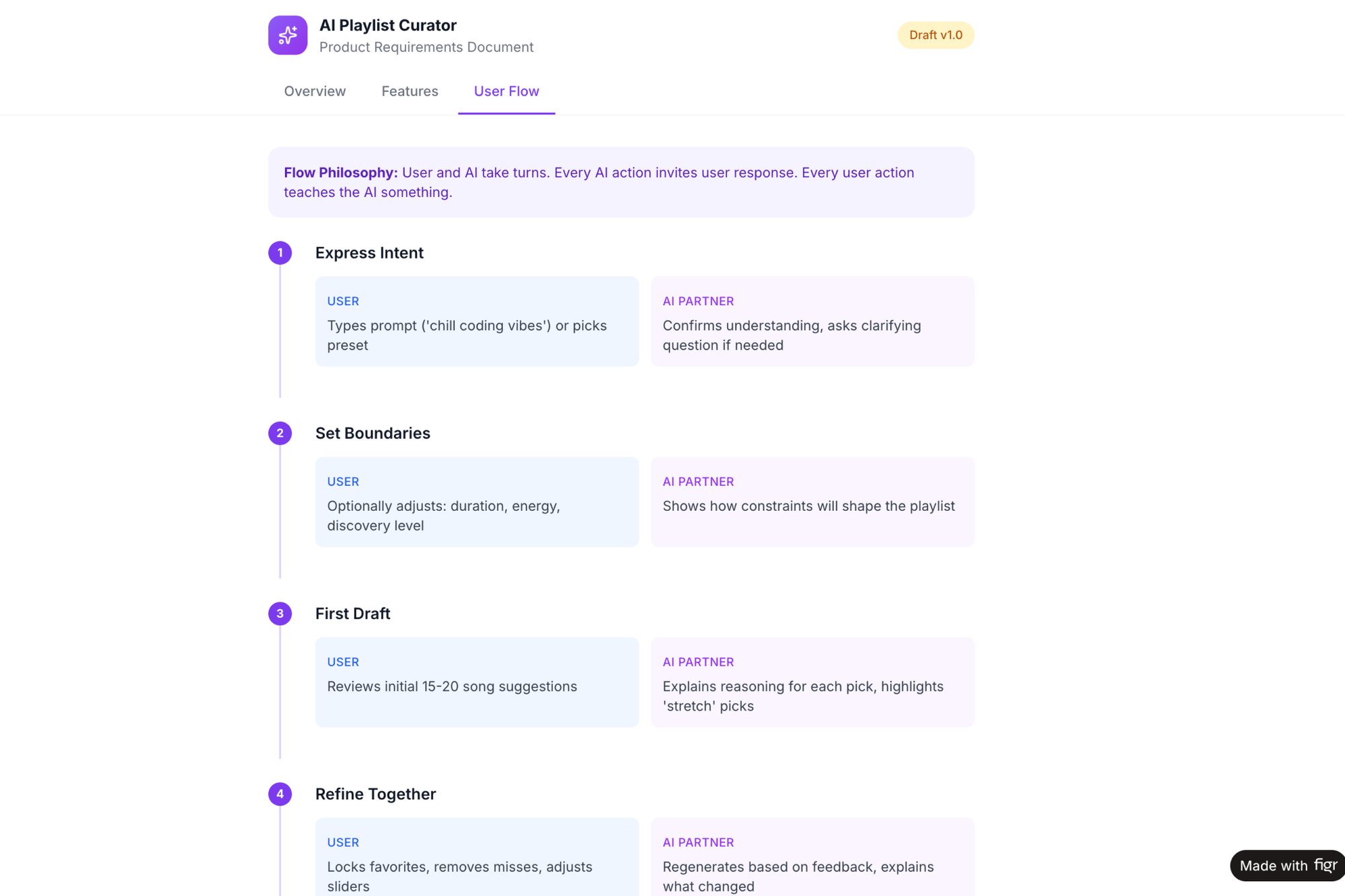
Clarity here is a kindness. A vague paragraph is open to interpretation, but a detailed Product Requirements Document (PRD) is not. An artifact like this comprehensive PRD for Spotify's AI Playlist Curation leaves little doubt about features, user stories, and acceptance criteria. It becomes a source of truth that aligns everyone from engineering to marketing.
Mapping The Execution Plan: The How and When
Okay, so we’ve defined the core of the project: the what and the why. Now we shift from the abstract to the operational. This is where ideas collide with the hard realities of time, money, and people. It’s also where many proposals devolve into a handful of vague dates and generic warnings.
We’re not just building a schedule here. We’re setting an operational tempo.
Think of this part as the logistics plan for a complex mission. You’ve shown stakeholders the destination. Now you have to give them a credible route to get there, complete with contingency plans for when the road gets bumpy. Because it always does.
This visual reinforces how a solid summary, problem statement, metrics, and scope create the foundation for a believable execution plan.
Timelines and Operational Tempo
A timeline isn't a Gantt chart. A Gantt chart is just a picture of a timeline. The real work is defining the rhythm of the project, marked by meaningful milestones that prove you’re actually making progress.
A weak timeline just says, "Phase 1: Q3."
That’s not a plan; it’s a guess.
A strong timeline is specific: "Milestone 1 (Week 4): User authentication flow prototype complete and tested with five internal users." It's accountable. Milestones aren't just dates on a calendar, they are tangible outputs that validate your assumptions and demonstrate momentum. They’re the checkpoints where you can course-correct before it's too late. If you’ve ever managed a project, you know that creating a clear timeline is half the battle. We put together a guide on creating a project roadmap with examples that shows how top teams visualize their execution plans.
Strategic Wargaming: Your Risks
The risk assessment section is too often treated as a box-ticking exercise, filled with predictable entries like "resource constraints." This is a massive missed opportunity. A great risk assessment is a strategic wargame you play against everything that could possibly go wrong.
Your job is to think through the failure modes with painful precision.
Instead of a vague "resource constraints," try this: "Dependency on the platform team's Q3 API release, which has a 40% chance of delay based on their historical delivery cadence."
That kind of specificity proves you understand the real-world friction of your organization. It also transforms a fuzzy anxiety into a concrete problem you can actually plan for. A proposal that acknowledges specific, credible risks is paradoxically more trustworthy than one that ignores them. It signals you're operating in reality, not just the idealized world of a slide deck.
Allocating Resources with Purpose
Finally, we get to resource allocation. This isn’t just a shopping list of names and budget numbers. It's the "who" and "what" required to execute the plan you’ve just laid out. Be specific about the skills needed, not just the headcount.
People: Specify roles and the expertise required. Do you need a senior front-end engineer with deep React experience, or just "one engineer"?
Tools: What software, subscriptions, or hardware does the team absolutely need to get the job done?
Budget: Connect every dollar back to a specific milestone or deliverable. Don't just ask for a lump sum; justify the investment by linking it directly to the value being created.
This whole section of your proposal serves a single purpose: to make the execution of your idea feel not just possible, but inevitable.
From Outline To Artifacts With AI
An outline is just words on a page. It's the architecture of an idea. But a winning proposal needs something more tangible to land. It needs proof. This is where modern tooling completely changes the game, turning your static project proposal into a dynamic, persuasive case that’s hard to ignore.
Think of your proposal like a movie script. The outline is the screenplay, sure, but stakeholders want to see the concept art. The storyboards. A trailer, even. Artifacts, like user flows and prototypes, are the trailers for your project. They make the future feel real, right now.
A friend at a Series C fintech company recently told me how they secured a massive budget for a platform overhaul. Instead of circulating a 30-page document, their lead PM presented a five-page summary and a single link. That link led to an interactive prototype of the new onboarding flow.
The conversation shifted instantly. It went from, "This sounds complicated," to, "When can we get this in front of users?"
Generating High-Fidelity Evidence
The gap between a list of requirements and a tangible artifact used to represent weeks of work. Now, it can be minutes. You can go from a simple prompt to a fully-realized user flow diagram or a list of critical test cases.
What I mean is, you can feed a system a single screenshot and get back a map of every possible user path. This uncovers hidden complexities before a designer ever opens Figma. For example, getting a detailed map of all the edge cases for a component like task assignment reveals the true scope of work, de-risking the entire engineering estimate from day one.
These artifacts serve three critical functions in a proposal:
They make abstract ideas concrete. It's one thing to describe a “streamlined checkout.” It's another to provide a clickable prototype of a redesigned Shopify checkout flow.
They de-risk the project. Uncovering complexity early isn't a problem; it's foresight. Presenting a comprehensive set of test cases for a new feature shows stakeholders you’ve already thought through all the ways it could break.
They demonstrate momentum. An outline is a plan. An artifact is progress. You are showing, not just telling.
A New Standard for Persuasion
This shift has deep implications for how we build and approve projects. The core economic incentive is always to reduce uncertainty. The cheaper and faster you can build a proxy for the final product, the better your decisions will be.
And right now, AI-powered tools are lowering the cost of creating these proxies to near zero.
A project proposal backed by a working prototype and a map of edge cases is not just a request for resources. It's a down payment on the final product. It fundamentally changes the conversation from "should we do this?" to "how quickly can we ship this?".
This approach transforms the proposal process from a persuasive writing exercise into a rapid demonstration of value. You’re replacing vague promises with something real. For teams looking to adopt this workflow, exploring the best AI tools for startups can offer a huge head start.
The next step is to stop thinking about your proposal as a document you write. Start thinking of it as a collection of assets you generate. Take your core problem statement and a screenshot of the relevant product area. Use an AI agent to generate the user flow, identify the edge cases, and build a prototype of the "after" state.
Then, attach those links to your one-page summary.
This is the new standard. It's faster, smarter, and infinitely more persuasive.
Why Blueprints Beat Proposals Every Time
Let's zoom out. Why do so many meticulously written, static proposals fail the moment they hit a dynamic software environment? What’s the invisible force that makes a document feel obsolete the second you hit send?
The basic gist is this: a traditional proposal is an artifact of a gatekeeping culture. It is a document optimized for a single moment: approval. Its primary job is to tick a box, pass a budget review, and get a signature. It’s built to answer the question, "Can we start?"
But that’s entirely the wrong question.
A New Culture of Alignment
The Blueprint Method isn't just a new template for a project proposal outline; it's a different operating system for your team. It's designed for a continuous culture of execution and alignment. It answers a much better question: "Are we all building the same thing?"
This is a profound shift. The goal is no longer to persuade one person one time. The goal is to forge a shared reality that sticks with the project for its entire lifecycle, keeping product, engineering, and design on the same page.
Last year, a head of product at a major logistics company told me their biggest bottleneck wasn't engineering speed or design talent. It was something he called "meeting drift." A project would get approved, but in every meeting that followed, the team would re-litigate the core assumptions because the original proposal left too much open to interpretation.
A well-crafted blueprint kills those meetings. When you can link directly to a detailed user flow or a prototype showing exactly how a feature is supposed to work, you preempt the endless "what if" questions that derail momentum. You spend less time debating hypotheticals and more time building. You can check out our collection of real-world service blueprinting examples to see exactly how this works in practice.
The Economics of Clarity
There's a good reason the global proposal management software market is exploding. A recent industry report projects its value will hit USD 4.57 billion by 2029. That growth isn't just about efficiency; it's a direct response to the massive cost of misalignment in competitive markets.
The tactical process of building a better proposal is directly wired to the strategic goal of building a high-velocity, low-friction product organization. When a blueprint becomes the source of truth, it becomes an economic lever. A Harvard Business Review study on IT projects found a direct link between clear, upfront planning and on-time, on-budget delivery. Projects with excellent planning and a shared understanding are far less likely to suffer from the scope creep and rework that plague so many initiatives.
In short, this is about transforming a bureaucratic hurdle into a strategic accelerator.
The takeaway is simple. Stop writing proposals to get approval. Start building blueprints to create clarity. Your next move isn’t to open a blank document and start summarizing. It’s to take your core idea and generate one tangible artifact, like a user flow or an edge cases map, that makes it real. That single artifact will do more persuasive work than ten pages of text ever could.
Common Questions About Project Proposals
You’re standing at a whiteboard, marker in hand, fielding questions after your presentation. The proposal is solid, the logic is tight, but the room is a symphony of competing anxieties.
The engineer wants more technical detail. The finance lead wants a more granular budget. The VP of Marketing just wants to know what this means for her team’s Q4 roadmap.
Each stakeholder looks at your project through a different lens. Your project proposal outline can't just be one-size-fits-all; it needs to be a prism, capable of refracting your core message into a spectrum of answers that meet each person where they are. How do you build a document that can do that?
How Much Detail Is Too Much
The ideal level of detail is a constant tug-of-war between clarity and cognitive load. Too little, and you look unprepared. Too much, and you overwhelm your audience before they get to the core idea.
The key is to front-load the "why" and link to the "how."
Your main proposal document should be ruthlessly focused on the problem, the proposed solution, and the business outcomes. The granular details, the deep technical specifications, the exhaustive resource lists, should all be appendices or linked artifacts. This structure respects everyone's time. An executive can grasp the strategic vision in five minutes, while an engineering lead can dive into the weeds as needed.
A senior PM I know has a rule: "The main proposal should fit on two screens without scrolling." Anything more, she says, is a sign that you haven't yet found the core of your own argument. It's a test of clarity, not just for the reader, but for the author.
Adapting Your Proposal for Different Audiences
Your project proposal outline must be a living blueprint, not a stone tablet. The core components stay the same, but the emphasis shifts based on who’s reading it.
For Executives and Finance: They care about strategic fit and ROI. Emphasize the Executive Summary, Success Metrics, and Budget.
For Engineering and Design Leads: They need to see the "how." Focus on the Scope, Deliverables, and Risks. A link to a detailed PRD or a user flow, like this one for a new setup flow in Shopify, is far more valuable than paragraphs of text.
For Cross-functional Partners (Marketing, Sales): They need to understand the customer impact and the schedule. Highlight the Problem Statement and Timeline.
When you're thinking about how an outline becomes an approved project, consider the precision required for securing investments. For those aiming to impress stakeholders, mastering the art of presentation is key. Learning how to create a pitch deck that wins funding can transform your ideas into tangible projects.
The goal isn't to create multiple versions of the proposal. It's to structure a single, modular document that lets different stakeholders easily find the information that matters most to them.
A great project proposal isn’t just a document; it’s a tool for alignment. It anticipates questions, provides clarity, and builds confidence. With Figr, you can stop writing proposals and start generating evidence. Transform your ideas into user flows, prototypes, and PRDs that make your case undeniable. Explore Figr today and start shipping faster.