Monday morning, the launch dashboard looked clean enough to calm a nervous executive team. Green arrows. Higher click activity. A tidy story about momentum.
By Wednesday, the story had collapsed.
A PM on my team had pushed a new onboarding flow live after a promising round of prototype feedback and an encouraging A/B read. The “engagement” metric climbed. Then support tickets started piling up. Session replays showed users hammering the same button because they couldn't tell what happened after the first click. The metric had gone up for the worst possible reason.
That's the kind of mistake validity in research is supposed to prevent.
Not in a classroom sense. In a roadmap sense. In a budget sense. In the painfully human sense of realizing that smart people, using real data, can still steer a team in the wrong direction if the data isn't measuring what they think it is.
I've seen this pattern enough times that I now treat validity as an operating discipline, not a research footnote. If your research lacks validity, your team doesn't just get a few details wrong. You can end up validating the wrong problem, prioritizing the wrong feature, and scaling the wrong behavior.
The Launch That Taught Us Nothing
The ugliest launches aren't the ones that fail loudly. They're the ones that look successful just long enough to earn trust.
A few quarters ago, I watched a product team celebrate a release because every early signal seemed to agree. More users touched the new flow. The funnel looked more active. Interview participants had said the concept “made sense.” Engineering had shipped on time. Sales liked the narrative.
Then retention data for the new cohort started to wobble.
What had looked like healthy engagement turned out to be friction. What looked like interest was confusion. What looked like validation was a stack of weak proxies leaning on each other. Nobody had asked the hard question early enough: are we measuring real value, or just visible activity?
Where teams usually go wrong
Most product teams don't fail because they ignore research. They fail because they over-trust research that feels directionally right.
That happens in familiar ways:
- Proxy worship: A team uses clicks, dwell time, or feature opens as a stand-in for success, even when those signals may reflect hesitation or error.
- Sample comfort: Researchers speak mostly to active users, friendly customers, or internal champions because they're easier to recruit.
- Narrative lock-in: Once a launch story sounds coherent, people stop looking for disconfirming evidence.
- Metric drift: A KPI starts as a practical signal, then slowly becomes a belief system.
One PM told me, “We had evidence from five different places.” He was right. The trouble was that all five places were vulnerable to the same bad assumption.
If the underlying measure is wrong, more dashboards don't make you safer. They make you more confident.
That's why validity matters so much in product work. It's the difference between insight and theater.
The business cost isn't abstract
When validity breaks, teams usually pay three times.
First, they spend engineering time on the wrong thing. Then they spend political capital defending it. Then they spend even more time unwinding it after customers expose the flaw.
By the time the team admits the research was weak, the cost is no longer “bad analysis.” It's roadmap drag, missed trust, and another quarter of explaining why a priority changed again.
The lesson wasn't that research failed us.
The lesson was that invalid research gave us the illusion of certainty.
What Is Research Validity Really
Validity sounds academic until you've built a roadmap on top of bad data. Then it becomes painfully practical.
The simplest way to think about it is this: validity in research asks whether your evidence deserves the decision you're about to make. Are you measuring the thing you claim to measure? Are your conclusions justified? Will the finding hold up outside the narrow setup that produced it?
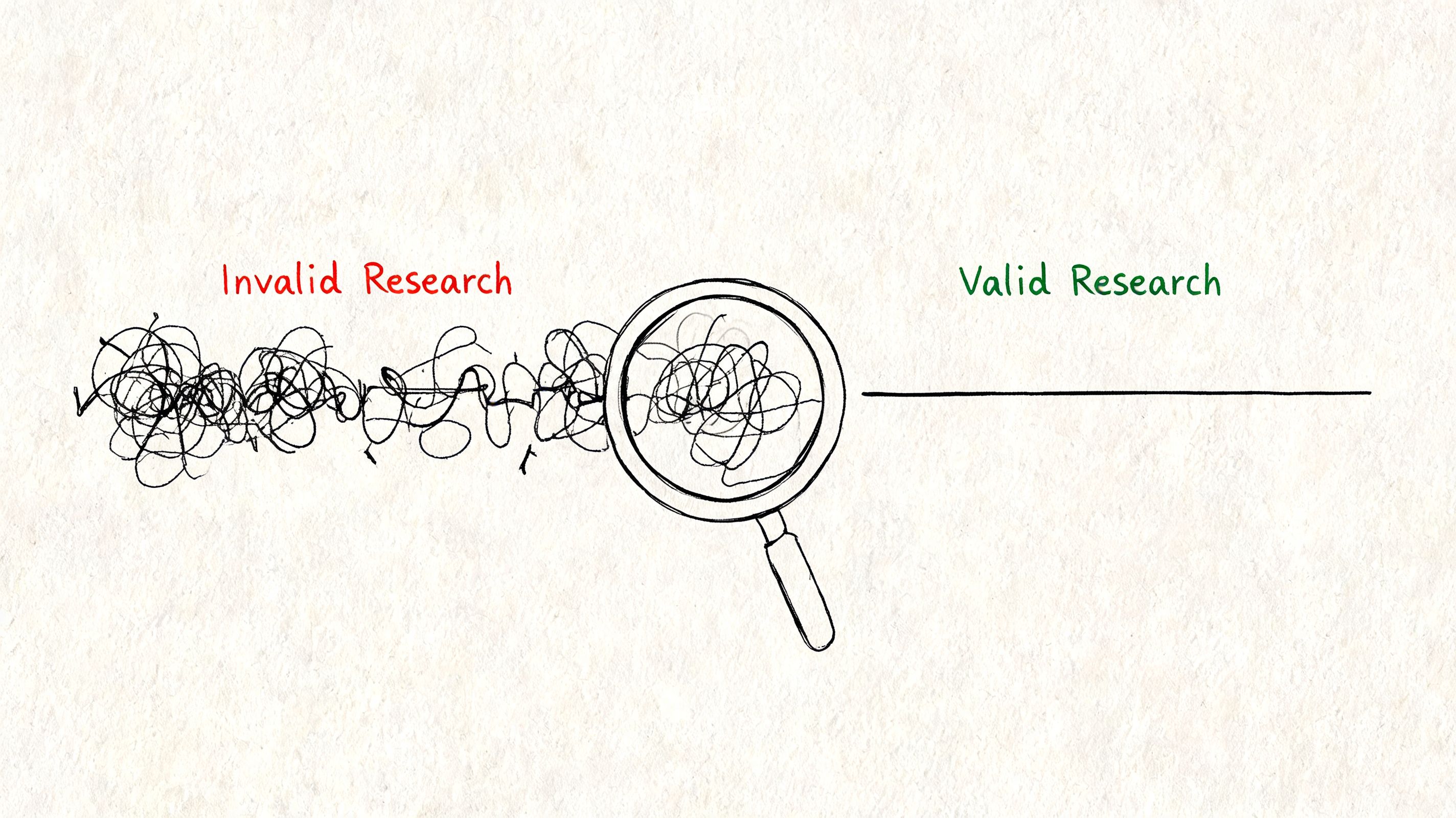
I think of it as the foundation under a product house. Features, positioning, onboarding, pricing tests, lifecycle messaging, all of it rests on assumptions about user behavior. If the foundation is unstable, the rest can look polished and still crack under pressure.
The basic gist is this: validity isn't about proving you're right. It's about reducing the odds that you're confidently wrong.
The confidence test
Here's the practical test I use in reviews:
Ask: if this result is true, what exactly does it let us believe or do?
That question forces precision. A survey response might tell you people like the idea of a feature. It does not automatically tell you they'll adopt it in a live workflow. A prototype success might show people can complete a task with guidance. It does not automatically prove the experience will work in production.
This gap matters in quantitative UX work. Open Textbook research methods guidance notes that criterion validity matters when a new measure needs to line up with an established outcome, such as a prototype metric aligning with actual conversion behavior. The same source states that low validity, such as Pearson correlation r = 0.2, can lead to 40-50% higher Type II errors in underpowered SaaS experiments and increase rework by 25%. That's not a small technical flaw. It's a decision-quality problem.
What validity changes in practice
Once teams grasp this, they stop asking only “what did users say?” and start asking better questions:
- Measurement question: Did we capture the right thing?
- Inference question: Did we draw too strong a conclusion from it?
- Transfer question: Will this still be true outside our test setup?
If you work across interviews, analytics, prototypes, and A/B tests, this lens sharpens everything. It also makes mixed-method work stronger, especially when paired with practical insights for product managers who need to interpret messy evidence without pretending it's cleaner than it is.
Validity won't make research perfect.
It will make your decisions harder to fool.
The Four Pillars of Valid Research
When product teams talk about “good research,” they often blur four different questions together. That's where confusion starts. A study can be strong in one way and weak in another.

I've found it useful to treat validity in research as four separate pillars. If one gives way, the whole structure leans.
Internal validity
This is the cause-and-effect question.
If conversion moved after your onboarding change, did the change cause it? Or did something else happen at the same time, such as a pricing update, a campaign spike, or a sales-led onboarding push?
Internal validity matters most when teams want to make a causal claim. “The redesign improved activation” is a causal claim. “Activation increased after the redesign” is only a time-based observation. Teams confuse those all the time.
What works here is discipline. Stable test conditions. Clear comparison groups. Fewer overlapping changes. A willingness to say, “we observed movement, but we can't yet isolate why.”
External validity
This is the transfer question.
Will a finding from a narrow context hold somewhere else? A test with friendly beta users in one market may not survive contact with new users, different devices, different levels of product literacy, or different motivations.
One of the most common traps in SaaS is assuming that a finding from your easiest-to-reach users represents your future customers. It often doesn't.
Practical rule: if the participants are unusually motivated, informed, or forgiving, your findings may be true for them and still fail in the market.
Construct validity
This is the meaning question. Are you measuring the concept you say you are?
If you claim to measure trust, are you really measuring trust, or are you just measuring familiarity? If you say a score captures product clarity, is it clarity, or simple task completion under ideal conditions?
This pillar has deep roots. Enago's summary of construct validity points back to Cronbach and Meehl's 1955 work, Construct Validity in Psychological Tests, and notes that without strong construct validity, 40-60% of early psychological tests overstated trait measurements. The same source says that in modern UX, strong construct validity with Cronbach's α > 0.8 predicts user retention 25% better.
That's why naming the construct clearly matters before anyone writes a survey, scripts an interview, or picks a success metric.
A useful complement is choosing the right methods for user research so your measure matches the decision you need to make, not just the method your team already knows how to run.
The video below gives a helpful primer on the broader validity framework.
Content validity and statistical conclusion validity
Content validity asks whether your measure covers the full shape of the concept. If you assess onboarding quality using only speed, you may ignore clarity, confidence, and error recovery. Your score becomes neat but incomplete.
Statistical conclusion validity asks whether your analysis supports the conclusion. Did you have enough power? Did you run too many tests? Did noise get promoted into a finding?
Here's a simple way to separate the two:
| Pillar | What it asks | Product example |
|---|---|---|
| Content validity | Did we cover the full concept? | Onboarding research includes comprehension, effort, and completion, not just time to finish |
| Statistical conclusion validity | Do the numbers support the claim? | An A/B test result is interpreted only after checking power and error risk |
Teams rarely fail because they've never heard these terms.
They fail because nobody stopped the meeting long enough to ask which pillar was weak.
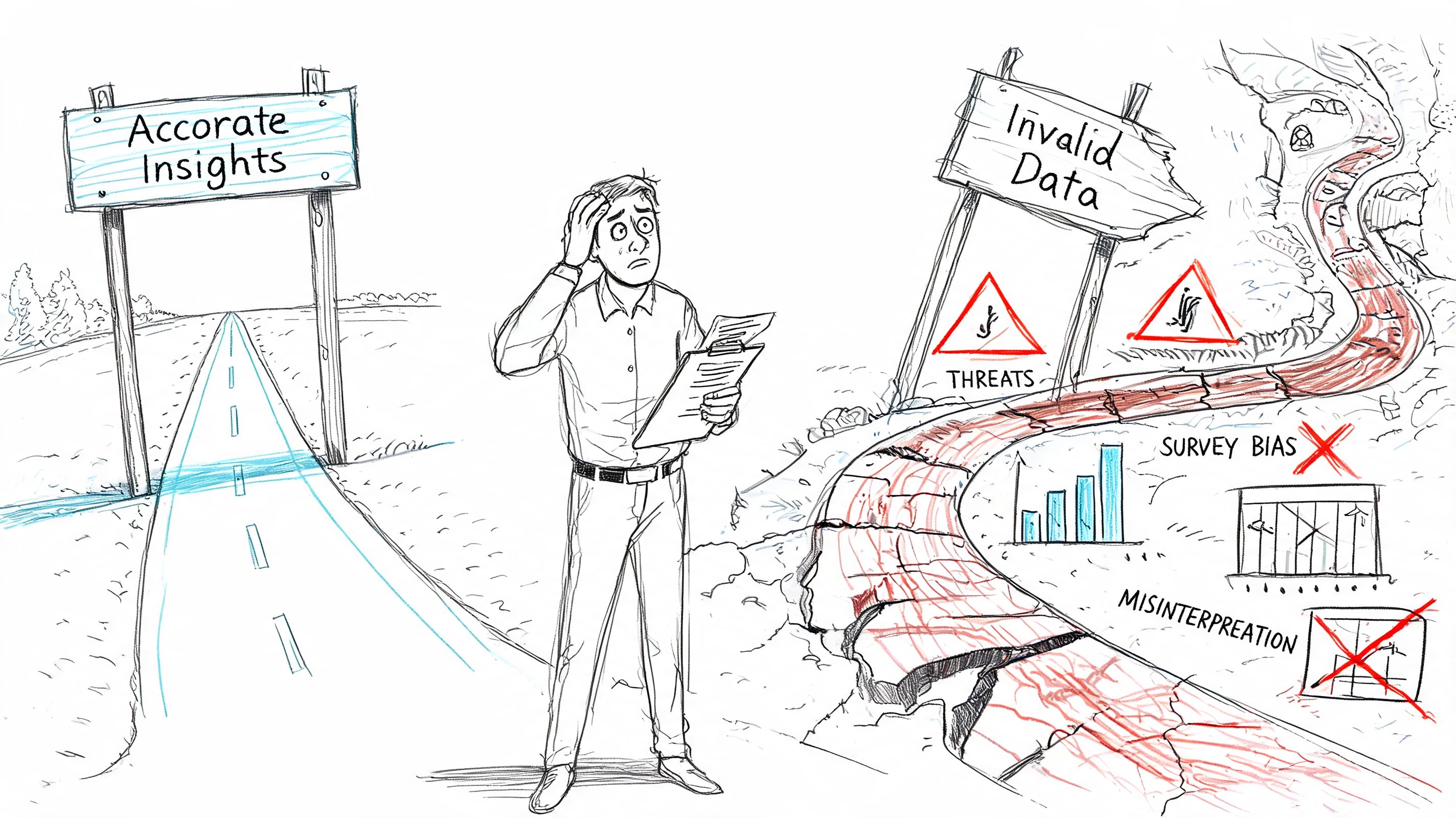
Common Threats That Invalidate Your Work
Most invalid research doesn't look reckless. It looks efficient.
The interview recruit went fast because customer success had a list ready. The survey shipped quickly because the PM reused last quarter's questions. The experiment concluded early because leadership wanted an answer before planning. Each step felt reasonable. Together, they bent the result.
The familiar failure modes
I keep seeing the same threats show up across surveys, usability tests, and experiments:
- Selection bias: You recruit power users, recent signups, or highly responsive customers and mistake them for the whole market.
- Timing effects: You run research during a major campaign, a seasonal spike, or a noisy release period.
- Leading prompts: The question nudges the answer before the participant thinks.
- Proxy mismatch: You measure motion instead of progress.
- Analysis overreach: You stretch a weak signal into a roadmap-level conclusion.
Each one can distort judgment. None of them require bad intent.
The biggest blind spot is usually who got left out
External validity breaks hardest when teams exclude users whose behavior is less visible in day-to-day product conversations. That pattern isn't limited to software. JAMA Network Open reporting on underserved populations and external validity notes that underrepresentation undermines generalizability and can worsen disparities. The same verified data draws a direct analogy for product teams: prototypes that ignore diverse users can produce 20-30% higher churn in underrepresented segments.
That's the kind of problem dashboards often hide.
If your test group is made up mostly of confident users on modern devices with strong English proficiency and stable connectivity, you may be learning more about your recruiting habits than your product.
Research gets distorted long before analysis. It often happens the moment a team decides who counts as a “normal user.”
What this looks like in shipping teams
A few warning signs usually tell you validity is drifting:
| Threat | What teams say | What it often means |
|---|---|---|
| Skewed recruiting | “We just used the fastest list available” | Convenience replaced representativeness |
| Vague questions | “Participants understood what we meant” | The team filled in meaning after the fact |
| Early experiment calls | “The trend is clear enough” | Statistical patience ran out before confidence arrived |
Disciplined experimentation helps, especially if teams follow strong A/B testing best practices and treat sample design, timing, and decision thresholds as part of the research itself, not admin work around it.
What doesn't work is trying to fix a biased setup with more enthusiasm in the readout.
How to Assess Validity in Product Research
You don't need a psychometrics lab to assess validity in research. You need a few habits that force the team to slow down at the right moments.
I use a simple rule: test the measure, test the interpretation, then test the handoff into decision-making. Most bad research survives because nobody checks all three.
For qualitative work
Qualitative studies fail validity tests when teams confuse vivid comments with dependable patterns. One strong interview can reshape a room because humans are built to remember stories more than distributions.
What works better is triangulation. If an interview theme appears in support tickets, session replays, and analytics, it becomes harder to dismiss and harder to romanticize. Member checking helps too. Ask participants whether your interpretation matches what they meant, not just whether they liked the conversation.
A few practical checks help:
- Clarify the construct: Write down what you mean by “trust,” “friction,” or “confidence” before the first interview.
- Audit your prompts: Remove wording that implies the right answer.
- Compare sources: Look for agreement and disagreement across methods.
- Stress test edge cases: Include users who struggle, hesitate, or abandon.
Teams running moderated studies can sharpen this further with usability testing tips for product teams, especially when task framing and observation discipline matter more than polished scripts.
For quantitative work
Quantitative validity breaks when a metric looks plausible but isn't anchored to a real outcome. That's why I ask analysts a blunt question: “What known behavior should this score correlate with?”
The answer doesn't need to be fancy. It does need to be explicit.
Metaplane's overview of construct validity notes that teams can assess construct validity with confirmatory factor analysis on captured screens, using n≥300 for stability, and that RMSEA ≤0.06 indicates good fit. The same verified data says tools with high construct validity correlate 0.75 with real-world retention, compared with 0.45 for tools relying only on face validity, and can cut revisions by 35%.
Those numbers matter less as targets to memorize and more as a reminder that validity can be examined, not guessed.
The often-ignored operational layer
There is another weak point that is frequently overlooked: data quality within the pipeline itself. If your survey panel has duplicate respondents, your CRM has stale contacts, or your follow-up sample is polluted by bad records, the research can degrade before analysis starts.
That's why operational hygiene matters. If your team runs recruitment or post-study follow-ups through outbound channels, resources on validating email addresses for B2B outreach can help reduce avoidable noise before it leaks into sample quality.
Better analysis can't rescue bad input data. It can only describe it more elegantly.
The practical standard is simple. Before trusting the result, ask whether the measure is stable, whether it maps to a real outcome, and whether the data collection process itself stayed clean.
Real-World Scenarios and Trade-Offs
A friend at a Series C company told me they had three days to validate a new workflow before leadership locked the quarter's priorities. They knew a deeper study would be better. They also knew the calendar wouldn't wait.
That's the tension every product team lives with.
The wrong response is perfectionism. The equally wrong response is pretending speed erases the need for validity. Good teams learn to scale rigor to risk.
When quick research is good enough
A fast usability test can be enough when the decision is local and reversible. If you're choosing between two button labels or checking whether users can find an entry point, a lightweight test may do the job.
It stops being enough when the decision is structural. New pricing logic, onboarding strategy, segmentation assumptions, and activation definitions deserve more than a rushed signal.
Here's the filter I use:
- Low-cost reversal: move faster, but name the uncertainty.
- High-cost commitment: increase rigor before rollout.
- Broad organizational impact: involve analytics and research early.
- Vulnerable user groups affected: widen the sample before declaring success.
Speed without validity is expensive
Teams often think validity slows them down. Usually, it saves them from compounding waste.
The NIH-hosted discussion of statistical conclusion validity traces the concept to Cook and Campbell's 1979 work and notes that when statistical power is below 80%, the risk of Type II errors is over 20%. The same verified data states that a 2018 analysis of 1,000+ A/B tests found 30% suffered from power issues, costing SaaS firms millions in misguided feature rollouts.
That's the hidden economics of rushed decision-making. A weak experiment doesn't just create uncertainty. It often creates false confidence at exactly the moment the team wants permission to scale.
The steering wheel, not the brake
Why do teams still cut corners? Because incentives push toward visible speed. Leaders want progress they can present. PMs want answers before planning locks. Researchers don't want to be cast as blockers.
But validity isn't the brake pedal.
It's the steering wheel.
A team with weak validity can move fast in a straight line toward the wrong hill. A team with decent validity may move slightly slower at first, then avoid months of rework, defensive storytelling, and messy reversals.
That trade-off gets easier once leaders start asking not only “how fast can we decide?” but “how wrong can we afford to be?”
The One-Page Validity Checklist
Research teams often don't need another research manifesto. Instead, they require a resource they can access before a project kickoff, before a launch review, or before a colleague claims, “this is good enough.”
Use this as a working standard.
Validity Checklist for Product Research
| Phase | Check | Key Question |
|---|---|---|
| Planning | Define the construct | What exactly are we trying to measure, and what is it not? |
| Planning | Match method to decision | Does this method actually support the decision we want to make? |
| Planning | Review the sample | Do these participants reflect the users affected by the decision? |
| Planning | Check exclusions | Who are we leaving out, and how could that distort the finding? |
| Execution | Audit prompts and tasks | Are we leading participants toward the answer we hope to hear? |
| Execution | Watch context | Is timing, seasonality, or a parallel release contaminating the result? |
| Execution | Compare evidence streams | Do interviews, analytics, and behavior point in the same direction? |
| Analysis | Challenge the first story | What else could explain this result? |
| Analysis | Separate signal from proxy | Are we measuring actual value or just visible activity? |
| Analysis | Set decision limits | What can we confidently conclude, and what remains uncertain? |
How to use it in real meetings
Don't treat this as a compliance artifact.
Use it to create friction in the right place. If a PM can't clearly define the construct, pause. If the sample is obviously narrow, say so out loud. If the team is about to make a broad claim from a thin signal, downgrade the decision, not the standard.
I also like pairing this with lightweight review rituals, especially when teams are already identifying product flaws through UX checks and want one shared language for evidence quality.
In short, validity in research becomes useful when it turns from a concept into a habit. A short checklist won't make your work perfect, but it will catch a surprising number of expensive mistakes before they harden into roadmap commitments.
Figr helps product teams turn messy product context into usable artifacts without starting from scratch. If you want a faster way to map flows, generate PRDs, surface edge cases, review UX against your live product, and create production-ready design outputs grounded in real app behavior, take a look at Figr.