

The debate in the conference room has circled the same point for twenty minutes: Do users want the filter menu on the left or at the top? It feels like every opinion is equally valid and equally loud. This is the moment where good intentions stall, where velocity dies, and where products are built on guesswork instead of evidence. The right ux research course provides the tools to break these deadlocks with data, not just another opinion.
A high-quality UX research course isn’t about learning to ask questions, it’s about learning to build a system for finding answers. It’s the difference between navigating with a compass and navigating by staring at the sun. One gives you a process for finding true north, the other just gives you a headache.
This is what I mean: research transforms product development from a series of subjective arguments into an objective, evidence-led process. This is what prevents costly rework and ensures you’re building something people actually need, not just what the loudest person in the room wants. For example, a clear set of test cases for a critical flow can settle a debate in hours, not weeks.
This guide breaks down the best courses not by their marketing copy, but by the specific job they help you do: turning ambiguity into a clear, actionable path forward. We've analyzed the top online and in-person programs from Coursera, Nielsen Norman Group, and others to help you find the perfect fit. For each option, you'll find a clear breakdown of the target audience, syllabus highlights, project work, and an honest assessment of its strengths and weaknesses. After gaining these new skills, knowing how to build a compelling career portfolio is the essential next step to showcase your expertise. This list is your map to finding the right training to make that happen.
1. Coursera
Coursera acts as a digital university library for the modern product team. It’s less a single course and more a vast ecosystem of learning paths, from foundational certificates to specialized, university-backed programs. For aspiring researchers or Product Managers needing to formalize their skills, this is often the most accessible starting point for a structured UX research course. It’s the place you go for a recognized credential without the commitment of a full degree program.
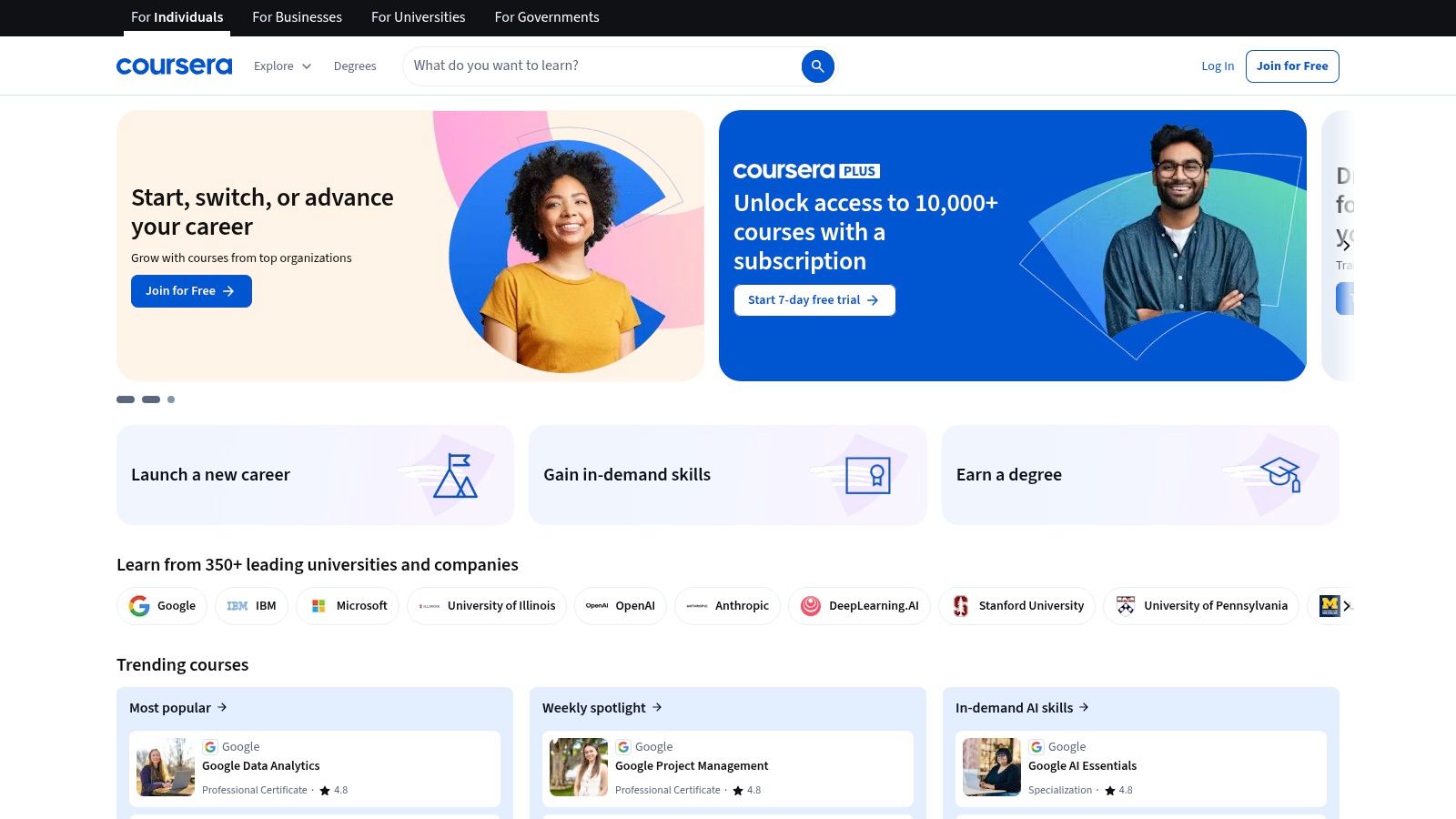
The platform's strength lies in its partnerships. The Google UX Design Professional Certificate is a standout, offering a comprehensive, beginner-friendly curriculum that includes dedicated modules on conducting usability studies and foundational research. For those seeking more academic rigor, the University of Michigan’s User Experience Research and Design Specialization dives deeper into specific methods, covering everything from surveys to diary studies. This specialization is particularly useful for understanding the theory behind the practice, including the nuances of qualitative analysis. For more on this, you can explore the fundamentals of what qualitative analysis entails and how it drives product insights.
Access and Investment
Coursera operates on a subscription model, typically around $49-$79 per month for a single specialization or certificate program. Financial aid is readily available, making it highly accessible. The key is self-discipline: the faster you complete the course, the lower the total cost.
Pros:
- Broad Selection: Offers everything from entry-level certificates to advanced academic specializations.
- Portfolio-Ready Projects: Most certificate programs include capstone projects designed to be portfolio-worthy.
- Flexible & Affordable: Self-paced learning and a low monthly cost make it easy to start.
Cons:
- Variable Depth: Quality and depth can vary significantly between courses and instructors.
- Hidden Costs: The subscription model can become expensive if you fall behind the recommended schedule.
Website: https://www.coursera.org/
2. LinkedIn Learning
LinkedIn Learning is the corporate library for professional development. It’s less about foundational, degree-level knowledge and more about targeted, role-specific upskilling. For a Product Manager needing to quickly grasp journey mapping or a team lead wanting to standardize the approach to remote interviews, this platform offers a direct path to applicable skills. Its main currency is efficiency: learn a concept this morning, apply it this afternoon.
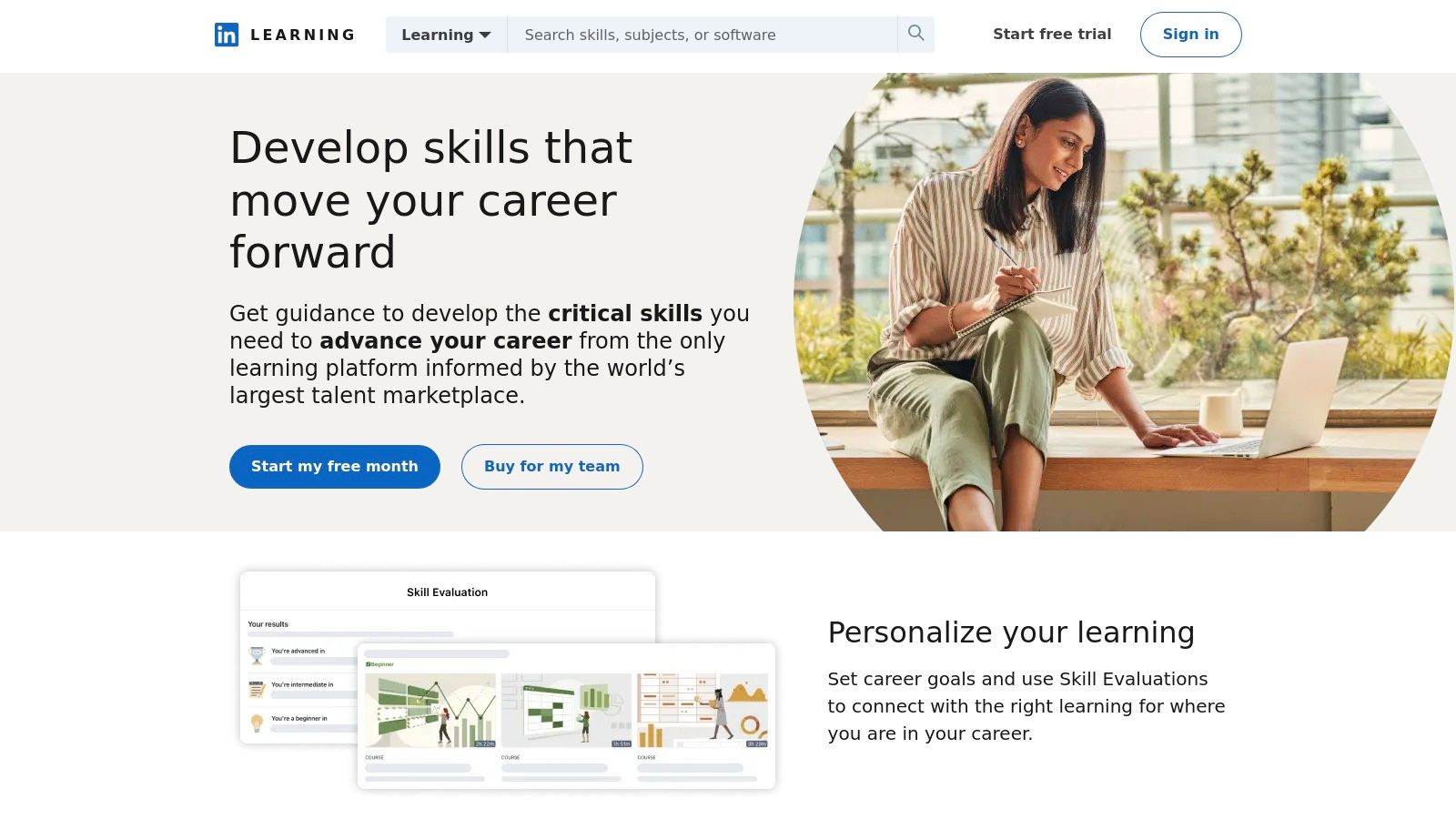
The platform's key advantage is its integration into the professional ecosystem. Courses like UX Foundations: Research and specialized content on conducting remote user interviews are taught by practicing industry experts. The real value lies in its curated Learning Paths, which string together 7-9 short courses to create a comprehensive skill set. Completing a path in UX Research allows you to instantly add a verifiable certificate to your LinkedIn profile, signaling your new capabilities to your network and potential employers. The focus is on practical, bite-sized lessons that fit into a busy work schedule.
Access and Investment
Access is typically through a monthly subscription of around $29.99, or it is often included with a LinkedIn Premium subscription. Many companies provide team licenses, making it a free resource for employees. A generous one-month free trial is almost always available, making it possible to complete a full UX research course at no cost if you're focused.
Pros:
- Professional Integration: Certificates are easily shared on your LinkedIn profile, adding immediate credibility.
- Bite-Sized Learning: Short video lessons are perfect for quick upskilling during a lunch break.
- Team-Friendly: Employer licensing options and a one-month trial make it highly accessible for teams.
Cons:
- Lacks Depth: Courses provide a strong overview but rarely match the depth of a dedicated bootcamp.
- Limited Portfolio Building: The emphasis is on knowledge acquisition, not creating extensive, hands-on portfolio projects.
Website: https://www.linkedin.com/learning/
3. Nielsen Norman Group (NN/g)
Nielsen Norman Group is less a course and more the established authority in the UX field. Run by industry pioneers Don Norman and Jakob Nielsen, their training is the gold standard for practitioners who need to move beyond theory and into evidence-based practice. Attending an NN/g event is like a pilgrimage for UX professionals: it's where you go to get direct access to the source material from the people who wrote the foundational texts. It’s ideal for those who have some experience but want to build a recognized, formal expertise.
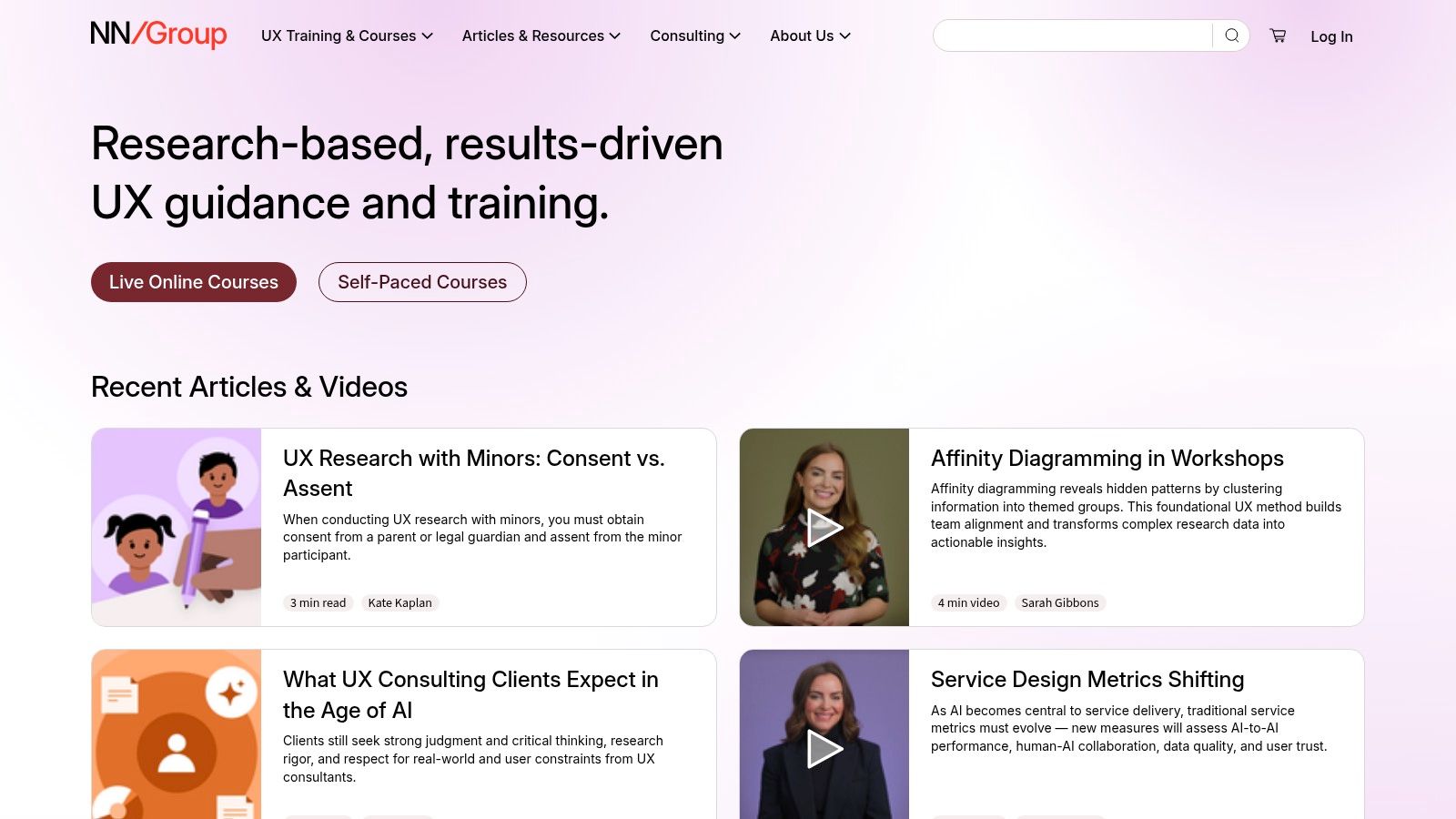
Their strength is in the rigorous, research-backed curriculum delivered in intensive, full-day sessions. The path to UX Certification involves accumulating credits from these live courses and passing exams, creating a credential with significant industry weight. The catalog is deep, with a strong focus on a ux research course covering topics from foundational usability testing and qualitative methods to advanced measurement and inclusive design. This is where you master the practicalities of different user research methods and learn how to apply them directly to your work. Recently, they've also added courses on AI-for-UX, keeping the content relevant for modern product teams.
Access and Investment
NN/g operates on a premium, per-course model. A single full-day virtual course can cost over $1,000, with in-person conferences costing more. This positions it as a professional development investment, often sponsored by employers who recognize the value of the certification.
Pros:
- High Brand Recognition: NN/g certification carries significant weight and credibility on a resume.
- Expert-Led Training: Learn directly from globally recognized leaders in the UX field.
- Immediate Applicability: Courses are packed with hands-on exercises you can use the next day.
Cons:
- Premium Pricing: The cost is a significant barrier for individuals without employer sponsorship.
- Limited Flexibility: Training is event-based, requiring you to conform to their schedule with few self-paced options.
Website: https://www.nngroup.com/
4. UX Design Institute
The UX Design Institute is less like a library and more like an apprenticeship. Where platforms like Coursera offer a sprawling menu of options, this institute provides a single, focused path: a university credit-rated Professional Certificate in User Research. It’s designed for those who don’t want to dabble in research as one part of a generalist UX course, but aim to master it as a distinct and deep discipline. This is the place for professionals seeking rigor and specialization.
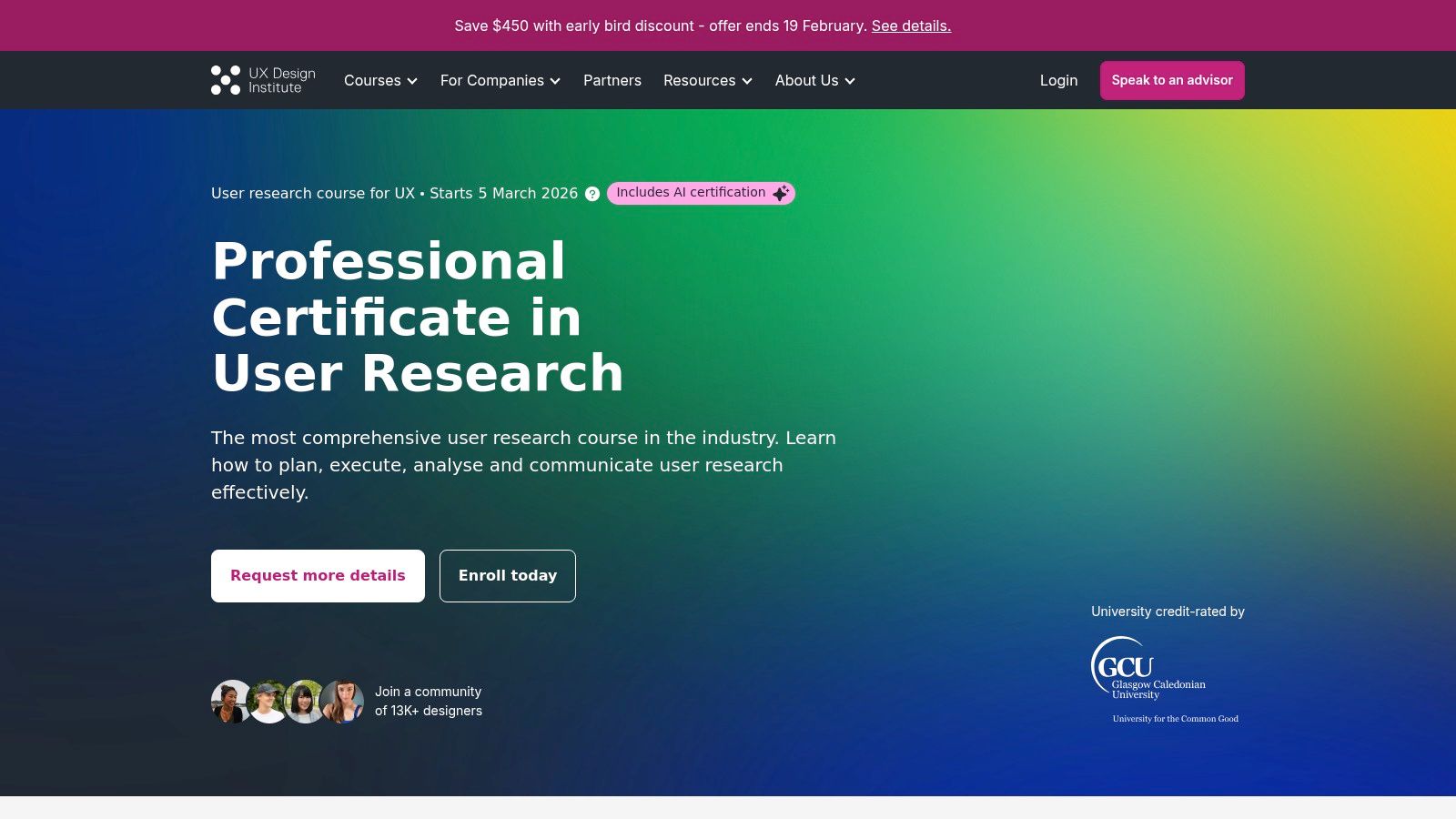
The curriculum is built around an end-to-end research project. You don't just learn about methods, you execute them. The course covers the full spectrum from planning and moderation to analysis and communicating insights. It provides a structured approach to both qualitative and quantitative methods, demanding students conduct interviews, usability tests, and surveys. Assignments are graded with personalized feedback, ensuring the final deliverable is a portfolio-ready case study that demonstrates true research competence, not just academic understanding.
Access and Investment
This program is a significant investment compared to subscription platforms, with tuition fees typically around €2,750, payable upfront or in installments. The course runs for approximately 4-6 months with fixed cohort start dates, blending self-paced video content with structured deadlines and live support. This model enforces accountability.
Pros:
- Deep Specialization: Entirely focused on user research, providing depth unmatched by generalist UX programs.
- Portfolio-Oriented: The course is structured around creating a comprehensive research project with personalized feedback.
- Structured Accountability: Fixed deadlines and cohort elements keep learners on track.
Cons:
- Higher Cost: The specialized focus comes with a premium price tag compared to MOOCs.
- Limited Flexibility: Fixed start dates mean you can't begin whenever you want.
Website: https://www.uxdesigninstitute.com/courses/user-research/
5. General Assembly
General Assembly is the digital equivalent of an intensive, hands-on workshop. Unlike self-paced platforms, it provides a structured, cohort-based environment where learning is live and instructor-led. This makes it an ideal choice for product teams or individuals who thrive on accountability, direct mentorship, and the energy of a classroom setting, whether virtual or in person. It’s where you go to immerse yourself completely and emerge with practical, job-ready skills in a compressed timeframe.
The curriculum is built around real-world projects, moving learners from theory to application quickly. The flagship UX Design Immersive is a full-time bootcamp that dedicates significant time to user research methodologies, from crafting interview scripts to synthesizing data into actionable insights. For those unable to commit to a full-time schedule, the part-time UX Design course offers a condensed yet potent version, covering core concepts like usability testing and evidence-based design. The emphasis is always on creating portfolio-ready work that demonstrates a clear, research-driven design process.
Access and Investment
General Assembly is a premium investment, with immersive bootcamps costing upwards of $15,000. Part-time courses are more accessible, typically in the $3,000-$4,000 range. They offer various financing options, including installment plans and loans. The value proposition is the live instruction, career services for immersive grads, and a strong alumni network, especially in major US tech cities.
Pros:
- Live Instruction: Real-time feedback and direct access to experienced instructors create a dynamic learning environment.
- Strong Network: GA has a well-regarded reputation in tech hubs, and career services can provide a significant advantage for job seekers.
- Structured Accountability: Scheduled classes and cohort-based projects ensure learners stay on track.
Cons:
- Significant Investment: The tuition is a major financial commitment compared to other online options.
- Rigid Schedules: The fixed cohort schedules require a significant time commitment that may not suit everyone's lifestyle.
Website: https://generalassemb.ly/
6. MeasuringU
If most UX research courses are liberal arts degrees, MeasuringU is the PhD program in quantitative analysis. It’s not for the faint of heart or the mathematically timid. This is where product teams go when “we think” needs to become “we know, with a 95% confidence interval.” Led by industry pioneers Jeff Sauro, PhD, and Jim Lewis, PhD, this platform is less about broad strokes and more about surgical precision in measurement.
The curriculum is a deep dive into the statistical backbone of user experience. Courses focus intently on topics like calculating sample sizes, designing statistically significant surveys, and benchmarking usability with metrics like the System Usability Scale (SUS). Their flagship offering, the UX Measurement Bootcamp, is an intensive, multi-week course that equips researchers to not just conduct studies but to defend their quantitative findings in a boardroom. It’s the kind of training that helps you understand precisely how to conduct usability testing with rigor, turning observations into defensible data.
Access and Investment
MeasuringU offers its courses on an à-la-carte basis, with individual workshops and bootcamps priced significantly higher than generalist platforms, often in the range of several hundred to a few thousand dollars. This reflects their specialized, expert-led nature. They also offer corporate training packages and provide valuable resources like statistical calculators and study credits on their platform.
Pros:
- Best-in-Class Rigor: Unmatched depth in quantitative and metrics-driven UX research.
- Expert Instructors: Learn directly from leading authors and practitioners in the field.
- Corporate Training: Offers custom workshops and training tailored to specific company needs.
Cons:
- Higher Pricing: A significant investment compared to MOOCs like Coursera or Udemy.
- Specialized Focus: May not be suitable for those seeking a broad introduction to qualitative methods.
Website: https://measuringu.com/
7. edX
edX serves as an academic portal, offering a curated collection of university-level courses without the full commitment of matriculation. For product teams and aspiring researchers who value academic rigor, it provides direct access to syllabi from renowned institutions. Think of it as auditing a university lecture from your desk, gaining structured knowledge from established Human-Computer Interaction (HCI) and UX programs. It's the ideal platform for anyone looking to ground their practical skills in established academic theory.
The platform distinguishes itself by aggregating content from universities like MIT, Harvard, and Berkeley. This gives learners access to a different flavor of a UX research course, one that often emphasizes foundational principles and theoretical frameworks. You might find a MicroMasters program in HCI that dedicates significant time to research ethics and experimental design or a professional certificate focusing on the cognitive psychology behind user behavior. It provides the "why" behind the "how," which can be invaluable for senior practitioners.
Access and Investment
Many courses on edX can be audited for free, granting access to lecture materials and readings. To earn a verified certificate and complete graded assignments, learners must pay a fee, which can range from $50 to over $300 per course. This model allows you to try before you buy, ensuring a course meets your needs before any financial commitment.
Pros:
- Academic Credibility: Courses are created and taught by university faculty, lending weight to the credentials.
- Flexible Audit Option: The ability to access course content for free lowers the barrier to entry significantly.
- Structured Learning: Content follows a university-style syllabus, providing a rigorous and methodical learning path.
Cons:
- Evolving Catalog: Courses and programs can be discontinued, so a specialization you start might not be available later.
- Less Mentorship: The platform is more self-directed and typically lacks the hands-on coaching found in bootcamps.
Website: https://www.edx.org/
8. Udemy
Udemy is the vast, sprawling digital marketplace of learning. It’s less like a university and more like a bazaar, where hundreds of independent instructors offer hyper-specific courses on nearly every conceivable research topic. If you need to master stakeholder interviews tomorrow or learn card sorting by Friday, there is almost certainly a focused, practical course waiting for you, often at a steep discount. It’s the ideal place for tactical, just-in-time skill acquisition.
This platform shines when you need to fill a specific knowledge gap without committing to a full curriculum. Are you struggling to get meaningful insights from user interviews? There are courses dedicated solely to that. Do you need a crash course on usability testing? You can find a dozen. The key is using the robust ratings and reviews system to vet instructors, as quality can vary. A well-chosen Udemy course can be a powerful and targeted way to level up a particular research skill.
Access and Investment
Udemy's model is based on individual course purchases, not subscriptions. Courses are frequently on sale, often for as low as $10-$20, and provide lifetime access. This makes it an incredibly low-risk way to explore a new UX research course or technique.
Pros:
- Very Affordable: Constant promotions make it one of the most budget-friendly options available.
- Targeted Learning: Excellent for mastering a single research method or tool quickly.
- Lifetime Access: Buy it once and refer back to the material anytime you need a refresher.
Cons:
- Inconsistent Quality: The open marketplace means course quality and instructor expertise vary widely.
- Limited Recognition: Certificates are issued by the instructor, not an accredited institution, and carry less weight.
Website: https://www.udemy.com/
9. Springboard
Springboard acts less like a library and more like an apprenticeship. It’s designed for those who need a structured path with human accountability, pairing project-based learning with dedicated mentorship. This isn't a passive learning environment, it’s an active, guided journey toward a specific career outcome, making it ideal for individuals transitioning into UX roles who need both skills and professional guidance.
The platform’s standout feature is its 1:1 mentorship. Students are paired with industry professionals for weekly calls, providing a consistent feedback loop that’s rare in online education. The curriculum is built around creating tangible portfolio pieces, covering core UX research course topics like user interviews, persona creation, journey mapping, and usability testing. A low-cost "Intro to Design" course allows students to test the waters before committing to the comprehensive UI/UX Career Track, which includes robust career coaching and job-search support. This model is built for turning theory into a demonstrable skill set.
Access and Investment
Springboard offers a low-cost introductory course (around $349) to test the platform. The full UI/UX Career Track is a significant investment, often costing over $10,000, with various financing options, deferred tuition plans, and a job guarantee for qualifying students.
Pros:
- Personalized Mentorship: 1:1 guidance provides accountability and industry-specific feedback.
- Career-Focused: The full track includes dedicated career services and a job guarantee.
- Low-Risk Entry: The intro course offers a low-cost way to evaluate the program’s fit.
Cons:
- High Cost: The career track represents a major financial commitment compared to other options.
- Time Intensive: Requires a significant time commitment to complete projects and benefit from mentorship.
Website: https://www.springboard.com/
10. CareerFoundry
CareerFoundry is less of a course and more of a guided career transition. It's built for the person who isn't just looking to learn a new skill but is determined to land a new job. This platform wraps its UX design curriculum, which includes a strong UX research course component, in a blanket of human support: one-to-one mentorship, tutor feedback, and dedicated career coaching. It’s the bootcamp equivalent of having a personal trainer for your career change.
The curriculum is project-based, forcing you to move from theory to application immediately. Students work through a comprehensive program covering everything from research planning and synthesis to creating high-fidelity prototypes. The key differentiator is the structured feedback loop. Your mentor isn’t just an instructor, they’re a seasoned professional who reviews your work and helps you shape it into a compelling narrative for employers. Building a powerful UX research portfolio is not an afterthought, it is the central pillar of the entire experience, ensuring you graduate with tangible evidence of your skills.
Access and Investment
CareerFoundry is a premium offering with upfront or monthly payment plans, often ranging from $7,000 to $8,000 for the full program. They offer a job guarantee under specific conditions, providing a safety net for the significant financial investment. The program is self-paced but typically takes 5 to 10 months to complete.
Pros:
- Intensive Mentorship: One-to-one guidance from industry professionals is invaluable.
- Career-Focused: The entire curriculum is designed to get you hired, from portfolio projects to interview prep.
- Job Guarantee: Offers a level of assurance for those committing to a full career change.
Cons:
- Significant Investment: The cost is substantially higher than self-serve platforms.
- Requires High Commitment: The program's success is directly tied to the student's personal dedication and effort.
Website: https://careerfoundry.com/
11. Memorisely
Memorisely is less a university library and more a high-intensity training gym for product people. It skips the long theoretical lectures in favor of short, live, cohort-based bootcamps designed for one thing: rapid, practical upskilling. For the Product Manager or designer who needs to add a specific research skill to their toolkit now, not next semester, Memorisely’s focused sprints are a compelling option. It’s built for the practitioner who learns by doing, alongside a small group of peers.
The platform’s core offering is its live bootcamps, including a dedicated UX Research Bootcamp. This isn’t a self-paced video series, it’s a scheduled, time-boxed commitment with live classes, hands-on projects, and direct access to instructors. The curriculum is relentlessly practical, moving quickly from research planning to execution of methods like user interviews and usability testing. This approach is ideal for those who thrive on structure and accountability. For ongoing learning, they also offer an on-demand library with subscription tiers.
Access and Investment
Live bootcamps are a one-time fee, typically costing several hundred to a few thousand dollars, positioning them as a more accessible alternative to immersive, multi-month programs. Their on-demand library operates on a Core and Pro subscription model, providing access to a collection of micro-classes and resources.
Pros:
- Practical & Focused: Time-boxed cohorts are perfect for concentrated skill sprints.
- Community-Driven: Small, live classes foster accountability and peer learning.
- Lower Cost: More affordable than long, immersive bootcamps, with a clear start and end.
Cons:
- Schedule Dependent: Live cohort schedules may not work for all time zones or busy professionals.
- Mixed Feedback: Some users report mixed experiences with subscription terms and communication.
Website: https://www.memorisely.com/
12. Brandeis University Online
For professionals who feel they have outgrown the bootcamp model, Brandeis University Online offers a significant step up in academic rigor. This isn't a quick primer: it’s a graduate-level Master’s Certificate in UX Research designed for those who need to build a formal, defensible research practice within their organization. It’s the equivalent of adding a specialized wing to your professional foundation, built with university-grade materials.
The program's core strength is its focused, applied curriculum. This 12-credit, fully online certificate dives deep into both qualitative and quantitative research methods, ethics in practice, and inclusive design principles. Unlike many self-paced options, this is structured learning with clear academic benchmarks. The most compelling feature is its stackable nature: the credits earned can be applied toward a full Master of Science in User-Centered Design. This creates a direct pathway for professionals looking to transition from a certificate to a full graduate degree without losing momentum. It’s an ideal UX research course for a product leader aiming to build a research function from the ground up.
Access and Investment
As a graduate-level program, access requires an application process and tuition is charged per credit, representing a more significant financial and time commitment than typical online courses. The program is designed for working professionals, offering part-time or full-time pacing.
Pros:
- Academic Credibility: Provides a formal, university-backed credential and a direct path to a master's degree.
- Structured Rigor: The curriculum is comprehensive, covering research ethics, data representation, and advanced methodologies.
- Career Advancement: Ideal for professionals seeking senior roles or to establish research leadership within their company.
Cons:
- Higher Commitment: The cost and time investment are substantially greater than bootcamps or MOOCs.
- Less Flexibility: Operates on an academic calendar with admissions deadlines, not on-demand enrollment.
Website: https://www.brandeis.edu/online/academics/certificates/ux-research/
12-Provider UX Research Course Comparison
.tbl-scroll{contain:inline-size;overflow-x:auto;-webkit-overflow-scrolling:touch}.tbl-scroll table{min-width:600px;width:100%;border-collapse:collapse;margin-bottom:20px}.tbl-scroll th{border:1px solid #ddd;padding:8px;text-align:left;background-color:#f2f2f2;white-space:nowrap}.tbl-scroll td{border:1px solid #ddd;padding:8px;text-align:left}ProviderDelivery & DurationResearch FocusTarget LearnerPrice LevelUnique Selling PointCourseraSelf‑paced; weeks–monthsIntro→intermediate; qual + quant, portfolio projectsBeginners, career switchersLow–MediumGoogle UX Cert, university specializationsLinkedIn LearningOn‑demand bite‑size video; learning pathsFoundations, practical methodsProfessionals & teamsLowLinkedIn‑shareable certificates, quick upskillingNielsen Norman Group (NN/g)Live full‑day workshops & virtual eventsUsability, measurement, inclusive researchMid‑senior UX pros, managersHighIndustry‑trusted UX certification & expert instructorsUX Design InstituteCredit‑rated online program; ~4 monthsEnd‑to‑end user research, portfolio assignmentsAspiring researchers, serious learnersHighUniversity credit‑rated program with portfolio feedbackGeneral AssemblyLive cohorts; part‑time or immersivePractical research + design, usability testingCareer changers, job seekersHighEmployer recognition and career servicesMeasuringUWorkshops & bootcamp; multi‑weekQuantitative UX, stats, benchmarking, metricsResearchers needing rigorous metricsHighBest‑in‑class quantitative rigor and toolsedXUniversity courses; audit optionAcademic UX/HCI modules, research topicsLearners seeking academic rigorLow–MediumUniversity‑backed courses with audit/verified optionsUdemyOn‑demand courses; lifetime accessTopic‑specific practical techniquesSelf‑directed learnersLowAffordable, wide topic marketplaceSpringboardMentor‑guided, project based programsResearch planning, interviews, testingCareer changers wanting mentorshipHigh1:1 mentors + job‑search supportCareerFoundryMentor + tutor online program; flexibleResearch, synthesis, portfolio developmentCareer changers, portfolio buildersHighOne‑to‑one mentorship and job‑focused curriculumMemoriselyShort live cohorts + on‑demand libraryTime‑boxed research bootcamps, hands‑on projectsPractitioners for fast upskillingLow–MediumSmall cohorts, practical sprints, community accessBrandeis University OnlineGraduate certificate; 12 creditsIn‑depth qual + quant, ethics, inclusive researchAdvancing professionals, academic pathHighGraduate‑level credits, stackable toward MS
The First Step is a Question
Learning UX research isn’t about memorizing a dozen methodologies or becoming an expert in thematic analysis overnight. It's about a fundamental shift in perspective. It's about changing your team's default setting from asserting to asking.
This entire list of courses, from the academic rigor of Brandeis to the practical sprints of Memorisely, serves a single purpose: to build the instinct to seek evidence before committing resources. Each one is a different kind of lever, designed to help you move your team from a position of opinion to one of evidence. The core skill isn't just running a survey or conducting an interview, it's about learning how to frame a question so precisely that the answer becomes undeniable.
Choosing Your Lever: From Theory to Action
The selection process can feel overwhelming. Do you need a deep, multi-week bootcamp from CareerFoundry, or a targeted, tactical workshop from Nielsen Norman Group? The choice depends less on the certificate and more on the kind of friction you currently face.
- If your team is new to the entire discipline, a foundational course like those on Coursera or from the UX Design Institute provides the essential vocabulary and frameworks. This is about building a shared language.
- If you are a Product Manager needing to embed research into a fast-moving sprint cycle, a more agile, project-based course from General Assembly or Springboard might be a better fit. You need tools, not just theory.
- For leaders looking to quantify user insights and present them to stakeholders, the quantitative focus of MeasuringU is invaluable. It helps you translate user sentiment into business impact.
The basic gist is this: map the course to the problem. Don't pick a comprehensive program if all you need is a sharper tool for a specific job, like usability testing. A friend leading product at a Series C fintech company recently told me his entire team took a single NN/g workshop on journey mapping. It wasn't about a career change, it was about fixing their broken onboarding flow. They identified one critical business problem and chose the most direct educational tool to solve it.
The Real Return on Investment
The economic incentive for this skill is brutally clear. A single insight uncovered through just a handful of user interviews can prevent months of wasted engineering effort. As Erika Hall notes in Just Enough Research, "You’re already doing research. Every time you make a decision, you’re betting on your assumptions." A good UX research course simply teaches you how to de-risk those bets.
In short, the right UX research course equips you to build products with more confidence and less waste. The certificate is a byproduct, the real value is in the reduced uncertainty. It's the difference between shipping a feature and hoping it works, versus shipping a feature and knowing why it will work. For example, a well-defined research plan could lead to a clear map of edge cases, like a card freeze flow, preventing costly post-launch fixes. From there, you could even generate an interactive prototype for the new and improved setup flow to test with real users.
Your next step isn't to enroll everywhere.
It's to identify the single most expensive assumption your team is currently making. What belief, if proven wrong, would be most damaging to your roadmap or your business? Start there. Find the one question that, if answered, would provide the most clarity and unlock the most progress. Then, review the options in this article and pick the course that best equips you to find that answer. The journey doesn't begin with a payment portal, it begins with a question.
Once you've sharpened your research skills, the next challenge is turning those insights into tangible product specifications quickly. Figr is an AI-native workspace designed for this exact translation, helping you move from user problems to high-fidelity prototypes and detailed user flows in minutes, not weeks. Instead of just documenting your research, you can build on it instantly at Figr.