

It’s 4:47 PM on a Thursday. Your VP just asked for something visual to anchor tomorrow's board discussion. You have a PRD. You have bullet points. You have 16 hours and no designer availability. The pressure is familiar. The request is vague. This is the moment a researcher’s real work begins: translating ambiguity into clarity.
Your UX research portfolio has the exact same job.
Most portfolios are treated like digital scrapbooks, a chronological gallery of past work. They show what you did. They list your methods. They are archives. But an archive doesn’t get you hired. An argument does. Time isn’t a conveyor belt of projects; it’s a switchboard connecting your skills to a company’s problems. Your portfolio is the operator.
Its one true job is to solve a user’s problem. That user is the hiring manager, and their problem is risk. They need to find a researcher who thinks in outcomes, not just outputs. They need to see evidence that your work moves the business forward.
The Mental Shift: From Outputs to Outcomes
Here is what I mean: hiring managers don’t buy your methods. They buy the results those methods produced. They assume you know how to run an interview. What they desperately need to see is proof that you can connect those activities to product decisions that create real value.
This requires a complete shift from “showing my work” to “proving my impact.”
Gallery Mindset: This is a list of activities. "I conducted 12 user interviews and created personas." And?
Product Mindset: This connects every activity to a result. "Our team hypothesized X, so I ran 12 interviews to validate it. The insights led us to pivot the feature design, which cut user onboarding time by 22%."
See the difference?
Last week I watched a PM sift through a dozen researcher portfolios. He told me the ones that stood out framed every project around a business challenge. The rest just felt like a long list of tasks. To build a portfolio that actually gets you hired, you have to understand what recruiters look for in application materials and shape your story to their needs.
Why Depth Beats Breadth Every Time
Once you see your portfolio as a product, curation becomes everything. A portfolio with ten shallow project summaries is less powerful than one with three deep, data-backed case studies. A survey of 74 UX recruiters found that portfolios with three to five in-depth case studies performed significantly better. Why? Hiring managers spend an average of just 30-60 seconds on an initial scan.
You can read the full research on these UX portfolio statistics.
A portfolio is an argument, not an archive. Every project you include is a piece of evidence supporting one central claim: that you are a sound business investment.
A hiring manager’s time is their most precious resource. Your portfolio must respect that. A deep case study lets them follow your thinking from the messy, ambiguous problem all the way to the quantified, final outcome. This is how you show you're not just executing tasks but thinking strategically. It's what separates a senior researcher from a junior one.
To help with your own workflow, you can check out our guide on how to manage design assets and inspiration boards to keep your projects organized and ready for presentation.
Deconstructing the Impact-Driven Case Study
Your case study is not a project diary. Think of it as a closing argument in court, where you present concrete evidence (your research) to prove a single, powerful point: you create business value.
Too many portfolios get stuck in a tired "Problem, Process, Solution" script. That’s not how real research works. It definitely doesn't capture the messy, strategic work that leads to a breakthrough. It’s time to tell a better story.
The goal is a fundamental mindset shift, from showing a gallery of artifacts to building a product that demonstrates tangible outcomes.
This isn’t just about rearranging sections. It’s about reframing your entire contribution from outputs to outcomes.
The Unseen Problem
Every great case study starts with a problem lurking beneath the surface, one nobody else was talking about yet. This is your chance to prove you don’t just take orders. You ask the right questions.
What was the product team’s initial assumption? What friction did you spot that wasn't on the roadmap? Start your story here, in the ambiguity. It immediately frames you as a strategic partner.
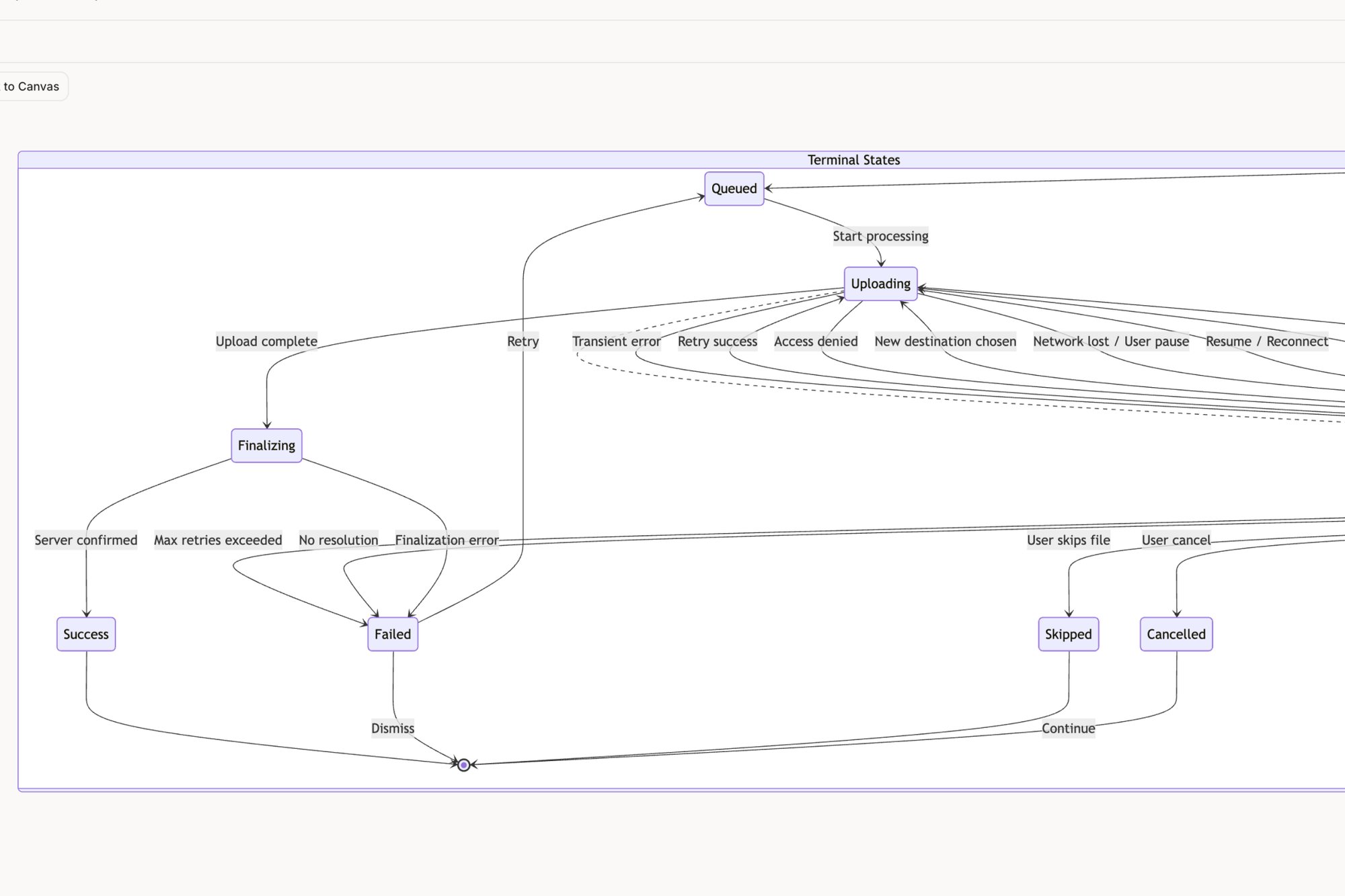
For example, a PM might ask you to "test the usability of our new file upload feature." Simple enough. But the real, unseen problem is that engineering has no plan for the dozen-plus failure states, from network drops to permission errors. Suddenly, your work isn’t just testing a happy path. It’s preventing months of expensive rework.
The Strategic Inquiry
Once you’ve framed the real problem, you defend your approach. Why a diary study instead of interviews? Why was a survey the right tool to quantify the pain you found in your qualitative work? This is where you demonstrate senior-level thinking.
Don’t just list what you did.
Explain why you did it.
Connecting your methodological choices directly to the business problem shows you’re not just following a playbook. You’re adapting your toolkit to the specific challenge. For a deeper dive, our guide on different user research methods shows how different approaches solve for different types of questions.
The Messy Middle and Key Artifacts
Now it’s time to show, not just tell. The "messy middle" is the reality of research, that journey from total ambiguity to sudden clarity. Hiring managers don't want a sanitized, linear story. They want to see how you navigate complexity.
This is the perfect spot to showcase one or two pivotal artifacts that made the abstract tangible for your team. Instead of just mentioning you mapped edge cases, show the map. For example, this exploration of Dropbox's upload failure states is compelling evidence of thoroughness and proves you can guide a team through the weeds.
A few other powerful artifacts you could feature:
A journey map that pinpoints specific emotional lows.
A key insight slide that boils down hours of interviews into a single, undeniable takeaway.
A scrappy prototype that directly addresses the core user pain point you uncovered.
The Quantified Outcome
This is it. The final, most crucial part of your story. How did your work actually change things? Without a clear outcome, your case study is just a story without an ending. You must connect your research directly to a measurable business result.
Your research is not the end product. The end product is a better business decision. Your case study needs to prove you can deliver that.
This is where most portfolios fall flat. The hard truth is that UX portfolios failing to quantify research impact get filtered out 70% of the time, according to research from Nielsen Norman Group. Hiring managers are looking for numbers.
Did your insights lead to a 10% increase in feature adoption? Did clarifying the user flow reduce support tickets by 15%? Find the number. Lead with it. It’s the clearest possible signal of your value.
Choosing and Curating Your Best Work
Your portfolio isn't an archive of everything you’ve ever done. It’s a curated exhibition. Its job isn’t to catalogue your past but to strategically signal the kind of work you want to do in the future. So how do you choose?
The choice can feel paralyzing because we mistakenly believe every project needs to show every skill. It doesn't. A powerful portfolio is a balanced system, with each project playing a distinct and complementary role.
Think of it like a three-legged stool. It needs balance to be stable and compelling. Each leg represents a core competency that, when combined, proves your range and depth as a researcher. I call this the Rule of Three.
The Rule of Three for Project Curation
Your goal is to select three case studies that collectively answer a hiring manager’s biggest questions about your abilities. Each project should have a specific job.
One project showing deep qualitative insight. This is where you flex your empathy and ability to uncover the why behind user behavior. It’s the story of how you took ambiguous, messy human feedback and found a clear, actionable signal in the noise.
One project showing quantitative fluency. This case study proves you can work with data to validate insights at scale. Maybe you analyzed survey results, dug into product analytics, or partnered with a data scientist. It shows you get that a single user story is powerful, but a trend backed by numbers is undeniable.
One project showing how you navigate complexity. This is your gnarly, real-world project. It could be mapping a sprawling user journey, like this detailed Shopify checkout setup flow, or untangling a legacy system with a dozen dependencies and stakeholders. This one demonstrates resilience, strategic thinking, and grit.
This simple structure moves you beyond just listing skills. It tells a cohesive story about your value as a researcher who can operate at different altitudes of a business: from the granular human detail to the 30,000-foot strategic view.
From Project Audit to Strategic Selection
The projects you select signal the kind of work you want to do next. To find them, you need to audit your past work not by its official title, but by the story it can tell.
A friend at a Series C company recently told me they hired a researcher who presented a single case study on optimizing a checkout flow. The work was similar in scope to this Shopify flow redesign, and it won them the job over candidates with more projects. Why? Because that one project elegantly demonstrated an understanding of business metrics, user behavior, and technical constraints all at once. It hit all three legs of the stool.
Your own audit can be simple. List your past projects and score each one against these questions:
Did this project uncover a surprising, non-obvious truth about our users?
Did this project directly influence a key performance indicator (KPI)?
Did this project require me to manage significant ambiguity or stakeholder complexity?
The projects that score highest are your prime candidates. They’re the hidden gems that connect your past accomplishments with your future career goals. For instance, a detailed exploration of a feature's failure states, like mapping the component states for a task assignment card, can be a powerful showcase of navigating complexity. Even a focused competitive analysis, like this one comparing scheduling tools, can demonstrate both qualitative and quantitative rigor if you frame the story correctly.
The most effective portfolio isn’t the one with the most prestigious logos. It's the one that most clearly demonstrates a repeatable process for turning uncertainty into business value.
Here's the takeaway: choose the projects that best equip you to tell a story about impact, not just activity. Select work that shows you don't just answer questions, you shape them.
From Artifacts to Evidence: The Art of Synthesis
It’s Tuesday afternoon. A product manager walks by your desk, looks at the user flow diagram you just printed, and says, "That's great, but what does it actually mean for the roadmap?"
Your beautiful, detailed artifact, full of arrows and decision nodes, suddenly feels like a map with no legend. It’s just lines on paper until you translate it into a story of consequence.
Raw artifacts like personas, journey maps, and interview notes are just ingredients. The magic, the part that justifies your role, is in the synthesis. It’s the art of transforming research outputs into compelling evidence of your strategic thinking. Your UX research portfolio is where you prove you’re not just a collector of data, but a translator of it.
Think of your case study as a chef’s tasting menu. Each dish, an artifact, is presented with a story that explains its purpose and how it contributes to the overall experience. You don't just show the dish; you explain the sourcing of the ingredients and the technique behind its creation.
Weaving a Narrative Around Your Artifacts
Anyone can show a user flow diagram. What sets a senior researcher apart is the ability to explain the critical decision points it revealed.
Why was one path chosen over another? Where did you uncover unexpected user behavior that forced a complete rethinking of the interaction model? Your captions and descriptions need to answer these questions, right there on the page.
A great example is a project that maps all the potential failure states in a critical user action. Imagine a user trying to freeze their credit card in a moment of panic. An artifact like this detailed Wise card freeze simulation isn’t just a diagram. It’s proof you can anticipate user anxiety and design for resilience.
Your artifacts are not trophies on a shelf; they are clues in a detective story. Each one must be presented with the context that makes its significance clear. What did this clue unlock? How did it change the direction of the investigation? That's the story you need to tell.
Making the Abstract Concrete for Stakeholders
Your audience: hiring managers, PMs, VPs: rarely has the time or context to decode a complex artifact on their own. You have to do the work for them. This means using prototypes and visual storytelling to bring your findings to life, especially for those who weren't in the room with you.
Consider a project focused on improving a complex B2B workflow. A detailed PRD might be accurate but uninspiring. However, a high-fidelity prototype showing the redesigned Shopify checkout setup flow makes the improvement instantly understandable. It turns an abstract recommendation into a tangible vision for the future. You can learn more about how to structure these findings in our guide on understanding qualitative analysis.
The job of synthesis is to build a bridge from 'what we saw' to 'what we must do'. Your portfolio needs to show the blueprints for that bridge.
This skill is precisely what separates tactical researchers from strategic ones. It demonstrates a deep understanding of the business ecosystem. In fact, historical data shows that portfolios emphasizing research impact with clear numbers achieve 90% higher recruiter loyalty, tying directly to business outcomes like a 30% sales uplift from AI-driven UX recommendations. You can explore more data on UX trend impacts to see how this plays out at scale.
Here's your takeaway: go back to one of your case studies right now. Look at the key artifact you’ve presented. Now, write a new caption for it that starts with the phrase, "This diagram was the moment our team realized..."
Finish that sentence. That’s the beginning of real synthesis.
Connecting Research to the Bottom Line
Last week, I watched a product manager dismiss a well-executed research report. The work was solid, the insights were interesting, but the final slide lacked a clear answer to a single, brutal question: “So what?”
This is the final hurdle for every UX researcher. It’s where deep craft meets the cold reality of business priorities. Your research isn't a standalone academic exercise; it's a financial instrument. It either saves money, makes money, or reduces the risk of losing money.
Your UX research portfolio has to prove you get this.
From User Pain to Business Case
The basic gist is this: you need to frame your work in the language of investment. Every single research project consumes resources, mostly time and salaries. Your case study must show a return on that investment. Plain and simple.
For instance, showing how your generative research for a new feature de-risked a six-figure engineering investment is a powerful story. It reframes your work from a "nice-to-have" into a critical risk mitigation strategy. You could showcase this by connecting your research directly to the feature's successful launch, like this detailed runway forecasting tool built for Mercury.
This demonstrates systems thinking, not just tactical execution.
Quantifying the Unquantifiable
So how do you assign a dollar value to an insight? It's not always direct, but you can get surprisingly close by focusing on second-order effects. The key is to partner with your product manager to get post-launch data and close the loop.
This one habit turns your case study from a simple project report into a story of tangible business value.
Consider these ways to frame your impact:
Efficiency Gains: "My research on the internal dashboard identified three workflow frictions. The subsequent redesign cut average task completion time by 45 seconds, saving the support team a cumulative 20 hours per week."
Risk Reduction: "Initial stakeholder assumptions pointed toward building Feature X. My interviews revealed the core problem was actually Y. By shifting focus, we avoided an estimated $150,000 in development costs for a feature users didn't actually need."
Conversion and Retention: "By identifying the primary drop-off point in the sign-up flow, our team implemented a simplified design that increased new user conversion by 8% in the first quarter."
This is the single most powerful way to differentiate yourself in a crowded market. You can dig deeper into how to forecast the MRR impact of product changes and even see how AI tools can help.
A research finding is a liability until it's connected to a business metric. At that point, it becomes an asset. Your portfolio is a balance sheet of those assets.
To do this effectively, you need to be a good storyteller. Mastering essential storytelling techniques for business helps you articulate impact in a language stakeholders understand. This isn't about embellishing the truth; it's about translating it for an audience that thinks in spreadsheets and P&L statements.
Your next step is clear. Go to your best case study and find the number. It might be a percentage lift, hours saved, or a dollar figure. Find it, and make it the headline of your outcome section. That single number speaks louder than a thousand pages of interview transcripts.
Your Next Step: Ship Your Portfolio
The perfect UX research portfolio is a myth. A shipped portfolio, on the other hand, is a tool that gets you interviews.
Your goal isn’t perfection. It’s getting version 1.0 out the door. The time for endless polishing, tweaking, and second-guessing is over. That cycle doesn’t build a better portfolio; it just builds anxiety. The real work begins the moment you share what you’ve made.
Confidence doesn't come from a flawless PDF.
It comes from action.
The Minimum Viable Portfolio
Think about your portfolio like a product launch. A minimum viable product isn’t about shipping something incomplete or broken. It’s about shipping the smallest possible thing that delivers core value. For your portfolio, that core value is a single, compelling argument for why someone should hire you.
The next step is not to spend another month designing a website from scratch.
It’s to choose one case study and rewrite it using the Impact-Driven framework from this guide. That’s your immediate, actionable task.
Frame the unseen problem that existed before you started.
Articulate your strategic inquiry, explaining why you chose your specific methods.
Show the messy middle with one or two key artifacts that reveal your thinking.
Quantify the outcome by connecting your work to a real business metric.
Ship, Iterate, and Improve
Once that single case study is rewritten, your next job is to get it in front of someone. Put it into a simple, clean format: a slide deck, a Notion page, or a basic website template will do just fine. Then, share it with one trusted colleague and ask for specific, honest feedback.
This is what I mean: treat this process like a usability test. Their questions are your user feedback.
Where were they confused? What part of the story felt weak? Their confusion isn’t their fault; it’s a signal that your narrative needs clarification.
Your goal for this week is not to finish your portfolio. It is to ship one piece of it.
Gather feedback. Iterate based on what you learn. A portfolio isn't a static document; it's a living product that improves with every real-world interaction, especially during interviews. The sooner you launch, the sooner you start learning.
Got Questions? Let's Talk Portfolio Specifics.
We’ve covered a ton of ground, but a few practical questions always pop up when you're deep in the weeds of building a portfolio. Let's get them answered right now so you can move forward.
How Many Case Studies Do I Actually Need?
This one's a classic case of quality over quantity. I always tell researchers to aim for three to five really solid, well-documented case studies.
In short, a hiring manager would much rather see a single project that clearly shows your strategic thinking and business impact than ten shallow summaries that just list what you did. Each case study needs to tell a complete story, from the messy beginning to the final, measured outcome.
What if My Best Work Is Locked Under an NDA?
This is probably the most common (and totally legitimate) hurdle researchers face. Don't panic. The key is to anonymize and abstract your work. Remember, your goal isn't to spill trade secrets, it's to showcase your process and how you solve problems.
Here’s how to do it without getting into trouble:
Swap out company names and product details for generic descriptions. Think "a leading fintech app" instead of the actual company name.
Blur, black out, or completely replace any proprietary data or specific UI elements.
Shift the story's focus to your strategic decisions, how you managed stakeholders, and the types of problems you solved. The "what" and "why" are more important than the specific IP.
A simple pro-tip: You can always create a password-protected version of your portfolio. Just add a note saying some work is confidential and you’re happy to provide access upon request. This shows you respect your past employers and signals that you’re a professional.
Should I Make a Website, a PDF, or a Slide Deck?
The short answer? Yes.
Each format plays a different role in your job search, and the smartest move is to have a version ready for each context.
A website is your public, always-on professional storefront. It’s perfect for discoverability and initial screening. A PDF is your go-to for emailing directly to recruiters or hiring managers: it's a clean, self-contained package. And a slide deck? That’s non-negotiable for interviews. It’s your presentation tool, letting you control the narrative and walk through your work like the compelling story it is.
Your UX research portfolio is a product, and Figr helps you build the artifacts that make it stand out. Use our AI agent to instantly map complex user flows, find critical edge cases, and generate high-fidelity prototypes directly from your product's context. This is how you create the tangible evidence of strategic thinking that hiring managers are looking for. Ship your portfolio faster and with more impact. Explore what you can build at https://figr.design.