It’s 3:17 PM on a Friday. The project plan looks perfect. Green lights across the board. But a phantom flicker of doubt crosses your mind. You’re tracking progress, not risk.
We often treat a project plan like a train schedule, a linear track from A to B. But it isn't a conveyor belt; it’s a switchboard. One crossed wire can cause cascading failures miles away. The real work is not just staying on schedule. It's anticipating where the board is weak before the lights go out. I call this ‘Risk Cartography’: the art of mapping invisible threats.
This isn't about listing generic problems. It's about seeing the specific, interconnected failure points that derail product teams. Last week, I watched a product lead present a flawless two-week sprint plan for a new feature. It took six weeks. Why? The plan accounted for creation, but not for clarification, validation, or the inevitable 'quick question' that wasn't quick.
The project risks examples that truly matter are rarely found in a textbook. They live in the quiet assumptions between teams. This article will dissect ten of these "ghosts," providing practical scenarios and mitigation tactics for product managers and UX teams.
The basic gist is this: to de-risk a project, you must first make the invisible risks visible.
1. Scope Creep: The 'Just One More Thing' Cascade
Imagine your project as a carefully packed suitcase. Scope creep is the stakeholder who keeps adding 'just one more thing' until the zipper bursts. This is one of the most common project risks examples, where a project’s requirements continuously expand. This cascade of small, seemingly harmless requests collectively overwhelms the system, leading to blown budgets and team burnout.
For instance, a simple login screen redesign can balloon to include SSO integrations, password recovery flows, and social logins. The real danger isn't the new feature. It’s the un-costed complexity it drags along. We saw this play out when analyzing a task management tool where adding a 'reassign' button triggered a need for new notification states and complex permissions logic. This turned a simple UI change into a major backend project.
Strategic Insight: The most dangerous requests are the ones that seem small. They bypass the formal change control process because they "only take a minute," but their dependencies create a web of untracked work.
To manage this, teams need a strong gatekeeping process. This means every request is documented and its full impact is assessed. Effective methods for how to prevent scope creep often involve making the "hidden work" visible. By mapping out the dependencies, as we did for the task assignment feature on this Figr canvas, a PM can show stakeholders the true cost of "just one more thing."
2. Resource Constraints: The Illusion of Efficiency
A project plan without a realistic resource model is just a wish list. This risk occurs when the team, time, or budget is fundamentally mismatched with the project's goals. This isn't just about working harder; it's a structural failure where quality becomes the first casualty. A single designer split across five initiatives, for example, isn't multitasking. They are context-switching their way to burnout and design debt. This is one of the more insidious project risks examples because it often masquerades as efficiency.
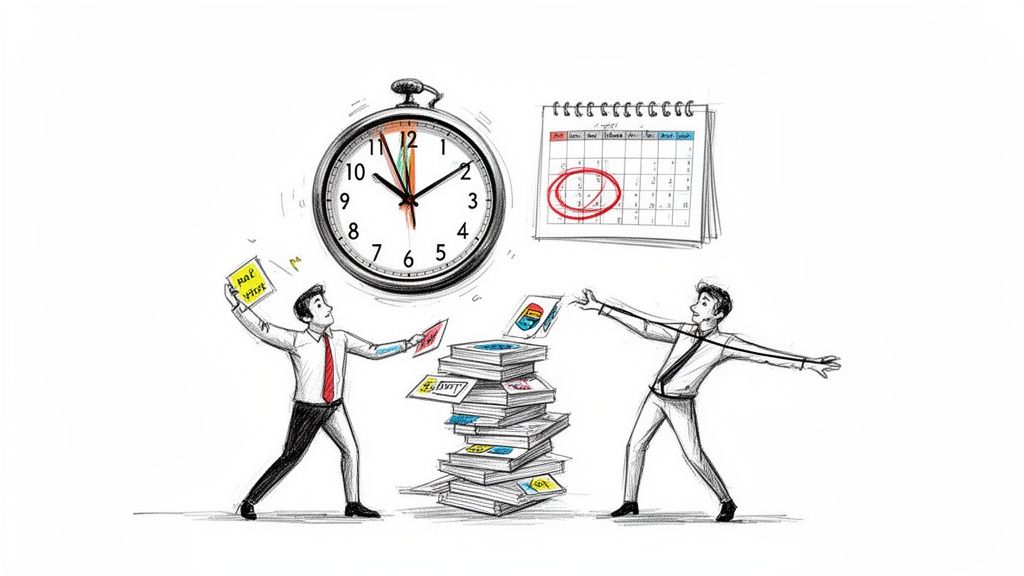
The pressure cooker of a two-week timeline for a complex redesign forces teams to make dangerous trade-offs. We’ve seen teams skip accessibility testing or defer critical edge case analysis until launch week, hoping nothing breaks. This is what I mean by structural failure: the timeline itself prevents the discovery of work. A friend at a fintech company told me her team was tasked with improving a checkout flow but had no QA resources. They found bugs post-launch that a proper test case analysis, like this one mapped for Wise's card freeze feature, would have caught in hours.
Strategic Insight: The most optimistic timeline is usually the most expensive. It doesn't account for the rework, bugs, and customer support costs generated by cutting corners.
To counter this, leadership must treat capacity planning not as an administrative task, but as a core strategic input. Before committing to a date, visualize team bandwidth against all active projects. Ruthless prioritization using a framework like RICE is essential, but it only works if the "cost" in the equation reflects the real effort.
3. Stakeholder Misalignment: The Orchestra Problem
A project team without alignment is like an orchestra where every musician is playing from a different score. This is a subtle but destructive project risk. Misalignment happens when executives, product managers, and engineers hold conflicting views on goals, metrics, or deliverables. The team builds different products in their heads, leading to inevitable rework and solutions that miss the market entirely.
This often plays out in subtle ways. A product manager might request a new "card freeze" feature, thinking of a simple toggle. Engineering, however, sees the need for complex state management and API security checks. Last week, I saw a team debate this exact scenario: design wanted an animated confirmation, while legal insisted on a friction-filled, multi-step process. Each stakeholder was protecting a valid interest, but their requirements were fundamentally at odds.
Strategic Insight: Misalignment isn't about bad intentions; it's about unspoken assumptions. Each stakeholder optimizes for their local domain (sales for revenue, legal for compliance) without a shared map of the overall project territory.
The goal is to make all assumptions explicit before a single line of code is written. Structured kickoff meetings are a start, but visual artifacts are better. For the "card freeze" feature, the team could have used a tool to generate all possible edge cases, as shown in this simulation. This surfaces conflicts early, turning a future argument into a current-day design decision. For more complex dynamics, a formal process of stakeholder mapping can clarify who needs to be consulted, when, and why.
4. Validation Gaps: Drawing a Map from Memory
Building a product without user research is like drawing a map from memory. Your intentions are good, but you’re likely headed for a cliff. This risk occurs when teams build based on internal assumptions or "best practices" instead of direct evidence from real users. It’s a shortcut that often leads to a much longer, more expensive journey of redesigns.
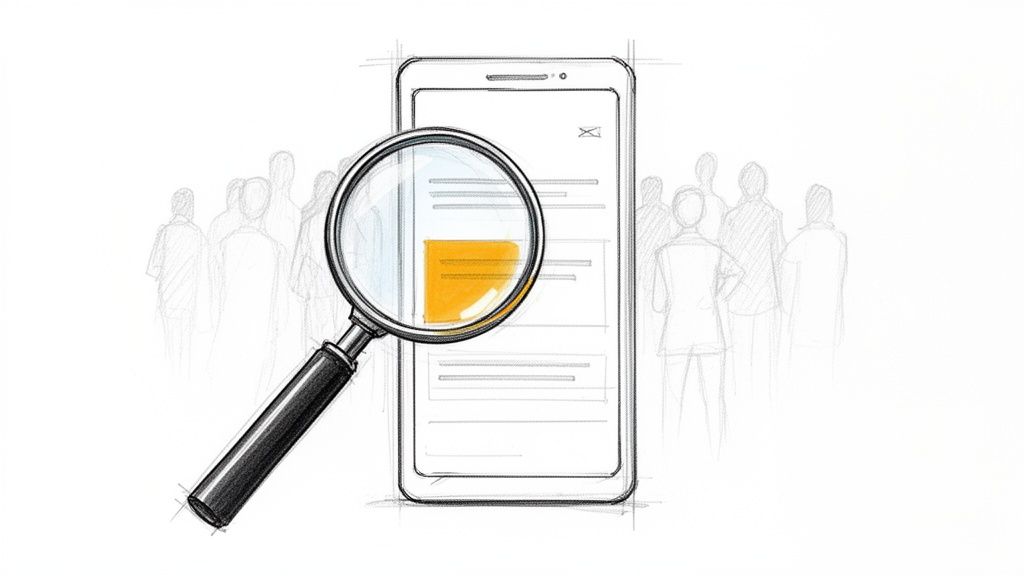
Last year, a PM at a health-tech startup launched a complex medication adherence form designed entirely by the engineering lead. It was logical, comprehensive, and completely unusable for its target audience: elderly patients. This is a classic example of this type of project risks examples. The team had to scrap months of work, all because they skipped a few days of user interviews.
Strategic Insight: The most dangerous assumption isn't "we know what users want." It's "we don't have time to ask them." This frames research as a luxury, not a core risk mitigation activity.
The remedy is to integrate validation into the workflow, making it non-negotiable. This means conducting usability tests on prototypes before a single line of code is written. For instance, testing a proposed flight search interface, as explored in this accessibility audit on Skyscanner, can reveal critical flaws in minutes. It's about shifting from "build, then test" to a continuous loop of learning. To get started, you can learn how to validate features before writing a single line of code.
5. Design System Drift: The Frankenstein Effect
Think of your design system as the product's DNA. System inconsistencies are genetic mutations that create a Frankenstein's monster of an interface where nothing quite matches. This is a subtle but corrosive project risk example, where designers and developers deviate from established standards. It starts with one team overriding a color token for a "one-off" need, until the product looks like it was built by five different companies.
For example, a team might decide the primary action button (button-primary-blue) isn't vibrant enough. They override the token with a custom hex code. Soon, other teams see the new color and copy it, creating a new, unofficial primary color. This fragments the brand and complicates future updates. Which blue do you change? We saw this in an e-commerce checkout flow where multiple shades of "error red" were used, creating a confusing and inaccessible experience.
Strategic Insight: Design system drift is a risk of team autonomy. When teams are empowered to move fast, they often see the central system as a suggestion, not a rule. The risk isn't malice, it's local optimization at the cost of global consistency.
The key to managing this is making the "right way" the easiest way. This involves a mix of clear documentation, automated tooling, and strong governance. For guidance on establishing these rules, a practical resource is understanding how to begin crafting a consistent app design system. Versioning your design system, like software, helps teams understand the 'why' behind the rules.
6. Inadequate Testing: Inspecting Deck Chairs on the Titanic
Think of your project as a ship ready for its maiden voyage. Inadequate testing is skipping the hull inspection because the deck chairs look nice. It's the assumption that because the main path works, the ship won't sink in a storm. This is one of the most silently destructive project risks examples, where insufficient QA coverage allows critical bugs to reach production. It often happens when testing is treated as a final-gate activity.
For instance, a team tests the "happy path" of a new modal but forgets to check how it behaves with long text strings, empty states, or rapid keyboard inputs. The result is a broken layout. We saw this with a client whose new card freeze feature for their finance app worked perfectly in demos but failed for users on older mobile devices because no one had tested on actual, non-emulated hardware. This oversight damaged user trust at a critical moment.
Strategic Insight: The most damaging bugs hide in plain sight within "obvious" user flows. Teams get so focused on the primary action that they neglect the equally important failure and recovery states, where user trust is truly won or lost.
To counter this, quality assurance must be integrated from the beginning. This means product managers should think about test scenarios from the moment they sketch a user flow. Developing a matrix of test cases, as we did for a Waymo trip modification concept, forces the team to confront every possible state. Making edge case testing a mandatory part of design sign-off ensures quality is built in, not bolted on.
7. Technical Feasibility: The Anti-Gravity Chase Scene
Think of your project as a screenplay and engineering as the physics of the film set. Technical feasibility is the risk that your script calls for an anti-gravity chase scene on a budget meant for a one-room drama. This is a contentious project risk example where a great idea meets the cold reality of code and platform limitations. It arises when product visions outpace what’s possible, affordable, or timely to build.
For example, a mock-up shows a fluid micro-animation that tanks performance on mid-range devices. Or a product manager requests real-time data sync that would instantly exhaust an external API's rate limits. The friction here isn't a lack of ambition. It's a disconnect between the "what" and the "how," leading to rework and strained team relationships.
Strategic Insight: The most expensive risks are not bugs, but elegant designs that are technically impossible. The later they are discovered, the more cross-functional work they unravel, turning sprints into rescue missions.
To manage this, embed feasibility checks into the design process, not just at the end. This means early and continuous collaboration between product, design, and engineering. Prototyping complex interactions or exploring edge cases, like in these test cases for a Waymo trip change, can reveal hidden complexities early. By making technical limits a shared starting point, teams can innovate within real-world constraints.
8. Accessibility Violations: The Missing Ramp
Think of your product as a public building. If you forget to add ramps and automatic doors, you've not only made it unusable for a segment of the population, you've also broken the law. This is a potent project risks example where a product fails to meet accessibility standards like WCAG. This isn't just about ethics; it's a significant business and compliance failure.
For example, a team might release a feature where interactive elements are unreachable with keyboard navigation. For a user who relies on a keyboard, the feature is fundamentally broken. We performed an accessibility audit on Skyscanner and found common issues like low-contrast text and small tap targets. These present major barriers for users with low vision or motor impairments. These aren't edge cases. They are core usability failures for millions of people.
Strategic Insight: Accessibility isn't a feature to be added later; it is a foundational requirement. Treating it as optional is like building a house and deciding later whether to add a front door. The cost of retrofitting is always exponentially higher than building it in from the start.
To manage this, accessibility must be a non-negotiable part of the definition of "done." Establish WCAG 2.1 AA as a baseline and integrate checks from the very beginning. Automate what you can, but always test with actual assistive technologies and with users who have disabilities.
9. Communication Gaps: The Whispered Secret
Think of your project as a secret whispered down a line. Communication breakdown is when that secret turns into nonsense by the end, creating a risk just as dangerous as any technical hurdle. This is an insidious project risks example because it’s not about code, it’s about context. When design specs are incomplete, vague, or only exist in a designer's head, engineering teams are forced to guess.
For example, a spec might show a button, but what about the loading state, the success state, or the error state if the action fails? We’ve seen a designer specify an animation without its timing, forcing an engineer to guess. The result was a clunky interaction that felt wrong, requiring another cycle of review and code changes. The real problem isn't the single missing detail, but the assumption that others share your mental model.
Strategic Insight: The most expensive bugs often stem from the cheapest mistakes: a missing note in a spec or an uncommunicated decision. These gaps act like silent project debt, compounding with every implementation choice made to fill the void.
To fix this, make documentation a byproduct of the design process, not an afterthought. This means capturing the "why" behind decisions and visually mapping all states. For a task assignment component, we didn't just design the buttons; we mapped out every resulting state change in this Figr canvas. By making the complete user flow and its edge cases visible, there's no room for interpretation.
10. Analytics Blindness: Flying Without Instruments
Launching a redesign without analytics is like flying a plane without an instrument panel. Analytics blindness is the risk of making decisions based on opinion and instinct because you have no visibility into how users actually behave. This project risk example is particularly dangerous because it feels like you're moving forward, but you have no idea if you're gaining or losing altitude.
For instance, a team might push a complete checkout redesign to "modernize" the UI, only to discover weeks later that conversion has tanked. Why? They never instrumented the original flow to identify where users were dropping off. We saw this in an analysis of the Shopify checkout setup for merchants, where engagement data revealed specific drop-off points that gut feelings would have missed. The data showed exactly where the friction was, turning a vague "make it simpler" goal into a targeted redesign strategy.
Strategic Insight: Analytics aren't just for validation after launch; they are a critical design tool for discovery before a single pixel is pushed. The most expensive mistakes are born from solving problems that data shows don't actually exist.
The cure is to define key success metrics before kickoff. This means instrumenting designs for measurement from day one. By mapping the Shopify checkout setup flow on this Figr canvas, teams can pinpoint exact friction points and design a new flow that directly addresses data-backed issues. In short, this turns guesswork into a measurable improvement.
From Risk List to Risk Radar
So, what do you do with this knowledge? A list of potential problems is just anxiety fuel if it doesn’t lead to action. The goal is to turn that static list into a dynamic radar. The project risks examples we’ve explored are not isolated thunderstorms. They are interconnected weather patterns.
Scope creep is often a symptom of unclear stakeholder alignment. Technical debt accumulates when timeline pressure overrides quality assurance. Why do we treat these as separate fires to put out? They are signals from a single, complex system. The real takeaway is to stop looking at risks as individual line items on a spreadsheet and start seeing the relationships between them.
This is the shift from passive awareness to active foresight. You can’t eliminate risk entirely, a lesson well-documented by Nassim Nicholas Taleb in The Black Swan, where he explores the extreme impact of rare and unpredictable events. However, you can make the common, predictable risks visible long before they derail a sprint. You can build an early-warning system.
To move from merely listing risks to actively managing them, understanding comprehensive approaches like enterprise risk management can be invaluable. It provides a structured way to identify, assess, and prepare for threats across an organization. The key is to create rituals that surface these issues early and often.
The first step is a small one.
Don't try to boil the ocean. Pick one project your team is working on right now. Take fifteen minutes and map the user flow for its single most critical interaction. A great example is mapping every failure state for a common action, like this exploration of Dropbox's file upload process.
Once you have that flow, ask yourself one question: what are the three most likely ways this could fail for a user? Not a technical failure, a human one. Is the button confusing? Is the next step unclear? What if they get distracted mid-flow? Write them down.
You’ve just turned a vague, anxious feeling into a specific, manageable set of problems.
You’ve started building your radar.
The examples in this article, from mapping edge cases to redesigning user flows, were built to show how quickly you can turn ambiguity into clarity. If you found yourself thinking, "I wish I could do that," you can. Figr is designed to help you visualize these flows, identify edge cases, and build interactive prototypes in minutes, not days. Stop documenting risks and start de-risking your product with Figr.