

Your go-to-market plan is locked, but a question from the CRO hangs in the air: “Are we sure the checkout flow is simpler than our main competitor?” Suddenly, the collective confidence in the room evaporates. That certainty you had five minutes ago? Gone.
This is the moment most launch plans fail. Not in the market after a splashy debut, but in the quiet, unexamined assumptions made weeks prior. A launch isn't a single event you cross a finish line for; it's the final domino in a long, carefully arranged sequence. If even one piece is misaligned, the whole chain collapses.
We’ve been trained to see launches as big, loud events. But the real work is silent. It happens in the weeks leading up to the announcement.
The Launch Before The Launch
A successful product launch isn't a single event. It's the result of countless decisions made correctly long before release day. The key is to move from hopeful assertions to provable confidence by grounding every choice in the reality of your product and your data. Only then are you actually ready for the market.
The Power of Context-Grounded Development
The basic gist is this: you must de-risk your launch by anchoring every artifact, from the initial PRD to the final interactive prototype, in the concrete reality of your existing product and data. I call this context-grounded development.
It’s an approach that values high-fidelity inputs over high-volume meetings. A friend at a B2B SaaS company recently told me about their last feature release. The team spent a month building what they thought was a streamlined onboarding flow. The problem? They designed it on a blank canvas, forgetting their own product’s complex permissioning system.
Two days before launch, they discovered new users couldn’t even access the feature. It cost them a six-week delay and a painful engineering fire drill.
Their mistake was common. They treated their new feature as a separate entity, not as an extension of an existing, breathing system.
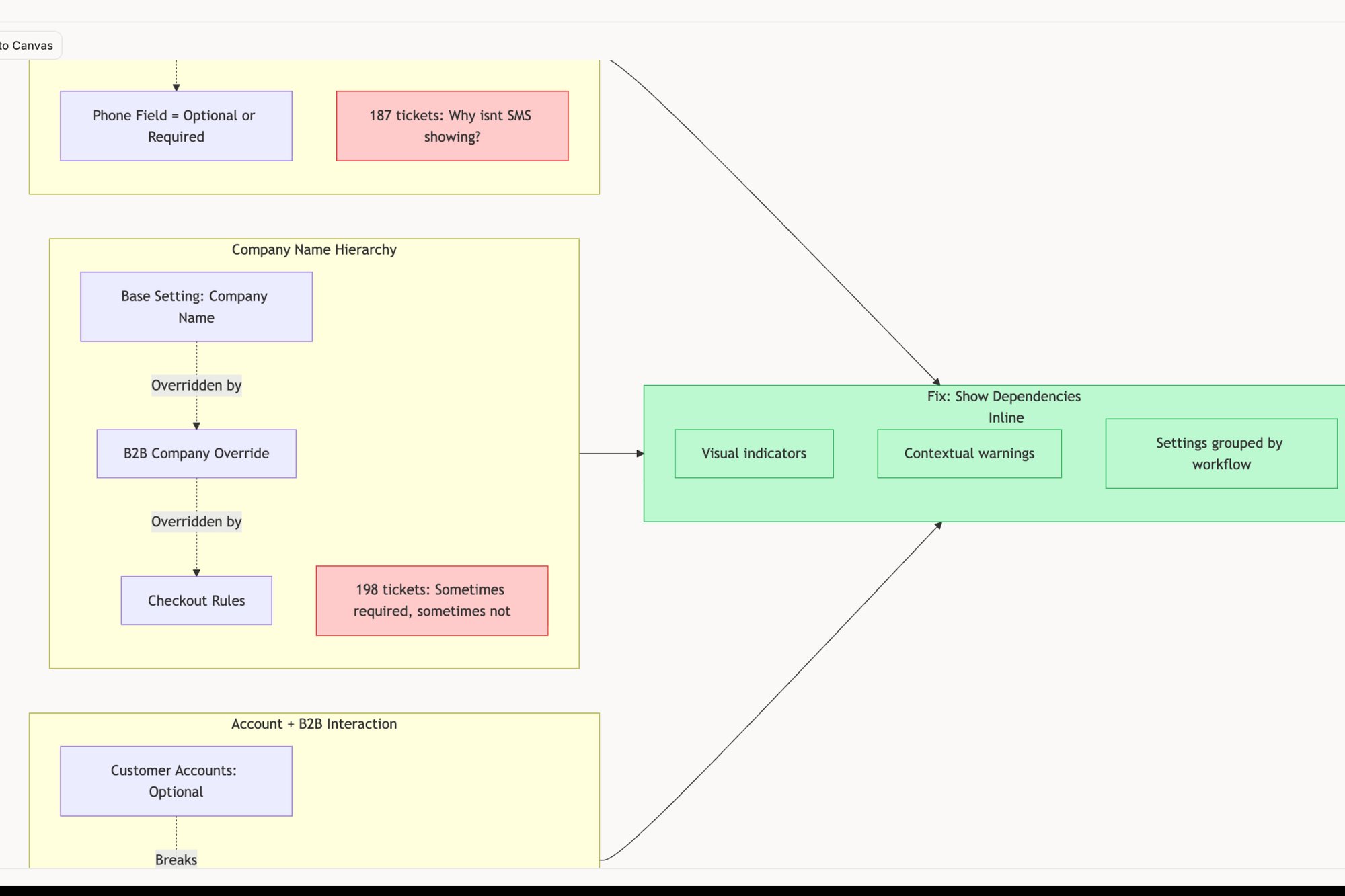
Context-grounded development means you start by understanding what is before you decide what will be. Instead of just brainstorming a new user flow for Shopify's checkout, you first map their current setup. For instance, you could use a tool to build an interactive canvas of the existing Shopify Checkout Setup Flow. This lets you pinpoint real friction points and design a superior experience based on evidence, not intuition.
Why This Matters Now More Than Ever
Why does this matter at scale? The pressure to ship quickly has never been greater. Product development isn't a conveyor belt of features, it’s a switchboard of dependencies. Pulling the wrong lever can short-circuit the entire system. According to a report by the Standish Group, over 31% of projects will be cancelled before they ever get completed, often due to failures in early-stage planning and requirements gathering.
Grounding every decision in real-world context is your primary lever for acceleration in this unforgiving arena. You can learn more about how new products are driving market trends and get additional insights on Accio.com.
This systematic approach is what separates a lucky launch from a repeatable one.
Like this.
Your goal is to build a fortress of evidence around your new product launch, making its success a logical conclusion rather than a speculative bet.
The next step is to master the art of validating your ideas before they consume engineering resources. You can begin this shift by learning how to validate features before writing a single line of code, turning abstract concepts into tangible, testable assets early in the process.
Mapping The Territory Before You Build
A feature idea isn't a map. It’s a single point of light in a vast, dark room: it shows you a destination but tells you nothing about the terrain in between. A successful product launch depends less on the brilliance of that initial idea and more on how thoroughly you survey the landscape before taking that first step.
Think of development like an expedition. You wouldn't set out without understanding the rivers you need to cross or the mountains you have to climb. Yet, product teams do this all the time. They fixate on a goal and just start marching, only to find an impassable chasm halfway through the journey.
I watched a team last year take what they thought was a simple two-week feature and see it bloat into a six-week slog. Why? Their product requirements document only described the "happy path." This forced their engineers to become impromptu product designers, constantly asking, "What happens if...?" Each question revealed another hidden state, another unmapped corner of the user experience.
Upfront clarity isn't bureaucracy. It’s acceleration.
From Vague Concepts to Buildable Plans
The only way to build a defensible plan is to first map the current reality. Assumptions are the currency of failed projects. Grounding your work in the tangible, observable truth of your existing product is the only antidote.
This process shifts a team's energy from hopeful assertions to provable confidence. You’re building a much more resilient foundation for any new product launch.
The key insight here is that confidence isn't an emotion you feel; it's an asset you build through diligent, early-stage exploration. For example, instead of just brainstorming a new checkout flow, you must first document the existing one. For a complex system like Shopify, that can feel incredibly daunting.
But modern tools can capture and visualize this reality almost instantly. When you map the current state, friction points and design flaws become immediately obvious. For example, a thorough analysis of a Shopify checkout redesign might reveal that the biggest drop-off isn't payment, but the address form. You’re no longer guessing where the problems are, you are seeing them.
Mapping the existing state isn't a step you take before the real work begins. It is the real work. It’s the act of turning the lights on in that dark room.
Creating The Foundational Artifacts
This "mapping" phase produces tangible artifacts that guide the entire project. For example, a thorough audit of a feature like Dropbox's file upload process can uncover hidden failure modes that would otherwise derail a launch. That level of sophistication is impossible without a deep, documented understanding of every step in the user journey.
Your mapping should produce several key outputs:
- A comprehensive user flow diagram: Don't just show the happy path. Map every detour, error state, and dead end a user might run into.
- An edge case inventory: What happens when the network fails mid-upload? Or when a user enters invalid data? Documenting these scenarios prevents last-minute scrambles and costly rework.
- A visual audit of the current experience: Screenshots and recordings create a shared, objective view of the starting point for the entire team. No more arguing about how things currently work.
An essential piece of this "launch before the launch" is developing a robust go-to-market strategy framework. This strategic document should be directly informed by the realities you uncover during your mapping phase, ensuring your market entry plan aligns with your product's actual capabilities.
For a step-by-step framework on orchestrating this entire process, see our new product launch playbook.
This meticulous groundwork is where you win. It transforms the development process from a series of surprises into the predictable execution of a well-defined plan. To dig deeper, check out our guide on how to conduct primary customer research to strengthen this discovery phase.
Next, we'll talk about how to translate this map into a language everyone on the team can understand and build upon.
The Prototype Is The Conversation
It’s Tuesday morning. You pull up a static mockup in a review meeting. Engineering nods, marketing smiles, and everyone agrees the design is clean. Two weeks later, a developer Slacks you: “What happens when a user clicks this button before the data loads?”
Suddenly, that clean design fractures into a dozen unanswered questions.
Static mockups are lies. They’re beautiful, dangerous lies that present a single, perfect state while hiding the messy, interactive reality of a product. A static image is a photograph, but a prototype is a film. The real story is in the frames between the pictures, in what I call the interaction gap. This is where most user frustration lives and where most projects go off the rails.
Closing the Interaction Gap
A prototype’s job isn’t just to look like the product. Its job is to behave like the product. It’s a simulator for decisions.
I once watched a PM present a simple “assign a task” component. The mockup showed one screen: an avatar, a task name, and an “Assign” button. Simple enough. But when they built an interactive prototype, they discovered 11 distinct states engineering would have to account for, all visible in the final component states mapping.
What does the component look like when loading? When the assignment fails? What if the user has no permission? Mapping this out transforms an abstract idea into a concrete set of engineering requirements before a single line of code is written.
This shift from static to interactive completely changes the conversation. Instead of asking, “Do you like this design?” you start asking, “Does this behavior make sense?” It forces your team to confront the difficult questions early, when the cost of change is nearly zero.
The Economics of Early Interaction
Finding a flaw on a static screen is hard. Finding it in a clickable prototype is easy. Finding it after it's been coded and shipped to users is catastrophically expensive, not just in engineering hours but in customer trust.
Consider a critical financial feature, like freezing a lost bank card. The "happy path" is simple. But what about all the edge cases?
- What if the network drops while the freeze request is in progress?
- What if the user tries to freeze a card that's already frozen?
- What if a transaction comes through a split-second before the freeze is confirmed?
Mapping these scenarios in a document is one thing. Experiencing them in a simulation like this Wise card freeze flow is another. A high-fidelity artifact allows the entire team—product, design, engineering, and QA—to pressure-test the logic together.
The prototype isn't a demonstration of the final product. It is the crucible where the final product is forged. It turns abstract requirements into a shared, tangible reality.
This approach fundamentally changes the dynamic of a launch. Instead of designers handing off pictures for engineers to interpret, the prototype becomes the single source of truth. It's the conversation piece that ensures what you design is what you build.
Building effective interactive models is a skill in itself. To go deeper, learn more by reading about the nuances of prototyping in UX design and how to make it a core part of your workflow. It's the most reliable path from a fragile idea to a robust user experience.
From Design Handover To QA Partnership
The phrase "design handover" paints a pleasant picture. One team neatly ties a ribbon on their work and passes the box to the next. It’s clean, linear, and completely wrong. In reality, that box is a minefield of missed states and unasked questions, set to detonate weeks later during a frantic QA cycle.
A new product launch deserves better than a last-minute bug hunt.
This old way of working recasts QA as an adversary, the team that finds flaws, instead of a partner that helps prevent them. We need to dismantle this concept entirely. The guiding principle is simple: QA begins the moment the first user flow is drafted. Quality isn't a stage in the process; it's an input from the very beginning.
Shifting Left From Bug Finding To Bug Prevention
Think of your product development process as building a skyscraper. Does it make sense to wait until all 20 floors are built before you send in the structural engineer to check the foundation? Of course not. The cost of fixing a foundational error on a nearly finished building would be catastrophic.
The same logic applies to software. Last week I watched a PM at a health-tech startup demo a new prescription renewal feature. It looked perfect. But the lead QA engineer asked a simple question: "What happens if the user's insurance has expired since their last renewal?"
Silence.
The beautiful UI couldn't answer. The team had designed for the happy path and handed it over, creating a critical blind spot that would have cost weeks of rework if discovered after development.
This is what I mean: your test plan should evolve with the design, not be a checklist created at the end. When QA is involved early, they bring a priceless perspective, pressure-testing the logic of a flow long before it becomes code. This continuous partnership is essential for a smooth new product launch. You can find more strategies for this collaborative model in our developer handoff playbook.
Making The QA Partnership Automatic
This partnership shouldn’t rely solely on meetings and goodwill. Modern tools can and should bridge the gap between design artifacts and test plans. Imagine generating comprehensive test cases directly from a user flow diagram. This isn’t some far-off idea, it’s happening now.
Take a new feature like modifying a ride mid-trip. By analyzing a proposed user flow, a tool like Figr can instantly generate a detailed suite of test cases for modifying a Waymo trip. It can cover everything from simple stop additions to complex scenarios involving timing conflicts and route recalculations. This process highlights a critical change in how we build products.
In short, your goal is to make the QA process boring.
A successful launch is one where the pre-launch bug bash finds almost nothing, because the big problems were already solved in the design phase.
So what's the next step? Invite your QA lead to your next design review. Don’t present a finished mockup. Show them the messy, in-progress user flow diagram and ask, "What did we miss?" Their answers will be one of the most valuable assets you have.
Launching With Your Eyes Open
The day your product goes live is the day your real education begins. For weeks, you've operated on hypotheses and prototypes. Now, for the first time, you get the unfiltered truth of real user behavior.
Most teams treat this day like a finish line. They pop the champagne and watch the vanity metrics. But visionary teams see it as the starting pistol for a new race: the race to understand.
This is what I mean by instrumented curiosity. It’s the practice of launching not just to hit a number, but to answer a specific, pre-defined question. It’s not enough to track conversion; you must understand the why behind the numbers. A launch isn't a final exam, it’s a series of controlled experiments.
From Launch Day To Learning Day
Think of your launch like a scientist’s laboratory. You wouldn't just mix chemicals to see what happens. You'd have a specific hypothesis: "If I add compound A to compound B, I expect C to happen because of X."
Your launch should be no different. The questions you couldn't answer during development, the debates you had about user preference, these now become your A/B tests. The launch is how you get the answers. A friend at a fintech startup was stuck debating two different sign-up flows. Instead of arguing, they launched both as an A/B test.
Within 48 hours, the data was clear. Version B, which asked for less information upfront, had a 22% higher completion rate. Their next iteration wasn't a guess, it was a direct, data-backed response to observed user behavior.
Connecting Analytics To Pre-Launch Questions
This level of insight doesn’t just happen by accident. It’s the direct result of work done before the launch. Your analytics setup should be a reflection of your team’s biggest uncertainties.
Modern tools can connect directly to your analytics, benchmark your new funnel against industry standards, and highlight where users are dropping off. You can see how a redesigned scheduling flow compares to the previous version, or analyze the drop-off points in a new setup process, like this one for Shopify's checkout.
The goal is to make learning the default outcome of a launch. Even if your primary metric doesn't move, if you understand why, the launch was a success.
This mindset is crucial in a global market where speed is everything. Innovation is surging, with countries like India and Viet Nam rapidly climbing the Global Innovation Index. This boom means prototyping faster is no longer optional. To succeed in these competitive landscapes, tools that ground launch decisions in product context are essential. You can discover more insights about why this is a prime year to launch a product on ProductInnov.com.
Instrumenting Your Curiosity
To truly be "Launching With Your Eyes Open" in today's market, you must also consider your product's visibility in AI search. Learn more about developing an effective AI Driven Content Optimization Playbook to ensure your new product is discoverable.
So, how do you put instrumented curiosity into practice?
- Define your launch questions: Before you go live, list the top three things you need to learn. Is it which headline drives more clicks? Is it whether users understand a new icon? Be specific.
- Build funnels for each question: Instrument your analytics to track user progression through the exact flows related to your questions.
- Benchmark your results: Don't just look at your own numbers. Compare your conversion and drop-off rates to established industry benchmarks to understand if your performance is good, bad, or average.
This is how you turn a launch from a gamble into a predictable engine for learning and growth. Your first iteration shouldn't be your best guess; it should be your first proven step toward what your users truly want.
How To Actually Make This Change Stick
It’s 3:15 PM on a Friday. Your team is aligned. The roadmap is set. The energy is high.
But a quiet question lingers in the back of your mind: will this new process actually stick? Or will we just snap back to our old, chaotic ways under the first real deadline pressure?
This feeling is normal. Adopting a new launch playbook isn't about memorizing steps on a checklist. It's about fundamentally changing the rhythm of how your team thinks and works together. Here are some of the real questions that come up when you try to make that change happen. This launch playbook fits within a broader system. For the full picture, see our guide to the product development lifecycle stages.
How Do We Start Without Boiling The Ocean?
The thought of overhauling your entire launch process can be paralyzing. Where do you even begin?
The key is to forget about process, at least at first. Start with a single, high-value artifact.
Don't send a company-wide email announcing a "new QA partnership model." That’s just corporate noise.
Instead, for your next feature, quietly generate a comprehensive list of test cases for modifying a Waymo trip. Share it with your QA lead and just ask for their feedback. This one small action grounds the big idea in a real task and proves its worth on the spot.
The basic gist is this: prove the value on a small scale first. One useful artifact is more persuasive than a hundred slides of process theory. The momentum from that one small win will pull the rest of the process along.
How Do I Handle Pushback From The Team?
You will, inevitably, hear some version of this: "This just feels like more work," or "We don't have time for this."
This isn't your team being difficult. It's a natural reaction to change, and it usually comes from a genuine concern about speed.
Your response shouldn't be to defend the process. It should be to reframe the timeline.
Here’s what I mean: mapping out every edge case for a feature like a Wise Card Freeze flow might take an extra day upfront. Yes, an entire day. But that one day prevents a solid week of frantic, last-minute bug fixing right before launch. The work doesn't disappear; it just moves. You’re shifting effort from the chaotic, expensive end of the cycle to the calm, low-cost beginning.
Frame it as an investment, not an expense. Ask your team: would you rather spend one hour debating edge cases in a calm room now, or 20 hours debugging a live production issue on a Sunday night later?
When the trade-off is that stark, resistance often turns into advocacy.
What’s A Realistic Timeline To See Results?
You won’t see a dramatic shift overnight. The real impact of this context-grounded approach unfolds in stages.
- First 30 days: The most immediate change happens in your meetings. Conversations become more specific, less abstract. Instead of debating opinions, you'll find yourselves pointing to a shared, interactive prototype on the screen. The focus shifts from "I think" to "Let's look."
- First Quarter: You'll start to notice a significant drop in "unplanned work." Those last-minute "quick questions" from engineering will decrease because the prototypes and user flows are just more thorough. Your launch cycles will feel less like a sprint and more like a predictable march.
- First 6 Months: This is where the economic impact becomes undeniable. You'll see a measurable reduction in post-launch hotfixes and rollbacks. According to research published by Stripe, using detailed signals to inform user experience is a key driver of conversion lifts. Your own data will start telling a similar story as you launch more polished, data-informed features.
The goal isn't just to launch faster. It's to launch better, with fewer costly surprises.
How Do I Measure The Impact Of This New Approach?
To prove this new playbook is working, you need to track metrics that go beyond simple velocity. Confidence is your new KPI. But how do you measure something as squishy as confidence?
You track the leading indicators of launch quality:
- Requirement Volatility: How many changes or scope additions are you making after a development sprint has already started? A decrease here is a direct signal that your upfront planning is getting sharper.
- Bugs per Feature (by type): Don't just count bugs; categorize them. A reduction in bugs related to "missed requirements" or "unhandled edge cases" proves your new process is catching the expensive mistakes early.
- Time in QA: A successful implementation should actually see the time QA spends on a feature decrease. They'll shift from hunting for bugs to simply validating expected behavior, which is a much faster (and happier) job.
Ultimately, a successful launch isn't just one that ships on time. It's one that ships with confidence, solves the right problem, and delights users from day one. That's the real impact you're aiming for.
Ready to stop launching with blind bets and start shipping with provable confidence? Figr is the AI design agent that grounds your entire workflow in real product context, from PRDs to production-ready prototypes. Explore Figr and start your first project today.