Monday morning, 8:47 a.m. The leadership sync starts in thirteen minutes. Sales wants a commitment for a prospect. Engineering wants fewer surprises. Design wants clarity on what is next. The backlog is full, the quarter is short, and the roadmap sitting in your deck somehow feels both too detailed and not useful enough.
That tension is product roadmap planning.
A roadmap is not a promise factory. It's not a prettier backlog either. It is a negotiated view of reality, shaped by strategy, pressure, evidence, and the uncomfortable truth that shipping something is only valuable if it changes something that matters.
I watched a PM last week walk into a review with a polished roadmap and leave with six new “urgent” asks from six different stakeholders. Nothing on the slide was wrong. But the roadmap had one fatal flaw. It didn't make the trade-offs legible. People could see items. They could not see the logic.
That's where most roadmap work breaks. Not in formatting. In meaning.
Start With Why Aligning Your Roadmap to Strategy
Roadmaps usually reveal company incentives faster than strategy docs do. If every roadmap item points to quarterly revenue, you'll get one kind of product. If every item points to user behavior, retention, and adoption, you'll get another. Neither is neutral. Both shape what teams reward, defend, and postpone.
That's why product roadmap planning starts with a sharp why. Not a slogan. Not “improve the experience.” A real statement about the value you intend to create and the evidence you'll use to judge whether you're doing it.
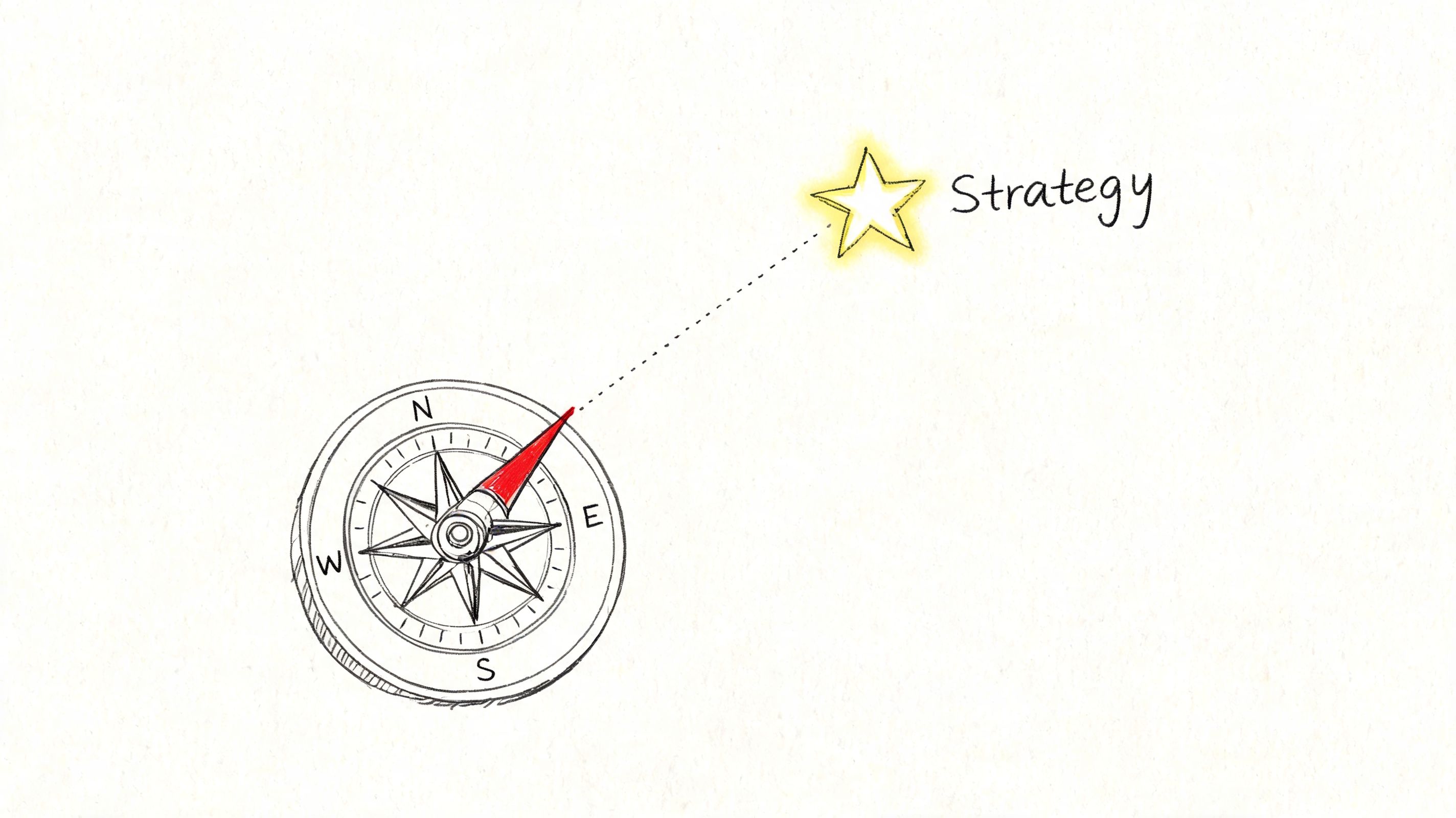
Name the North Star
I like to think of strategy as a North Star metric plus a set of deliberate constraints. The metric tells you where to point. The constraints tell you how not to get lost.
For many SaaS teams, the business goals are obvious enough: revenue growth, expansion, retention, market share. But roadmaps improve when you translate those goals into product outcomes. Productboard notes that effective roadmaps define metrics such as revenue growth and Net Promoter Score, and Product School's 2025 guide recommends using OKRs for quarterly objectives that connect goals like improving customer satisfaction to a measurable metric like NPS, as summarized in Productboard's roadmap planning analysis.
That matters because teams can't prioritize well from aspiration alone.
A good Objective says where you're going. A good Key Result tells the team how progress will show up in the product. “Improve customer satisfaction” is direction. “Increase NPS” is testable. “Improve onboarding conversion” is even better because it links strategy to a part of the journey people can directly change.
Business metrics are necessary, customer metrics are revealing
Executives often default to business-oriented measures because they're visible and easy to discuss in planning cycles. That's understandable. But customer behavior usually tells you earlier whether your roadmap is healthy.
Practical rule: If a roadmap item can't explain which user behavior it should change, it probably isn't strategy. It's hope.
Outside signal proves especially beneficial. If you want a wider lens on how founders and operators frame market shifts before they show up in your planning meetings, it's worth taking time to explore founder product news. That kind of context doesn't replace product strategy, but it does sharpen the assumptions behind it.
Strategy should make saying no easier
The most useful roadmap artifact in any company is often a sentence that kills ten bad ideas.
Use a filter like this:
- Strategic fit: Does this item support the product outcome we care about now?
- Behavioral link: What user action or experience should change if we build it?
- Measurement plan: How will we know it worked?
- Opportunity cost: What stronger bet would this push aside?
When teams skip this work, everything sounds important. When they do it well, the roadmap gains teeth. It becomes a decision instrument, not a compromise document.
Gather Intelligence Not Just Ideas
The worst backlogs all have the same smell. Lots of motion. Very little signal.
Last week, a PM at a growing SaaS company showed me a backlog with hundreds of items. Feature requests from sales. Fragments from support tickets. Notes from customer interviews. A few founder asks. A few “quick wins.” The list looked busy enough to feel responsible. But nothing in it answered the only useful question: what problem is repeating loudly enough that it deserves roadmap space?
That's the difference between collecting ideas and gathering intelligence.
Backlogs become feature factories when inputs stay unprocessed
Raw inputs matter. User interviews matter. Product analytics matter. Support transcripts matter. Competitive context matters. But none of them should go straight onto the roadmap.
The basic gist is this: roadmap inputs need synthesis before they deserve priority.
ProductPlan's analysis makes the distinction clear. Business metrics such as customer acquisition cost are common, but customer-oriented metrics like retention, churn, and feature usage offer a truer test of product performance. Their example is memorable: journey analysis can show that adding ten “friends” in an app boosts usage by 50%, which gives the team a precise behavior to target. The same analysis notes that teams using these analytics report up to 50% higher feature adoption rates, according to ProductPlan's roadmap analytics guide.
That's not a reason to chase random behavioral proxies. It's a reminder to find the behaviors that predict value.
Turn scattered evidence into opportunity areas
I usually look for patterns across four streams:
- Qualitative friction: What are users repeatedly confused by, avoiding, or working around?
- Quantitative drop-off: Where do users abandon, stall, or fail to activate?
- Operational pain: What do support, success, and sales keep compensating for manually?
- Market movement: Where are competitors reframing expectations or category norms?
Once you have those, don't write roadmap items yet. Write opportunity statements.
For example, not “build advanced filters.”
Instead, “help evaluators find the right data set faster during first-session exploration.”
That shift sounds small. It changes everything.
If your research inputs are getting messy, a practical process for tagging, consolidating, and reviewing evidence helps. This guide to effective research management is useful for teams that need more discipline around how insight gets captured and reused. For deeper discovery practices, these product team market research strategies are a strong companion.
Good roadmap planning doesn't start with “what should we build?” It starts with “what keeps showing up, and why?”
Build a discovery rhythm, not a one-time workshop
A roadmap built once a quarter from stale notes will always drift. The teams that stay sharp keep a light but steady cadence. They review interview patterns, usage behavior, funnel movement, and stakeholder requests as part of an ongoing operating habit.
You don't need more ideas.
You need better evidence compression.
Prioritize With Frameworks Not Feelings
This is the crucible. Every team says they value strategy. Prioritization reveals whether they mean it.
When a roadmap debate goes badly, people argue from role power. Sales says a deal depends on it. Engineering says the architecture won't hold. Design says the flow is broken. The CEO says the market is moving. Everyone may be right. That still doesn't tell you what belongs first.
This is what I mean. Strong prioritization frameworks don't remove judgment. They force judgment into the open.
Three useful models, three different jobs
I keep coming back to three frameworks because they solve different kinds of conflict.
| Framework | Best For | Key Components | Primary Pro | Primary Con |
|---|---|---|---|---|
| RICE | Growth-stage teams with decent data | Reach, Impact, Confidence, Effort | Makes assumptions explicit and comparable | Can create false precision when data is weak |
| MoSCoW | Stakeholder-heavy planning and scope negotiation | Must have, Should have, Could have, Won't have | Fast, intuitive, useful in cross-functional conversations | Categories can get politicized if “Must” becomes everyone's favorite label |
| Opportunity Scoring | Discovery-led teams focused on unmet user needs | Importance, satisfaction gaps, opportunity level | Keeps user pain central to prioritization | Harder to use if user insight is thin or outdated |
Use the framework that matches your planning problem
RICE is good when your team has enough signal to estimate reach and impact with some credibility. It works well for comparing onboarding improvements, engagement experiments, and monetization bets. It's less useful when the underlying issue is not score calculation but strategic disagreement.
MoSCoW helps when the roadmap is turning into a negotiation theater. It gives teams a simple way to separate genuine commitments from nice-to-haves. I've seen it work especially well in release planning conversations where legal, sales, and support all need to weigh in.
Opportunity Scoring is what I reach for when a roadmap is drifting toward feature accumulation. It asks a better opening question: where is customer need important and still poorly served? That reframes the conversation away from requests and toward gaps in value.
Argue over inputs, not opinions
A framework is useful only if the team is willing to challenge the assumptions inside it.
Ask things like:
- For RICE: Is the reach estimate real, or are we using aspiration as math?
- For MoSCoW: What makes this “Must,” and what breaks if we delay it?
- For Opportunity Scoring: Which customer evidence says this pain is both important and unresolved?
That kind of conversation is healthier than “I just feel this is bigger.”
If you want a simpler visual method for sorting urgency against value before moving into a fuller roadmap discussion, this guide to shipping what matters is worth using with your team.
The best prioritization model is the one your team will use honestly, not the one with the fanciest spreadsheet.
No framework will save a roadmap from politics entirely. But a good one will at least make the politics visible.
Build Your Timeline and Release Plan
A prioritized list is still just a pile until you sequence it.
Product roadmap planning transforms into communication design. You're translating decisions into a timeline that people can understand without mistaking it for a fixed promise. That distinction sounds subtle. It's one of the hardest disciplines in product.
Sequence by theme, not by feature clutter
I prefer to group work into a few strategic themes rather than a long procession of isolated items. Themes tell a story. They help executives see intent, engineering see coherence, and go-to-market teams understand what's coming without forcing false precision.
A simple sequence usually works:
- Now holds work already in motion and close to delivery.
- Next contains the initiatives you're confident enough to prepare for.
- Later captures direction without pretending certainty.
- Done gives stakeholders a visible record of movement and learning.
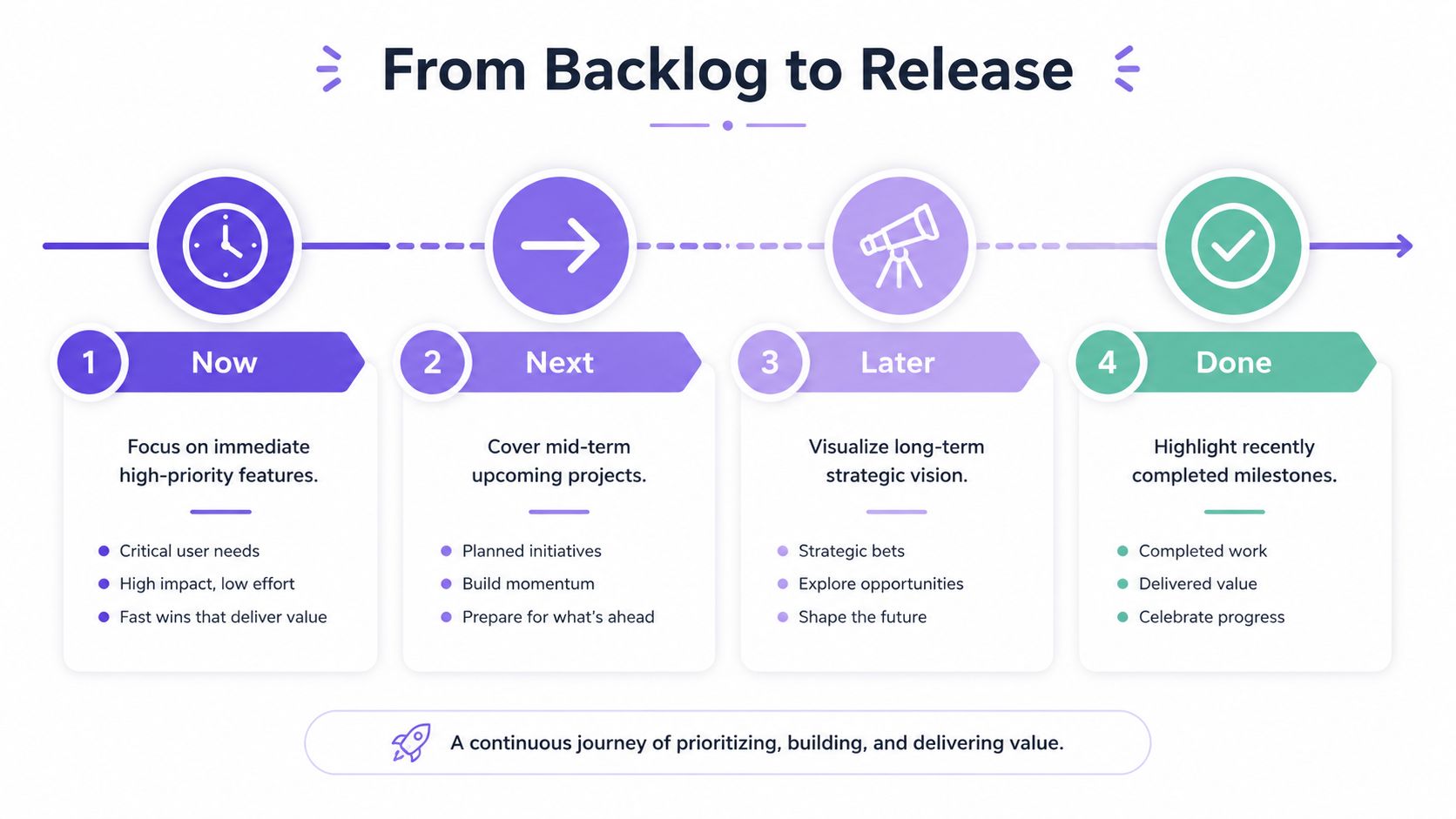
This format helps because it communicates confidence levels, not just order.
Dates should inform, not trap
You still need timing. Teams have launches, dependencies, enablement work, and customer conversations to manage. But tying every item to a rigid date too early is how roadmaps become brittle.
What works better?
- Use date ranges for themes, not exact dates for all feature details.
- Call out dependencies openly, especially shared engineering resources and external approvals.
- Separate release intent from release certainty, so stakeholders know what is likely versus what is conditional.
A release plan should also account for everyone who has to carry the work across the finish line. Sales enablement, customer success prep, docs, onboarding changes, pricing updates, support macros, analytics instrumentation. If those aren't in the conversation, the feature may launch in code and fail in the business.
For teams tightening that operational handoff, Figr's guide to agile release planning is a useful reference. And if your roadmap is feeding toward a launch, this checklist for planning your product debut on Saaspa.ge helps connect product sequencing to go-to-market readiness.
Leave room for learning
The best release plans have spine and flexibility at the same time. They show what the team believes now, where confidence is highest, and what assumptions could still change the sequence.
That honesty builds trust faster than fake certainty ever will.
Master Stakeholder Alignment and Communication
A roadmap succeeds when people believe it reflects reality, not when it looks polished.
I've seen mediocre roadmaps work because the team trusted the logic and the update cadence. I've also seen beautiful roadmaps collapse because every function was reading a different story into the same slide.

Different stakeholders need different resolutions
Executives usually want to know whether the roadmap supports company goals, where the biggest bets are, and what risk is emerging. They don't need every dependency. They need the narrative and the exposure.
Engineering leaders need a different view. They need sequencing logic, risk concentration, major dependencies, and enough detail to judge whether the plan is feasible. If the roadmap hides uncertainty here, trust erodes fast.
Sales and customer-facing teams need something else again. They need confidence in direction, language they can share externally, and a clean understanding of what is committed versus exploratory.
This is why one roadmap can support multiple views without becoming multiple truths.
Alignment fails when teams optimize for shipping, not outcomes
One of the most important gaps in roadmap practice is measurement of alignment itself. Aakash Gupta's analysis captures the issue well: “roadmaps packed with features but disconnected from business or user goals can lead to bloated backlogs and missed opportunities.” The stronger practice is to define roadmap health metrics and use quarterly checkpoints to assess whether shipped work moved retention, conversion, or revenue, not just whether it launched on time, as described in this roadmap best-practices analysis.
That point is bigger than process.
At scale, every function has an incentive to protect its own certainty. Sales wants promises. Engineering wants stability. Leadership wants accountability. Product sits in the middle, translating uncertainty into coordinated action. The roadmap is where those incentives collide.
If your roadmap review is only about status, you're managing optics. If it's about outcomes, you're managing the business.
A practical walkthrough can help teams reset how they present and socialize roadmap decisions:
Build a communication cadence, not a presentation habit
A living roadmap usually needs a repeating rhythm:
- Monthly review with cross-functional leads: changes in priority, delivery risk, and newly surfaced evidence.
- Quarterly outcome checkpoint: what shipped, what moved, what didn't.
- Ad hoc stakeholder updates: when meaningful assumptions change, not when politics demand theater.
For PMs who need a stronger operating model for these conversations, this is useful advice for product managers.
Stakeholder alignment isn't soft work. It's hard operational work, done in human language.
Measure Impact and Avoid Common Pitfalls
Shipping closes a ticket. It does not close the loop.
The strongest product teams treat roadmap items as hypotheses with an owner, a success signal, and a review point. The weak teams treat launch as proof. That's how roadmaps turn into graveyards of shipped features that nobody can defend a quarter later.
Measure the outcome, not just the delivery
Every roadmap theme should have a before-and-after question attached to it.
Before launch, ask: what specific behavior or business result should this change?
After launch, ask: did it?
That sounds obvious. It's rarely done with discipline.
A good measurement loop usually includes:
- A leading indicator that tells you early whether the feature is changing behavior
- A lagging indicator that shows whether the behavior translated into durable business impact
- A review point where the team decides to expand, revise, or kill the initiative
- A visible owner responsible for collecting the evidence and bringing it back to the roadmap
If your team needs cleaner thinking around signals that reflect user value, this guide to meaningful UX metrics is a practical place to start.
The common traps are painfully predictable
The patterns are consistent enough that most experienced product leaders can spot them early. ProductPlan's analysis quantifies several of them. Static roadmaps become obsolete in under 3 months for SaaS products, and 70% of teams end up referencing outdated versions. A feature-over-outcome focus is another major failure mode, where 73% of teams ship features that don't move metrics. Their guidance also notes that anchoring roadmap items to OKRs with specific success metrics helps, and that teams reviewing roadmaps in agile cadences achieve 35% faster time-to-value, according to ProductPlan's analysis of why roadmaps fail.
Those numbers matter because they describe familiar behavior, not edge cases.
What good teams do instead
Here's the operating model I've seen work repeatedly.
- Keep one source of truth: The roadmap can have different audience views, but it should not have conflicting versions.
- Review on a real cadence: If the market, customer behavior, or delivery reality changes, the roadmap has to move with it.
- Tie every major item to an outcome: If the team can only describe the deliverable, the item is undercooked.
- Instrument before launch: If analytics, event tracking, or funnel checkpoints aren't ready, you're choosing ignorance.
- Give teams permission to stop: Some bets underperform. Good roadmap planning includes a path to kill or narrow them.
- Separate confidence from desire: A stakeholder wanting something badly does not increase delivery certainty or expected impact.
The roadmap is not there to make everyone comfortable. It is there to help the company make sharper bets with fewer illusions.
A grounded checklist for your next roadmap cycle
Use this in your next planning round.
- Write the strategic outcome first. Don't start from features.
- Attach one primary metric to each theme. If there isn't one, keep refining.
- Pressure-test evidence quality. Are you looking at repeated patterns or isolated requests?
- Choose a prioritization method deliberately. Don't mix frameworks mid-argument unless you explain why.
- Sequence work by confidence bands. Now, Next, and Later usually works better than overcommitted dates.
- Publish audience-specific views from one roadmap. Different detail, same truth.
- Set a review date when the item is added. Every bet deserves a scheduled verdict.
- Cull aggressively. If a shipped item didn't move the metric, decide what changes or what stops.
In short, product roadmap planning works when you treat the roadmap as a continuous negotiation with reality. Strategy gives it direction. Discovery gives it evidence. Prioritization gives it discipline. Communication gives it buy-in. Measurement gives it honesty.
That's the whole job.
If your team wants help turning roadmap thinking into production-ready artifacts, Figr is one option worth evaluating. It helps product teams generate PRDs, user flows, prototypes, edge cases, test cases, and UX reviews from real product context, and it can connect those artifacts to analytics and funnel analysis so roadmap decisions are easier to trace back to actual behavior.