It’s 4:47 PM on Thursday. Your VP just asked for something visual to anchor tomorrow's board discussion on the competitive landscape. You have a PRD. You have bullet points. You have a list of direct rivals, but you know the real threats are often invisible, lurking just outside your immediate field of view.
Your market isn't a two-player game; it's a crowded arena with pressures coming from every direction.
This is where most competitive analysis falls flat. It becomes a feature-for-feature comparison, a flat list of who does what. We've all seen these basic showdowns, like the endless analyses comparing Jira and Linear task creation. While useful, they only show one piece of the puzzle. They miss the hidden currents that actually shape your strategic options. You can explore a quick UX audit of these tools here to see what I mean.
The Strategic X-Ray
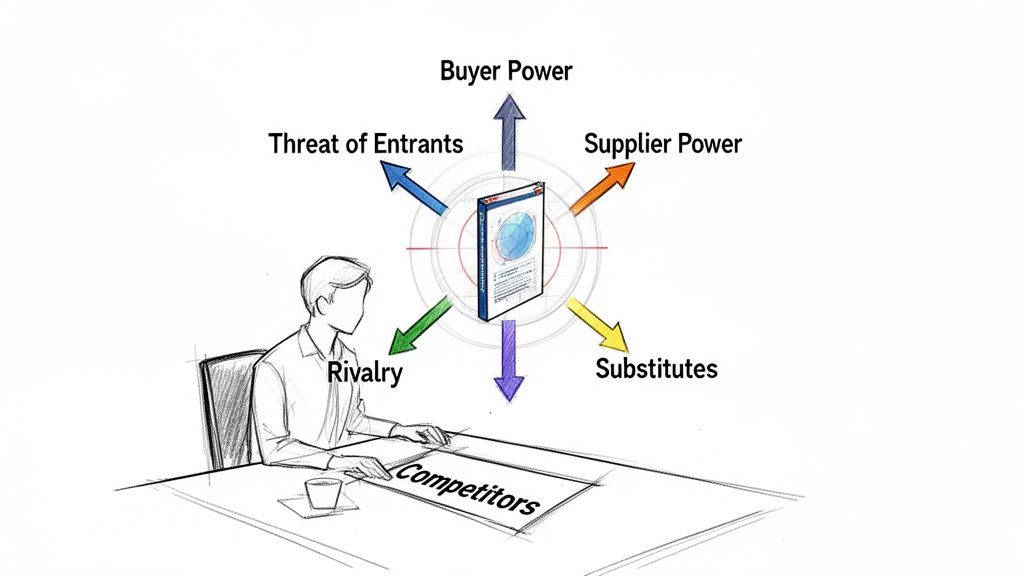
The basic gist is this: to see the full picture, you need a different kind of lens. You need a strategic x-ray, a tool to see the structural pressures shaping your industry’s profitability. This is what a Five Forces analysis template offers. It's a framework for mapping the entire system of competition, not just the players you see today.
This model, developed by Michael E. Porter at Harvard Business School in 1979, has become one of the most durable tools in business strategy. Its power is in revealing the underlying causes of profitability and giving you a framework to anticipate and influence competition. You can discover more insights about Porter's enduring framework and its application across industries. The goal is to move from reactive to proactive by understanding the forces that dictate your options.
A friend at a software startup recently used this model and had a revelation. They were obsessed with a single, well-funded competitor. But the analysis showed their real vulnerability wasn't rivalry: it was the low-cost substitutes customers were cobbling together with spreadsheets and free tools. Their biggest threat wasn't another company. It was customer ingenuity.
This is the power of the Five Forces framework. It forces you to look beyond the obvious rivals and consider the entire ecosystem:
- Suppliers: How much power do your key vendors and platforms hold over you?
- Buyers: How easily can your customers drive down your prices or switch away?
- Substitutes: What alternative solutions, even imperfect ones, solve the same core problem?
- New Entrants: How easy is it for a new company to enter your market and compete?
- Rivalry: How intense is the direct competition among existing players?
By understanding these pressures, you can move beyond simply reacting to competitors. You start to see the architecture of your market. You can identify the most powerful forces and build a strategy that defends against them or even uses them to your advantage.
Translating the Five Forces for SaaS and Software
Michael Porter’s famous model was born in a world of steel mills and shipping lanes. It was designed for physical goods, where moats were dug with capital and scale. So what happens when your product is code, your distribution is the cloud, and your factory is a developer’s laptop? How does a Five Forces analysis even work then?
The framework's power isn’t in its original examples; it’s in its fundamental structure. We just need to translate it.
Think of it as updating a classic map for a digital territory. The cardinal directions remain the same, but the landmarks are new. The competitive pressures are identical, but they show up in entirely different ways.
Threat of New Entrants in Software
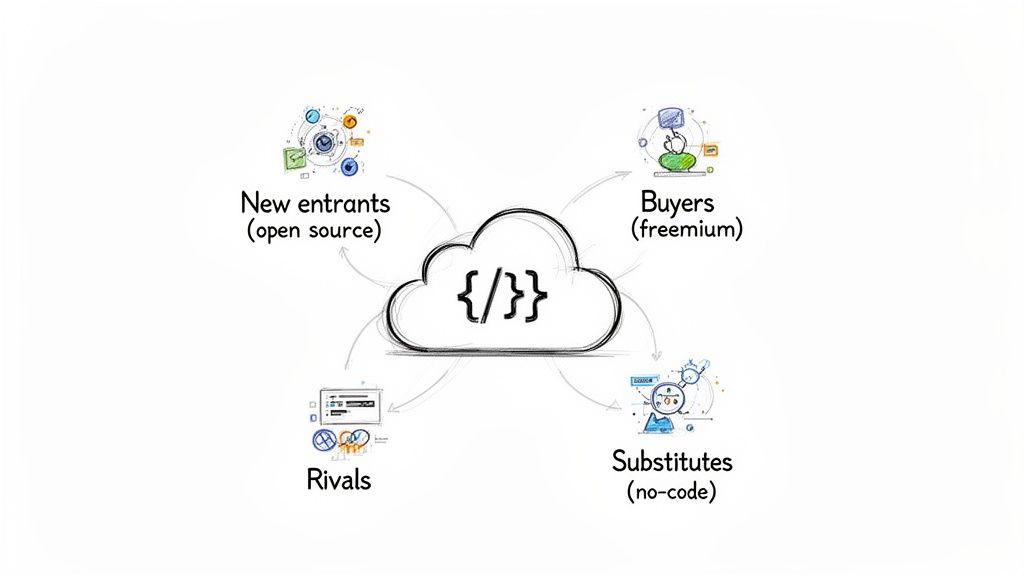
In the physical world, barriers to entry are tangible and high: factories, distribution networks, supply chains. In software, the barriers look deceptively low. A few developers can spin up an AWS instance and launch a product over a weekend.
The threat isn't just another venture-backed startup. It's the explosion of no-code platforms, the rise of powerful open-source alternatives, and the lean team that can build a "good enough" version of your core feature in a month.
Ask yourself these questions:
- How fast could a small, focused team replicate our core value proposition?
- Are there open-source projects that could be tweaked to compete with us?
- Could our product be built using a no-code or low-code platform?
- How strong are our network effects or proprietary data advantages, really?
A high threat here means you need a moat that isn't just about features. It’s about building a defensible position through community, unique data, brand, and deep integrations. A solid market entry strategy framework can help you map out these moats from day one.
Bargaining Power of Buyers (Customers)
For most SaaS companies, buyer power is incredibly high. The internet blew away geographic constraints, handing customers a global marketplace of options. Switching costs, once a powerful lock-in, have plummeted.
A friend at a B2B SaaS company recently told me they lost a five-figure deal not to a direct competitor, but because the client decided to "just stick with Google Sheets for another quarter."
That’s raw buyer power in action.
Prompts to consider:
- How easy is it for a customer to export their data and walk away?
- Does the freemium model in our market anchor price expectations near zero?
- How much of our service can be patched together with simpler, cheaper tools?
- Are our customers individuals or enterprises on long-term contracts?
Bargaining Power of Suppliers
Who are the "suppliers" to a software company? They don't deliver raw materials; they provide the foundation your business is built on.
Your key suppliers are your true dependencies: AWS for hosting, Stripe for payments, and the critical third-party APIs that power your features. If any one of them changed their pricing or terms tomorrow, how would it impact your business? That dependency is the true measure of supplier power. A 10% price hike isn't a negotiation; it's a tax you simply have to pay.
To get a read on this force:
- How many core features depend on a single third-party API?
- What would be the real cost to switch from our primary cloud provider?
- Do our key platform suppliers (like the App Store) take a significant cut of revenue?
Threat of Substitute Products
Substitutes are different from competitors. A competitor offers a similar solution. A substitute solves the underlying problem in a completely different way. For a project management tool, Jira is a competitor. A spreadsheet or a physical whiteboard are substitutes.
I watched a product team spend six months building an elaborate reporting dashboard, only to see adoption flatline. They later discovered their target users were just exporting raw data to build their own pivot tables in Excel: a substitute that offered far more flexibility. The real threat wasn't a rival dashboard but a familiar, versatile tool.
Questions for your team:
- What did our customers do to solve this problem before our product existed?
- What manual processes or general-purpose tools are people using instead of a dedicated solution?
- Could a new technology, like AI assistants, make our entire product category obsolete?
Intensity of Competitive Rivalry
Finally, we look at the head-to-head fight. In SaaS, this is often the most visible and brutal force. The fight for market share is fierce, fueled by venture capital and the relentless pursuit of growth.
Rivalry gets intense when:
- The market is crowded: Dozens of competitors are all chasing the same customers.
- Products are undifferentiated: Features are copied in weeks, leading to a race to the bottom on price.
- Market growth is slow: The only way to grow is to steal share from someone else.
The scheduling tool market is a perfect example. A feature launched by Calendly is often replicated by rivals like Cal.com within months, and vice versa. This intense rivalry puts constant pressure on innovation and pricing. It makes differentiation a matter of survival, as you can see in this in-depth comparison of their setup speeds.
By asking these translated questions, your Five Forces analysis stops being an academic exercise and becomes a sharp diagnostic tool for the realities of the software world.
Moving from Theory to a Quantifiable Analysis
A qualitative feel for your market is a good start. But a great analysis isn't a feeling, it's a number. How do you move from sensing that supplier power is high to actually proving it?
You have to translate abstract pressures into a concrete score.
The market isn’t a single weather system; it’s a series of microclimates. Each force has its own intensity. The only way to see the full picture is to measure each one individually, giving you a quantified map of your competitive terrain. This is the shift from observation to true analysis.
A friend at a Series C company recently did this. His team had been obsessing over two direct competitors, pouring resources into matching their every move. But after scoring each of the five forces, they saw a shocking picture. The "Competitive Rivalry" score was a 3. The "Threat of Substitutes" score was a 5.
They were fighting the wrong war.
Scoring Your Competitive Landscape
The core idea is to assign each of the five forces a score on a simple scale, usually 1 (very low threat) to 5 (very high threat). This turns a vague discussion into a structured, data-driven conversation. A low score indicates a source of strength for you. A high score signals a significant threat to your profitability.
Here’s a practical way to think about scoring each force for a software business:
Threat of New Entrants
- 1 (Low): Entry requires proprietary tech (like complex AI models), strong network effects, or exclusive regulatory approval.
- 3 (Medium): Entry requires a skilled team and moderate funding, but established brands have a strong advantage.
- 5 (High): A small team can launch a viable competitor quickly using open-source tools or by targeting a niche you currently serve.
Bargaining Power of Buyers
- 1 (Low): You have high switching costs due to deep integration, proprietary data formats, or long-term enterprise contracts.
- 3 (Medium): Customers can switch, but it involves some pain, like data migration or retraining their team.
- 5 (High): Customers can switch providers overnight with near-zero cost or effort. Freemium models and consumer apps often live here.
Bargaining Power of Suppliers
- 1 (Low): You use multiple, substitutable suppliers for key infrastructure like cloud hosting or payment processing.
- 3 (Medium): You rely on a few key suppliers (like a primary cloud provider), but alternatives exist if needed.
- 5 (High): Your business is critically dependent on a single provider, like the Apple App Store, a sole API provider, or a specific platform.
This isn't just a theoretical pressure. The 2024 Federal Reserve Small Business Credit Survey revealed that 29 percent of small businesses still experienced supply chain disruptions. Those dependent on single suppliers were hit the hardest. For SaaS, this highlights the immense power held by a concentrated group of cloud providers and API vendors, a factor you can read more about in studies on competitive forces.
Putting It All Together in a Template
To make this process tangible, you need a central place to document your scores and the reasoning behind them. A simple, structured document is the best way to start. It organizes your thinking and makes your analysis shareable.
This is what I mean. A good five forces analysis template isn't just a form to fill out. It's a structured argument you build, piece by piece, to defend your strategic choices.
The scoring process forces you to justify why you believe a certain threat is high or low. The real value is in the discussion that scoring provokes, which often uncovers hidden assumptions. You might even find that these insights help you build better forecasts: a topic we explore in our guide to using AI for forecasting the impact of product changes.
So here's the grounded takeaway: Download a simple template. Force yourself and your team to assign a number from 1 to 5 for each force. That single act of quantification is the first step toward building a strategy based on evidence, not just intuition.
Interpreting Your Results to Define Your Strategy
You’ve done the work. You filled out the five forces analysis template and scored each threat. Each score represents a small storm cloud of competitive pressure.
So, what now?
An analysis without action is just an academic exercise: a map with no destination. The scores themselves aren't the point; their meaning is. They are the diagnostic data you need to write a prescription for your product strategy.
This is the zoom-out moment. The incentives driving your competitors, suppliers, and customers aren't random; they're a system. They follow a logic. Once you understand the structure of that system, you can find the leverage points. You can stop pushing against solid walls and start looking for unlocked doors.
This simple workflow shows how to turn your scores from the five forces analysis template into an actual strategy.
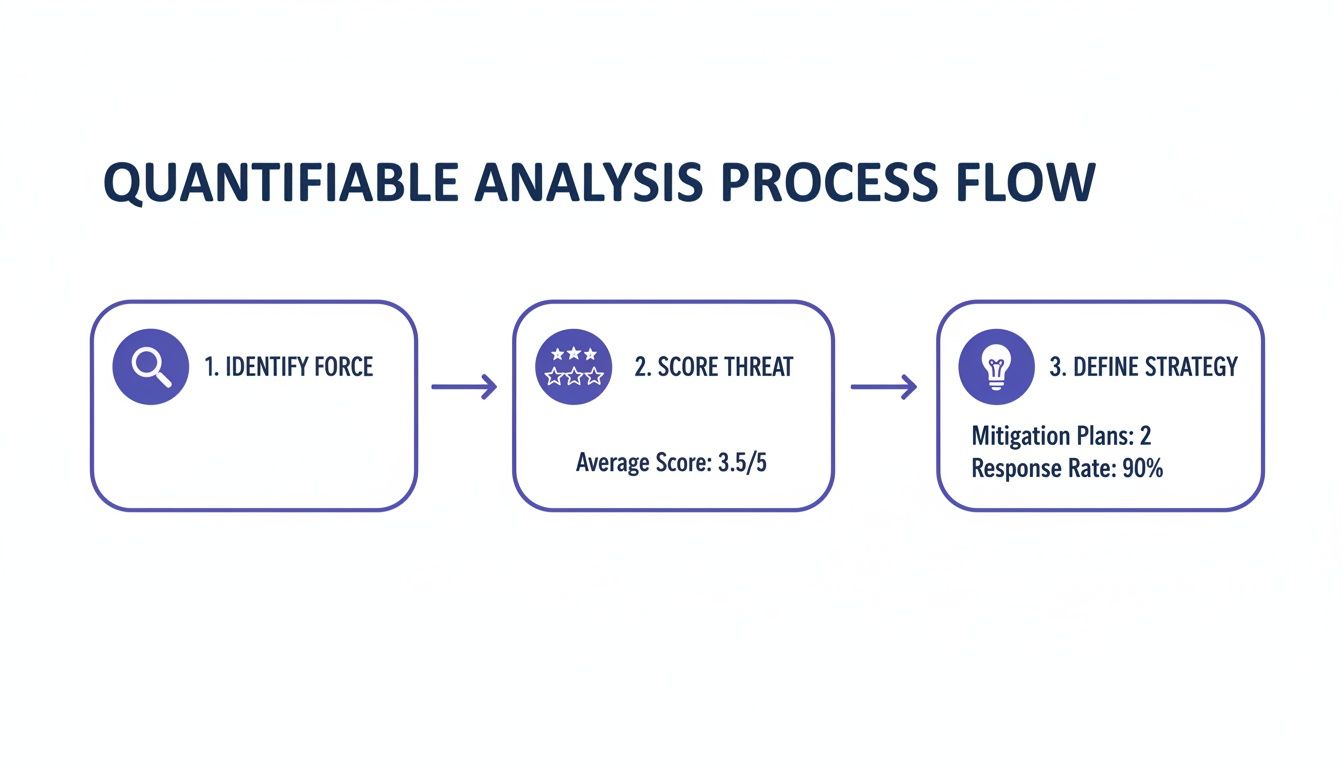
The diagram lays out a clear path: identify a force, score its threat, and define a strategic response. This process turns abstract pressures into concrete actions.
From Scores to Strategic Archetypes
Your set of scores paints a picture of your industry. Is it a blood-red ocean of intense rivalry or a calm blue sea? The pattern of high and low scores suggests a strategic archetype: a general posture you should adopt.
Consider these scenarios:
- High Rivalry & High New Entrants: This is a "Red Ocean" scenario. Your strategy must be about differentiation. You can't win by being the same, only cheaper. You need a unique value proposition, a stronger brand, or a superior user experience that competitors cannot easily copy.
- Low Rivalry & High Barriers to Entry: This is a "Calm Sea." The strategic focus here is market capture and expansion. Since competitive pressure is low, your goal is to grow the market, deepen your relationship with existing customers, and build moats to keep it calm.
- High Buyer Power & High Substitutes: This is a "Commodity Trap." Your product is seen as interchangeable. The primary strategy here is to increase stickiness and switching costs. This means moving from a simple tool to an integrated platform, creating network effects, or becoming a system of record that is painful to leave.
Turning Individual Forces into Product Plays
Beyond the big picture, each individual score on your five forces analysis template points to specific product and business moves. You can neutralize a threat or amplify an advantage with targeted actions.
A friend at a legal tech company recently told me their analysis revealed extreme bargaining power from buyers (law firms). Their response? They shifted their roadmap to focus on deep integrations with the case management systems these firms already used. This increased the switching costs, effectively lowering buyer power over time.
This is exactly what I mean by finding leverage.
Let's look at a few examples:
If the Threat of New Entrants is high, like the constant pressure scheduling tools face from alternatives such as Cal.com, your strategic response could be to build a network effect. The more users you have, the more valuable your platform becomes, making it harder for a new player to gain a foothold.
If the Bargaining Power of Buyers is high, your focus should be on features that increase stickiness. This is precisely why a company like Dropbox would meticulously map every single upload failure state. A perfectly reliable experience creates dependency and reduces a buyer's desire to switch.
If the Threat of Substitutes is high, your strategy is to lean into the unique value of a specialized tool. You might build workflow automation or industry-specific templates that a spreadsheet could never offer. One powerful way to do this is to combine market trend analysis with your product roadmap.
The goal is not to eliminate all five forces; that is impossible. The goal is to choose a strategic position where the forces are weakest or where you can best defend against them. Your analysis provides the intelligence. Your strategy is the action plan.
Automating Your Analysis with Real Product Context
The biggest challenge with any strategic framework? Keeping it tethered to the ground. It’s far too easy to drift into high-level assumptions in a conference room, completely detached from the daily reality of your users. Your Five Forces template can quickly become a theoretical exercise.
This is where the right tools can completely change the game.
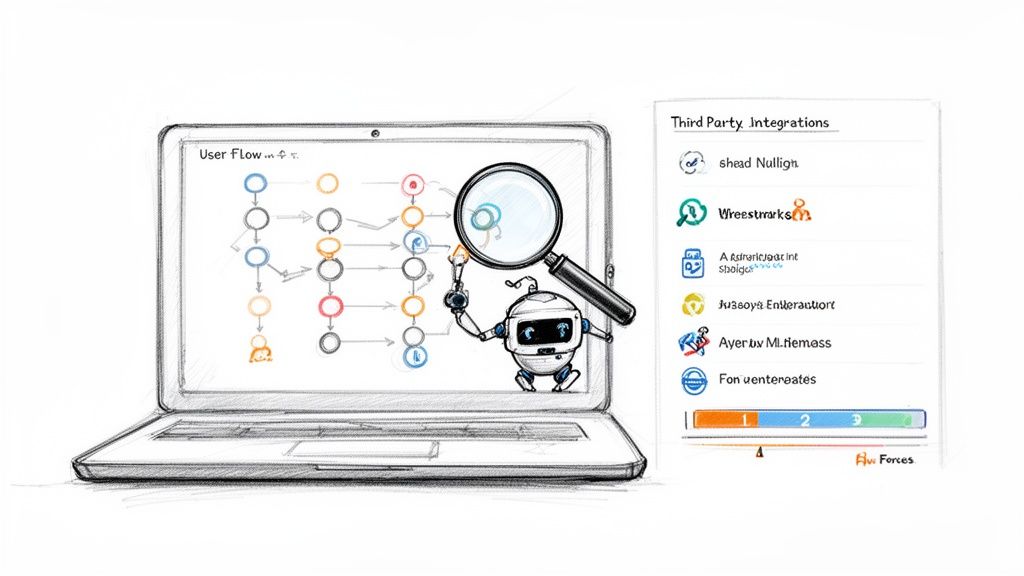
Instead of starting from a blank canvas, imagine an AI agent that already understands your product’s ecosystem. It knows your user flows. It sees your design system. It has context on your strategic goals. This flips the analysis from a manual data-gathering slog into a focused, guided exploration.
From Abstract Forces to Concrete Artifacts
Last week I watched a product manager use Figr to map out a competitor’s entire onboarding sequence. This wasn't guesswork based on marketing screenshots. It was a visual, click-by-click analysis of the real user journey, which fed directly into their assessment of Competitive Rivalry.
Suddenly, the abstract concept had tangible evidence. The basic gist is this: by connecting strategic frameworks to actual product artifacts, you replace assumptions with facts.
Bargaining Power of Buyers: How do you actually quantify "switching costs"? Instead of guessing, analyze the real user flows for data export features. A complex, multi-step process means higher switching costs. A one-click export? Much lower. For a real-world example, explore this deep dive into the Shopify Checkout Setup Flow, which reveals just how intricate the steps are for merchants.
Bargaining Power of Suppliers: How reliant are you on third-party APIs? Rather than listing them from memory, you can map every single screen and feature that depends on an external service. A detailed map of these dependencies, like the one used to analyze the network degradation states in Zoom, provides a clear, visual answer to how much power your suppliers truly hold.
Threat of Substitutes: What are customers really doing instead of using your product? Analyzing session recordings or sifting through support tickets can reveal the makeshift solutions people use every day. These are your true substitutes.
This approach turns a static document into a dynamic, evidence-based tool. It’s the difference between reading a paper map and having a live GPS that recalibrates based on real-time traffic.
A Living Strategic Guide
A Five Forces analysis isn’t a document you create once and then file away. The market doesn't sit still. Your analysis needs to be a living, breathing guide.
This is where automation becomes a true strategic advantage. By using tools that can continuously monitor your product and your competitors, you can keep your analysis updated with fresh data. You could set up an alert for when a competitor changes their pricing page or redesigns their onboarding flow.
This shift turns your analysis from a snapshot into a motion picture. You are no longer just reacting to market changes; you are anticipating them because you have a system in place to detect the early signals. A friend at a Series B company told me they use this method to automatically benchmark their UX against their top two rivals every quarter. This proactive stance is essential for anyone looking to understand how AI tools can benchmark product performance effectively.
It's not just about filling out a template; it's about building a system that keeps you perpetually informed.
Your Grounded Takeaway
So, your next step is to connect your framework to your product. Don't start with a blank document. Start with a real user flow, a key screen, or a critical integration.
Choose one force to begin. For example, if you're worried about Buyer Power, capture the user flow for account cancellation or data export in your own app. Seeing the actual steps a user must take provides a concrete, undeniable starting point for your analysis.
Ground your strategy in the reality of your product, and you'll build something that can withstand the pressures of the real world.
Your Next Step Is Your Only Step
Reading about strategy is one thing. Actually doing it is another.
Your goal for this week is not to deliver a perfect, exhaustive Five Forces analysis. That’s a surefire way to let a project stall before it even kicks off. It feels too big, so you put it off until “next week.”
Instead, your only goal is to take the very first step.
It's small. It's manageable.
Download the Five Forces analysis template we've shared. Pick just one force: whichever one feels most pressing for your product right now. Is it the constant pressure from new startups? Or maybe the negotiating power of that one huge customer who dictates your roadmap?
Spend one hour this week. Just one. Fill out that single section.
In short, start the conversation. This small, achievable action will build the momentum you need to turn this powerful framework from a concept into a core part of your strategic toolkit.
A single hour dedicated to one force is infinitely more valuable than weeks spent planning a flawless review that never actually happens. That one hour forces you to put ideas on paper, to confront your own assumptions, and to turn those abstract market pressures into concrete points for discussion. The clarity you’ll gain will be more than worth it.
The next move is yours.
Lingering Questions
A good five forces analysis is a starting point, not a finish line. It often surfaces more questions than answers. (Good. That means you’re digging in the right places.) Here are a few of the most common ones that crop up.
How Often Should I Rerun This Analysis?
This isn’t a one-and-done document you carve into stone. For most SaaS industries, a full review every 12 to 18 months is a solid rhythm. Think of it as an annual physical for your strategy.
That said, some events should trigger an immediate revisit. Did a major new competitor just land a massive funding round? Did a core supplier like AWS or Stripe just radically alter their pricing? Did a new technology pop up that could completely substitute what you do? These are your cues to pull out the template and reassess.
Can This Really Be Used for a Brand New Product?
Absolutely. In fact, it's one of its most powerful applications.
Running a five forces analysis template before you write a single line of code is like sending a scout ahead to map the terrain. Is the ground favorable? Or is it a swamp? The framework reveals if an industry’s structure is inherently hostile. This early read can save you a mountain of time and money by steering you toward a more promising market, or by helping you shape your entry strategy to neutralize the biggest threats from day one.
What Do I Do If I Have Multiple Buyer Types?
This is a critical question, especially for any platform or marketplace business. The short answer: segment your analysis. You cannot average out the power of different buyer groups. It just doesn't work.
Think about a company like Shopify. They have to run a separate “Bargaining Power of Buyers” analysis for their merchants (who buy the platform) and for the end consumers (who buy from the merchants). Each group has totally different motivations, switching costs, and leverage. Dissecting them individually gives you a far more nuanced, and strategically useful, picture of the pressures you’re actually up against.
Tired of starting your strategic analysis from a blank page? Figr is an AI agent that learns your product and market context, generating user flows, UX reviews, and competitive analysis to automatically inform your strategic frameworks. Ship UX faster with Figr.